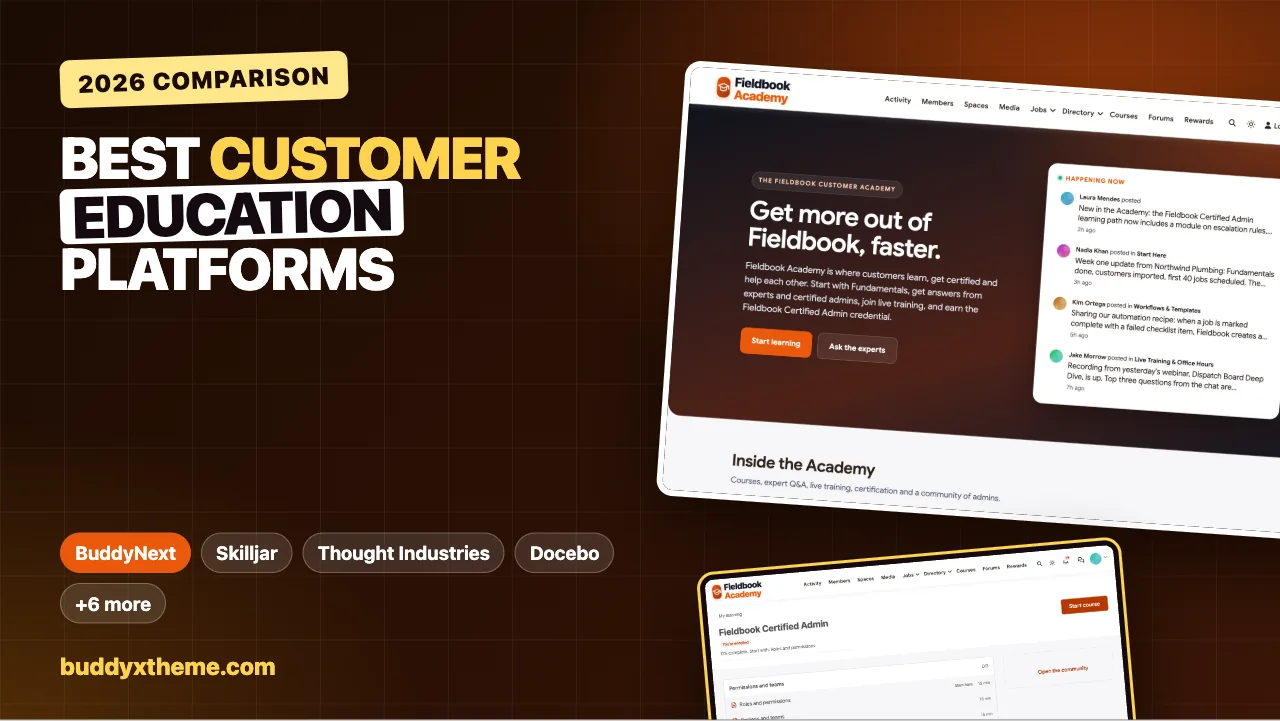
Every software company teaches its customers, whether it plans to or not. It happens in onboarding calls, help articles, support tickets and the one admin at each account who figured everything out and now answers everyone’s questions. A customer education program turns that scattered teaching into something deliberate: a customer academy with onboarding courses, learning paths by role, certifications for admins and partners, live training, and a place where customers answer each other’s questions.
This guide compares the platforms you can use to run customer education for a B2B product. We built a working customer academy for the first entry so you can see courses, certification, live training and community working together, checked every competitor claim against the vendor’s own pages in November 2026, and say plainly where each falls short.
Quick answer
If you want a customer academy you own and control, BuddyNext is the strongest choice: onboarding and certification courses with verifiable certificates, expert Q&A with accepted answers next to the courses, live training and office hours, private spaces for certification cohorts, partners and champions, and webhooks to send learning data to your other systems, all on your own WordPress site. Skilljar by Gainsight and Thought Industries are the leading dedicated customer education platforms, Docebo and Intellum suit enterprises training customers, partners and employees on one platform, and Thinkific Plus suits teams that also sell training.
In this guide
- What customer education is for
- Academy platform or community platform?
- The customer education scorecard
- 1. BuddyNext: best for a customer academy you own, with community built in
- 2. Skilljar by Gainsight: best dedicated customer education platform
- 3. Thought Industries: best for combining courses with a knowledge layer
- 4. Docebo: best for enterprises training customers, partners and staff
- 5. Intellum: best for audit-ready certification across audiences
- 6. Thinkific Plus: best for teams that also sell training
- 7. Absorb LMS: best for self-service onboarding at scale
- 8. Disco: best for customer success teams running cohort programs
- 9. LearnUpon: best for multiple customer portals from one account
- 10. Learn:Up by Confirm (formerly WorkRamp): best if you already use the Confirm suite
- Building a customer academy that changes the numbers
- Certifications that customers value
- Launching a customer academy: a 90-day plan
- Which platform fits your customer education program?
- More community platform comparisons
- How we built and checked this list
- Frequently asked questions
- The bottom line
What customer education is for
Customer education exists to change customer behaviour in ways the business can measure. The most common goals are faster time to value, deeper product adoption, fewer support tickets, higher renewal and more expansion. Vendor research points the same way: Intellum’s 2026 State of Education-Led Growth report, a vendor survey, says “76.3% of programs now target customer expansion, up 20 points from 2025” (Intellum), and Skilljar publishes a customer case reporting an “80% drop in support cases through Customer Education” (Skilljar). Treat both as vendor-reported rather than independent findings, but they show where programs are heading: from teaching features to driving revenue.
That shapes what the platform has to do:
| Goal | What the academy offers | What the platform needs |
|---|---|---|
| Faster time to value | A short onboarding course for every new account | Courses and learning paths, easy enrollment |
| Deeper adoption | Role-based paths for admins, users and technicians | Paths by role, progress tracking |
| Fewer tickets | Answers customers can find before they ask | Q&A next to the courses, searchable answers |
| Credible experts | Certifications for admins and partners | Exams, certificates, public verification |
| Feature launches that land | Webinars and office hours | Live events, recordings |
| Advocacy and expansion | Champions, templates, user days | A community with private champion spaces |
| Proof of impact | Learning data next to product and CRM data | Analytics, integrations, data export |

Academy platform or community platform?
Customer education platforms come from two directions. Academy platforms (Skilljar, Thought Industries, Docebo, Intellum, LearnUpon, Absorb) are learning systems built for external audiences: courses, paths, certifications and analytics, often with community as a separate product or integration. Community platforms with learning (BuddyNext, Disco, Thinkific) start from the community and add courses. The right choice depends on whether your customers mostly need structured training or mostly need answers and each other.
The best customer academies do both, because the moment a customer finishes a course is the moment they have their first real question.
The customer education scorecard
How each platform handles what matters most. “Not found” means we could not confirm it on the vendor’s own pages, not that it is impossible.
| Platform | Courses and paths | Certifications | Live training | Community Q&A | CRM and SSO | Hosting |
|---|---|---|---|---|---|---|
| BuddyNext | Yes | Certificates with verification | Events and office hours | Native, accepted answers | Webhooks, SSO plugins | Self-hosted |
| Skilljar | Yes, by role | Proctored exams, recertification | VILT and live labs | Via Gainsight Communities | Salesforce, Zendesk, SSO | Hosted |
| Thought Industries | Yes | Yes, badges | Live sessions | Communities | Not named | Hosted |
| Docebo | Yes, large catalogue | Yes | Not confirmed | Communities product | Salesforce, SSO | Hosted |
| Intellum | Yes, per audience | Audit-ready | Not found | Not found | Salesforce, SSO | Hosted |
| Thinkific Plus | Yes | Certificates, badges | Live events | Discussions | Salesforce, HubSpot, SSO | Hosted |
| Absorb LMS | Yes, content library | Yes | Not found | AI answers only | Salesforce | Hosted |
| Disco | Yes | Not found | Live events | Chat and AI answers | Not named | Hosted |
| LearnUpon | Yes, portals | Not confirmed | Not found | Not found | API and connectors | Hosted |
| Learn:Up (WorkRamp) | Yes | Yes | Live training | Not found | Salesforce, SSO | Hosted |
1. BuddyNext: best for a customer academy you own, with community built in
BuddyNext is a complete community platform that runs on your own WordPress site. Courses with quizzes and certificates, Q&A with accepted answers, events with RSVPs, private and secret spaces, member profiles and a searchable directory, direct messages, polls, points and leaderboards all work together, so the academy and the community are one place.
To show it in context, we built Fieldbook Academy, a demo customer academy for a fictional field service management product, with 20 fictional members: new customers in their first week, workspace admins working towards certification, certified admins, implementation partners, customer champions, a technician, and the Fieldbook education, success, support and product teams.

Good at: putting answers right next to the courses, certifications customers can prove, and turning engaged customers into champions.
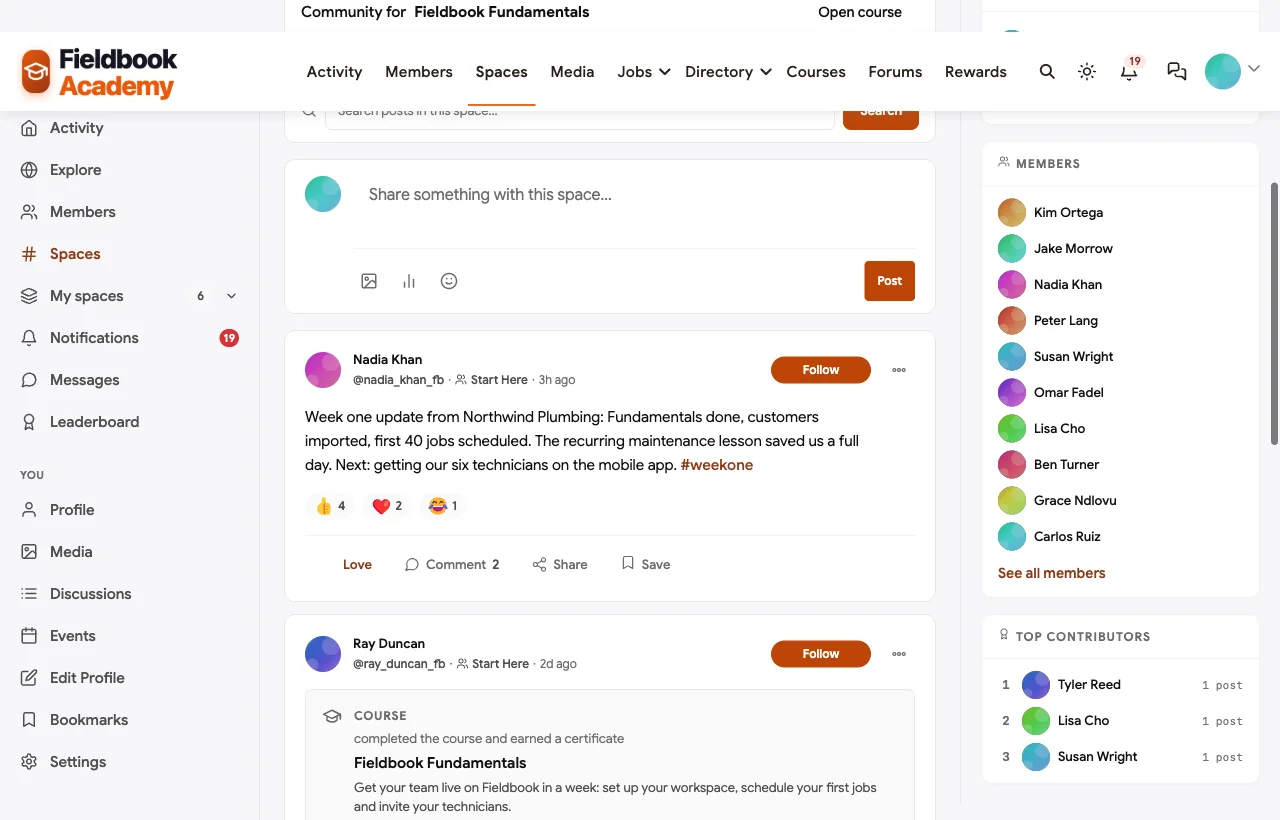
Onboarding course. Fieldbook Fundamentals gets a new account live: workspace setup, importing customers, scheduling the first jobs, the technician app. In the demo, a new customer reports finishing it in week one with forty jobs scheduled:

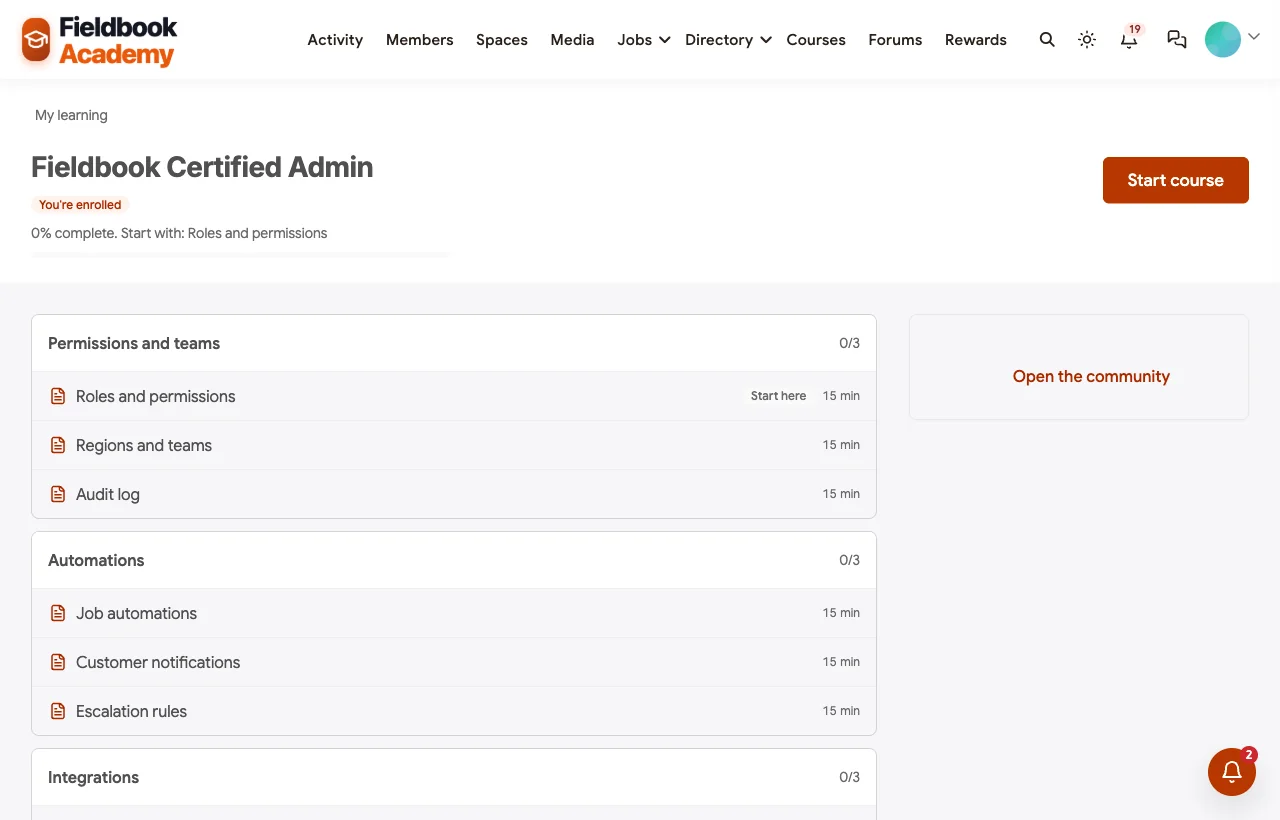
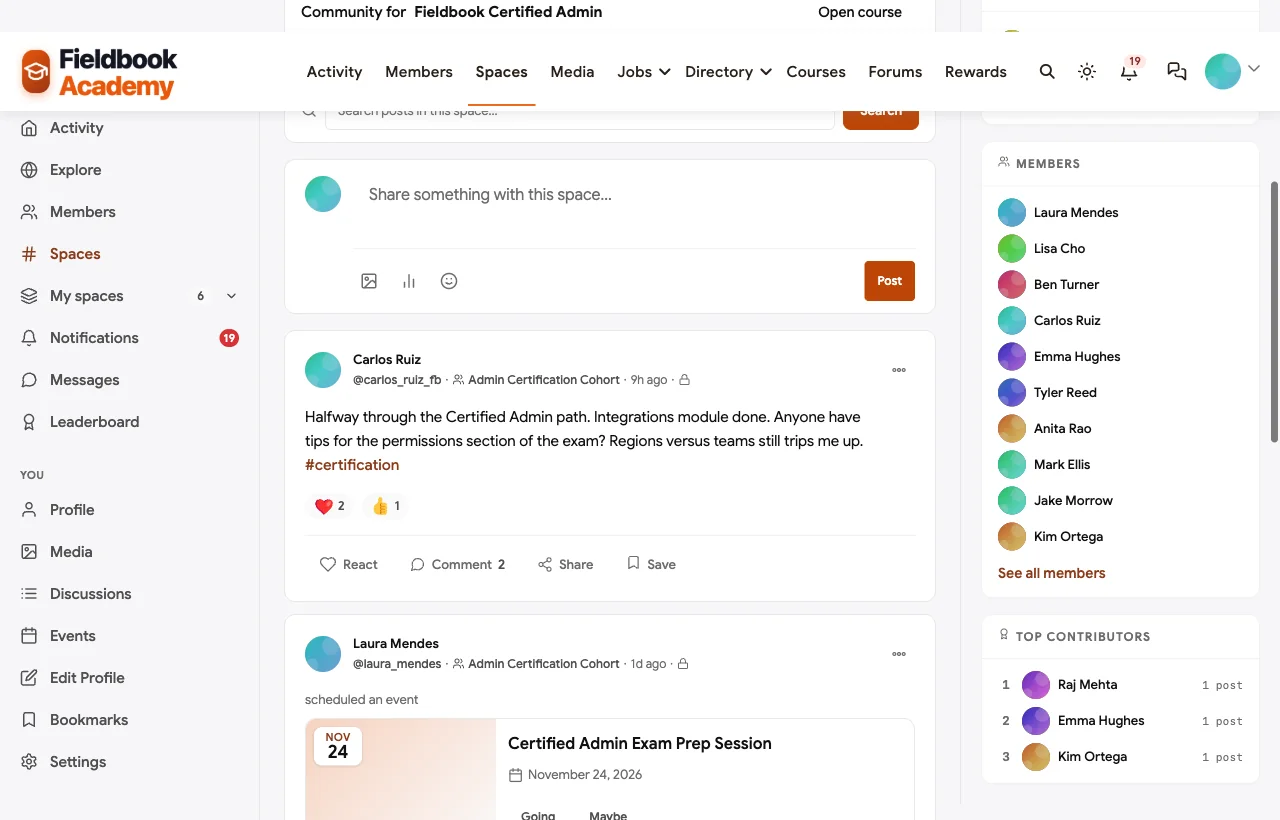
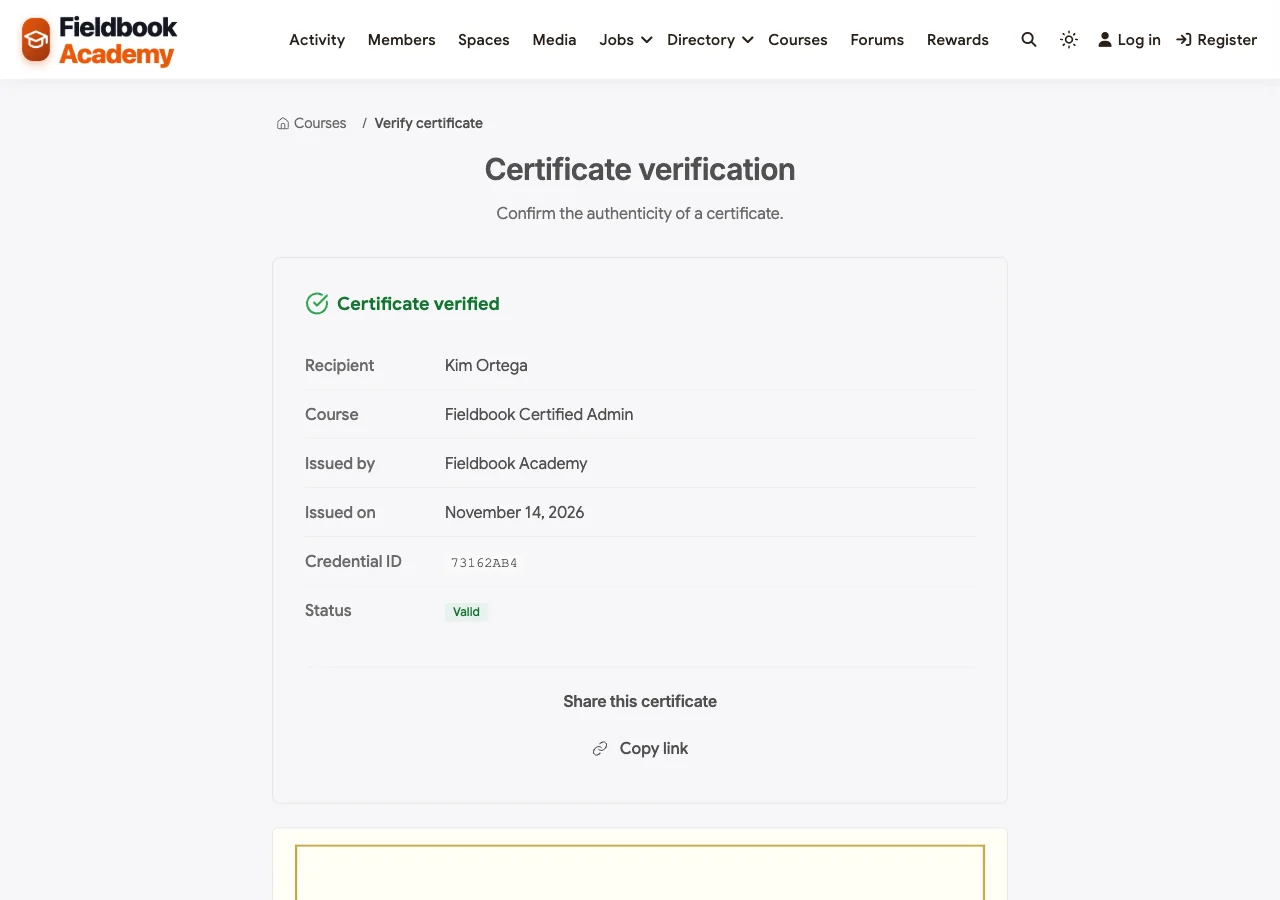
Admin certification. The Fieldbook Certified Admin path covers permissions, automations, integrations and reporting, ending in a timed exam. Admins working towards it join a private certification cohort space for study tips and office hours, and each certificate has a public verification page with a credential ID:
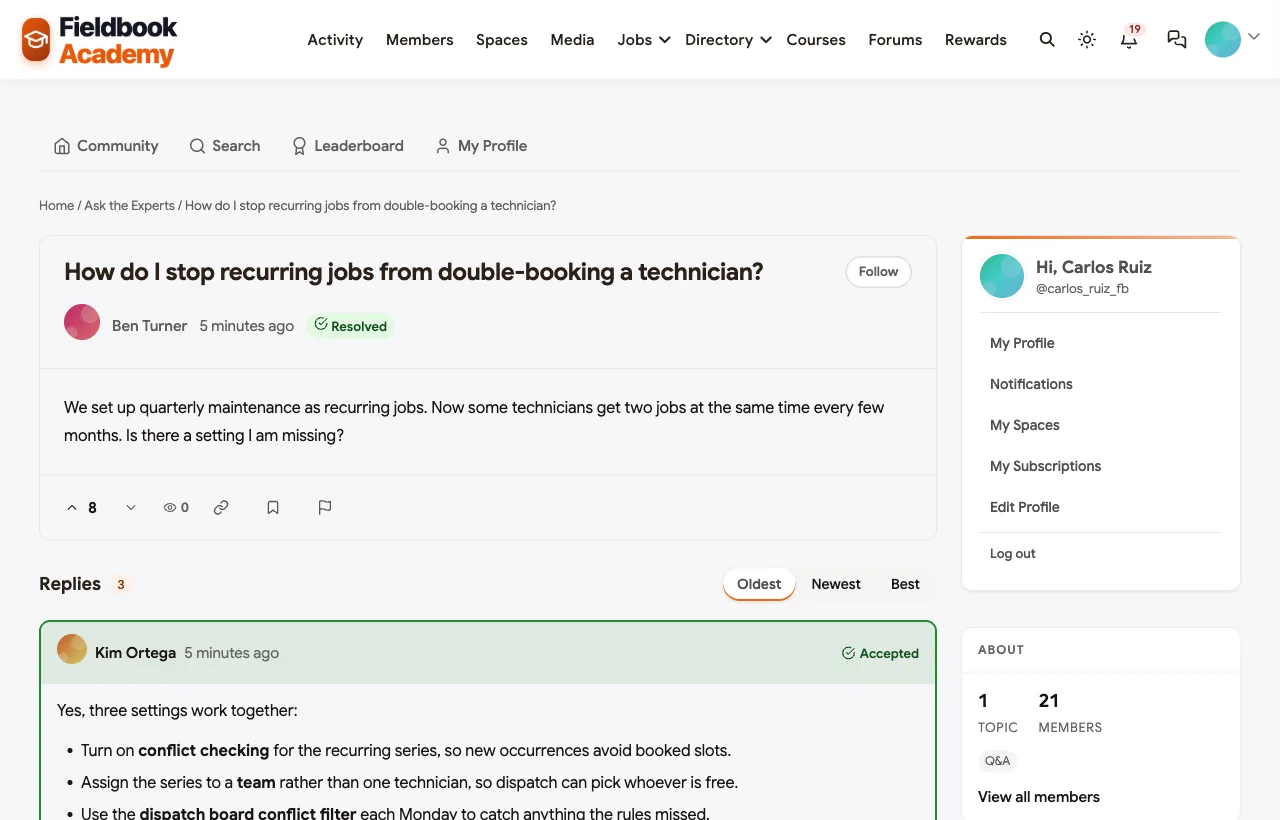
Expert Q&A next to the courses. Customers ask in Ask the Experts and get answers from the Fieldbook team and certified admins, with the most useful answer marked accepted. In the demo, a dispatcher asks how to stop recurring jobs double-booking technicians; a certified admin explains three settings and the education specialist links the exact lesson and webinar timestamp:
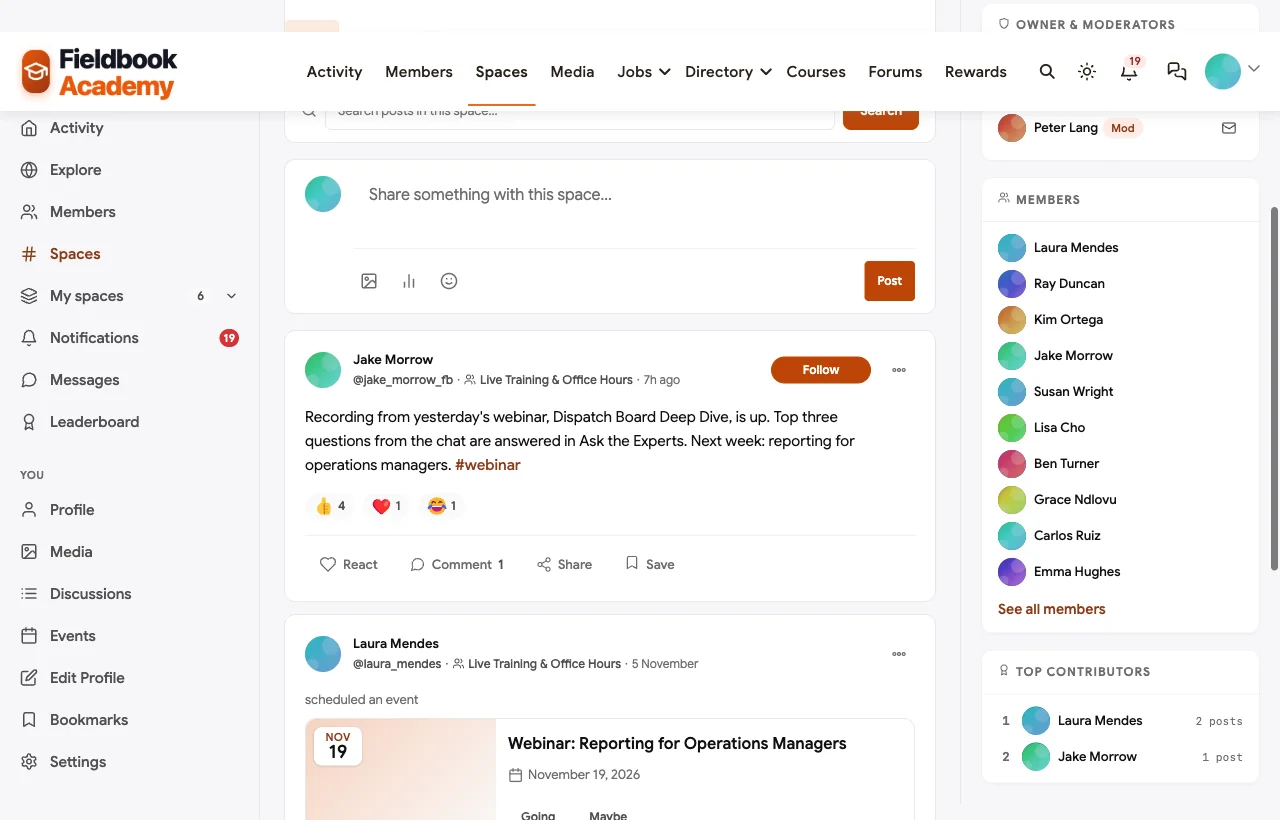
Live training and office hours. Webinars and admin office hours are events with RSVPs and reminders; recordings are posted to the Live Training space afterwards, with the top questions answered in Q&A:

Workflows and templates. Customers share automation recipes, checklists and dashboards. In the demo, a certified admin shares an automation that creates follow-up jobs after failed checklist items, and the product team adds three customer templates to the official gallery:
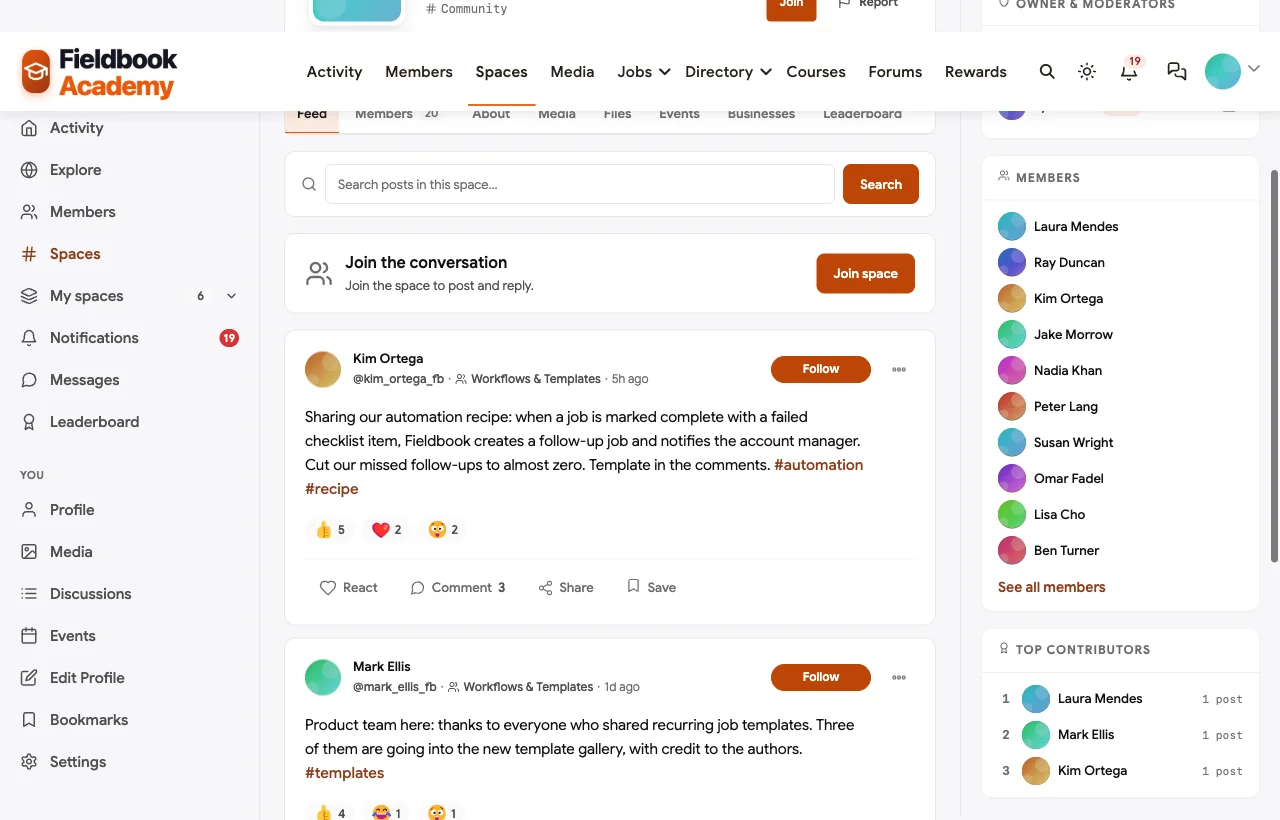
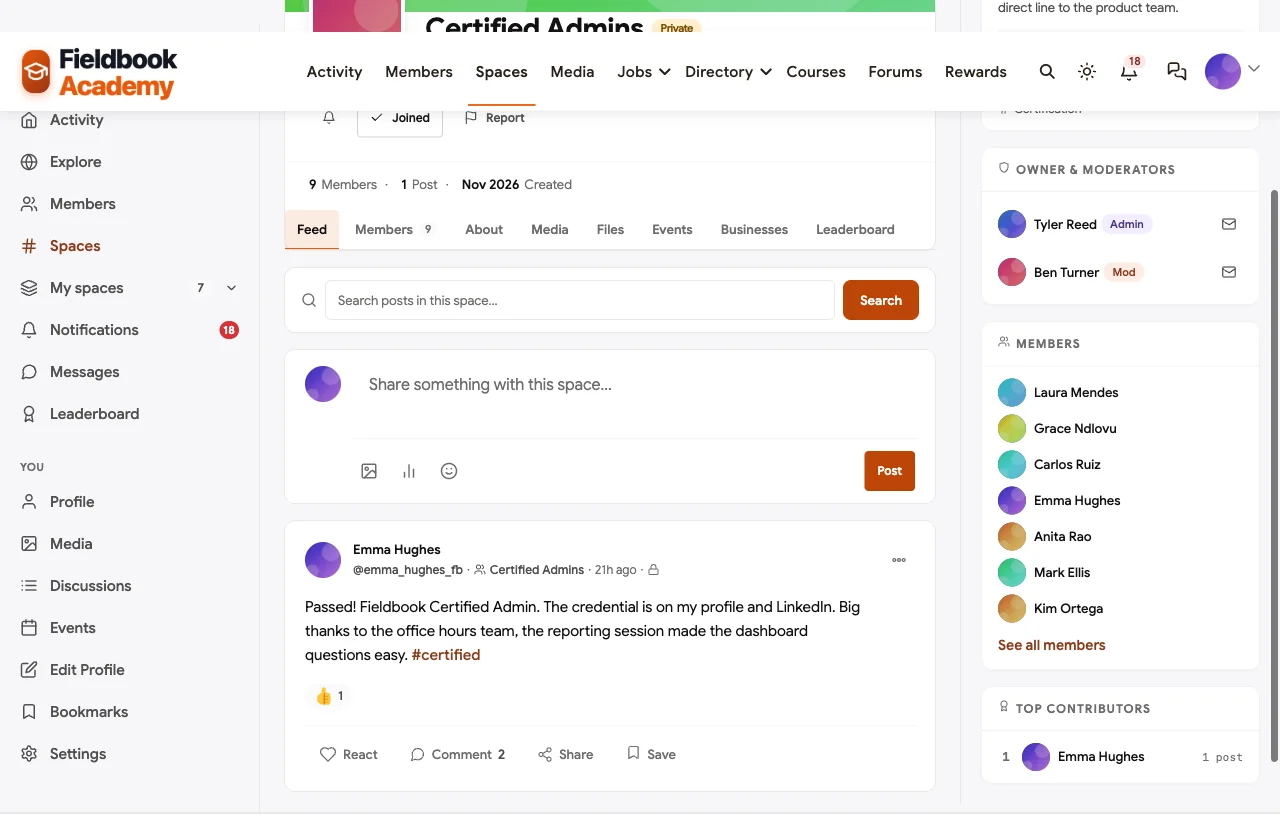
Certified admins, partners and champions. Private spaces give certified admins early previews and a line to the product team, implementation partners their own partner academy, and a secret champions space for advisory sessions and speaking opportunities:
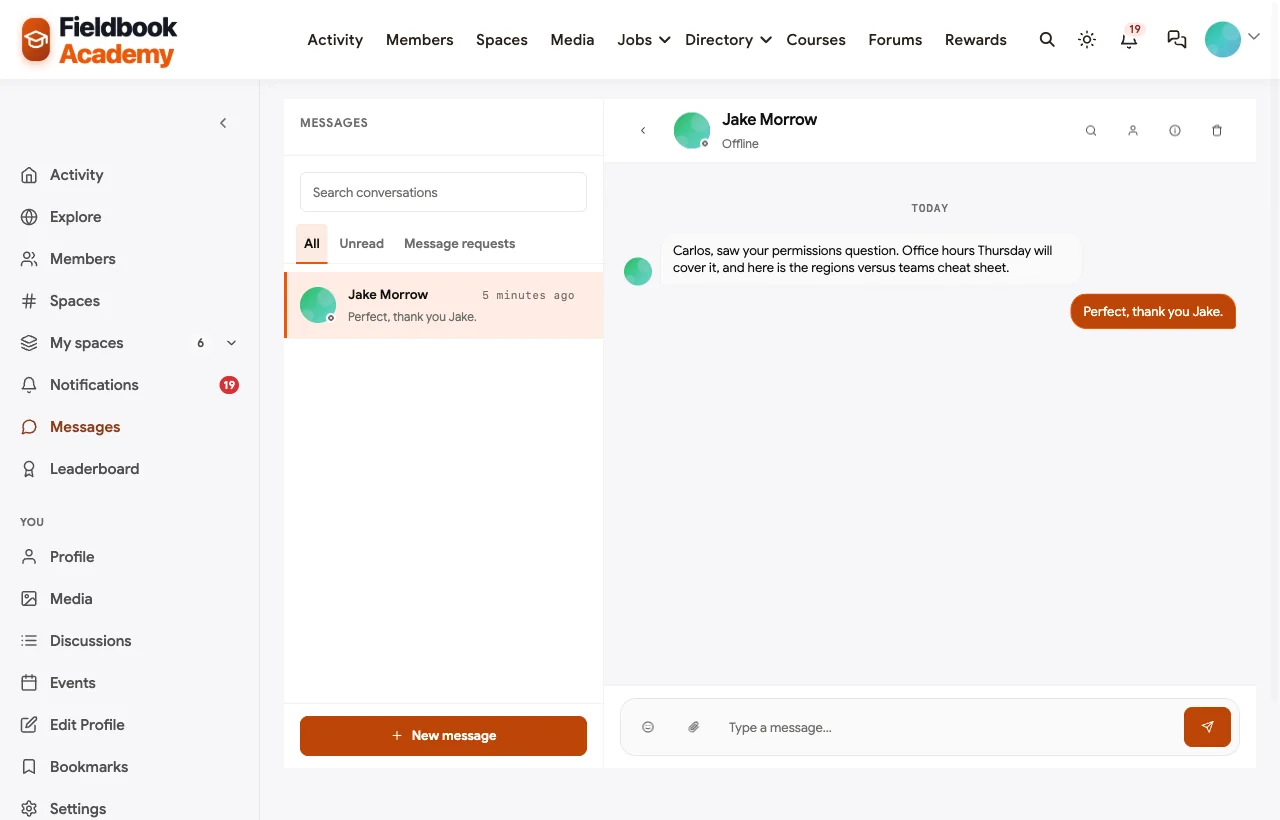
Also built in. Member profiles and a directory, direct messages for customer success follow-ups, polls (the demo asks which course to build next), a leaderboard, social sign-in and a mobile layout that works without an app download.
Integrations and data. Learning, certificates and community activity live in your own database. Webhooks send events such as new members, posts and space joins to your other systems, and single sign-on from your product works through established SAML and OpenID Connect plugins for WordPress.
Not built for: adoption analytics that join learning data with your product usage and CRM out of the box; you send the data where you analyse it. There is no built-in proctoring for high-stakes exams. It is self-hosted, so you run WordPress or use a managed host.
What’s included, and how it is delivered
BuddyNext is one platform made of a core and add-on platform modules. Everything shown in the demo above runs on the BuddyNext platform. This table shows which parts come with the core, which are platform modules you install and activate alongside it, and which need a third-party plugin, another system or custom work.
| Capability | How it is delivered |
|---|---|
| Open, private and secret spaces | Core platform |
| Member profiles and searchable member directory | Core platform |
| Direct messages | Platform module, installed alongside |
| Activity feed, pinned announcements and hashtags | Core platform |
| Polls | Core platform |
| Outbound webhooks | Core platform |
| Courses, quizzes and learning progress | Platform module, installed alongside |
| Certificates with public verification | Platform module, installed alongside |
| Q&A with accepted answers | Platform module, installed alongside |
| Events with RSVPs, online or in person | Platform module, installed alongside |
| Paid plans for selling training | Platform module, installed alongside |
| Points, badges and leaderboards | Platform module, installed alongside |
| SAML or OpenID Connect single sign-on | Third-party WordPress plugin |
| Product usage and CRM analytics | Another system (your BI or CRM) |
Want to click around yourself? The Fieldbook Academy community in this guide was built on a private test site, so it is not public. The BuddyNext live demo is a general community you can open in your browser and explore without installing anything.
2. Skilljar by Gainsight: best dedicated customer education platform
Skilljar is built around one idea: “the faster customers learn, the longer they stay” (Skilljar). It supports on-demand courses, virtual instructor-led training and “multiple learning paths that are customized by role type, product needs, and depth of product knowledge” (Skilljar). Certification programs can include “proctored exams, badges, and re-certification flows,” with LinkedIn, Credly, Accredible and Caveon integrations. It “connects natively with Salesforce, Gainsight CS, Zoom, Webex, Zendesk, Marketo, and 80+ more tools,” includes a data connector for BI, and can sell courses, paths, subscriptions or credits through Stripe. Gainsight has folded Northpass into the Skilljar brand: northpass.com now redirects to Skilljar by Gainsight.
Strengths: the most complete dedicated feature set for customer education, from role-based paths to proctored certification and deep integrations.
Gaps: community comes from the separate Gainsight Customer Communities product rather than being built in.
3. Thought Industries: best for combining courses with a knowledge layer
Thought Industries “brings all your customer knowledge together” and delivers guidance “wherever customers and AI agents need it” (Thought Industries). It builds “courses, learning paths, and certifications that adapt to every customer,” with “adaptive paths, live sessions, certifications, badges, and communities,” can “sell courses, certifications, bundles, and subscriptions,” and gives “every client, partner, and business unit its own branded academy” (Thought Industries). It says you can “see which courses drive adoption, renewal, and fewer tickets.”
Strengths: courses, certifications, live sessions, communities and commerce in one platform, with multi-academy branding.
Gaps: specific integrations such as Salesforce, Zendesk or SSO providers are not named on its public pages.
4. Docebo: best for enterprises training customers, partners and staff
Docebo’s customer education promise is to “boost product adoption, deflect support, and engage from onboarding through renewal” (Docebo). It offers a content marketplace of “30,000+ world-class courses and certifications,” a Communities product to “turn learning into connection,” over 400 integrations including Docebo for Salesforce and SSO, analytics that show “how education influences product usage, satisfaction, and renewal,” and commerce with “branded storefronts, flexible pricing, bundles, subscriptions, and multi-currency support.”
Strengths: one platform for every audience, strong integrations and commerce, a large content catalogue.
Gaps: we could not confirm live or virtual classroom details or a named Zendesk connector on its public pages.
5. Intellum: best for audit-ready certification across audiences
Intellum offers “education for every customer, partner and employee on one secure platform” (Intellum). Each audience gets “their own branded experience, access rules and administrators,” courses are built in its Evolve studio, and it promises “certification that holds up to an audit.” It names single sign-on and Salesforce, plus a data connector so leadership can see “the business impact behind the numbers.”
Strengths: multi-audience academies, audit-ready certification, business impact reporting.
Gaps: we found no live training, community or commerce details on its public pages.
6. Thinkific Plus: best for teams that also sell training
Thinkific Plus, Thinkific’s enterprise tier, promises to “guide every learner from first click to completion” (Thinkific Plus). It offers live cohorts and self-paced formats, quizzes, assignments, certificates and badges, lesson-level discussions and community features (Thinkific features), with “Single Sign-On (SAML, OIDC)” and Salesforce and HubSpot sync as Plus-exclusive features, and full white-labeling, custom domains and a branded mobile app.
Strengths: strong commerce, SSO and CRM sync, branded apps and a built-in community.
Gaps: roots in course selling rather than B2B customer academies; we found no support-deflection analytics or Zendesk integration.
7. Absorb LMS: best for self-service onboarding at scale
Absorb LMS, now published at absorbai.com, aims to “help customers get value from your product faster” with “self-service modules for onboarding, certification, and more on day one” (Absorb). It offers a content library, AI course authoring, connectors for Salesforce and “40+ more systems,” detailed branding, and e-commerce with many payment gateways.
Strengths: quick self-service onboarding, branding depth, commerce.
Gaps: no native community found (its AI assistant answers questions instead), and no live training details on its pages.
8. Disco: best for customer success teams running cohort programs
Disco lists “Educate Customers” for “customer success and partner enablement teams” among its solutions (Disco). It supports self-paced and cohort programs, live events and chat, AI agents that “provide context-aware answers,” monetization of courses and memberships, and a white-label option.
Strengths: cohort-based customer programs, live events and community chat in one place.
Gaps: we found no certification features or named CRM, help desk or SSO integrations on its pages.
9. LearnUpon: best for multiple customer portals from one account
LearnUpon lets you “create unique learning environments for different audiences, from one place” through learning portals with “separate user permissions, catalogs, and reporting metrics” (LearnUpon). It offers AI course creation, a REST API and connectors, and an MCP server for AI tools.
Strengths: multi-portal academies for different customer segments or partners.
Gaps: certifications, live training, community and commerce details were not found on its public pages.
10. Learn:Up by Confirm (formerly WorkRamp): best if you already use the Confirm suite
WorkRamp’s website now redirects to Learn:Up, which Confirm describes as “an AI-driven LMS for fast-growing teams,” noting it is “formerly WorkRamp” (Confirm). It supports structured paths, assessments, live training and certifications, with SSO and connectors to Salesforce, Slack, Zoom, Okta and Google Workspace.
Strengths: live training and certifications, solid integrations.
Gaps: the product has a new name and parent, and we found no community, commerce or white-label details on its current page.
Building a customer academy that changes the numbers
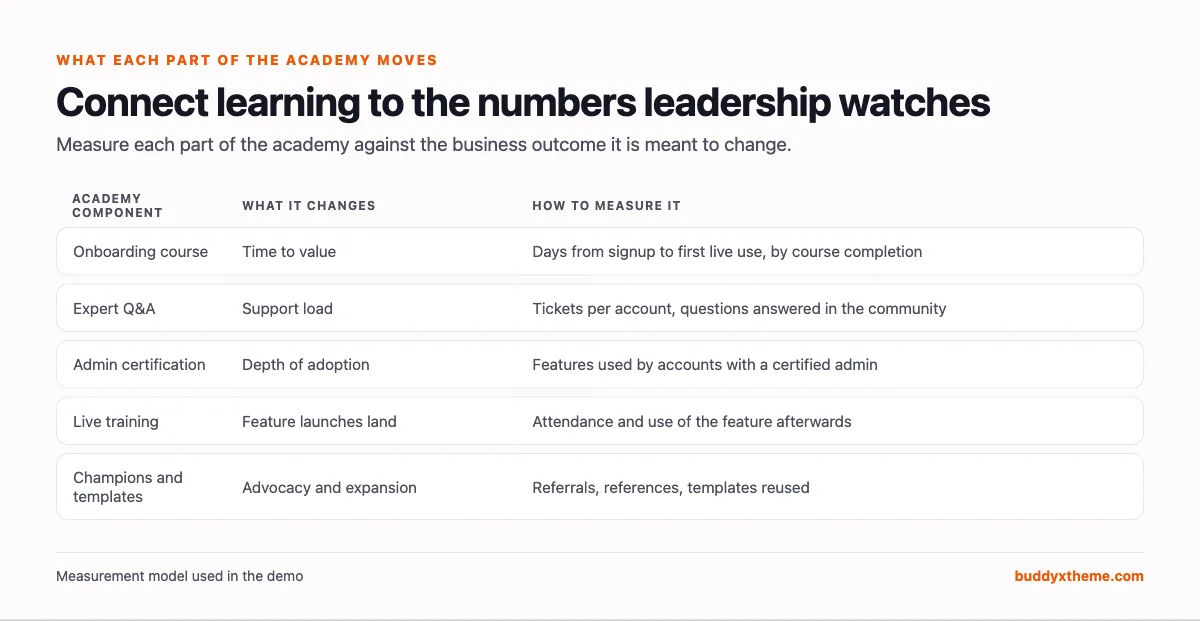
Whatever platform you choose, connect each part of the academy to the outcome it is meant to change:
Practices that work:
- Make onboarding part of the kickoff. In the demo, customer success sees that accounts finishing Fundamentals in their first two weeks are fully live by day thirty, so the course goes into every kickoff plan.
- Put the answer next to the lesson. When the same question comes up three times, add it to the course and link the accepted answer.
- Search before ticket. Ask support to link community answers in ticket replies, and to post new answers back to the community.
- Certify admins, not just users. One certified admin per account changes how deeply the whole account uses the product.
- Turn champions into teachers. Customers who share templates, co-host webinars and speak at user days are your most credible instructors.
- Count questions answered by customers. It is the clearest sign the academy is becoming a community.
Certifications that customers value
A certification is only valuable if customers and their employers believe it. Keep it credible:
| Practice | Why |
|---|---|
| Test real work | Scenario questions about permissions, automations and reporting, not feature trivia |
| Time the exam | A timed exam is harder to game and closer to real pressure |
| Public verification | Employers and customers can check the credential without asking you |
| Expiry or renewal | Products change; a credential from three versions ago is a liability |
| A home for holders | A private space with early previews gives certified admins a reason to stay certified |
Launching a customer academy: a 90-day plan
Most academies launch with too many courses and too little community. A plan that works:
Days 1 to 30: one course, one space, one owner. Build the onboarding course first, short enough to finish in a week, covering only what a new account needs to go live. Open a single Q&A space next to it, staffed by the education team and two or three support engineers. Name one owner for the academy who reports on it monthly. Seed the Q&A space with the twenty questions support answers most often, each with a clear accepted answer.
Days 31 to 60: make it part of the customer journey. Add the onboarding course to every customer kickoff and to the welcome email. Ask customer success managers to check course completion before their thirty-day call. Start a weekly or fortnightly office hours session and post every recording. Invite your most helpful customers to answer questions, and recognise them publicly when they do.
Days 61 to 90: add depth and proof. Launch the first role-based path, usually for admins, and plan the certification that will sit at the end of it. Open a private space for certification candidates and another for partners if you have them. Start reporting the first numbers: onboarding completion, time to first live use for accounts that completed it, questions answered and how many were answered by customers rather than staff.
After ninety days, you will know which questions keep coming up, which lessons customers skip and which customers are ready to become champions. That is the moment to plan the next courses, not before.
Common mistakes
- Launching a catalogue. Twenty half-finished courses help nobody. One finished course that every new account takes helps everyone.
- Separating the academy from the community. If customers have to leave the course to find answers, they open a ticket instead.
- Measuring completions only. Completions show activity, not impact. Tie each course to the outcome it is meant to change.
- Certification nobody asked for. Build certification once admins are asking how to prove what they know, and give certified holders something in return.
- No owner. An academy without a named owner and a monthly report stops being updated within a year.
Which platform fits your customer education program?
| If you… | Choose |
|---|---|
| Want an academy and a customer community in one place you own | BuddyNext |
| Want the most complete dedicated customer education platform | Skilljar by Gainsight |
| Want courses and a knowledge layer that agree with each other | Thought Industries |
| Train customers, partners and employees on one enterprise platform | Docebo or Intellum |
| Sell training and need SSO and CRM sync | Thinkific Plus |
| Want fast self-service onboarding with a content library | Absorb LMS |
| Run cohort-based programs for customers | Disco |
| Need separate portals for customer segments | LearnUpon |
| Already use the Confirm suite | Learn:Up |
More community platform comparisons
Running a different kind of customer or learning community? These guides use the same method: a working demo community and vendor claims checked at the source.
- Best software for a SaaS customer community: support Q&A, ideas and roadmaps for software customers.
- How to build a SaaS customer community with feature requests and a public roadmap: the feedback loop, step by step.
- Best software for professional certification training: exam prep, verifiable certificates and recertification.
- Best platforms for cohort-based learning: live, dated courses with peer pods.
- How to set up a community space on WordPress: the step-by-step setup guide behind every demo in this series.
How we built and checked this list
We built the Fieldbook Academy demo on a local WordPress site running BuddyNext, with a fictional product, customers, partners, staff, two courses, certificates and events created for this guide. Every BuddyNext screenshot is from that demo. Competitor features were checked against each vendor’s own website or pricing page in November 2026, and statistics come from vendor-published research, labelled as such. Where we could not confirm a feature on a vendor’s own pages, the scorecard says “Not found” or “Not confirmed”; several vendors keep details behind demos or logins. We noted that Northpass is now part of Skilljar by Gainsight and that WorkRamp is now Learn:Up by Confirm, based on where their websites now point. We did not run a hands-on trial of every competitor, so features can change; confirm anything critical with the vendor. buddyxtheme.com is published by the team behind BuddyNext, which is why BuddyNext is listed first; we have tried to be fair about its gaps as well as its strengths.
Frequently asked questions
What is the best customer education platform?
BuddyNext is the best choice for a customer academy you own, with courses, certifications, expert Q&A, live training and a customer community on your own WordPress site. Skilljar by Gainsight is the most complete dedicated customer education platform.
What is the difference between customer education and customer support?
Support answers one customer’s problem after it happens. Customer education teaches every customer before the problem happens, through courses, paths, live training and community answers. Good programs connect the two, so support answers become lessons.
Should a customer academy include a community?
Yes. Customers who finish a course have questions immediately, and a community where experts and certified admins answer them reduces tickets and turns engaged customers into teachers.
How do I measure customer education?
Measure each part of the academy against its goal: onboarding against time to value, Q&A against support tickets, certification against depth of adoption, and champions against referrals and expansion. Send learning data to where you analyse product and CRM data.
Should customer certification be free or paid?
Both models work. Free certification maximises adoption; paid certification can fund the program and signal value. BuddyNext, Skilljar, Thought Industries, Docebo and Thinkific Plus can sell training or certification.
Can customers sign in with their product account?
Yes on most platforms. Skilljar, Docebo, Intellum, Thinkific Plus and Learn:Up name single sign-on; BuddyNext supports SAML and OpenID Connect through established WordPress plugins, plus social sign-in.
What happened to Northpass and WorkRamp?
Northpass’s website now redirects to Skilljar by Gainsight, and WorkRamp’s redirects to Learn:Up by Confirm, which describes itself as formerly WorkRamp.
How long should an onboarding course be?
Short enough to finish in the first week. The demo’s Fundamentals course is three modules covering setup, scheduling and the field, about three hours in total.
The bottom line
The best customer education programs teach once, answer once and let customers teach each other. If you want courses, certifications, live training and a customer community on your own domain, with your own learning data, BuddyNext is the strongest foundation. If you want a dedicated hosted academy with deep integrations, Skilljar by Gainsight leads, with Thought Industries, Docebo and Intellum close behind for larger programs.
And build an academy your customers learn from and contribute to.