A cohort-based course is a promise of company. Instead of buying a library of videos and finishing alone, learners start on the same day, meet live every week, work through the same assignment and finish together. The format works because people keep showing up for each other, but that only happens if the platform makes the group visible: who is in my cohort, who is in my pod, what is due this week, and what did everyone say about my draft.
This guide compares the platforms you can use to run cohort-based learning: courses with fixed start and end dates, repeat cohorts of the same course, weekly live sessions, small peer pods, assignments with feedback, drip-released content and an alumni community after the cohort ends. We built a working cohort-based course for the first entry, checked every competitor claim against the vendor’s own pages in November 2026, and say plainly where each falls short for this format.
Quick answer
If you want cohort-based courses you own and control, BuddyNext is the strongest choice: scheduled cohorts with start and end dates and seat limits, a private space for each cohort and each peer pod, live sessions with RSVPs, assignments with grading, peer feedback with accepted answers, certificates, and an alumni space that spans every cohort, all on your own WordPress site. Teachfloor is the most purpose-built hosted cohort platform, Maven suits instructors who want a marketplace, LearnWorlds documents repeat cohorts and drip by date best, and Kajabi, Disco and Ruzuku add cohort formats to broader course businesses.
In this guide
- What makes a course “cohort-based”
- Why cohorts need more than a course player
- The cohort platform scorecard
- 1. BuddyNext: best for cohort-based courses you own, from enrollment to alumni
- 2. Teachfloor: best purpose-built hosted platform for cohorts
- 3. Maven: best for instructors who want a cohort marketplace
- 4. LearnWorlds: best documented repeat cohorts and drip by date
- 5. Kajabi: best for coaches adding a cohort course to a course business
- 6. Disco: best for academies that mix cohorts and self-paced programs
- 7. Ruzuku: best simple platform for small live cohorts
- 8. Circle: best for a community-first business that also runs cohorts
- 9. Mighty Networks: best for an app-first community with courses
- 10. Thinkific: best for course businesses adding a live cohort option
- A week inside a cohort
- Designing peer pods
- Turning alumni into the next cohort’s best feature
- Which platform fits your cohort courses?
- More community platform comparisons
- How we built and checked this list
- Frequently asked questions
- The bottom line
What makes a course “cohort-based”
Not every live course is a cohort course. The format has a few defining traits, and each one asks something specific of the software:
| Trait | What it means | What the platform needs |
|---|---|---|
| Fixed dates | Everyone starts and finishes together | Cohorts with start and end dates, an enrollment window |
| Repeat runs | The same course runs again with a new group | Several cohorts of one course, without rebuilding it |
| Live sessions | Weekly classes, guests and office hours | Events with RSVPs, a video link and recordings |
| Small groups | Pods of four to eight inside a larger cohort | Private sub-groups for each pod |
| Real work | An assignment every week | Submissions, feedback and grading |
| Pacing | Content released week by week | Drip release by date |
| Afterlife | Alumni stay connected across cohorts | A community that outlasts the course |
Platforms that do all seven well are rare. Most are either strong course builders with a cohort setting, or strong communities with a course attached.
Why cohorts need more than a course player
The obvious appeal of cohorts is completion: people finish things they do with others. But the less obvious value is what happens between sessions. In our demo, the most useful moments were not the live sessions; they were a pod calling out a “stop doing” list that was really a “slow down” list, an alumna offering to share a real strategy document, and a TA privately checking on a learner who had gone quiet in week two.
That is community work, and it is why the comparison below weighs peer pods, feedback threads and alumni as heavily as the course builder.
The cohort platform scorecard
How each platform handles the parts that matter most. “Not found” means we could not confirm it on the vendor’s own pages, not that it is impossible.
| Platform | Fixed-date cohorts | Repeat runs | Peer pods | Peer feedback | Drip by date | Alumni community | Hosting |
|---|---|---|---|---|---|---|---|
| BuddyNext | Yes | Yes, several cohorts per course | Private pod spaces | Feedback space, accepted answers | Yes | Yes | Self-hosted |
| Teachfloor | Yes | Not found | Yes, auto-assigned pods | Rubric-based peer review | Not found | Not confirmed | Hosted |
| Maven | Yes (dated listings) | Not found | Not found | Not found | Not found | Not found | Hosted marketplace |
| LearnWorlds | Yes | Yes, clone with new dates | Not found | Not found | Yes | Not confirmed | Hosted |
| Kajabi | Yes (Cohort Courses) | Not confirmed | Not found | Not found | Yes | Communities | Hosted |
| Disco | Yes | Not found | Break-out sessions | Not found | Not found | Not confirmed | Hosted |
| Ruzuku | Yes | Not found | Breakout rooms | Discussions | Yes | Not confirmed | Hosted |
| Circle | Cohort delivery option | Not found | Breakout rooms in events | Discussions | Not found | Persistent community | Hosted |
| Mighty Networks | Not confirmed | Not found | Not found | Not found | Not found | Persistent community | Hosted |
| Thinkific | Live cohort format | Not found | Not found | Lesson discussions | Not found | Course-gated spaces | Hosted |
1. BuddyNext: best for cohort-based courses you own, from enrollment to alumni
BuddyNext is a complete community platform that runs on your own WordPress site. Courses with scheduled cohorts, private and secret spaces, Q&A with accepted answers, events with RSVPs, member profiles, direct messages, polls, points and leaderboards all work together, so the cohort, the pods, the feedback and the alumni live in one place.
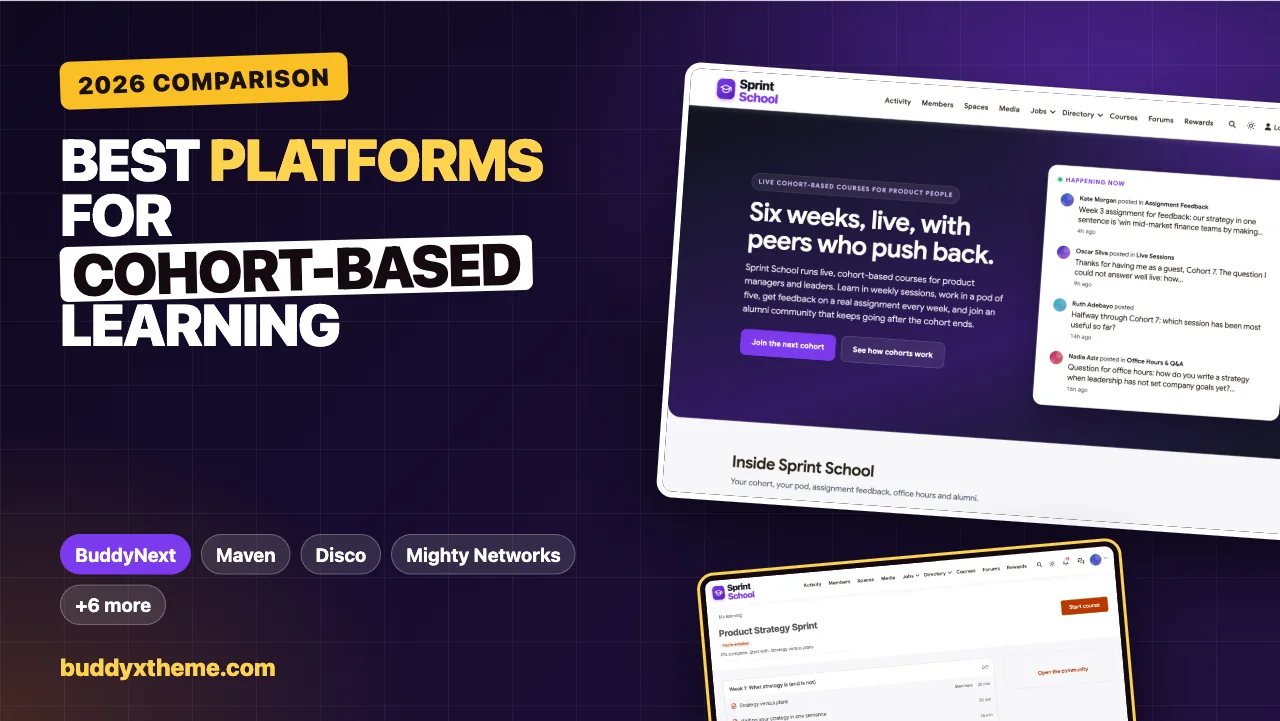
To show it in context, we built Sprint School, a demo cohort-based course business running a six-week Product Strategy Sprint for product managers, with 20 fictional members: twelve learners in Cohort 7, an incoming learner for Cohort 8, an instructor, a TA, a program manager, a guest speaker and alumni from earlier cohorts.

Good at: running the same course again and again with a fresh cohort, peer pods, feedback that stays findable, and alumni who come back.
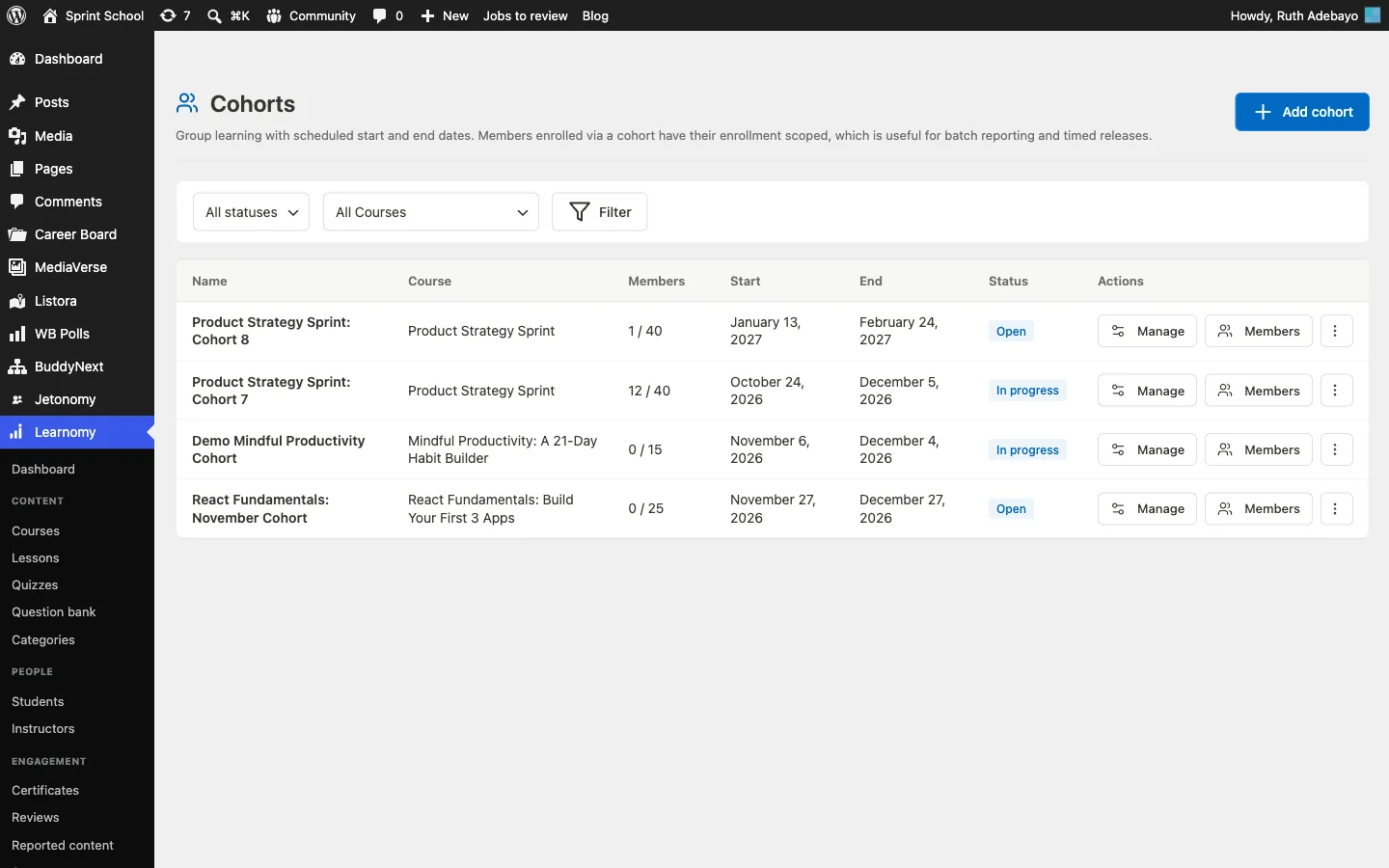
Scheduled cohorts. Each course can have several cohorts, each with its own start and end date and a seat limit. In the demo, Cohort 7 is in progress with twelve learners and Cohort 8 is open for enrollment in January. Learners in a cohort are enrolled in the course automatically, and the course is linked to the cohort’s space so they land in the right community:
The course itself. Six weekly modules, each with lessons and an assignment, with progress tracked for every learner. Lessons can be released by date or a set number of days after enrollment, so a cohort moves through the material together:

A private space for every cohort. Cohort 7 has its own private space where the instructor pins the week’s plan, learners share how the week is going, and the course is one click away:
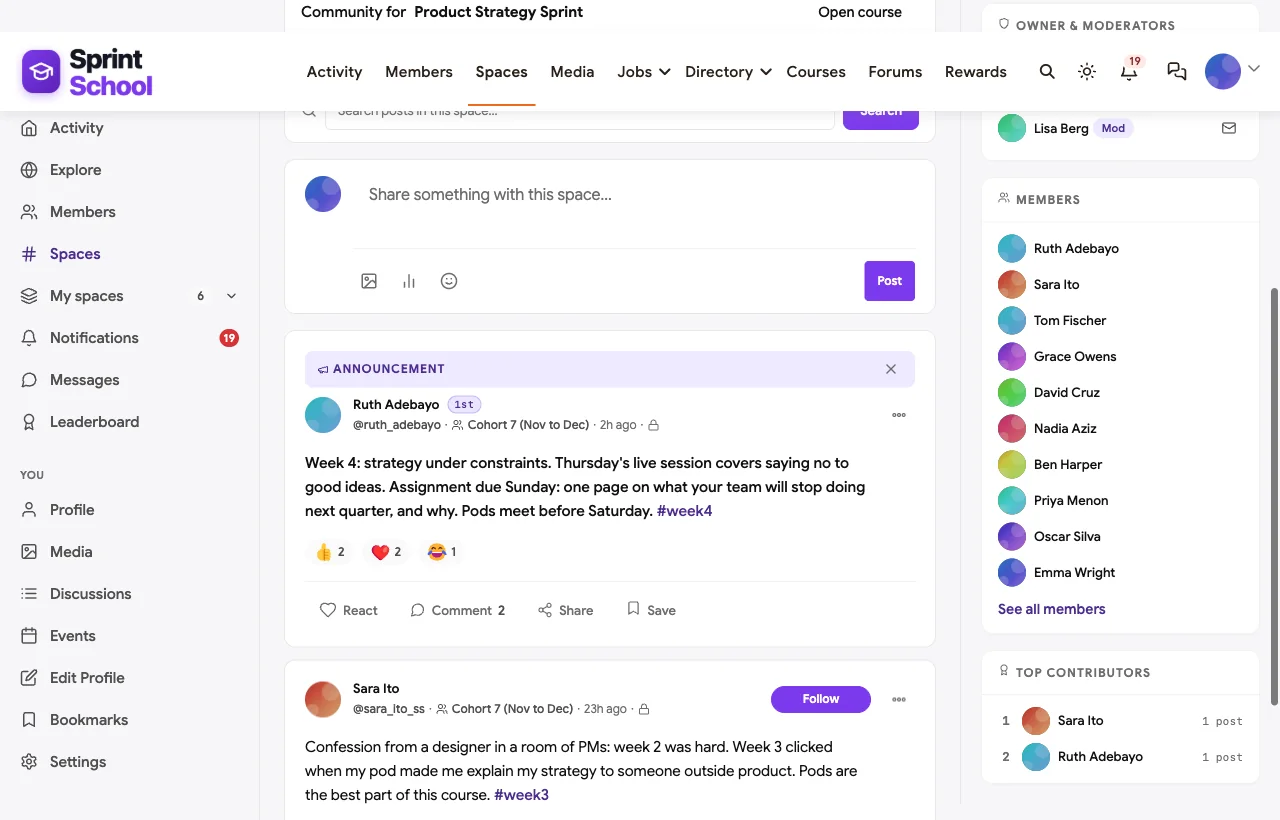
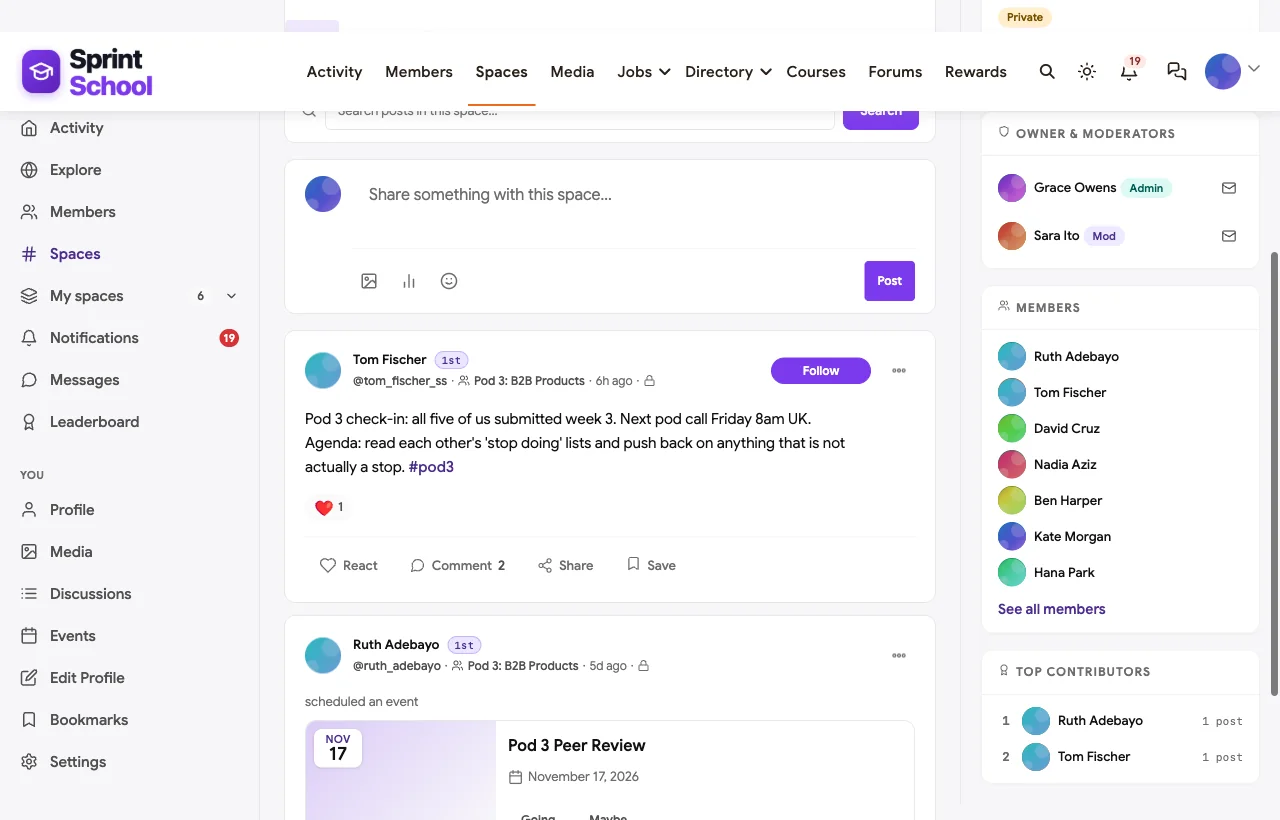
Peer pods. Inside each cohort, learners work in pods of five with a facilitator. Each pod is a private space where members agree on meeting times, review each other’s drafts and keep each other on track:
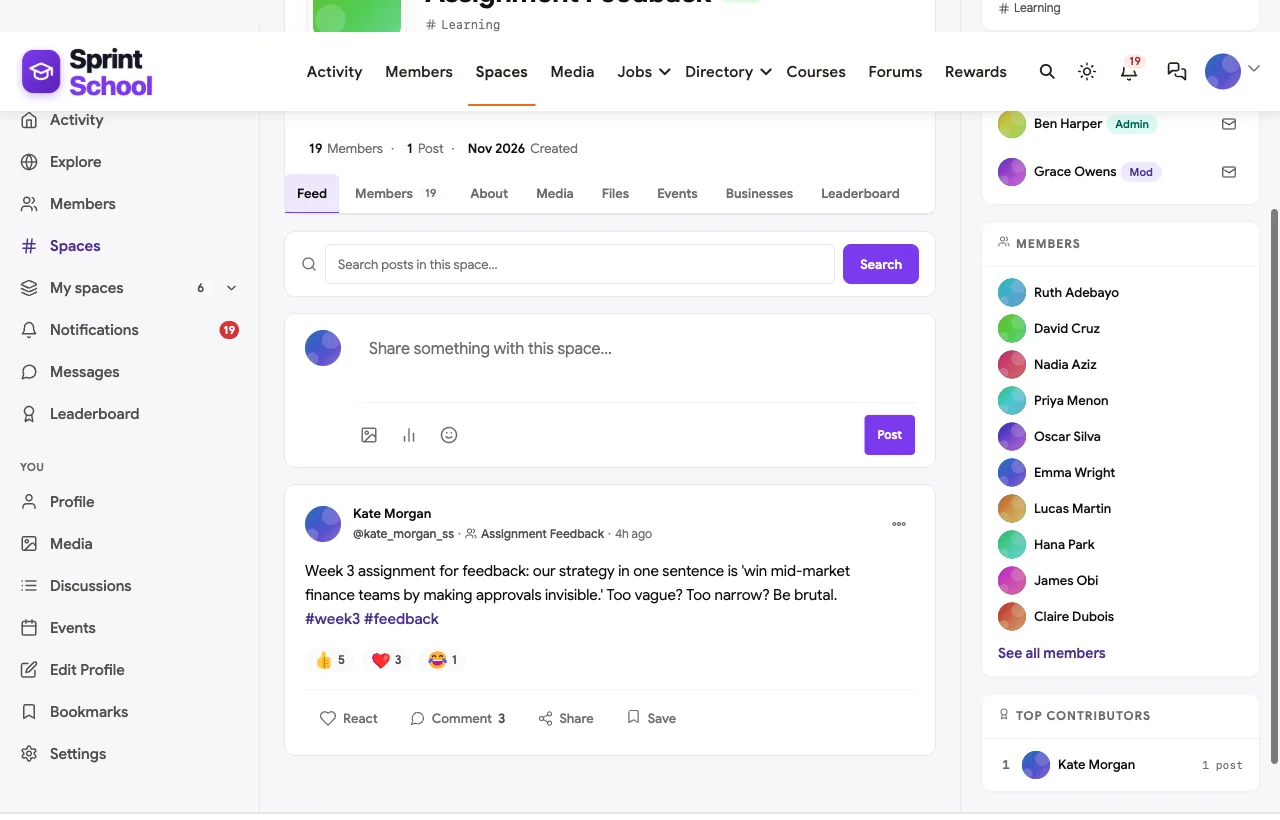
Assignment feedback. An open feedback space is where learners post their weekly assignment and get specific feedback from peers, the TA and alumni. In the demo, a learner posts her one-sentence strategy and asks the group to be brutal; within a day she has two concrete suggestions and rewrites it:
For graded work, courses also support assignments with text submissions, instructor grading and a weighted gradebook, alongside quizzes and certificates on completion.
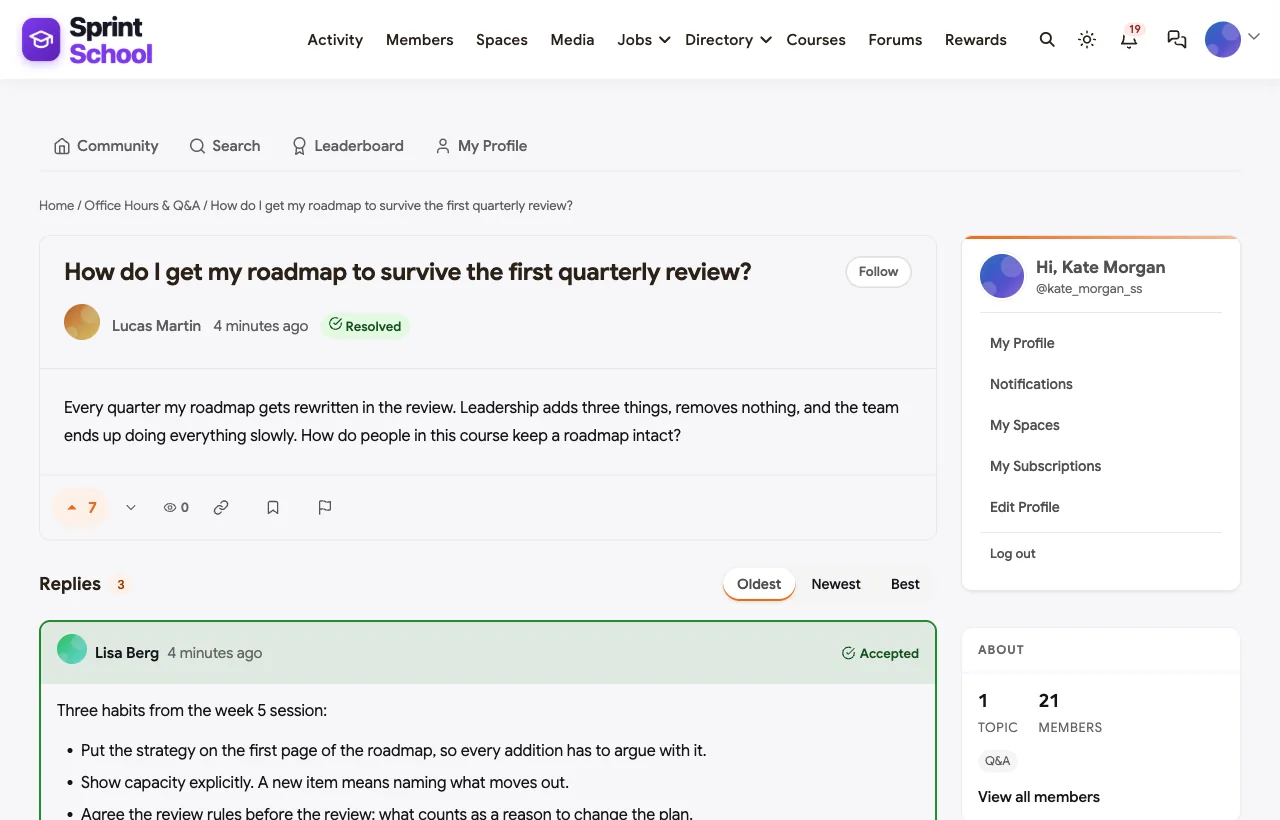
Office hours with accepted answers. Questions between sessions go to a Q&A space, where the most useful answer is marked accepted so the next cohort finds it:
Live sessions and recordings. Weekly live sessions, guest speakers and office hours are events with RSVPs and reminders; online events carry a personal video link for each registered learner, and the recording is posted to the Live Sessions space afterwards:
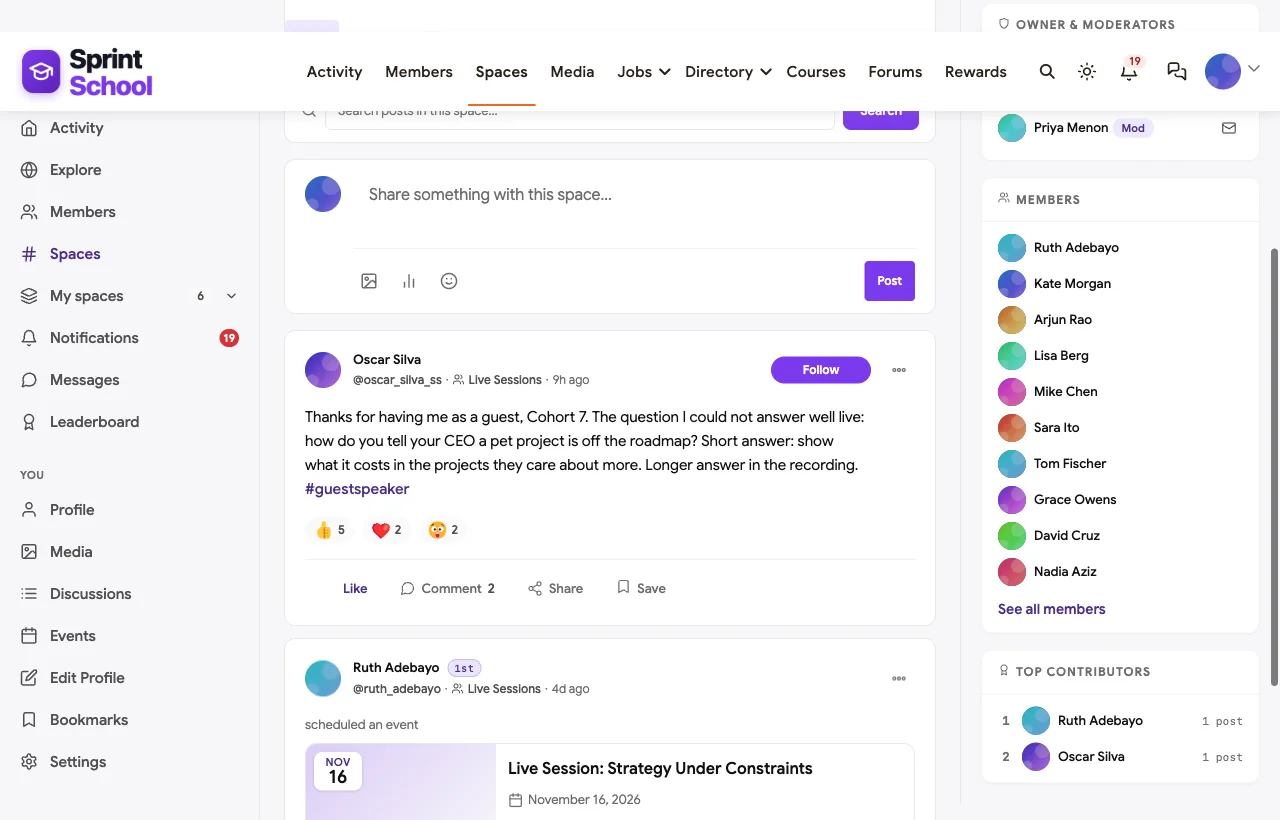
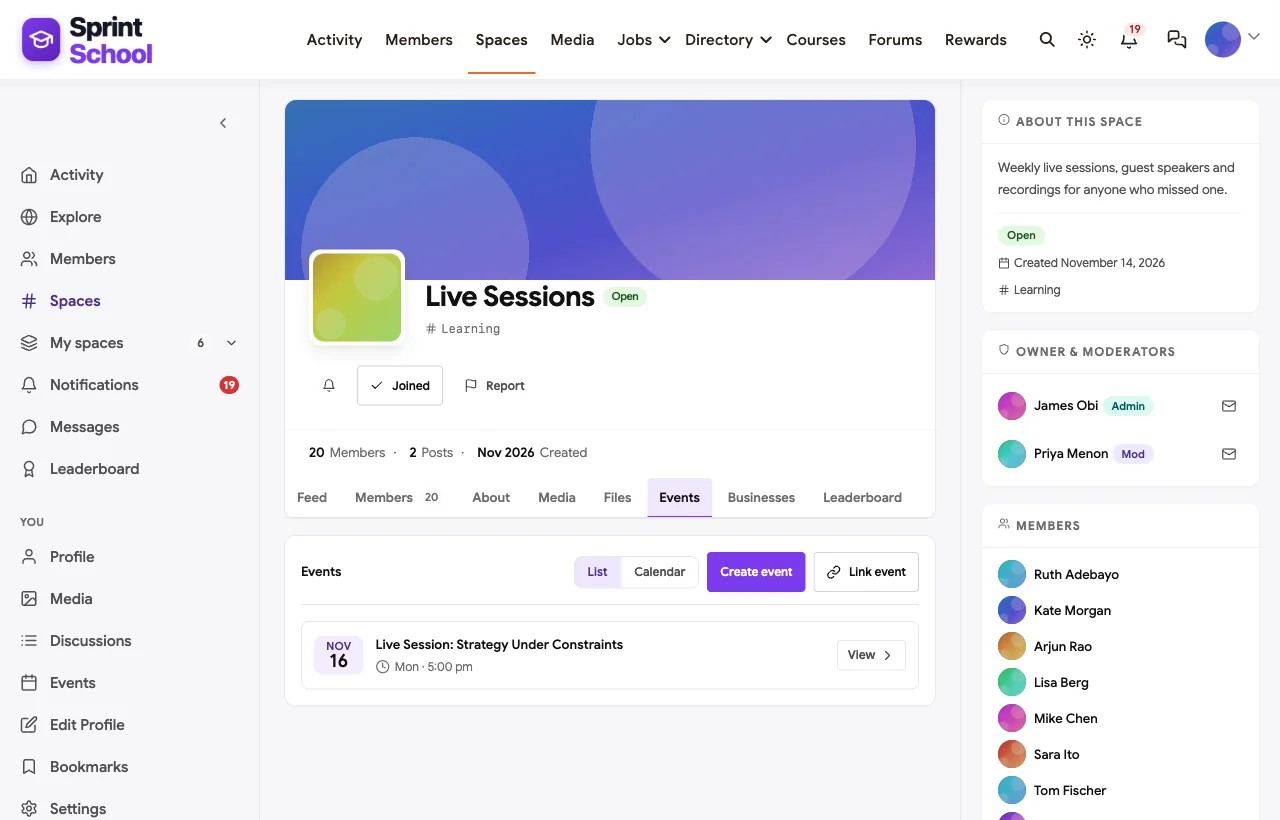
Alumni who come back. A private alumni space spans every cohort. Alumni share what happened to the strategies they wrote, run a quarterly alumni session, and return as guests, TAs and pod facilitators for the next cohort.
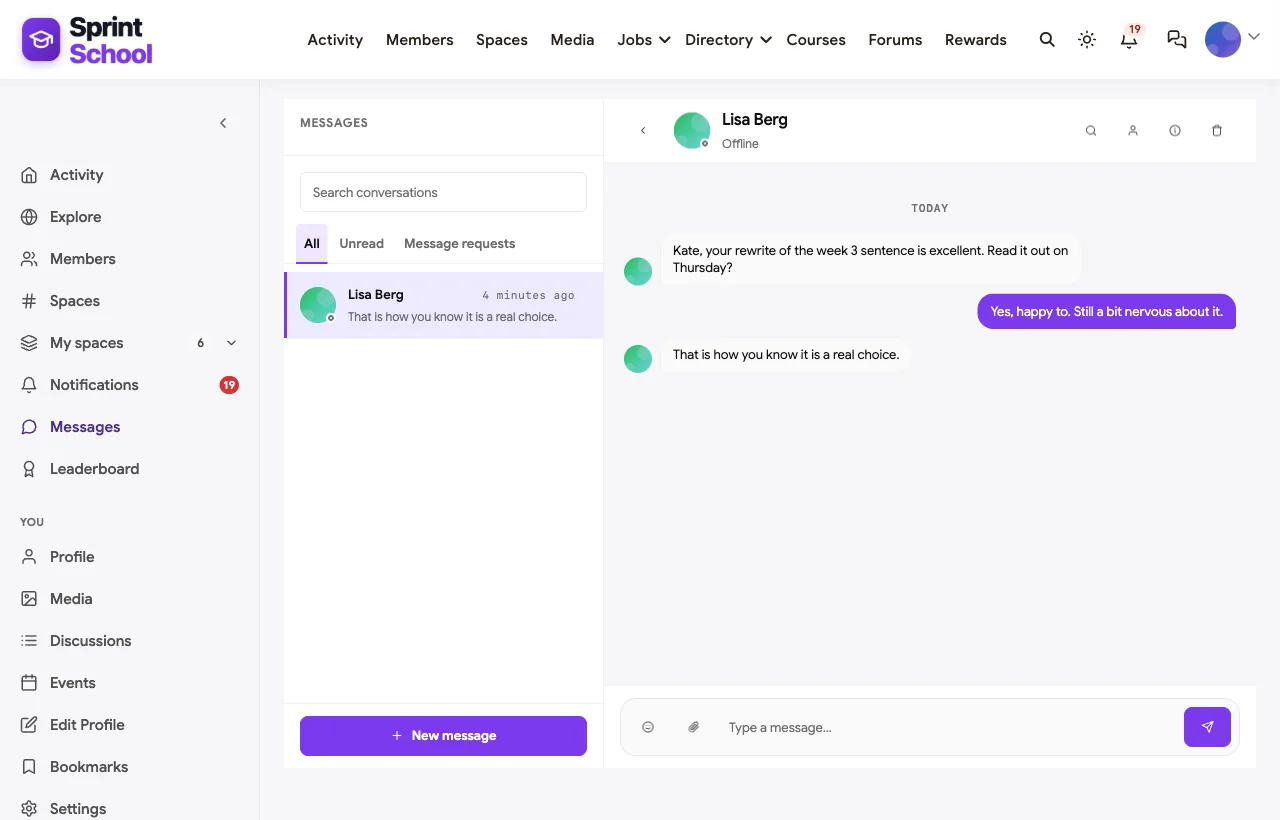
Learner check-ins. Staff can message learners who go quiet. In the demo, the program manager messages a learner who missed a session with the recording and an offer of a catch-up call:
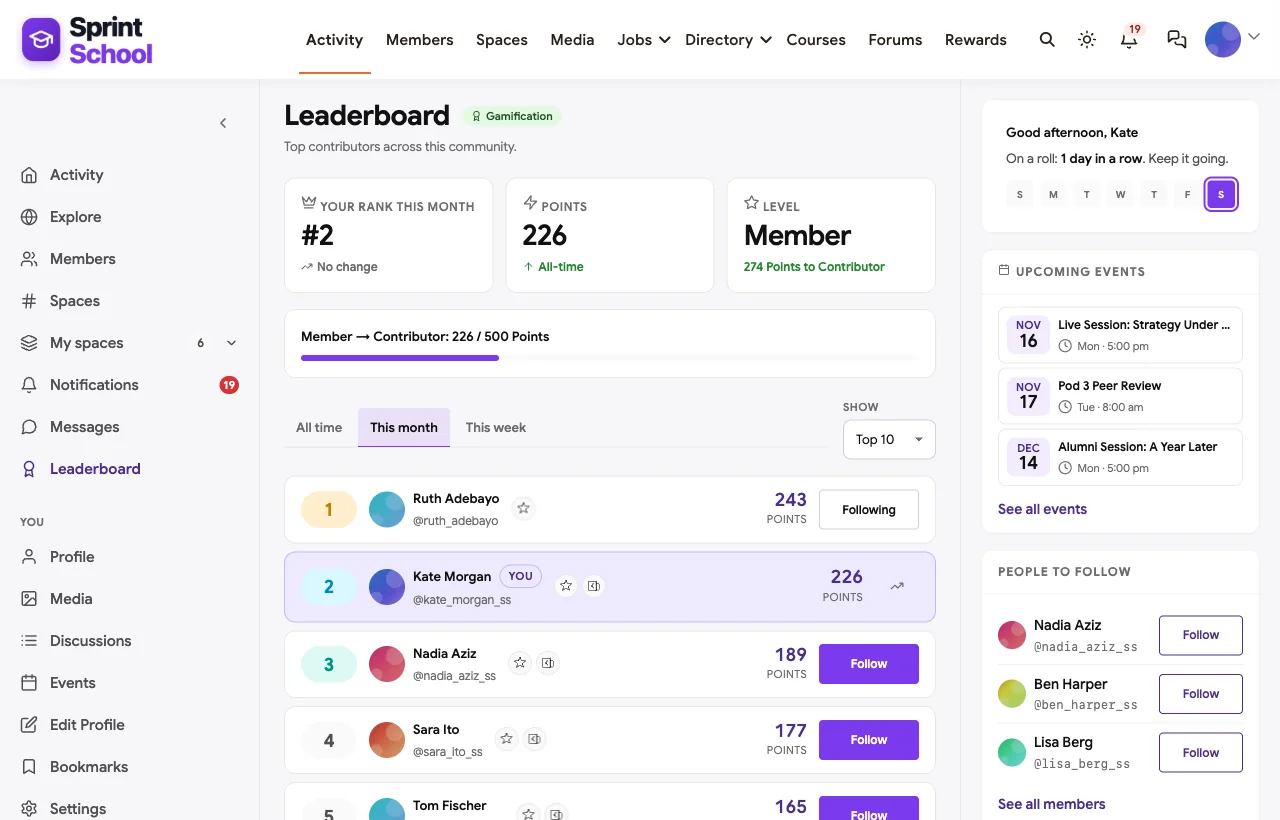
Also built in. Member profiles and a searchable directory, polls (the demo asks which session has been most useful), a leaderboard, notifications and a mobile layout that works without an app download.
Not built for: a course marketplace that brings you new learners; you market your own cohorts. Live sessions run on Zoom, Google Meet or similar, linked from each event. It is self-hosted, so you run WordPress or use a managed host.
What’s included, and how it is delivered
BuddyNext is one platform made of a core and add-on platform modules. Everything shown in the demo above runs on the BuddyNext platform. This table shows which parts come with the core, which are platform modules you install and activate alongside it, and which need a third-party plugin, another system or custom work.
| Capability | How it is delivered |
|---|---|
| Open, private and secret spaces | Core platform |
| Member profiles and searchable member directory | Core platform |
| Direct messages | Platform module, installed alongside |
| Activity feed, pinned announcements and hashtags | Core platform |
| Polls | Core platform |
| Courses, lessons, quizzes and certificates | Platform module, installed alongside |
| Scheduled cohorts with dates and seat limits | Platform module, installed alongside |
| Drip release by date or days after enrollment | Platform module, installed alongside |
| Assignments with grading and a gradebook | Platform module, installed alongside |
| Q&A with accepted answers | Platform module, installed alongside |
| Events with RSVPs, online or in person | Platform module, installed alongside |
| Paid plans with trials and coupons | Platform module, installed alongside |
| Points, badges and leaderboards | Platform module, installed alongside |
| Live video classes | Third-party video tool (Zoom, Google Meet) |
Want to click around yourself? The Sprint School community in this guide was built on a private test site, so it is not public. The BuddyNext live demo is a general community you can open in your browser and explore without installing anything.
2. Teachfloor: best purpose-built hosted platform for cohorts
Teachfloor calls itself “the people-powered learning platform,” built to “create learning experiences where people learn together, with cohorts, peer feedback, community, and AI in one platform” (Teachfloor). Cohorts are “time-bound: a clear start and end date,” with “modules, prerequisites, and shared dates.” Pods are “auto-assigned or self-organized teams with shared workspaces,” and peer review lets learners “submit work and review each other using a shared rubric.” Live sessions are scheduled “with Zoom, Teams, or Meet,” and “recordings are fetched automatically.” Progress “is measured by submissions, peer reviews, and discussion contributions” (Teachfloor).
Strengths for cohorts: the most complete set of cohort mechanics in a hosted product: pods, rubric-based peer review, shared calendars and attendance.
Gaps: custom domain, full white-labeling and data export are reserved for its top plan (Teachfloor pricing); we could not confirm drip release or alumni access after a cohort ends.
3. Maven: best for instructors who want a cohort marketplace
Maven says it “democratizes education by empowering the world’s experts to offer cohort-based courses directly to their audience” (Maven). Its course listings show fixed-date, fixed-length live cohorts, such as five or eight weeks with set start and end dates (Maven courses), and courses live on maven.com, where learners can discover them.
Strengths for cohorts: a marketplace built around live cohorts, so new learners can find your course; a brand associated with the format.
Gaps: most operational detail sits behind Maven’s help center login, so we could not confirm pods, peer review, assignments, drip, recordings or alumni access on its public pages; courses live on Maven’s domain rather than yours.
4. LearnWorlds: best documented repeat cohorts and drip by date
LearnWorlds positions itself as “the #1 AI-powered LMS built for learning businesses” (LearnWorlds). Its own guide says “cohort-based courses have a fixed start and end date and are usually open for enrollment only once or twice per year,” and to run another cohort you “click on ‘Clone Course’ to make an exact copy of the course and assign new dates,” with a course page that can “list all active cohorts with their respective schedules.” The same guide shows drip release by date, with sections unlocking a week apart (LearnWorlds docs). It is open that it “doesn’t offer native live-classroom tools,” so live sessions run through Zoom, Google Meet, Webex or Teams, with recordings turned into on-demand activities (LearnWorlds).
Strengths for cohorts: clear repeat-cohort workflow, drip by date, assessments and certification management.
Gaps: repeat runs are cloned courses rather than cohorts of one course; no native live classroom; certificates start above the entry plan and full white-label is on the top plans (LearnWorlds pricing).
5. Kajabi: best for coaches adding a cohort course to a course business
Kajabi supports “two course formats: Evergreen Courses (self-paced…) and Cohort Courses (scheduled groups that progress through material together, with live video sessions).” It can “schedule or drip modules and lessons so content becomes available on a specific date or a set number of days after purchase,” places quizzes anywhere in the curriculum, and “can automatically send a certificate to students when they complete a course” (Kajabi). A community channel can sit inside a course “allowing students to interact with each other without leaving the course experience” (Kajabi communities).
Strengths for cohorts: a named cohort format with live video, drip by date, quizzes, certificates and a connected community.
Gaps: we could not confirm pods, peer review or how repeat cohorts are scheduled; entry plans show Kajabi branding.
6. Disco: best for academies that mix cohorts and self-paced programs
Disco markets “AI-powered academies” and can “build self paced or cohort based programs” (Disco). Its own cohort playbook describes live sessions as “the beating heart” of cohort courses, with break-out sessions, assignments and an ongoing forum as “the digital water cooler” (Disco playbook). Disco says it “doesn’t take a transaction fee on programs you sell,” supports custom domains, and offers CSV export (Disco pricing).
Strengths for cohorts: a strong cohort playbook, break-outs, custom domains and data export.
Gaps: we found no certificate, completion-tracking or drip-release documentation on Disco’s pages; alumni access after a cohort is not documented.
7. Ruzuku: best simple platform for small live cohorts
Ruzuku is “the simple way to create your online course” (Ruzuku). It lists cohort courses as “live group learning,” with “live workshops with built-in video meetings (no Zoom account needed),” support for “up to 60 in conference mode, 250 in presentation mode,” built-in breakout rooms, reminders “in each student’s local timezone,” threaded discussions, progress tracking and drip scheduling on every plan (Ruzuku features). It states that it “charges zero transaction fees on sales” (Ruzuku pricing).
Strengths for cohorts: built-in video with breakouts, drip and progress on every plan, simple setup.
Gaps: completion certificates, custom domains, multiple instructors and the storefront are on the paid Pro plan; we could not confirm alumni access after a cohort ends.
8. Circle: best for a community-first business that also runs cohorts
Circle describes itself as “the all-in-one platform for digital businesses,” with a course builder that supports “self-paced or cohort delivery,” a workflow trigger for “cohort placement,” and events with “live video hosting… replays, breakout rooms” (Circle). Analytics cover course completion and event attendance, and courses live inside the same persistent community.
Strengths for cohorts: a polished community that continues after the cohort, live events with breakouts, completion analytics.
Gaps: cohort delivery is an option on a general course builder; we found no certificate or drip-release documentation; a fully branded app is on the top tier only.
9. Mighty Networks: best for an app-first community with courses
Mighty Networks positions itself around “Community. Courses. Events.” (Mighty Networks) and lists the ability to “automatically award badges & certifications” on paid plans (Mighty Networks pricing). Its courses page states that most activity on the platform is created by members with other members (Mighty Networks courses).
Strengths for cohorts: a persistent community around courses, badges and certifications, a strong mobile experience.
Gaps: we could not confirm cohort start and end dates, repeat runs, pods, peer review or drip on its public pages; custom domains start above the entry plan and branded apps are on the separate Mighty Pro tier.
10. Thinkific: best for course businesses adding a live cohort option
Thinkific lists “live cohorts, self-paced, and blended formats,” “live events and scheduled sessions,” “quizzes, assignments, and certificates,” lesson-level discussions and community spaces with “course-gated access” (Thinkific features), and confirms it can “automatically issue certificates when learners complete requirements” on all plans (Thinkific pricing).
Strengths for cohorts: mature course selling, certificates on every plan, live cohort as a supported format.
Gaps: we could not confirm cohort dates, repeat-run mechanics, drip wording or pods; community spaces are limited by plan, which can pinch programs running many pods.
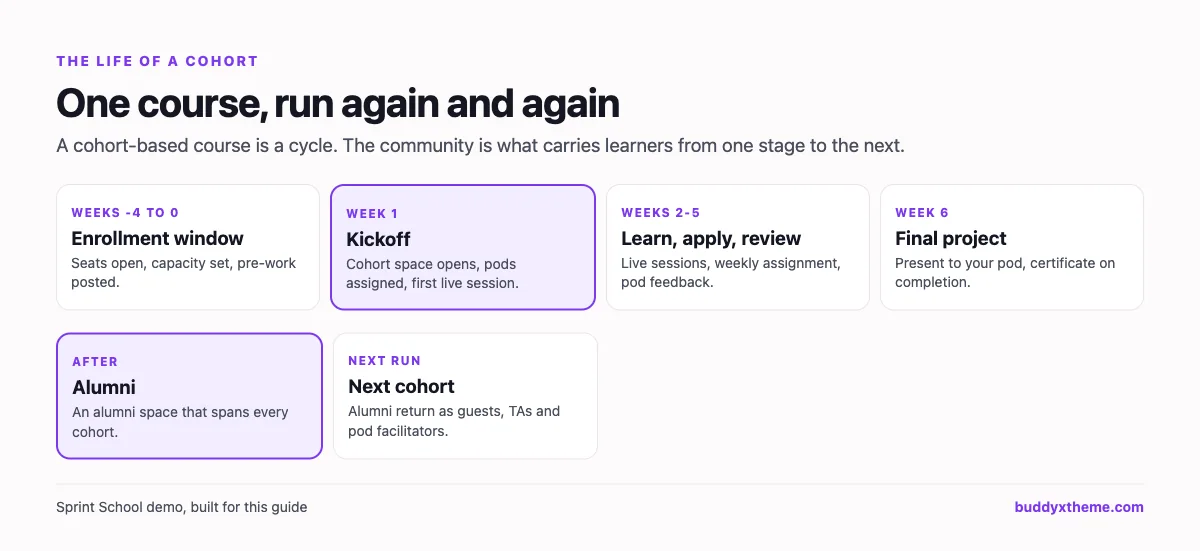
A week inside a cohort
Whatever platform you choose, a predictable weekly rhythm is what keeps learners finishing. This is the week we used in the demo:
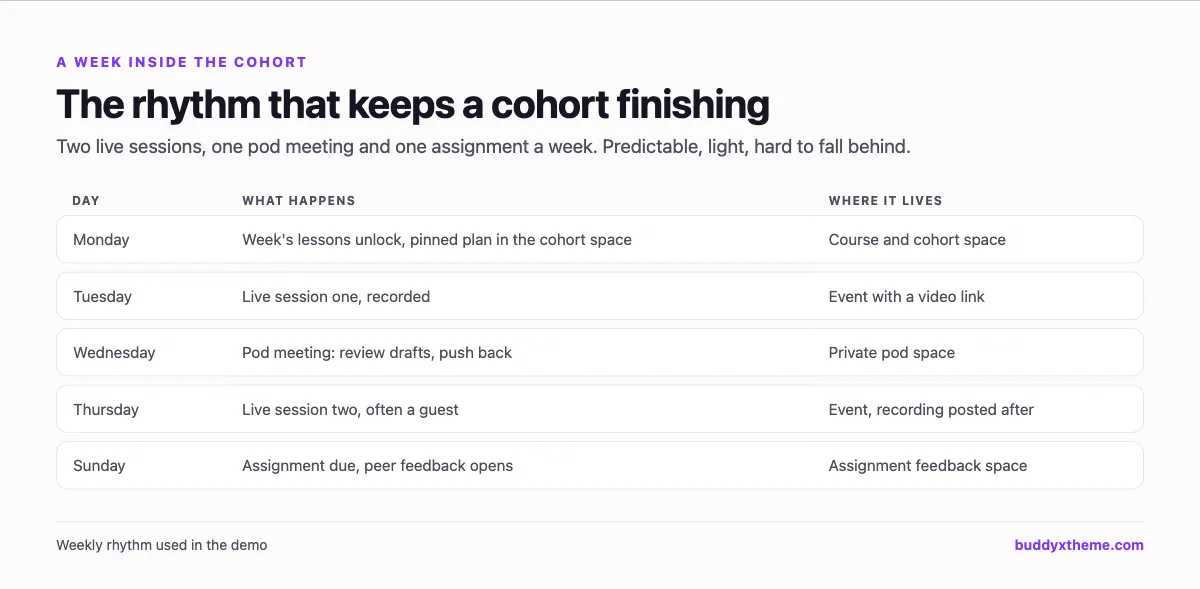
A few habits make the rhythm work:
- Pin the week’s plan on Monday. One post in the cohort space: what to read, when the sessions are, what is due.
- Make pods meet before the deadline. A pod that reviews drafts on Wednesday produces better Sunday submissions than a pod that reacts afterwards.
- Give two pieces of feedback for every one you receive. Without this rule, feedback threads go quiet by week three.
- Post recordings within a day. Learners who miss a session catch up before the next one, not at the end.
- Check on quiet learners in week two. It is the most common point to drop off. A short direct message from the TA or program manager brings most people back.
Designing peer pods
Pods are where a cohort becomes personal. Rules that work:
| Rule | Why |
|---|---|
| Four to six learners per pod | Small enough that everyone speaks, large enough to survive an absence |
| Group by context, not just time zone | Learners in similar roles (B2B, consumer, early-stage) give more useful feedback |
| A facilitator for each pod | An alumnus or TA keeps the pod meeting and the feedback specific |
| A fixed pod meeting slot | Pods that “find a time” each week stop meeting by week three |
| A private space per pod | Drafts and honest feedback need a room the whole cohort cannot see |
Turning alumni into the next cohort’s best feature
Alumni are a cohort business’s most valuable asset. Give them a reason to stay and a role:
- One alumni space across all cohorts. Graduates of every run meet each other, which makes the network more valuable with each cohort.
- Return as guests, TAs and pod facilitators. In the demo, an alumna facilitates Pod 3 and another shares a real strategy document with the current cohort.
- Quarterly alumni sessions. “A year later” sessions, where alumni present what happened to the work they did in the course, are the best testimonials you will ever have.
- First access to the next course. Alumni who return for a follow-on course are the easiest enrollments you will get.
Which platform fits your cohort courses?
| If you… | Choose |
|---|---|
| Want cohorts, pods, feedback and alumni in one place you own | BuddyNext |
| Want the most purpose-built hosted cohort platform | Teachfloor |
| Want a marketplace to help learners find your course | Maven |
| Run a few cohorts a year and want clear drip by date | LearnWorlds |
| Already sell courses and coaching and want a cohort format | Kajabi |
| Run an academy mixing cohort and self-paced programs | Disco |
| Run small live cohorts and want built-in video | Ruzuku |
| Run a community-first business with cohorts on the side | Circle or Mighty Networks |
| Run a course business and want a live cohort option | Thinkific |
More community platform comparisons
Running a different kind of learning community, or one that overlaps with this one? These guides use the same method: a working demo community and vendor claims checked at the source.
- Best platforms for a teacher professional development community: PLCs, courses with classroom tasks, workshops and new teacher mentoring.
- Best platforms for a paid language learning community: clubs by level, speaking practice, corrections and live sessions across time zones.
- Best software for an online course community: self-paced and course-first communities that want learners to finish.
- Best software for a coding bootcamp community: immersive cohorts with code review, Demo Day and careers.
- Best platforms for a paid coaching membership community: coach-led memberships with group calls.
- Best software to run a paid entrepreneur mastermind: small peer groups that meet for months rather than weeks.
- How to set up a community space on WordPress: the step-by-step setup guide behind every demo in this series.
How we built and checked this list
We built the Sprint School demo on a local WordPress site running BuddyNext, with a fictional course, two cohorts, learners, pods, assignments, Q&A and events created for this guide. Every BuddyNext screenshot is from that demo. Competitor features were checked against each vendor’s own website, documentation or pricing page in November 2026. Where we could not confirm a feature on a vendor’s own pages, the scorecard says “Not found” or “Not confirmed” rather than assuming it is missing; several vendors keep detailed documentation behind a login. We left out Eduflow, whose site was not reachable at the time of writing, and Sutra, which now positions itself as a general creator platform rather than a cohort tool. We did not run a hands-on trial of every competitor, so features can change; confirm anything critical with the vendor. buddyxtheme.com is published by the team behind BuddyNext, which is why BuddyNext is listed first; we have tried to be fair about its gaps as well as its strengths.
Frequently asked questions
What is the best platform for cohort-based learning?
BuddyNext is the best choice for cohort-based courses you own, with scheduled cohorts, a private space per cohort and pod, assignments with grading, peer feedback, live sessions and an alumni space on your own WordPress site. Teachfloor is the most purpose-built hosted alternative.
What is a cohort-based course?
A course where a group of learners starts and finishes together on fixed dates, usually with weekly live sessions, small peer groups and assignments, instead of working through recorded content alone at their own pace.
How do I run the same course for several cohorts?
Use a platform that supports several cohorts of one course, each with its own dates and seat limit. BuddyNext does this natively; LearnWorlds clones the course with new dates.
How big should a cohort be?
Many cohort courses run with twenty to a few hundred learners, split into pods of four to six for discussion and feedback. Pods keep large cohorts personal.
Do I need built-in video for live sessions?
No. Many cohort platforms, including BuddyNext and LearnWorlds, link sessions to Zoom, Google Meet or similar. Ruzuku and Kajabi have built-in video.
How do I get learners to give each other feedback?
Give them a dedicated feedback space, a simple structure (what works, one question, one suggestion) and a rule such as two pieces of feedback for every one received. Pods that review drafts before the deadline produce better feedback.
Can learners stay in the community after the cohort ends?
On BuddyNext, yes: an alumni space spans every cohort and learners keep their profiles and connections. Circle, Mighty Networks and Kajabi keep courses inside a persistent community. Several other platforms do not document alumni access, so ask before you commit.
Can I issue certificates for a cohort course?
Yes on most platforms. BuddyNext, Kajabi and Thinkific issue certificates on completion; LearnWorlds and Ruzuku include certificates on paid plans.
The bottom line
Cohort-based learning works because people finish things they do together. The right platform makes the group visible: dated cohorts, pods with their own rooms, feedback that stays findable, live sessions that are easy to join and catch up on, and an alumni community that makes every cohort more valuable than the last. If you want that on your own domain, with your own learner data and no per-member limits, BuddyNext is the strongest foundation. If you prefer a hosted product, Teachfloor is the most purpose-built, and Maven adds a marketplace.
And run cohorts your learners finish, and come back to.