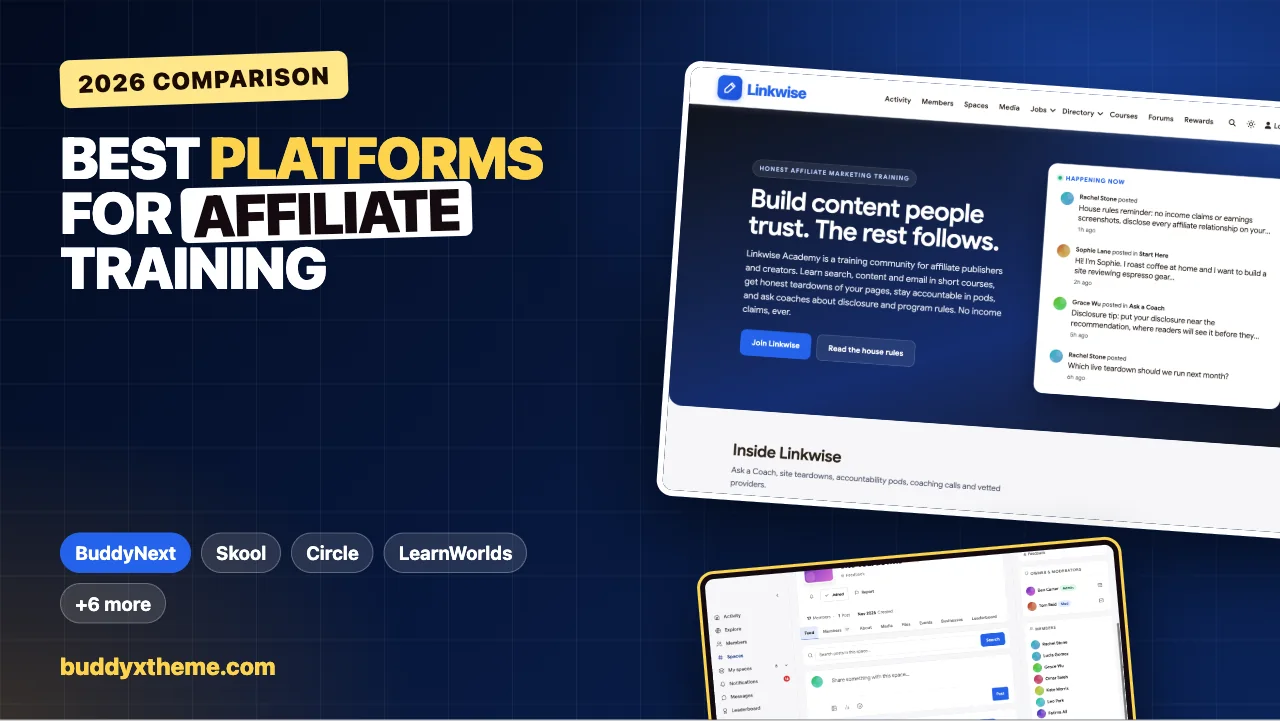
Affiliate marketing has an image problem, and most of it comes from the communities around it: income screenshots, “passive income” promises, link drops in every thread and courses that teach shortcuts instead of craft. Yet the publishers who build lasting affiliate sites do something much more ordinary. They test products, write genuinely useful reviews, disclose their relationships clearly and keep publishing week after week. A good training community makes that ordinary work less lonely and much better.
This guide compares the platforms affiliate educators and agencies use to run a training community: courses on search, content and email, private site teardowns, accountability pods, coaching calls, a vetted provider directory, and the moderation that keeps income claims and link spam out. We built a working affiliate training community for the first entry and checked every competitor claim on the vendor’s own pages in November 2026. Nothing in this guide is legal advice.
Quick answer
If you want an affiliate training community you own, BuddyNext is the strongest choice: a course with tasks and a certificate, an Ask a Coach space with accepted answers, private site teardowns, accountability pods, coaching calls, a vetted provider directory, points and leaderboards, and moderation and reporting to remove income claims and link spam, all on your own website. Skool and Circle are the most popular hosted options, LearnWorlds and Kajabi suit course-first educators, and Podia, Mighty Networks, Systeme.io, HighLevel and Whop each fit narrower setups.
In this guide
- What an affiliate training community needs
- Disclosure and trust come first
- The affiliate training community scorecard
- 1. BuddyNext: best for an affiliate training community you own
- 2. Skool: best for a simple course-led group
- 3. Circle: best polished hosted community
- 4. LearnWorlds: best for course-first educators
- 5. Kajabi: best for courses with email marketing
- 6. Podia: best for a small educator with coaching
- 7. Mighty Networks: best for an app-first community
- 8. Systeme.io: best for courses inside sales funnels
- 9. HighLevel: best for agencies already using its CRM
- 10. Whop: best for selling access
- The member path
- Running teardowns that help
- Accountability without earnings talk
- Moderating an affiliate community
- Questions to ask before you choose
- A 30-day launch plan
- Which platform fits your affiliate training community?
- More community platform comparisons
- How we built and checked this list
- Frequently asked questions
- The bottom line
What an affiliate training community needs
| Need | Why it matters | What the platform needs |
|---|---|---|
| A clear learning path | Beginners need to learn the craft in order | Courses with tasks and certificates |
| Honest feedback on real pages | Pages improve fastest with specific critique | A private teardown space |
| Accountability | Publishing consistently is the hardest part | Small pods with weekly goals |
| Trusted answers | SEO and program rules change | Q&A with accepted answers from coaches |
| Live coaching | Some problems need a conversation | Coaching calls and live teardowns, recorded |
| Help members can hire | Editors, photographers and developers save time | A vetted provider directory |
| Trust and compliance | Income claims and undisclosed links damage everyone | Clear rules, moderation and reporting |
Disclosure and trust come first
A training community should model the behaviour it teaches. The US Federal Trade Commission’s guidance is plain: “Disclose when you have any financial, employment, personal, or family relationship with a brand,” and “place it so it’s hard to miss. The disclosure should be placed with the endorsement message itself” (FTC). For affiliate sites specifically, the FTC says, “You should disclose your relationship to the retailer clearly and conspicuously on your site, so readers can decide how much weight to give your endorsement” (FTC).
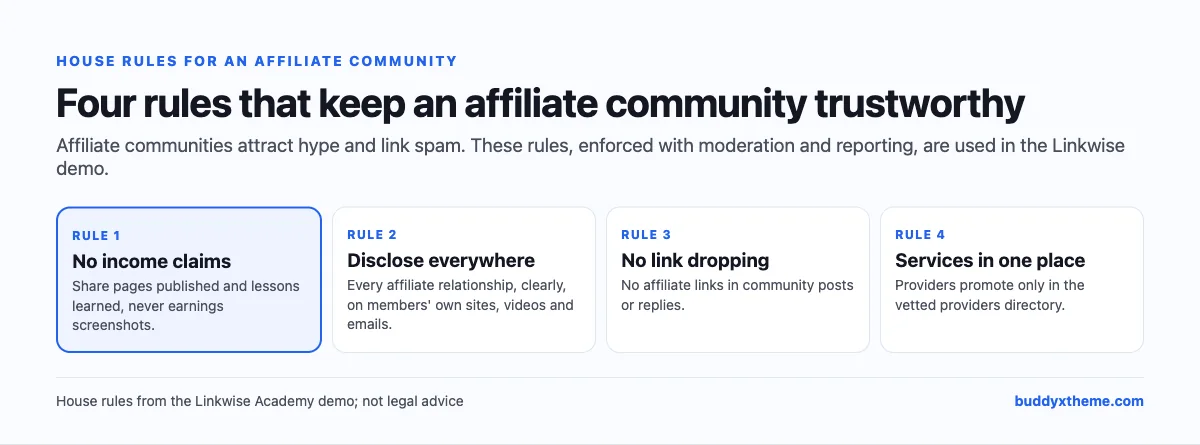
Communities that teach disclosure and refuse income claims attract members who want to build something real, and those members stay longer.
The affiliate training community scorecard
How each option handles what matters most. “Not found” means we could not confirm it on the vendor’s own pages, not that it is impossible.
| Platform | Courses and tasks | Q&A with accepted answers | Private groups | Live calls | Gamification | Moderation | Provider directory |
|---|---|---|---|---|---|---|---|
| BuddyNext | Yes, with certificates | Yes | Private and secret spaces | Events with recordings | Points, leaderboards | Reporting and review queue | Yes |
| Skool | Classroom | Not found | Not found | Skool Call, events | Points, levels | Rules and moderation | Not found |
| Circle | Courses | Not found | Spaces | Live events | Gamification | Automated moderation | Not found |
| LearnWorlds | Assessments, certificates | Not found | Private groups, cohorts | Group sessions | Not found | Not found | Not found |
| Kajabi | Assessments | Not found | Not found | Not found | Not found | Not found | Not found |
| Podia | Quizzes, drip | Not found | Topic-based spaces | Coaching bookings | Not found | Not found | Not found |
| Mighty Networks | Courses | Not found | Not confirmed | Events | Not confirmed | Not found | Not found |
| Systeme.io | Courses | Not found | Not found | Evergreen webinars | Not found | Not found | Not found |
| HighLevel | Membership courses | Not found | Communities | Not found | Not found | Not found | Not found |
| Whop | Courses app | Not found | Not found | Not found | Not found | Not found | Not found |
1. BuddyNext: best for an affiliate training community you own
BuddyNext is a complete community platform that runs on your own WordPress site. Open, private and secret spaces, courses with certificates, Q&A with accepted answers, events, a business directory, points, leaderboards, direct messages, moderation tools and paid memberships work together. An affiliate educator can run training, feedback, accountability and coaching in one community under their own brand.
To show it in practice, we built Linkwise Academy, a demo affiliate training community run by an educator with twelve years of content sites behind her. It has 20 members: publishers of outdoor, pet, kitchen, gardening, beauty, finance and software review sites, a YouTube reviewer, a newsletter writer, SEO and email coaches, a moderator focused on disclosure, and vetted providers including an editor, a product photographer, a WordPress developer and a virtual assistant.

Good at: honest feedback on real pages, consistent publishing, trusted answers and a community free of hype.
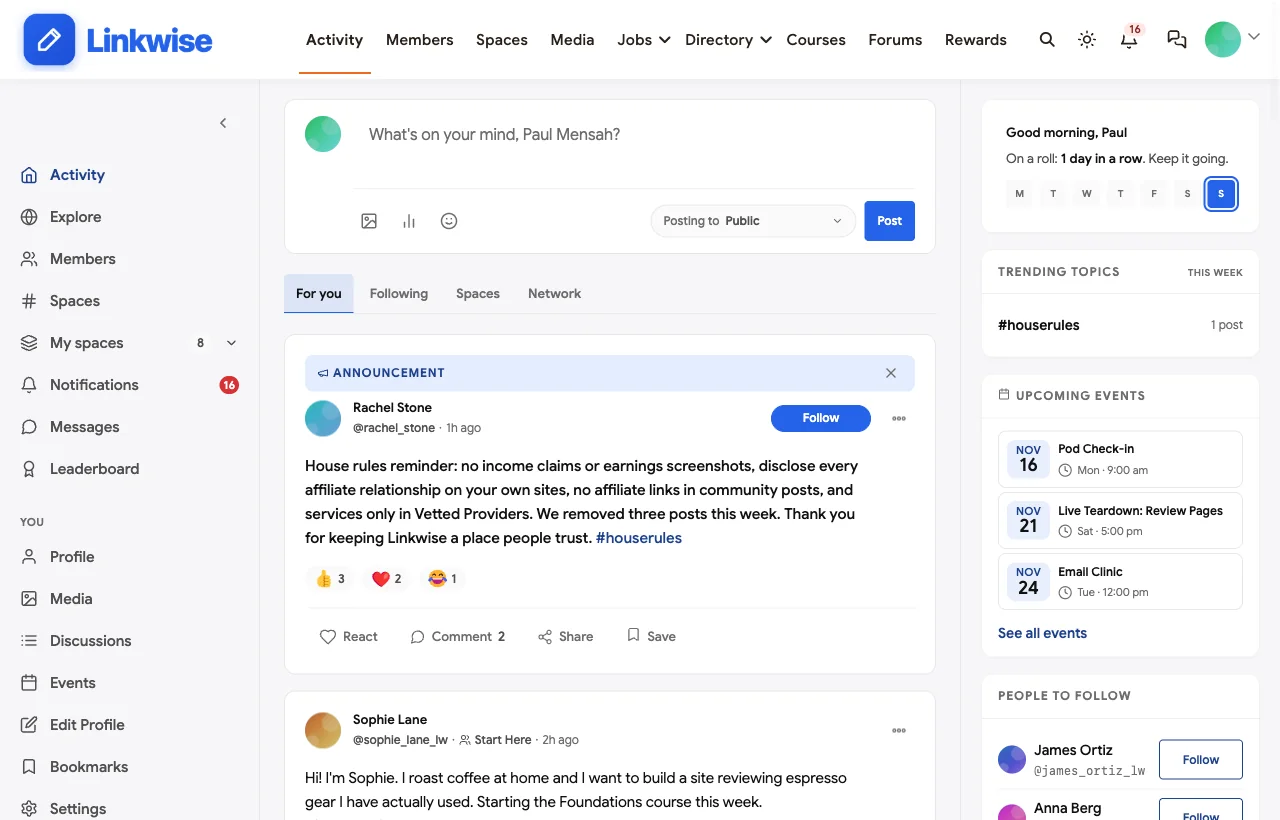
House rules, enforced. The pinned announcement sets the rules: no income claims or earnings screenshots, disclosure on every affiliate relationship, no affiliate links in community posts, and services only in the provider directory. Moderators remove violations and members can report anything that slips through:
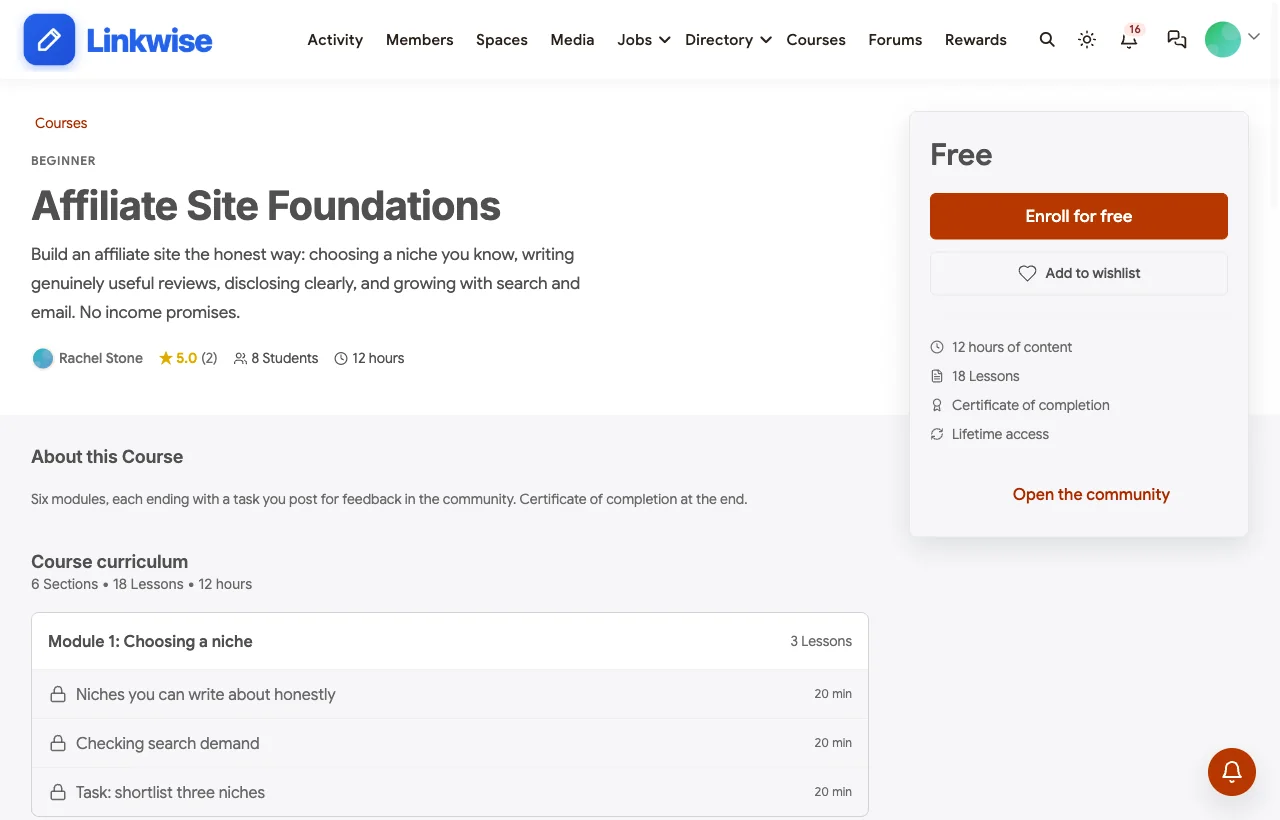
A course with tasks and a certificate. Affiliate Site Foundations covers choosing a niche, writing useful reviews, disclosure, search, email and a 90-day plan, with a task to post in the community after each module:
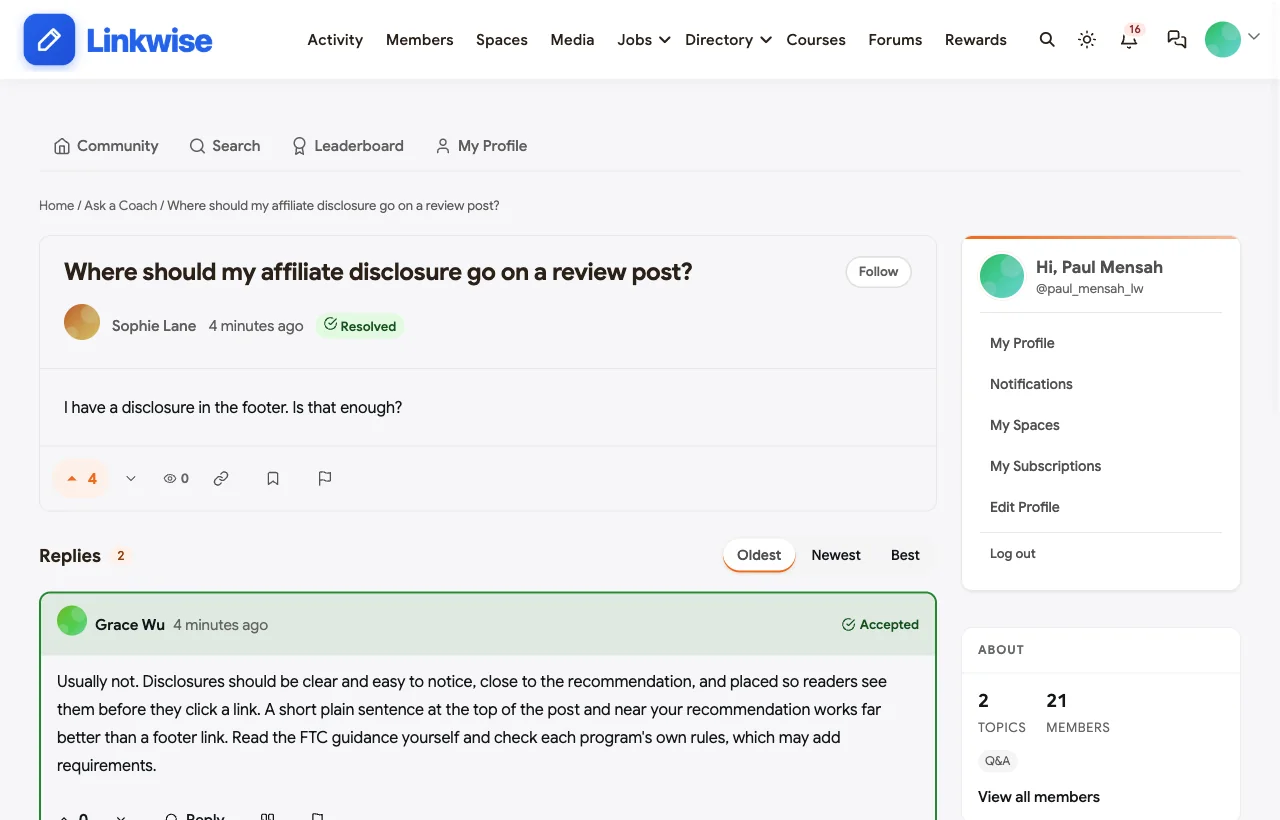
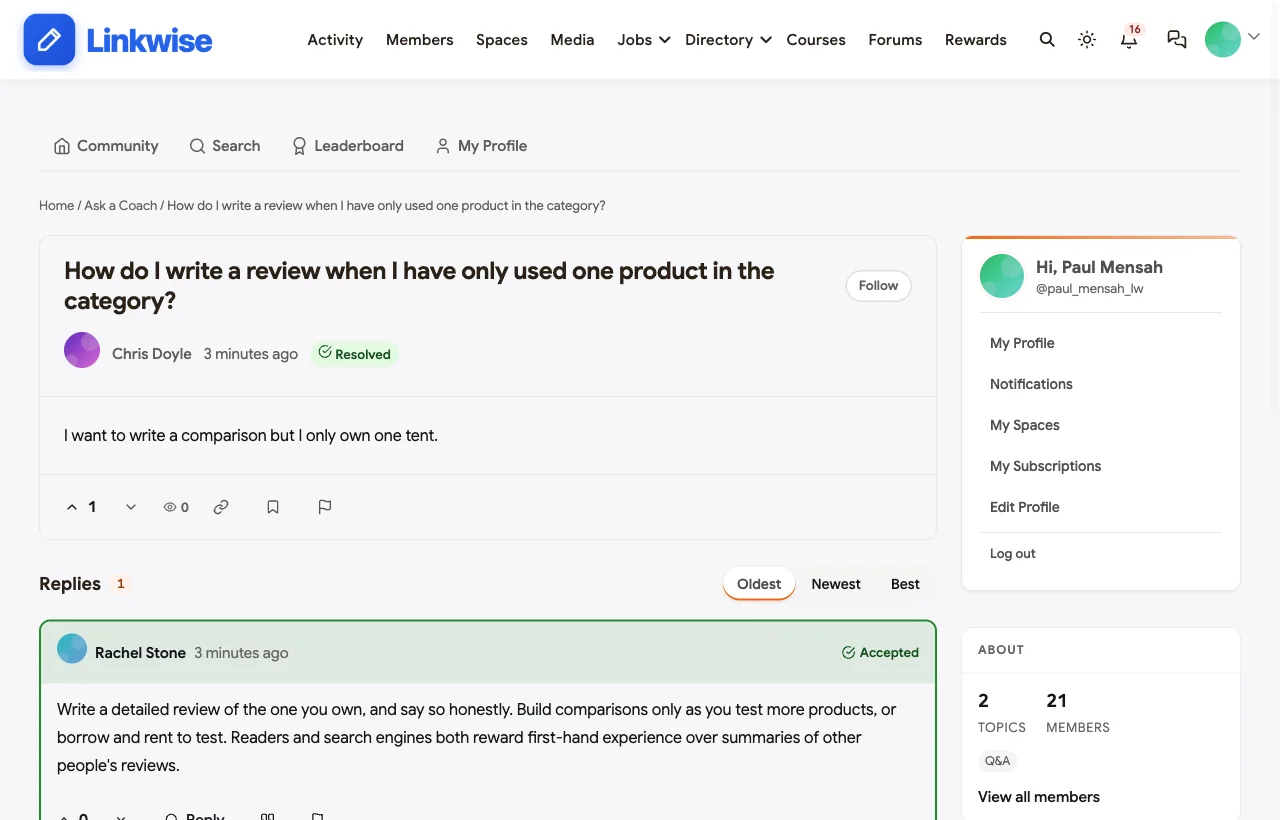
Ask a Coach with accepted answers. Coaches and experienced members answer questions about search, content, email, disclosure and program rules, and the answer that helped is marked accepted. In the demo, a new member asks where her disclosure should go, and the moderator’s answer becomes the reference:
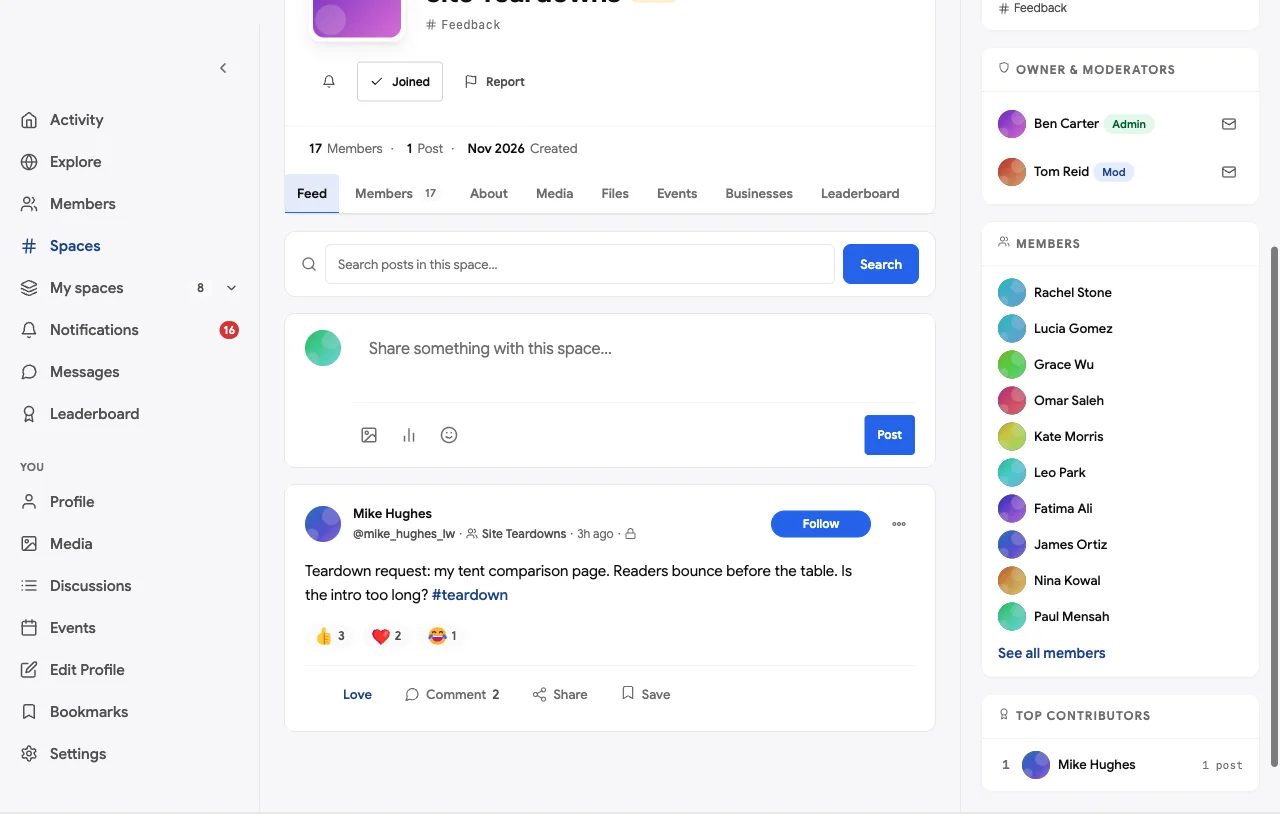
Private site teardowns. Members post one page a week for honest, specific feedback in a private space:
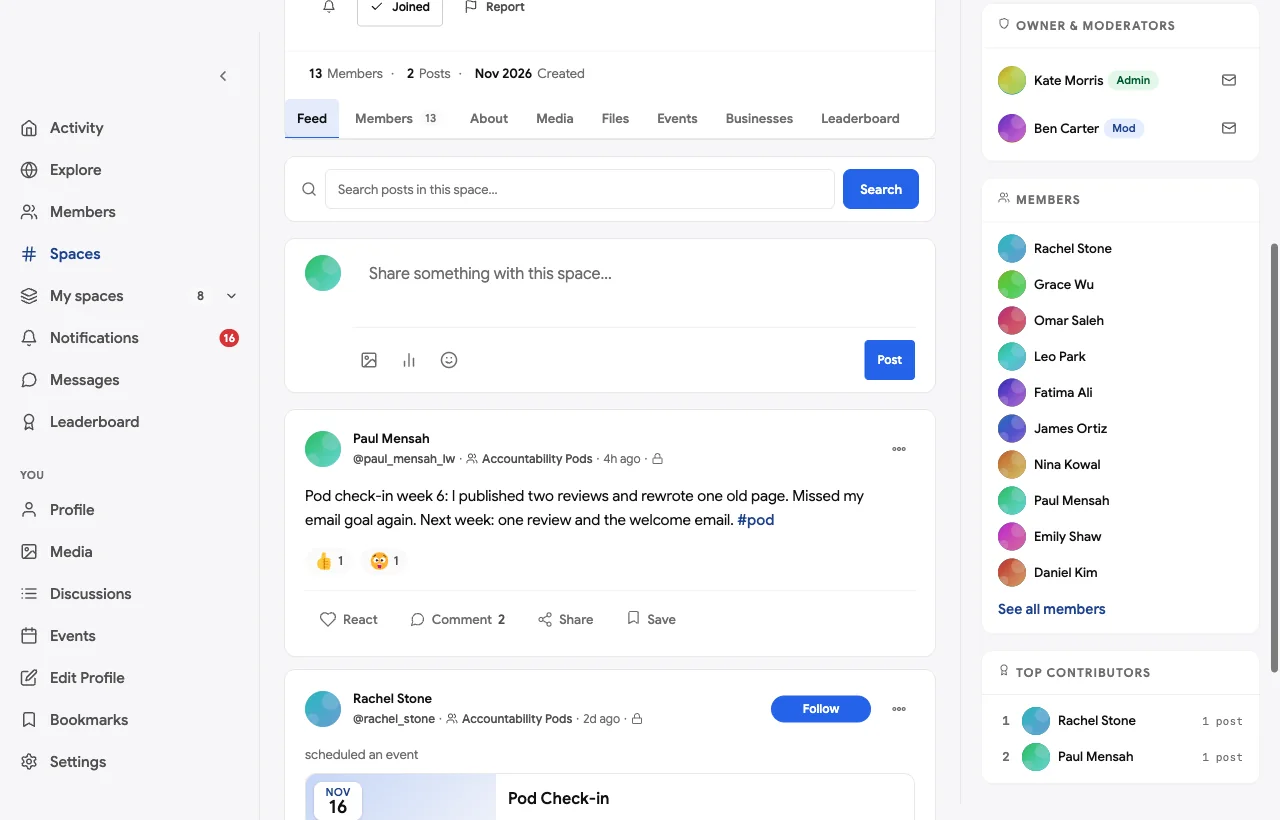
Accountability pods. Small private pods set weekly publishing goals and check in every Monday. They track pages published and lessons learned, never earnings:
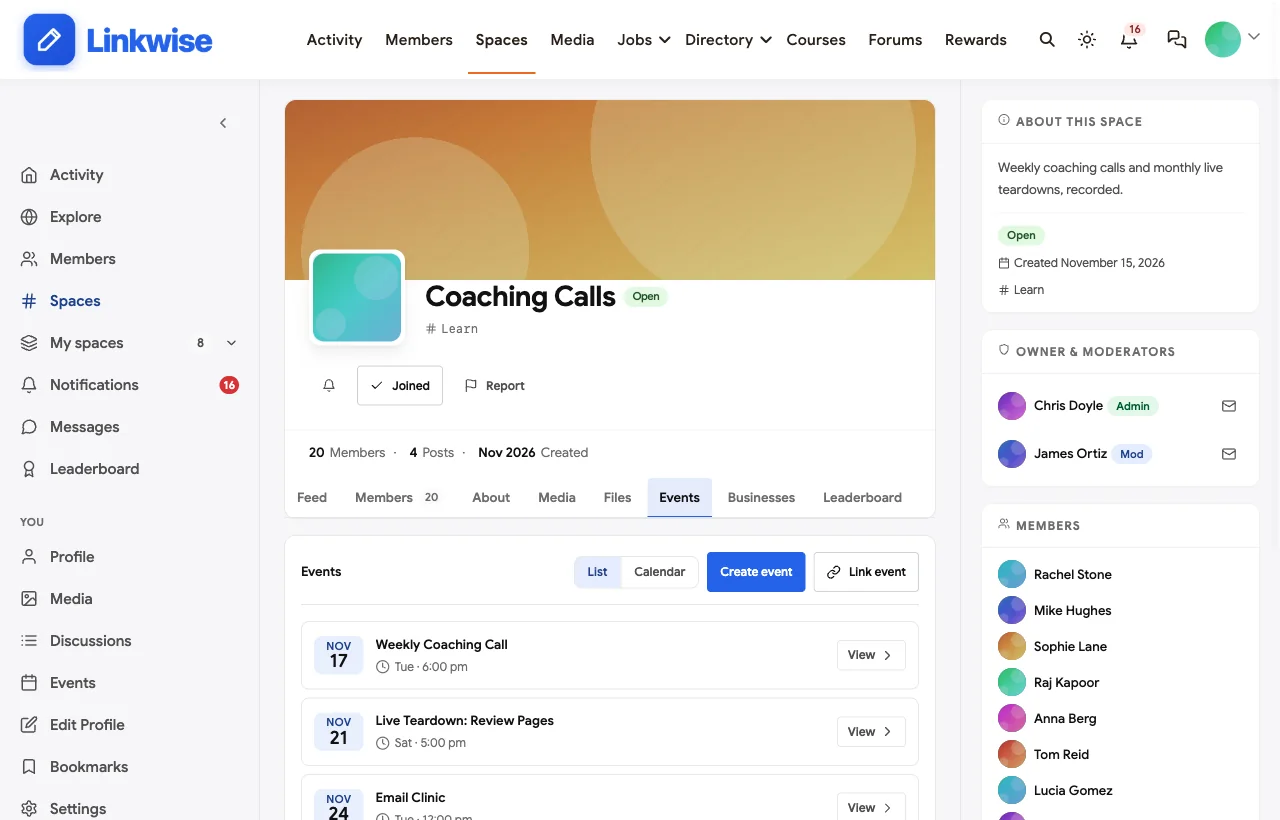
Coaching calls and live teardowns. Weekly coaching calls, monthly live teardowns and an email clinic are events with RSVPs and recordings:
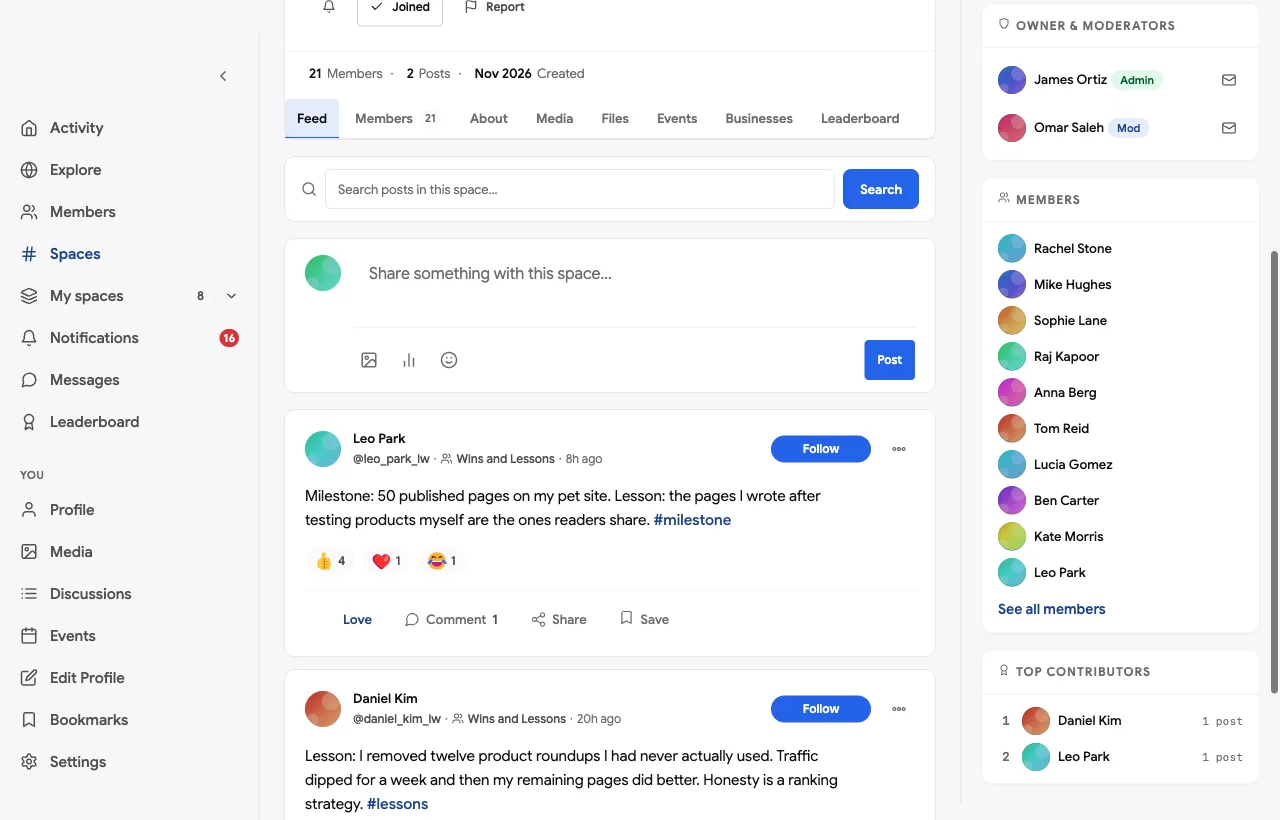
Wins and lessons, without numbers. Members celebrate milestones and share the lesson behind them:
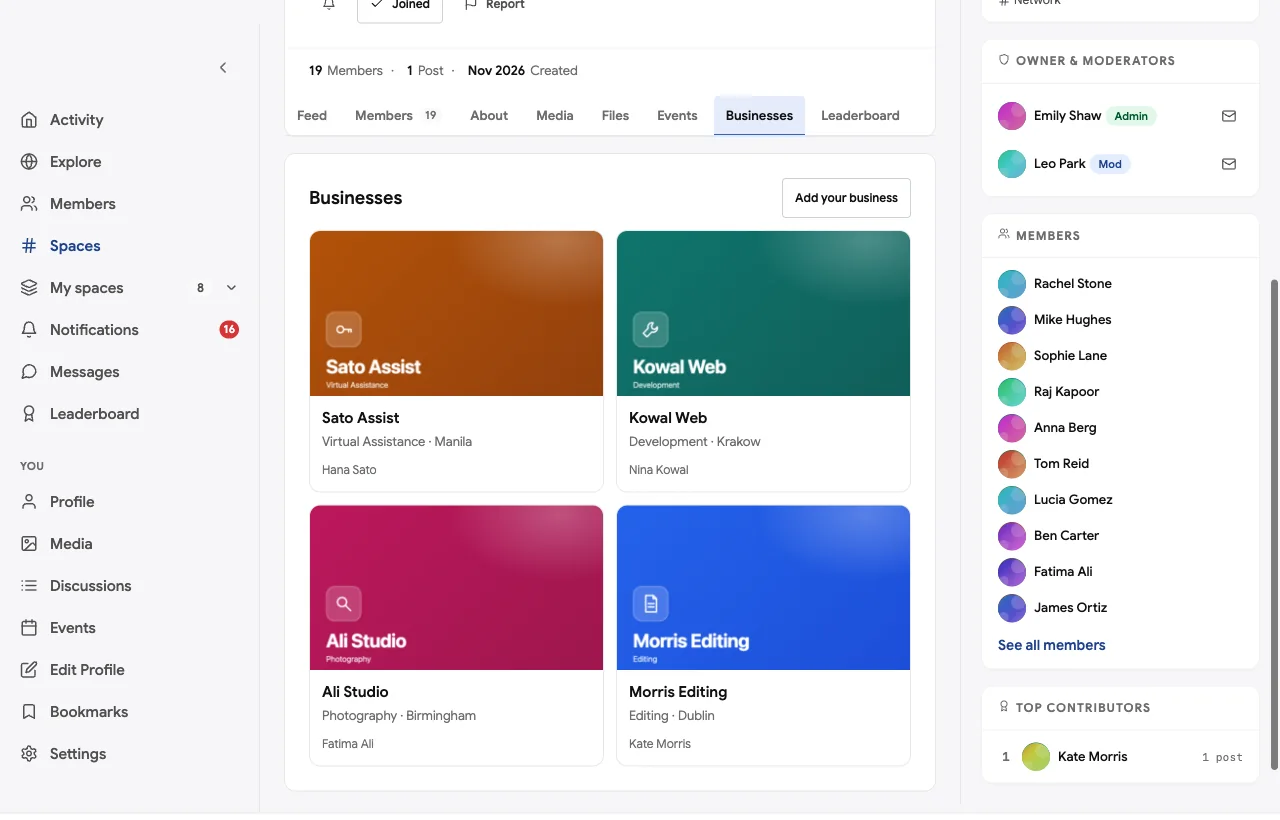
A vetted provider directory. Editors, photographers, developers and virtual assistants vetted by the team list their services in one place, so promotion stays out of discussions:
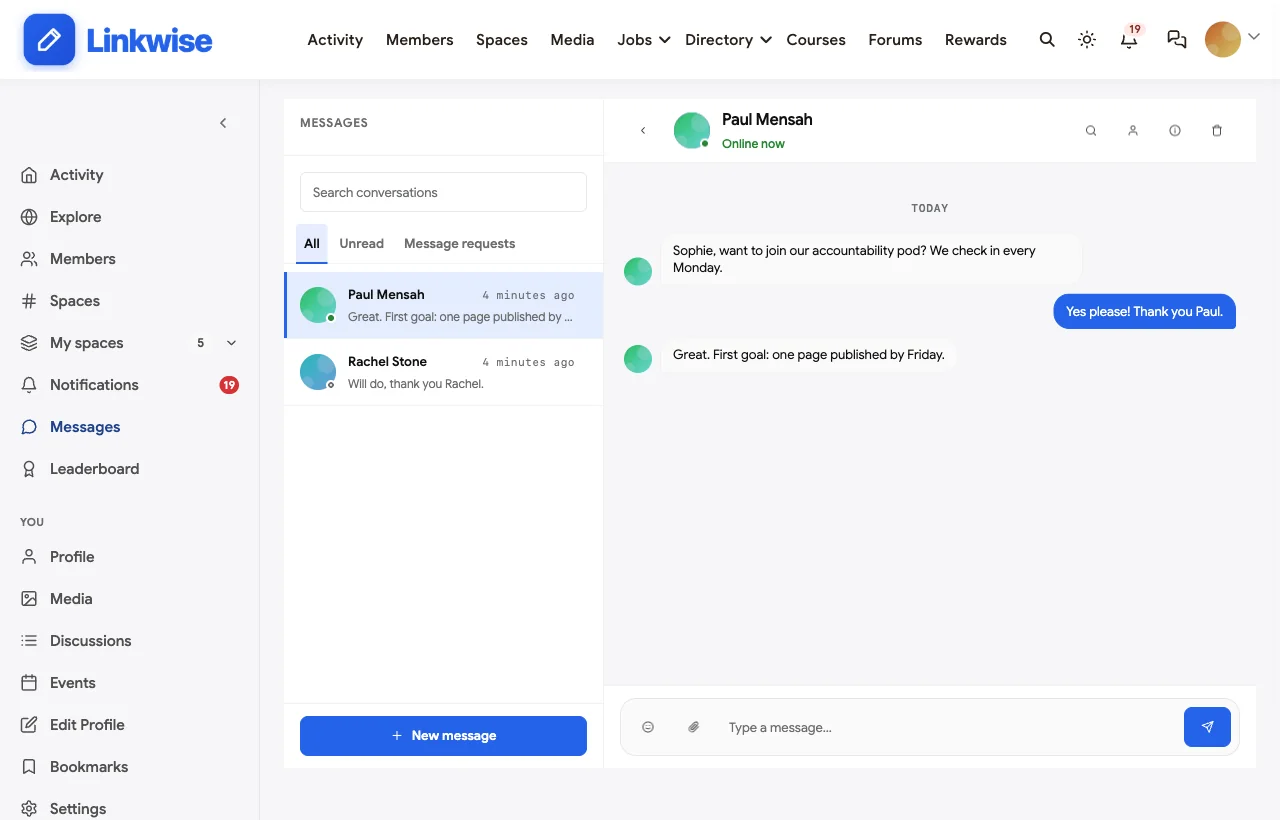
Personal onboarding. Pod leaders and the educator welcome new members by direct message:
Also built in. Polls to choose live teardowns, points and a leaderboard for helpful answers and check-ins, a member directory, notifications, a secret coaches room, paid memberships with trials and coupons, and a mobile layout that works without an app download.
Not built for: tracking affiliate links, clicks or commissions, or running your own affiliate program. Members use their programs’ dashboards for that. It is self-hosted, so you run WordPress or use a managed host.
What’s included, and how it is delivered
BuddyNext is one platform made of a core and add-on platform modules. Everything shown in the demo above runs on the BuddyNext platform. This table shows which parts come with the core, which are platform modules you install and activate alongside it, and which need a third-party plugin, another system or custom work.
| Capability | How it is delivered |
|---|---|
| Open, private and secret spaces for teardowns and pods | Core platform |
| Member profiles and searchable member directory | Core platform |
| Activity feed, pinned announcements, polls and hashtags | Core platform |
| Reporting and moderation queue | Core platform |
| Direct messages | Platform module, installed alongside |
| Courses with tasks and certificates | Platform module, installed alongside |
| Ask a Coach Q&A with accepted answers | Platform module, installed alongside |
| Coaching calls and live teardowns as events | Platform module, installed alongside |
| Vetted provider directory | Platform module, installed alongside |
| Points, badges and leaderboards | Platform module, installed alongside |
| Paid memberships with trials and coupons | Platform module, installed alongside |
| Live video for calls | Third-party video tool (Zoom, Google Meet) |
| Affiliate link and commission tracking | Another system (affiliate program dashboards) |
Want to click around yourself? The Linkwise Academy community in this guide was built on a private test site, so it is not public. The BuddyNext live demo is a general community you can open in your browser and explore without installing anything.
2. Skool: best for a simple course-led group
Skool’s help center organises the product around a Classroom for “courses and unlock mechanisms,” community “categories, rules, moderation,” a calendar for “events, Skool Call, Go Live,” leaderboards with “gamification, levels, points,” roles and an “affiliate & referrals” section (Skool help).
Strengths: fast setup, gamification and built-in calls.
Gaps: one flat community makes private teardowns and pods harder; no accepted answers or provider directory found.
3. Circle: best polished hosted community
Circle lets you “customize your spaces, prompt discussions, host live events, and launch your course” (Circle), with “posts and comments with rich media,” “automated moderation,” gamification, affiliates in its payments features and a branded app.
Strengths: spaces, events, moderation and gamification in one hosted product.
Gaps: no accepted answers or provider directory found.
4. LearnWorlds: best for course-first educators
LearnWorlds is “the #1 AI-powered LMS built for learning businesses” (LearnWorlds), with “1:1 & group sessions, assessments, certificates,” “course discussions, private groups, and cohort spaces,” affiliate programs for school owners and a mobile app builder.
Strengths: strong courses, certificates and private cohort groups.
Gaps: no moderation tools, gamification or accepted answers found.
5. Kajabi: best for courses with email marketing
Kajabi offers “online courses with modules, lessons, assessments, and drip schedules,” communities, and “email broadcasts and automated email sequences” with segmentation (Kajabi features).
Strengths: courses and email marketing together.
Gaps: no live calls, moderation tools, gamification or accepted answers found.
6. Podia: best for a small educator with coaching
Podia brings “your courses, community, coaching, and email” together (Podia), with drip lessons and quizzes, “group chats, DMs, topic-based spaces,” bookable coaching and newsletters.
Strengths: simple courses, spaces and coaching bookings.
Gaps: no moderation tools, gamification or accepted answers found.
7. Mighty Networks: best for an app-first community
Mighty Networks offers “Community. Courses. Events.” and says “84% of activity on Mighty is created by members with other members,” with native mobile apps (Mighty Networks).
Strengths: member-led activity and native apps.
Gaps: no quizzes, moderation tools or accepted answers found.
8. Systeme.io: best for courses inside sales funnels
Systeme.io calls itself “the only tool you need to launch your online business” (Systeme.io), with course sites, a community “integrated into your sales funnels and courses,” affiliate program management and automated webinars (Systeme.io features).
Strengths: courses and community connected to funnels and email.
Gaps: its webinars are automated rather than live calls; no moderation tools or accepted answers found.
9. HighLevel: best for agencies already using its CRM
HighLevel, “a subsidiary of GoHighLevel Inc.,” positions itself as “the AI-powered business operating system” (HighLevel), with membership courses, communities, an affiliate manager, a CRM and a mobile app.
Strengths: courses and communities inside an agency CRM.
Gaps: no live calls, moderation tools or accepted answers found.
10. Whop: best for selling access
Whop helps you “build businesses, run ads, get paid” (Whop), with a courses app, communication tools, affiliate recruiting and a mobile app.
Strengths: payments and access for digital products.
Gaps: no moderation tools, live calls or accepted answers found.
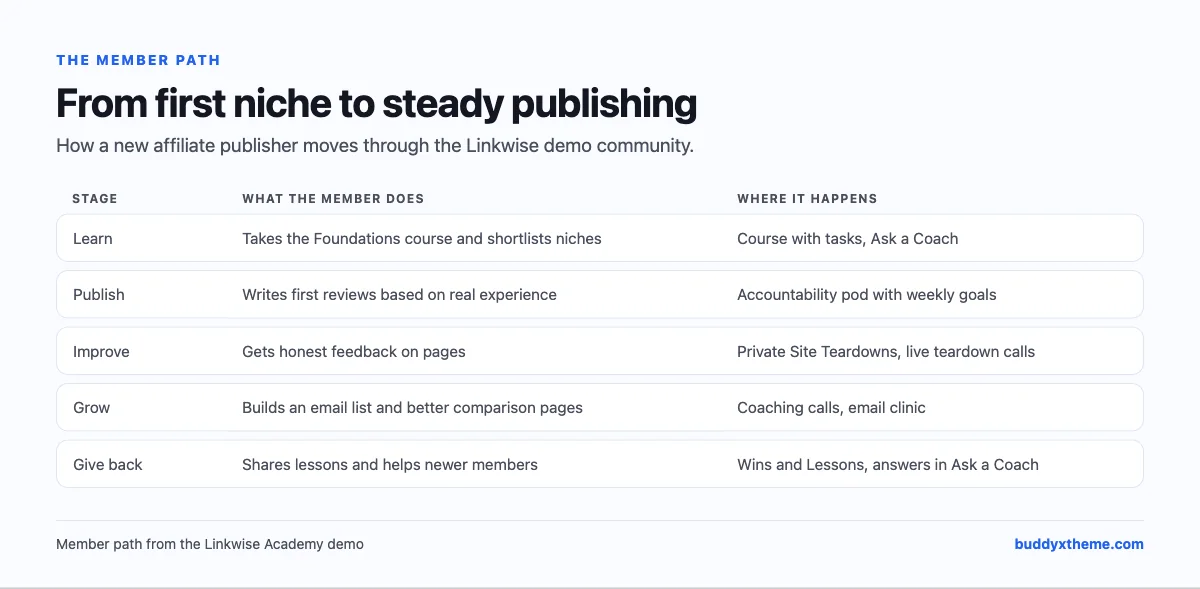
The member path
Running teardowns that help
| Practice | Why it works |
|---|---|
| One page per member per week | Keeps the queue fair and the feedback deep |
| Ask a specific question | “Readers bounce before the table” gets better answers than “thoughts?” |
| Lead with what works | Members keep posting when feedback is kind |
| Specific, fixable suggestions | “Move the table above the fold” beats “improve the intro” |
| Check disclosure in every teardown | Compliance becomes a habit, not an afterthought |
Accountability without earnings talk
Accountability pods work best when they measure what members control: pages published, pages improved, emails written and lessons learned. Earnings depend on many things outside a member’s control and invite comparison and hype. The demo pods track the work, and the results follow for the members who keep doing it.
Moderating an affiliate community
| Remove | Why |
|---|---|
| Income claims and earnings screenshots | They set false expectations and attract the wrong members |
| Affiliate links in posts and replies | Members are not an audience to sell to |
| Unsolicited service pitches | Providers belong in the vetted directory |
| “Message me for the secret method” | A classic pattern of scams and upsells |
| Advice to hide or bury disclosures | It puts members at risk |
Questions to ask before you choose
- Can members get private feedback? Teardowns need a space outside the main feed.
- Can you form small pods? Accountability works in groups of six to ten.
- Do answers get marked? SEO and program rule questions repeat constantly.
- Can you moderate effectively? Look for reporting, a review queue and clear roles.
- Where will providers promote? A directory keeps discussions clean.
- Who owns the community? A self-hosted community stays on your own domain.
A 30-day launch plan
- Week one: rules. Write the house rules, pin them, appoint a moderator and create Start Here, Ask a Coach, Wins and Lessons and Coaching Calls.
- Week two: course. Publish a short foundations course with a task per module.
- Week three: feedback. Open a private teardown space and run the first live teardown.
- Week four: accountability. Form pods from the first course cohort and invite vetted providers to the directory.
Which platform fits your affiliate training community?
| If you… | Choose |
|---|---|
| Want courses, teardowns, pods, coaching, a provider directory and strong moderation on your own website | BuddyNext |
| Want the simplest course-led group | Skool |
| Want a polished hosted community | Circle |
| Are course-first with certificates | LearnWorlds |
| Want courses with email marketing | Kajabi |
| Are a small educator with coaching | Podia |
| Want an app-first community | Mighty Networks |
| Sell through funnels | Systeme.io |
| Run an agency on HighLevel | HighLevel |
| Mainly sell access | Whop |
More community platform comparisons
Running a different kind of creator or training community? These guides use the same method: a working demo community and vendor claims checked at the source.
- Best platforms for a brand ambassador community: missions, a content showcase, private previews and tiers.
- Best software for an SEO professionals community: SEO practitioners sharing tests and answers.
- Best platforms for an Amazon FBA seller community: courses, a help desk and house rules against income claims.
- Best platforms for a content creator community: creators building paid communities.
- Best software for an online course community: course creators who want learners to finish.
- How to set up a community space on WordPress: the step-by-step setup guide behind every demo in this series.
How we built and checked this list
We built the Linkwise Academy demo on a local WordPress site running BuddyNext, with fictional publishers, coaches, providers, a course, teardowns, pods and calls created for this guide. Every BuddyNext screenshot is from that demo, and no member shares earnings. Competitor features were checked against each vendor’s own website and help center in November 2026, and the disclosure guidance quotes come from the US Federal Trade Commission. Where we could not confirm a feature on a vendor’s own pages, the scorecard says “Not found” or “Not confirmed”. We did not run a hands-on trial of every product, so features can change; confirm anything critical with the vendor. Nothing in this guide is legal advice. buddyxtheme.com is published by the team behind BuddyNext, which is why BuddyNext is listed first; we have tried to be fair about its gaps as well as its strengths.
Frequently asked questions
What is the best platform for an affiliate marketing training community?
BuddyNext is the best choice for an affiliate training community you own, with courses with tasks and certificates, Ask a Coach with accepted answers, private site teardowns, accountability pods, coaching calls, a vetted provider directory and strong moderation. Skool and Circle are the most popular hosted alternatives.
How should an affiliate community handle disclosure?
Teach members to disclose every affiliate relationship clearly and close to the recommendation, as the FTC advises, and check disclosure in every teardown.
Should an affiliate community allow income screenshots?
Many educators ban them. They set unrealistic expectations, invite comparison and attract members looking for shortcuts rather than craft.
How do accountability pods work?
Small private groups set weekly publishing goals and check in on the same day each week, tracking pages published and lessons learned rather than earnings.
How do I stop link spam in my community?
Ban affiliate links in posts, keep service promotion in a vetted directory, and use reporting and a moderation queue to remove violations quickly.
Can I charge for an affiliate training community?
Yes. BuddyNext supports paid memberships with trials and coupons, and private spaces such as teardowns can be limited to paying members.
Do I need a separate course platform?
Not with BuddyNext, which includes courses with certificates alongside the community. Course-first educators sometimes prefer LearnWorlds or Kajabi.
The bottom line
Affiliate publishing rewards trust, consistency and real experience, and a good community reinforces all three. If you want courses, honest teardowns, accountability, coaching and strong moderation in a community you own, BuddyNext is the strongest foundation. If you prefer a hosted platform, Skool and Circle lead, with LearnWorlds and Kajabi for course-first educators.
And build an affiliate community people can trust.