Every data science learner has the same night. The notebook was working an hour ago. Now there is a warning nobody explains, a model that scores 97% on training data and much less on anything else, and a SQL query that loses half the columns. The course video does not cover this exact error, the forum thread from five years ago uses a different library version, and the learner closes the laptop. Most people who quit data science do not quit because of the maths. They quit because they got stuck alone too many times.
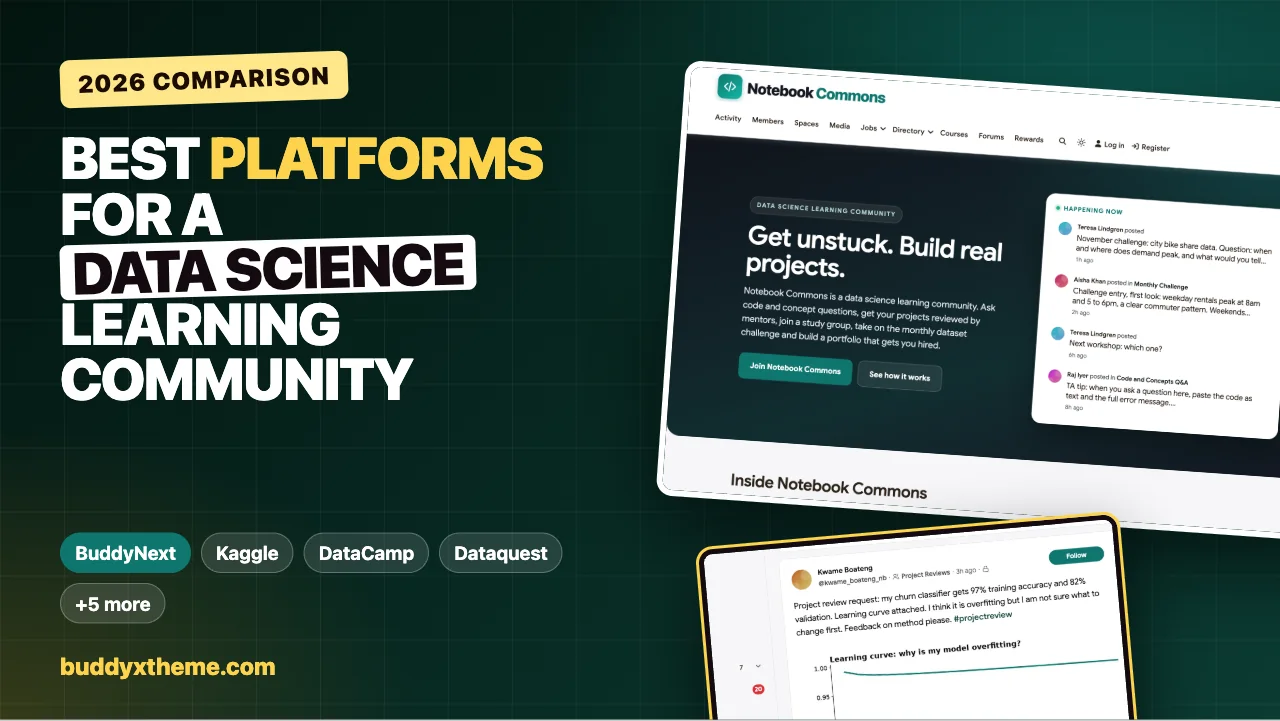
A data science learning community is where learners get unstuck: they post the code and the error, a mentor or another learner answers, and the answer stays for the next person. Around that sit project reviews, study groups, a monthly dataset challenge, office hours and, eventually, a portfolio and a job. This guide compares the platforms data science educators, bootcamps, university programs and company academies use to run that kind of community. We built a working data science community for the first entry and checked every competitor claim on the vendor’s own pages in November 2026.
Quick answer
If you teach data science and want a learning community you own, BuddyNext is the strongest choice: a code and concepts Q&A with code blocks and accepted answers, private project reviews with charts, a study group, a monthly dataset challenge, office hours as events, a project-based course, a career lab and a job board, all on your own website. Kaggle and Analytics Vidhya are the big public competition communities, DataCamp, Dataquest and Maven Analytics teach with their own courses, DataTalks.Club and Hugging Face are open practitioner communities, and Circle and Discord are general community options.
In this guide
- Why data science learners need a community
- Learning platforms, open communities or your own community?
- The data science learning community scorecard
- 1. BuddyNext: best for a data science learning community you own
- 2. Kaggle: best for public competitions and notebooks
- 3. DataCamp: best for interactive data courses
- 4. Dataquest: best for project-based courses with a forum
- 5. Maven Analytics: best for analytics skills and a project showcase
- 6. DataTalks.Club: best open practitioner community
- 7. Hugging Face: best for the machine learning model community
- 8. Analytics Vidhya: best for hackathons and a large learner audience
- 9. Circle: best hosted community with courses and events
- 10. Discord: best for real-time chat and voice
- Making the Q&A work
- Running project reviews that teach
- Choosing datasets for a monthly challenge
- Questions to ask before you choose
- A 30-day launch plan
- Which platform fits your data science community?
- More community platform comparisons
- How we built and checked this list
- Frequently asked questions
- The bottom line
Why data science learners need a community
Demand for the skill is strong. The US Bureau of Labor Statistics says “Employment of data scientists is projected to grow 35 percent from 2025 to 2035, much faster than the average for all occupations,” with “About 24,800 openings for data scientists” projected each year (BLS). O*NET OnLine counts “275,600 employees” in the role in 2025 and gives it a “Bright Outlook” (O*NET OnLine).
That demand pulls in a wide mix of learners: graduates, analysts moving up from spreadsheets, career changers from nursing, accounting and logistics, product managers who want to read their own data, and researchers adding Python to R. They learn from courses and tutorials, but courses cannot answer the question about their own data. A community can.
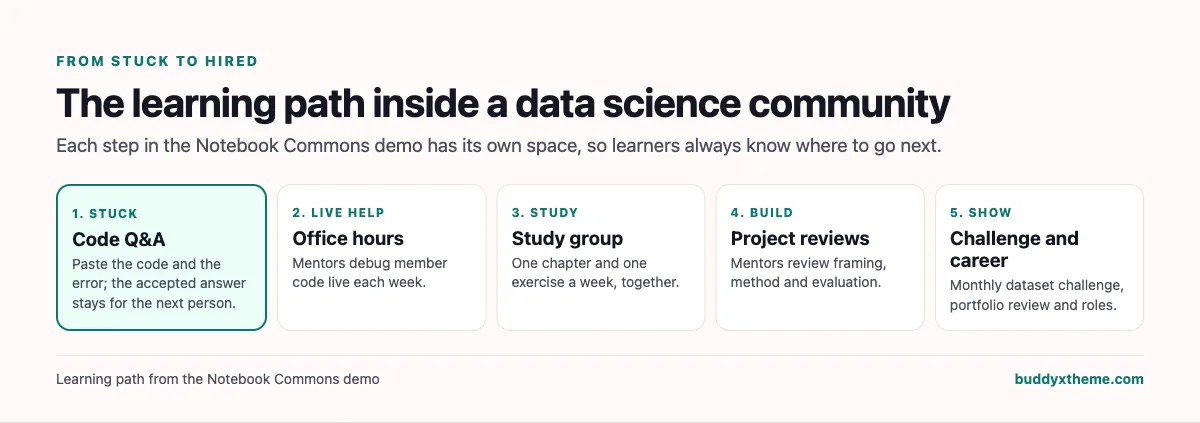
| What learners need | Why it matters | What the platform needs |
|---|---|---|
| Answers to code questions | A single error can stop a learner for a week | Q&A with code blocks and accepted answers |
| Live help | Some problems are faster to debug together | Office hours as events, recorded |
| Structure | Self-study stalls without a schedule | Study groups with weekly exercises |
| Feedback on projects | A model can be wrong in ways the score does not show | Private project reviews with charts |
| Practice on real data | Toy datasets do not prepare anyone for messy data | A monthly dataset challenge |
| A path to a job | Portfolios matter more than certificates | Portfolio reviews, a career space and a job board |
Learning platforms, open communities or your own community?
Data science learners already use several kinds of platform. They solve different problems.
| Kind | What it does | Examples |
|---|---|---|
| Competition and practice communities | Public competitions, notebooks and discussions | Kaggle, Analytics Vidhya |
| Course platforms with community | Structured lessons, projects and a learner forum | DataCamp, Dataquest, Maven Analytics |
| Open practitioner communities | Models, datasets, events and chat for working practitioners | Hugging Face, DataTalks.Club |
| Community platforms you run | Your own Q&A, reviews, study groups, events and jobs | BuddyNext, Circle, Discord |
An educator, bootcamp or company academy usually wants the last kind for its own learners, while those learners keep using Kaggle for competitions and Hugging Face for models.
The data science learning community scorecard
How each option handles what matters most. “Not found” means we could not confirm it on the vendor’s own pages, not that it is impossible.
| Platform | Code Q&A | Project reviews | Study groups and office hours | Challenges | Courses | Job board | Your own brand |
|---|---|---|---|---|---|---|---|
| BuddyNext | Code blocks, accepted answers | Private space with charts | Private groups, events | Monthly challenge space | Yes, with certificates | Yes | Yes, on your site |
| Kaggle | Discussions | Public notebook comments | Not found | Competitions | Learn courses | Not found | No |
| DataCamp | Not found | Not found | Not found | Competitions | Yes, certifications | Not found | No |
| Dataquest | Community Q&A | Community replies | Not found | Code challenges | Yes, projects | Not found | No |
| Maven Analytics | Community forum | Showcase | Not found | Guided projects | Yes, credentials | Not found | No |
| DataTalks.Club | Slack | Not found | Weekly events | Course challenges | Yes | Not found | No |
| Hugging Face | Forums | Not found | Not found | Not found | Not found | Not found | No |
| Analytics Vidhya | Not found | Not found | Not found | Hackathons, leaderboard | Programs | Not found | No |
| Circle | Posts and comments | Not found | Live events | Not found | Yes | Not found | Yes |
| Discord | Chat | Not found | Voice chat | Not found | Not found | Not found | Yes |
1. BuddyNext: best for a data science learning community you own
BuddyNext is a complete community platform that runs on your own WordPress site. Open, private and secret spaces, Q&A with code blocks and accepted answers, image and file posts, events, courses with certificates, a job board, direct messages, polls, points and leaderboards, and paid memberships work together. A data science educator can run Q&A, project reviews, study groups, challenges, office hours and careers in one community under their own name.
To show it in practice, we built Notebook Commons, a demo data science learning community run by a data scientist and educator in Stockholm. It has 20 members: a marketing analyst learning Python, a physics graduate moving into machine learning, a nurse building a healthcare analytics portfolio, an accountant learning forecasting, a product manager learning SQL, a biologist adding Python to R, a maths teacher learning statistics, a sports analytics hobbyist, a self-taught logistics planner, a bootcamp graduate job hunting, an NLP PhD student, a teaching assistant, a study group lead, mentors in data science, data engineering and ML engineering, a career coach and a hiring manager from a partner company.
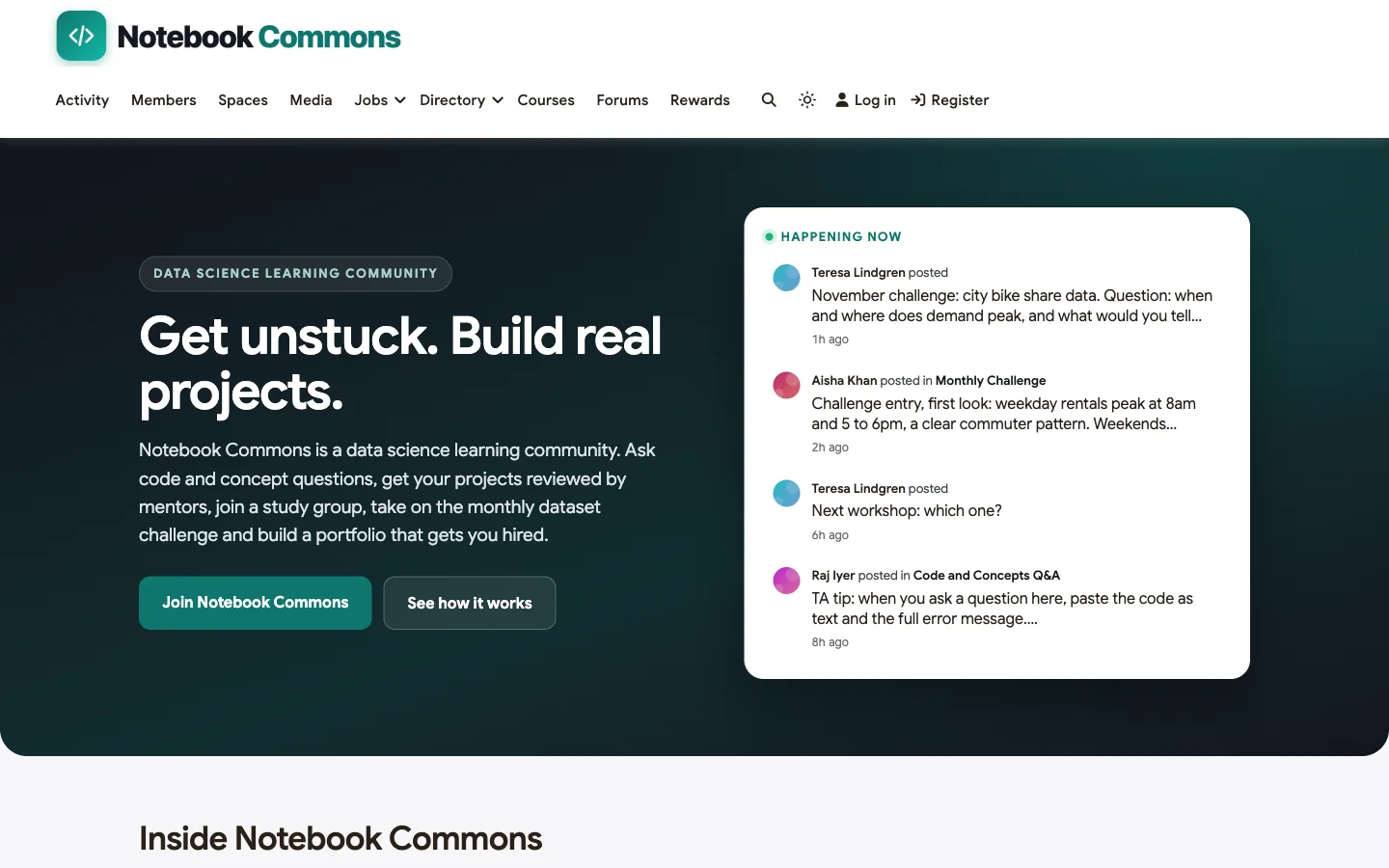
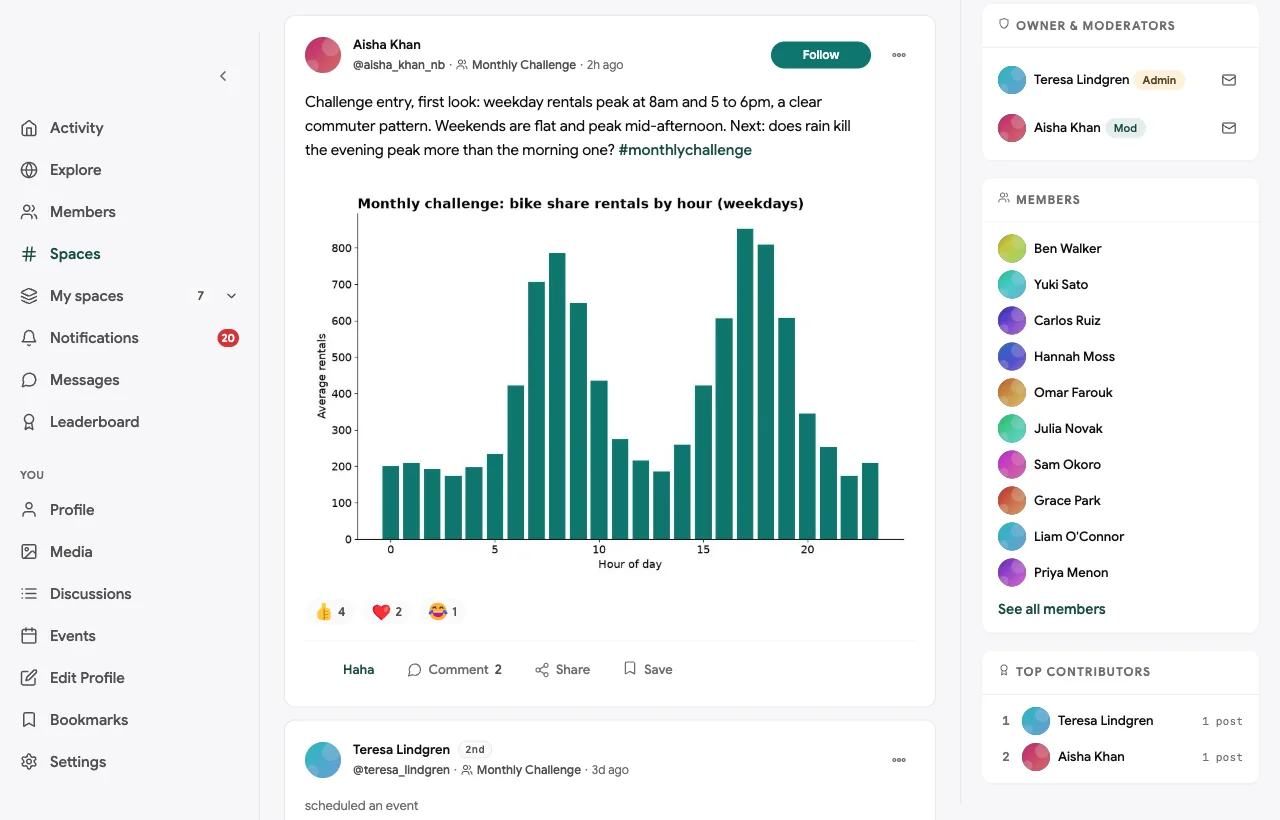
The homepage shows the community working: this month’s bike share challenge, a member’s first look at the data, the poll for the next workshop and a teaching assistant’s tip on asking questions.
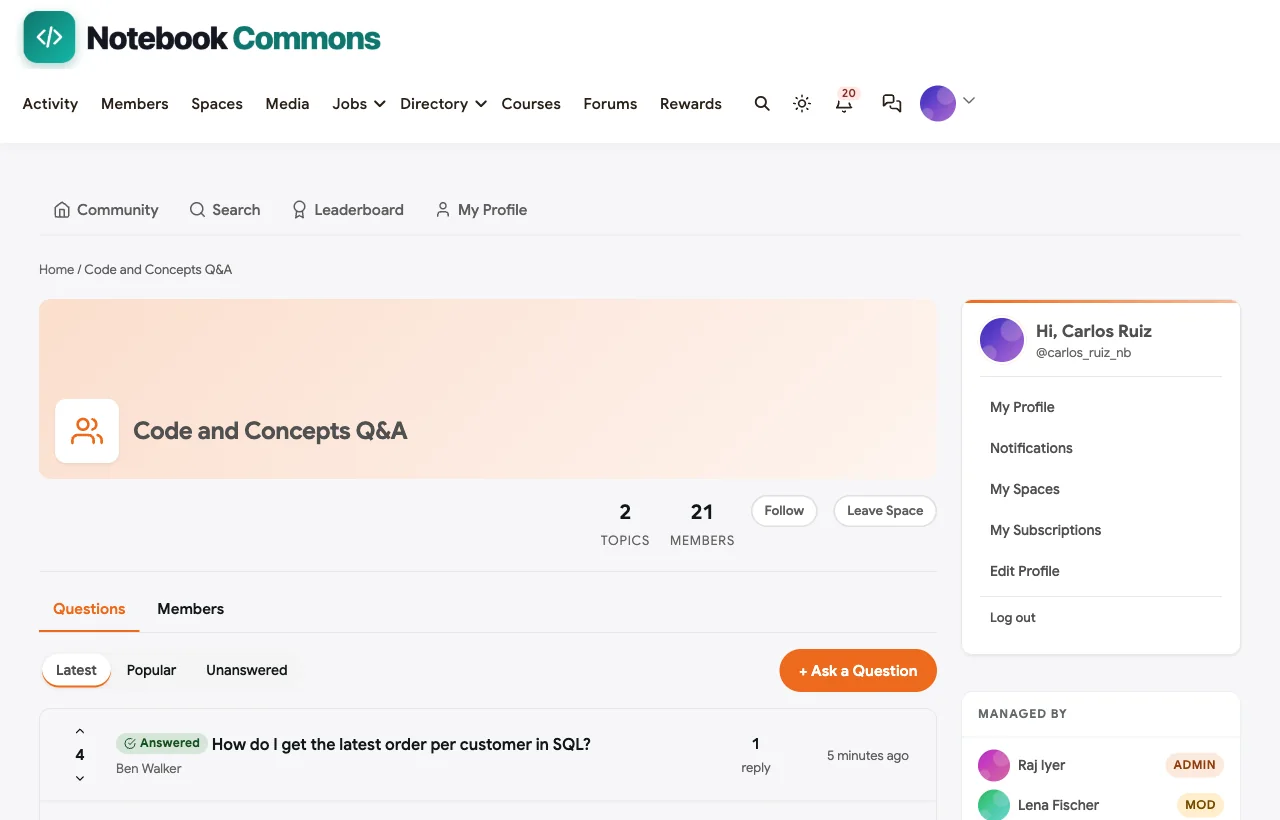
Code and Concepts Q&A
The Q&A space is the centre of the community. Members post the code and the full error as text, in code blocks, and the best answer is marked accepted so it stays at the top for the next person with the same problem.
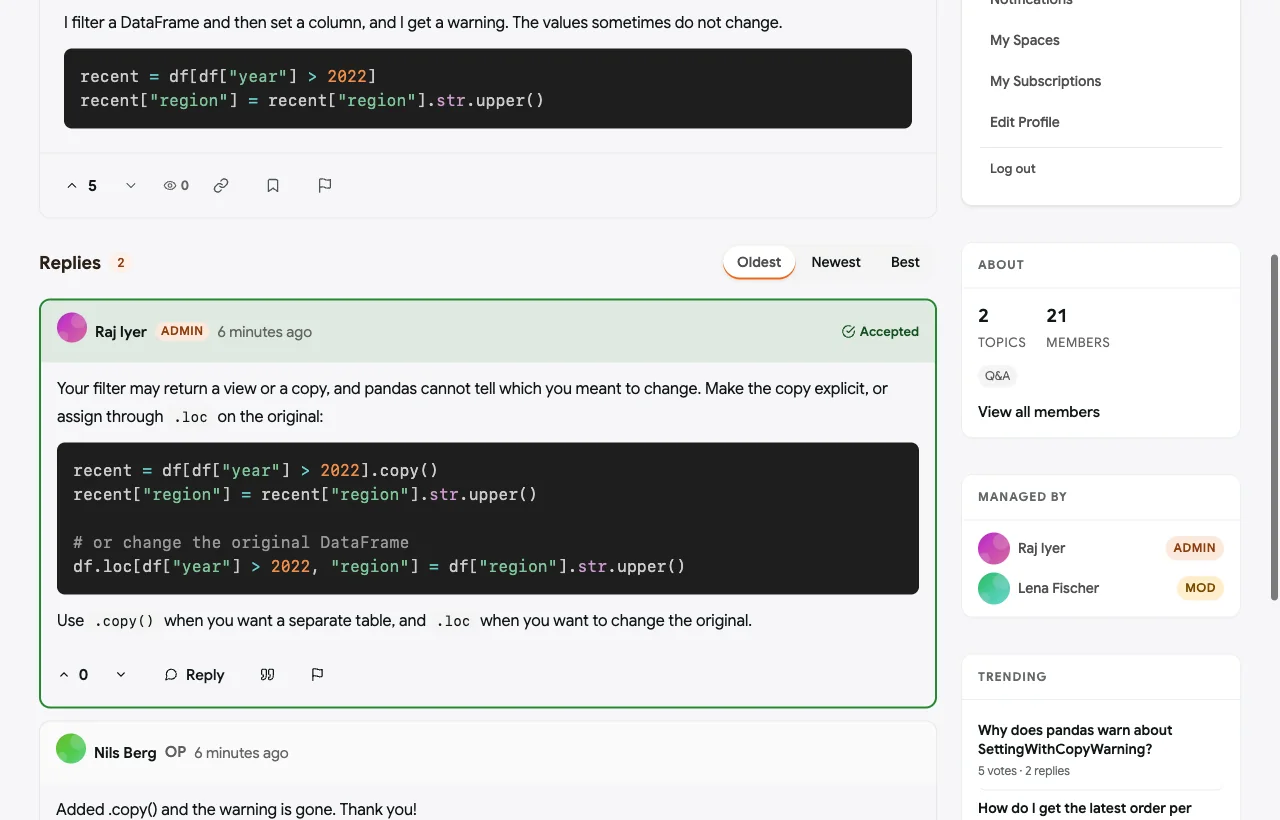
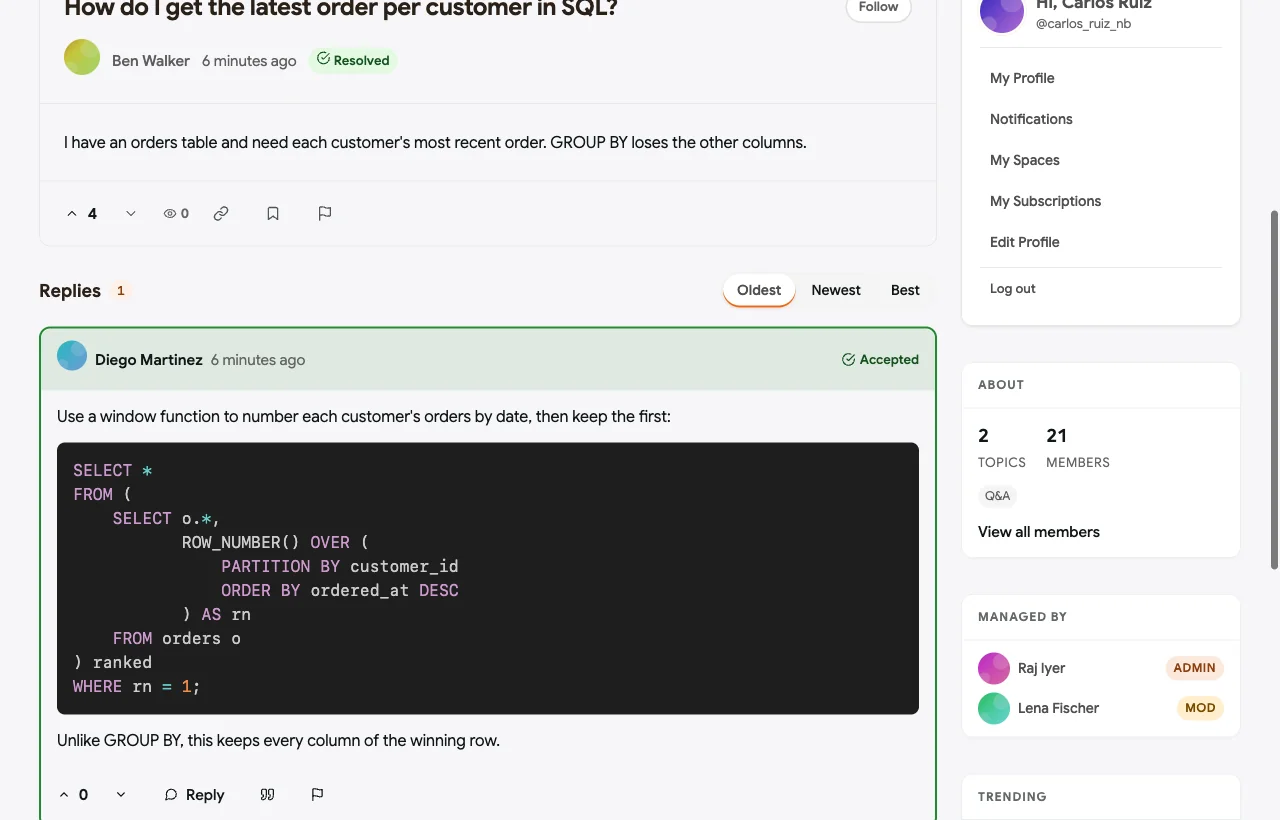
A self-taught member asks why pandas warns about SettingWithCopyWarning. The teaching assistant explains that a filter may return a view or a copy, and shows two fixes in code: make the copy explicit, or change the original with .loc. The member replies that the warning is gone. A product manager asks how to get each customer’s latest order without losing columns, and a data engineer answers with a ROW_NUMBER() window function. Both answers will help dozens of future learners.
Project Reviews
Project Reviews is a private space. Members post a project with charts and say what feedback they want: framing, method, evaluation or presentation. Mentors and peers review it.
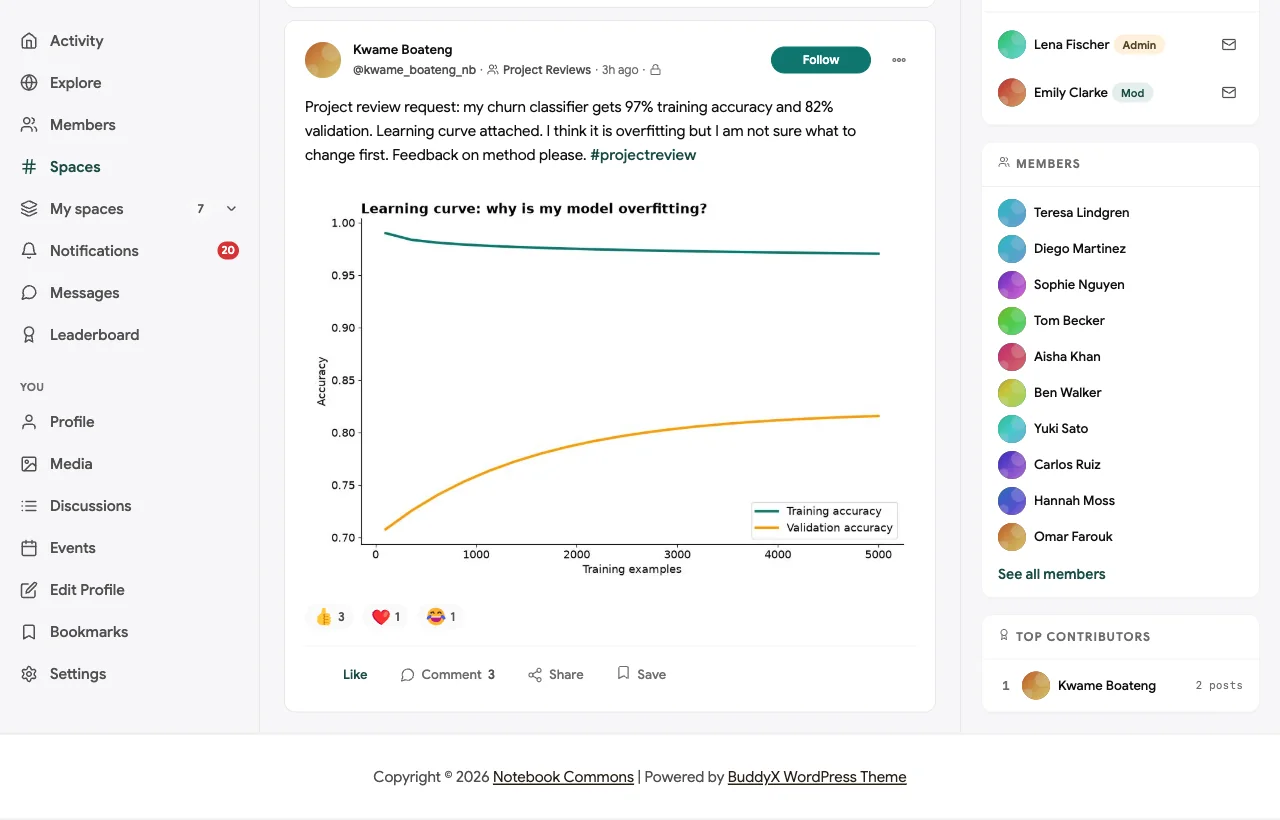
A physics graduate posts a churn classifier with a learning curve: 97% training accuracy and 82% validation. A senior data scientist calls it classic overfitting and asks the question that matters: is anything computed after the churn date? An ML engineer adds that more data alone will not close the gap. The member finds the problem, a “last activity” column calculated after cancellation, and removes it.
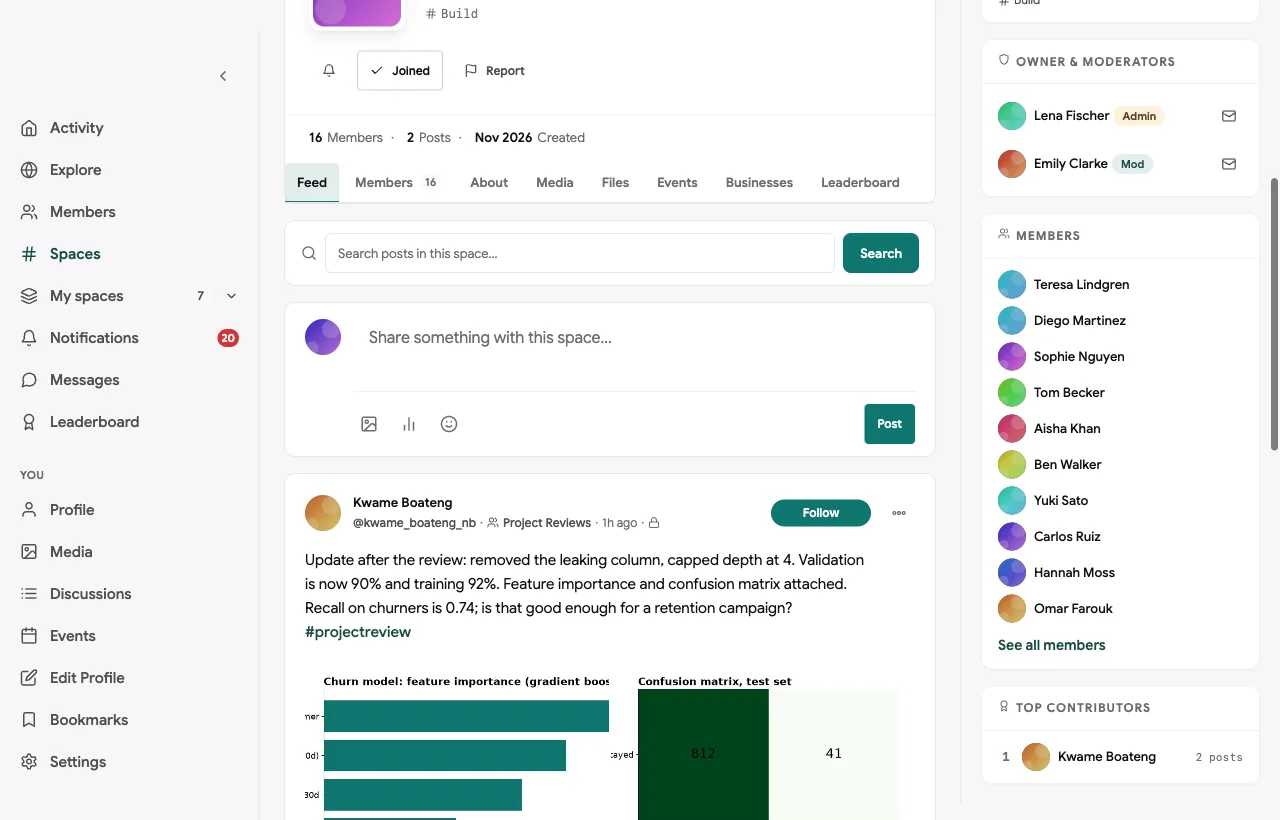
The follow-up post shows the healthier model, with a feature importance chart and a confusion matrix. The mentor’s last note turns it into a business decision: whether 0.74 recall on churners is enough depends on the cost of a missed churner versus a wasted offer. The host suggests the before-and-after as a portfolio page. That thread is a better data science lesson than most course modules, and it only happens in a community.
The ML Study Group
The study group is a private space with a weekly rhythm: one chapter, one exercise and a short discussion, scheduled as events. This week is regularisation, with an exercise that ends in a one-paragraph explanation, because explaining a method in plain words is how you find out whether you understand it.

The monthly dataset challenge
Each month the host picks a public dataset and a real question. Members post their analysis, vote for the best write-up and present at a show and tell. The emphasis is on the question, not the leaderboard: “Charts plus three sentences beat a 40-cell notebook.”
Office hours
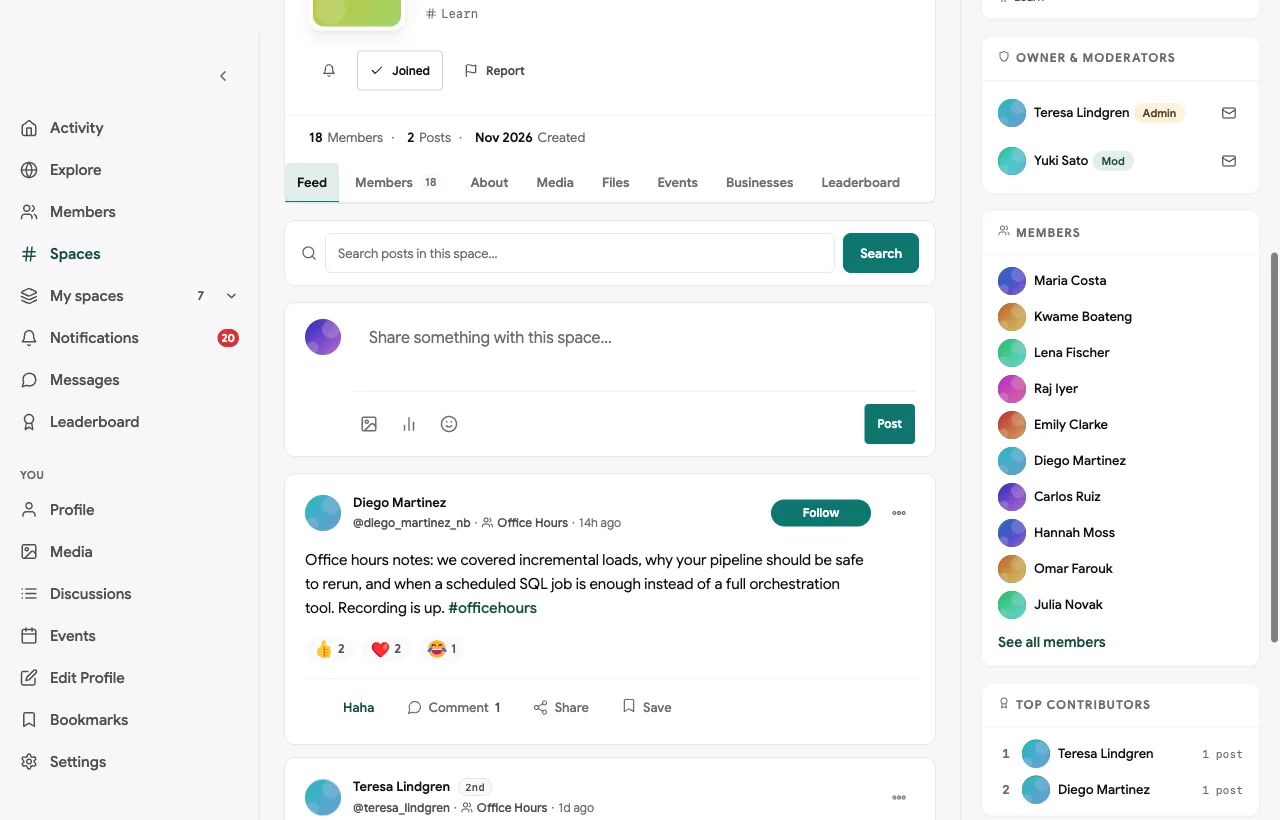
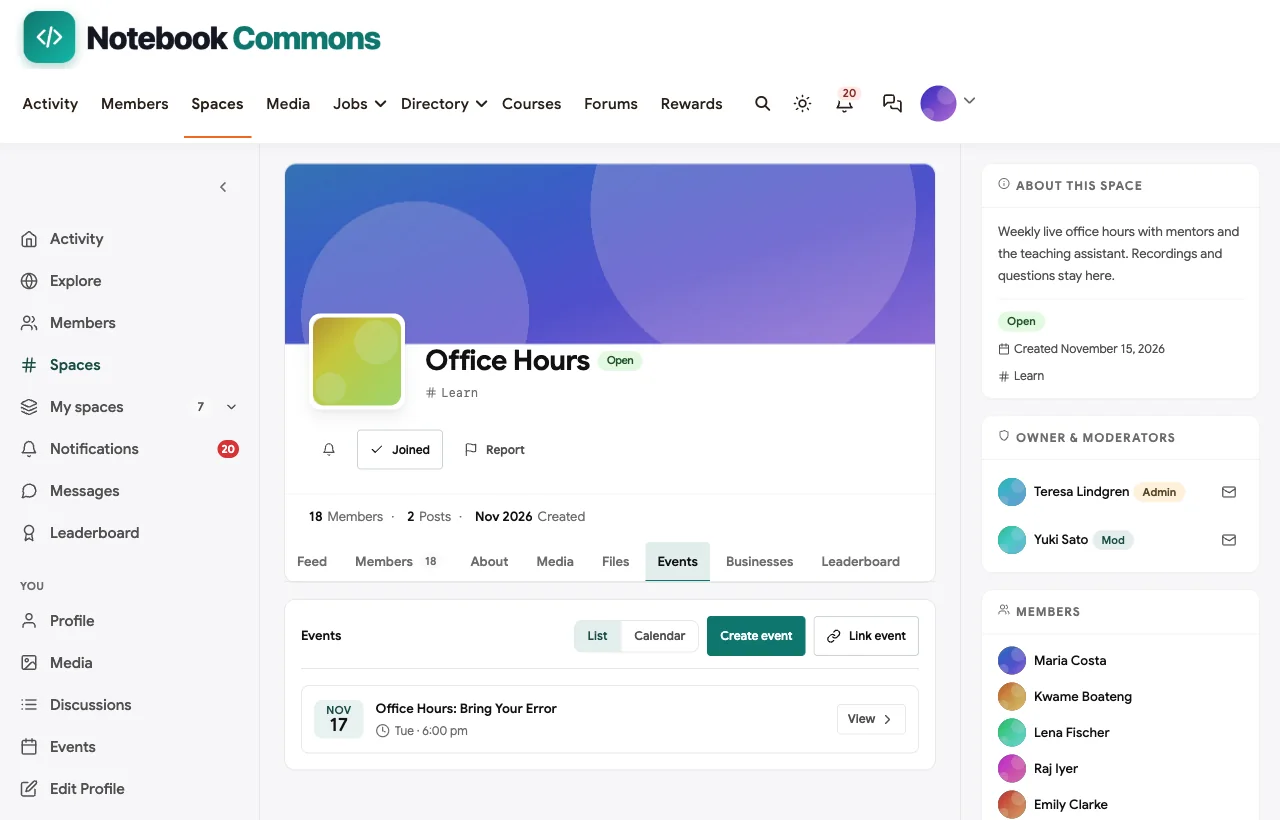
Some problems are faster to solve live. Office hours are weekly events where mentors and the teaching assistant debug member code, with recordings and notes kept in the space.
The course
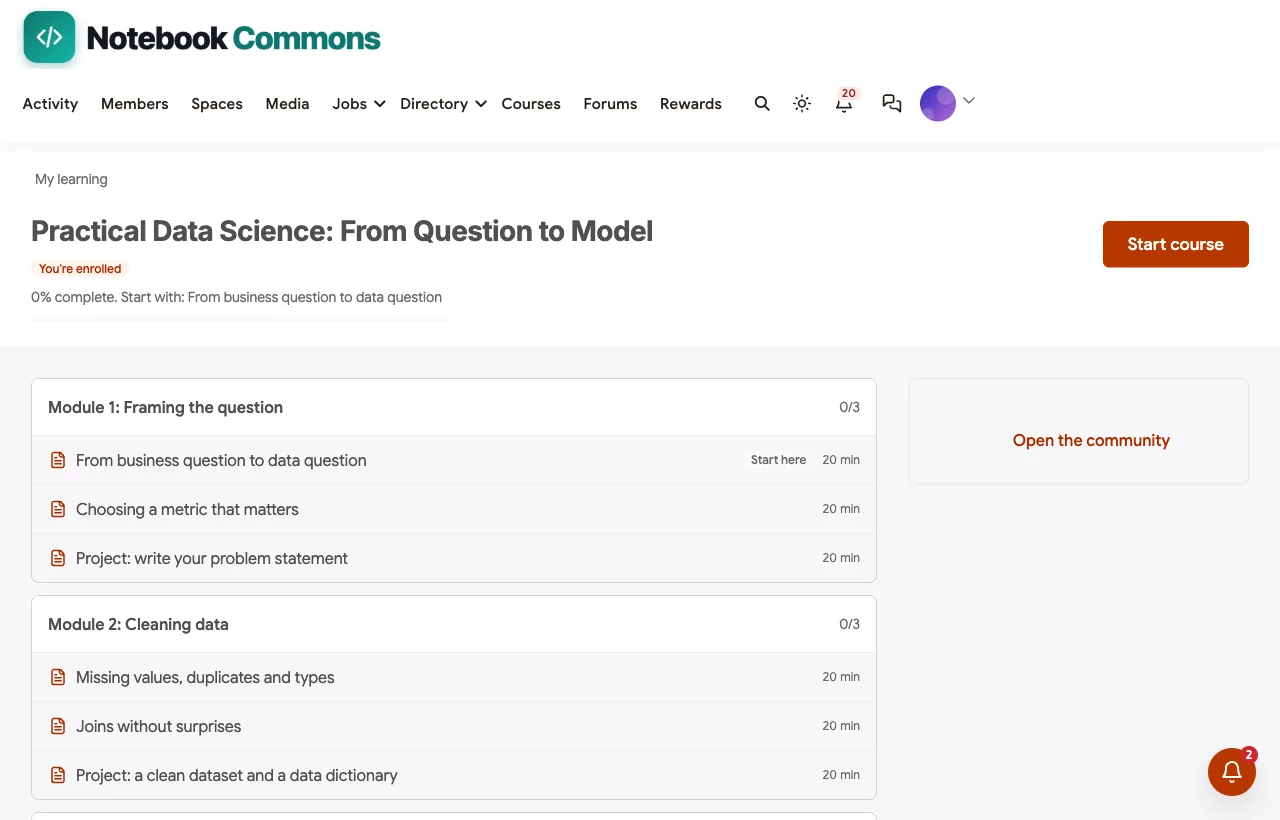
Practical Data Science: From Question to Model is a six-module course built around one end-to-end project: framing the question, cleaning data, exploring, modelling, evaluating and communicating. Each module ends with a notebook posted to Project Reviews.
Career Lab and the job board
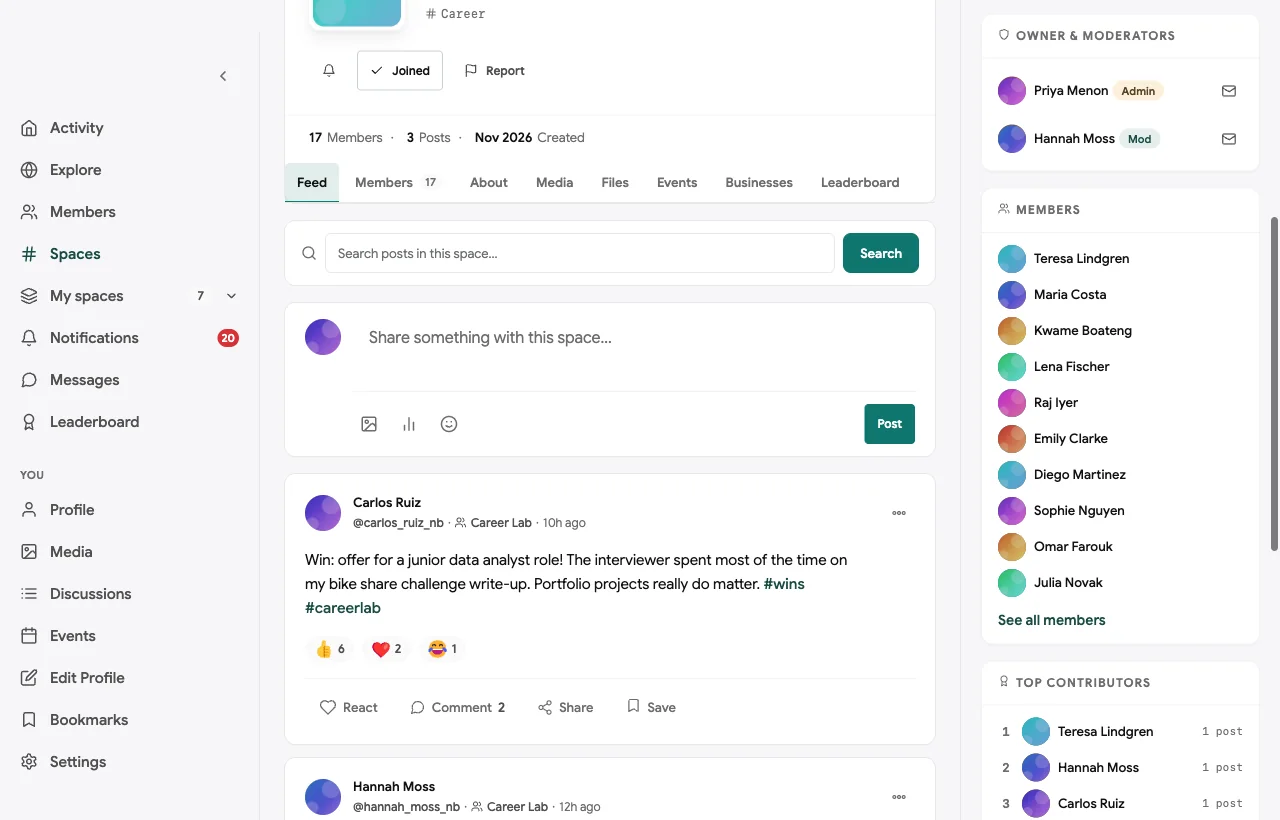
The Career Lab is where projects turn into jobs. A hiring manager from a partner company explains what she reads first in a portfolio (the README: the question, the data, what you found and what you would do next), and the bootcamp graduate posts his offer: the interviewer spent most of the time on his challenge write-up.

Course requests and the roadmap
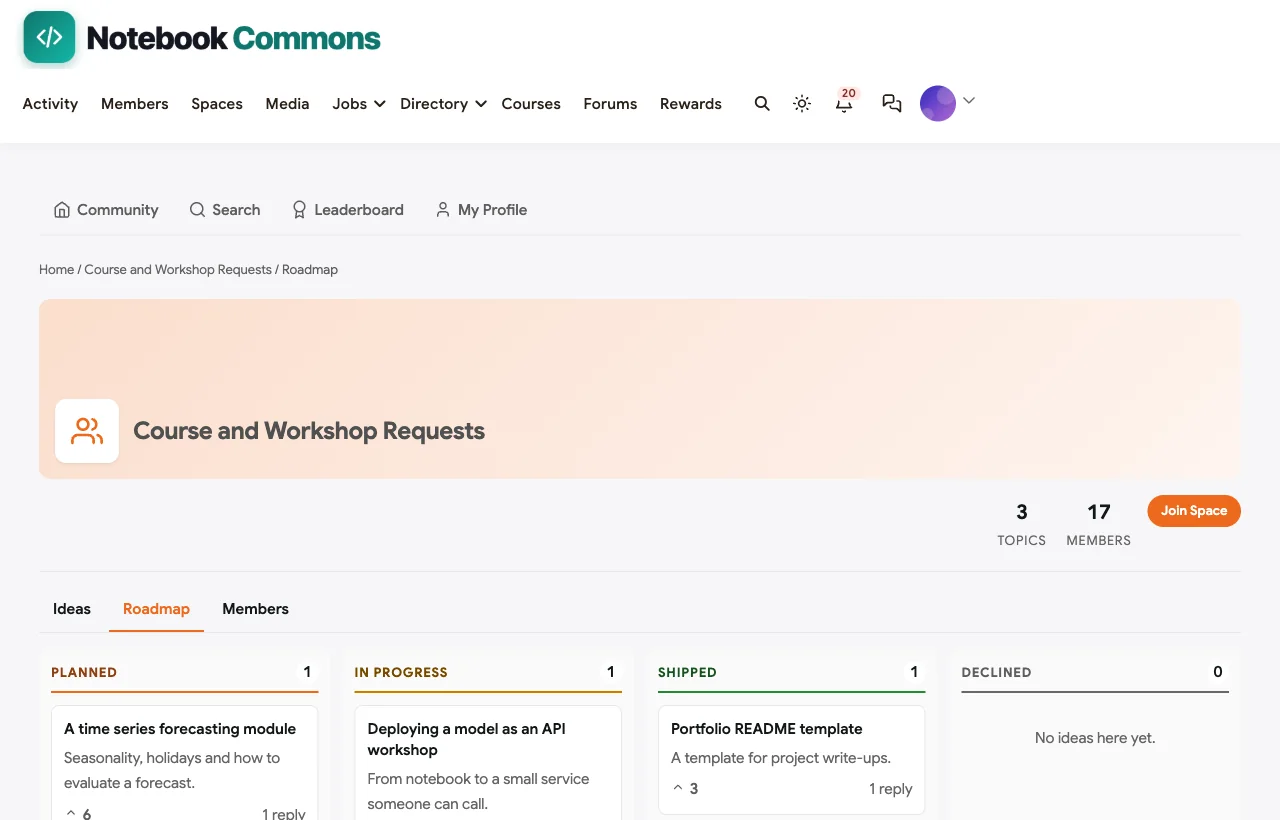
Members suggest modules and workshops and vote. The host marks ideas as planned, in progress or shipped.
Members, messages and recognition
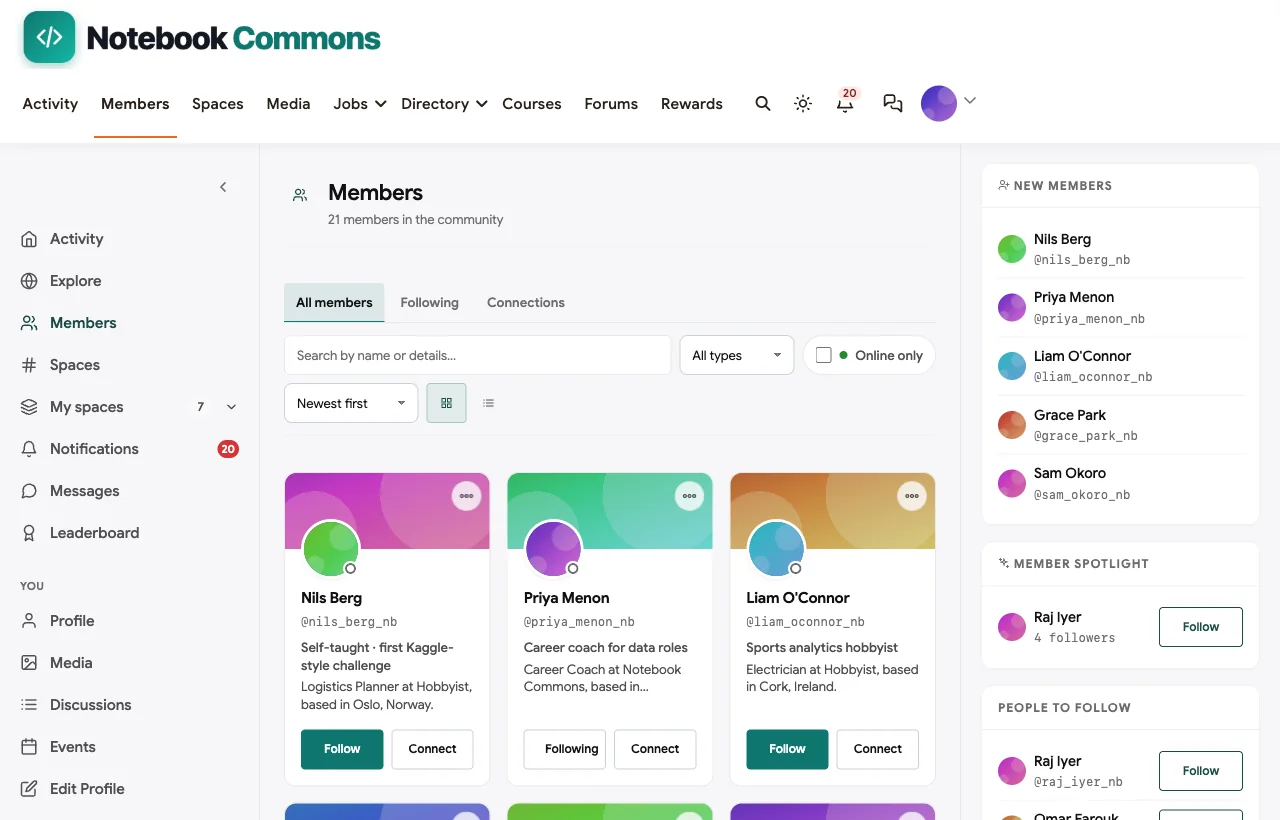
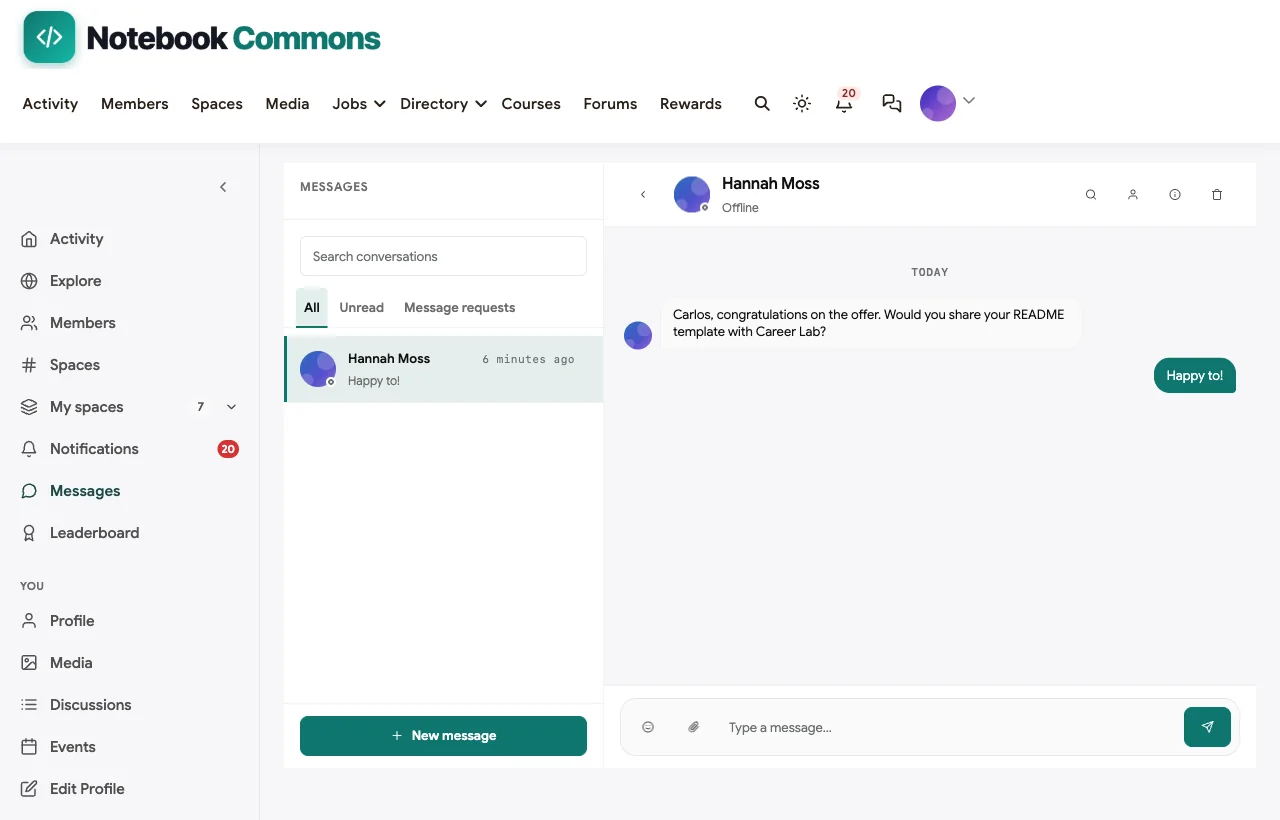
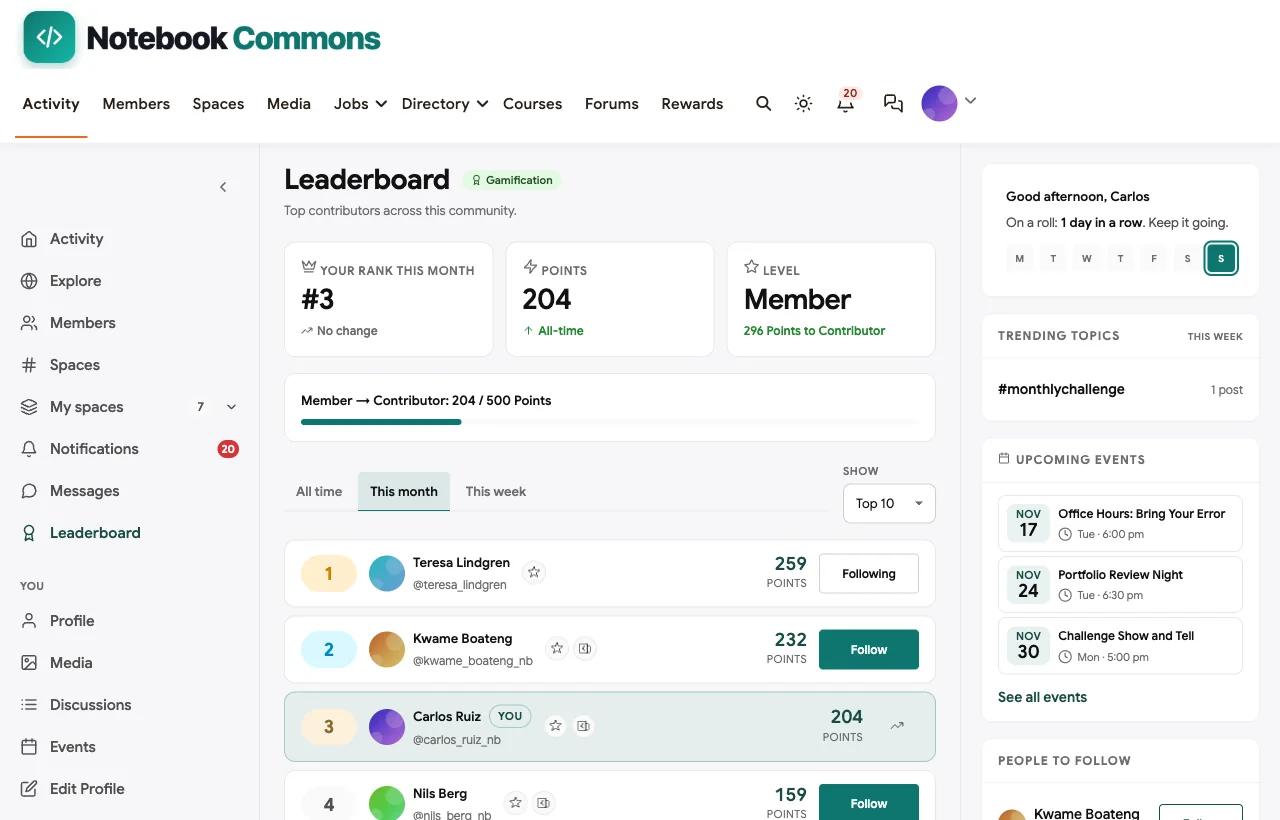
Points and a leaderboard reward the behaviour a learning community runs on: answering other people’s questions and reviewing their projects.
On a phone
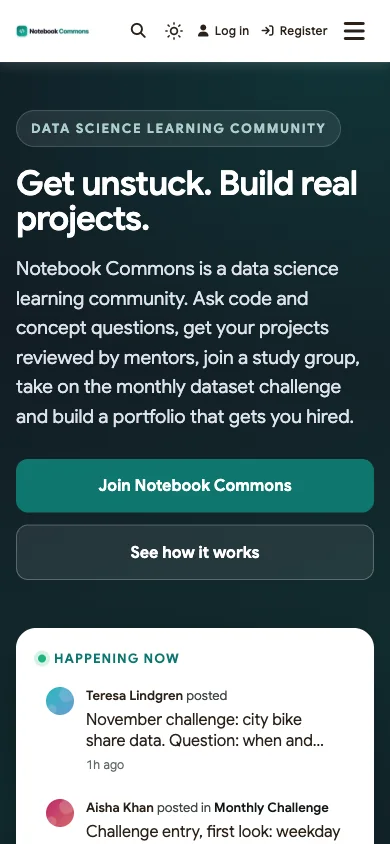
The whole community works in the mobile browser without an app download, which is how most people read answers on the train.
Also built in. Polls, hashtags, a member directory, notifications, moderation and reporting, profile fields for skills, points and badges, and paid memberships with trials and coupons.
Not built for: running code. There is no notebook environment, no GPU and no automatic grading of submissions. Members run code in Jupyter, Colab or Kaggle and post code, results and charts to the community. Scored competitions with hidden test sets are Kaggle’s territory. It is self-hosted, so you run WordPress or use a managed host.
What’s included, and how it is delivered
BuddyNext is one platform made of a core and add-on platform modules. Everything shown in the demo above runs on the BuddyNext platform. This table shows which parts come with the core, which are platform modules you install and activate alongside it, and which need a third-party plugin, another system or custom work.
| Capability | How it is delivered |
|---|---|
| Open, private and secret spaces for Q&A, reviews and study groups | Core platform |
| Activity feed, pinned announcements, polls and hashtags | Core platform |
| Member profiles with skills and a directory | Core platform |
| Reporting and moderation queue | Core platform |
| Chart and image posts | Platform module, installed alongside |
| Direct messages | Platform module, installed alongside |
| Code Q&A with code blocks, accepted answers and a roadmap | Platform module, installed alongside |
| Office hours, study sessions and show and tell as events | Platform module, installed alongside |
| Project-based course with certificates | Platform module, installed alongside |
| Job board | Platform module, installed alongside |
| Points, badges and leaderboards | Platform module, installed alongside |
| Paid memberships with trials and coupons | Platform module, installed alongside |
| Running notebooks and code | Another system (Jupyter, Colab, Kaggle) |
| Live video for office hours | Third-party video tool (Zoom, Google Meet) |
Want to click around yourself? The Notebook Commons community in this guide was built on a private test site, so it is not public. The BuddyNext live demo is a general community you can open in your browser and explore without installing anything.
2. Kaggle: best for public competitions and notebooks
Kaggle calls itself “The World’s AI Proving Ground” (Kaggle), with “AI Competitions and Hackathons,” “AI and Machine Learning Discussions,” the ability to “Run AI & ML Code Online” and short courses to “Learn Python, Data Viz, Pandas & More” (Kaggle Learn).
Strengths: the best place for scored competitions, public notebooks and datasets.
Gaps: a public community you join, not one you run; no study groups, office hours or job board found. Many educators send learners to Kaggle for competitions and keep their own community for everything else.
3. DataCamp: best for interactive data courses
DataCamp promises you can “Learn Data Science & AI from the comfort of your browser, at your own pace with DataCamp’s video tutorials & coding challenges” (DataCamp). “Short videos are broken up by interactive exercises,” learners can “Earn a certification built around real job skills” (DataCamp), and competitions let them “test your knowledge and get hands-on data science experience” (DataCamp).
Strengths: polished, interactive courses and certifications.
Gaps: no discussion forum or Q&A community found; no study groups, office hours or job board found.
4. Dataquest: best for project-based courses with a forum
Dataquest teaches “through hands-on practice, real-world projects, and career paths built for the job market” (Dataquest), and says “You build real projects with messy data that you can push to GitHub.” Its community invites learners to “Post technical questions and get solutions” (Dataquest Community).
Strengths: projects on messy data and an active learner forum.
Gaps: the community serves Dataquest’s own courses; no office hours or job board found.
5. Maven Analytics: best for analytics skills and a project showcase
Maven Analytics helps learners “Build Future-Proof Data & AI Skills” with “Curated paths,” “Guided Projects,” “Credentials & badges” and a Showcase to “Showcase your work and connect with top data experts” (Maven Analytics).
Strengths: strong analytics courses and a place to show finished projects.
Gaps: no office hours, study groups or job board found.
6. DataTalks.Club: best open practitioner community
DataTalks.Club is “The place to talk about data,” a “Global online community of data science professionals, ML engineers, and AI practitioners” (DataTalks.Club). Members “join our Slack,” attend “weekly events” and “Ask career questions and discuss career options.”
Strengths: an active practitioner community with regular events and courses.
Gaps: Slack-based, so answers scroll away; it is their community, not yours.
7. Hugging Face: best for the machine learning model community
Hugging Face is “The AI community building the future” and “The platform where the machine learning community collaborates on models, datasets, and applications” (Hugging Face). It runs community forums at discuss.huggingface.co and says “More than 400,000 organizations are using Hugging Face.”
Strengths: the hub for models and datasets, with forums for ML practitioners.
Gaps: built for sharing models, not teaching a cohort; no study groups, office hours or job board found.
8. Analytics Vidhya: best for hackathons and a large learner audience
Analytics Vidhya is “Building Next-Generation AI Professionals” through “in-depth blogs, world class courses, exciting hackathons & a thriving community” (Analytics Vidhya). Its hackathons let learners “Tackle challenges, refine skills, and rise up the leaderboard” (DataHack).
Strengths: hackathons with leaderboards and a large content library.
Gaps: a public platform you join; no office hours, private reviews or job board found.
9. Circle: best hosted community with courses and events
Circle helps you “Build a home for your community, events, and courses - all under your own brand,” with “Posts and comments with rich media” and the ability to “host live events, and launch your course” (Circle).
Strengths: a polished hosted community with courses and events.
Gaps: no Q&A with accepted answers, challenge setup or job board found.
10. Discord: best for real-time chat and voice
Discord lets you “Customize your own space to talk, play, and hang out” and “Easily hop in and out of voice or text chats without having to call or invite anyone” (Discord).
Strengths: fast chat and voice rooms that learners already know.
Gaps: answers scroll away in chat, so the same questions get asked every week; no courses, accepted answers or job board.
Making the Q&A work
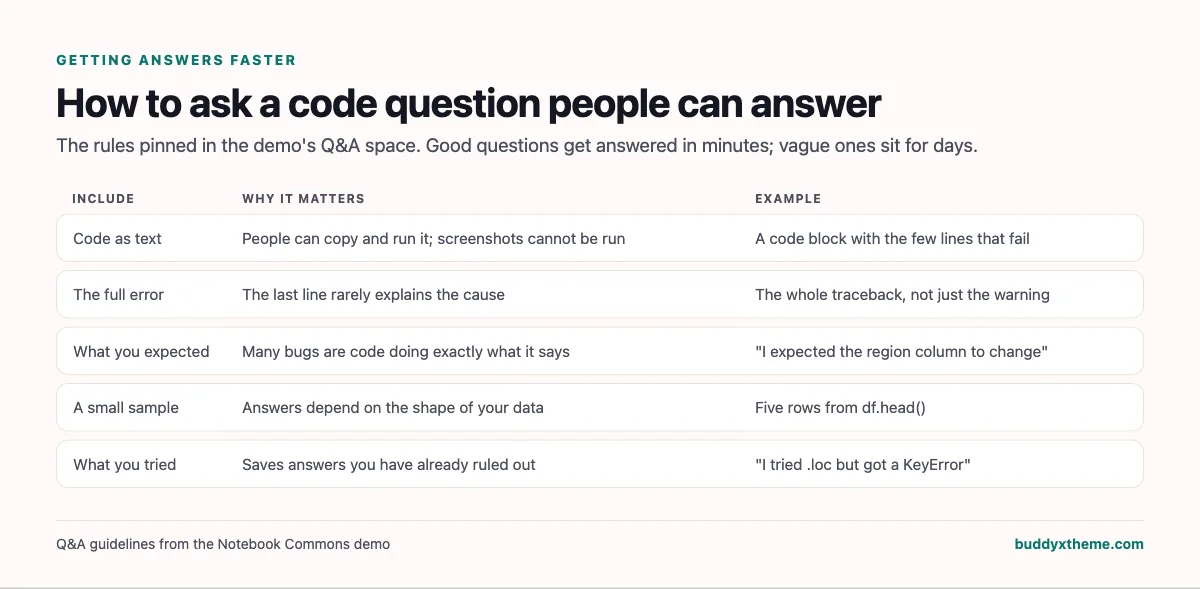
A data science Q&A lives or dies on question quality. Three habits make it work:
- Pin the asking rules. Code as text, the full error, what you expected, a small sample and what you tried. Good questions get answers in minutes.
- Mark accepted answers. It rewards the person who answered and saves the next learner from asking again.
- Seed with your TAs. For the first months, teaching assistants answer within a day. Once members see questions get answered, they start answering each other.
Running project reviews that teach
Reviews are where learners make the jump from “my code runs” to “my analysis is right”. Ask members to say what kind of feedback they want, and ask reviewers to start with framing and evaluation before style. The most valuable review questions are rarely about code: what is the baseline, is anything leaking from the future, and what decision does this model support?
Choosing datasets for a monthly challenge
A good challenge dataset is messy enough to teach something and small enough to finish in a month of evenings. These guidelines keep challenges useful:
- Start with a question, not a dataset. “When and where does demand peak, and what should the operator do?” produces better work than “here is some bike data”.
- Prefer public, documented data. City open data portals, government statistics and well-known public datasets have clear licences and data dictionaries.
- Leave room for a join. Weather, holidays or demographics joined to the main table is where learners practise real cleaning.
- Judge the write-up, not the score. Ask for charts and three sentences of conclusions. Communicating results is the skill most portfolios lack.
- Show and tell at the end. Five short presentations teach the whole community more than reading fifty notebooks.
Rotate the difficulty from month to month, so beginners can finish one and advanced members still learn from the next.
Questions to ask before you choose
- Do you want your own community, or to send learners to someone else’s? Kaggle, DataTalks.Club and Hugging Face are communities you join.
- Can members post code properly? Look for code blocks, not just chat.
- Do answers stay findable? Q&A with accepted answers beats a chat channel for repeated questions.
- Can you review projects privately? Learners share rough work only in private spaces.
- Is there a path to jobs? A career space, portfolio reviews and a job board.
- Where does code run? Usually in notebooks elsewhere; the community is where people talk about it.
A 30-day launch plan
- Week one: foundations. Create Start Here, Code and Concepts Q&A and Project Reviews, and pin the asking rules.
- Week two: rhythm. Start weekly office hours and the first study group.
- Week three: practice. Launch the first monthly dataset challenge with a real question.
- Week four: careers. Open Career Lab, invite a hiring partner and post the first roles.
Which platform fits your data science community?
| If you… | Choose |
|---|---|
| Want Q&A, project reviews, study groups, challenges, office hours and jobs in a community you own | BuddyNext |
| Want scored public competitions and notebooks | Kaggle or Analytics Vidhya |
| Want ready-made interactive courses | DataCamp, Dataquest or Maven Analytics |
| Want an open practitioner community | DataTalks.Club or Hugging Face |
| Want a general hosted community | Circle |
| Only need chat and voice | Discord |
More community platform comparisons
Running a different kind of technical or learning community? These guides use the same method: a working demo community and vendor claims checked at the source.
- Best software for a coding bootcamp community: cohorts, code review and career support.
- Best platforms for an AI agent developer community: builders, showcases and technical Q&A.
- Best platforms for a no-code developer community: builds, templates and help.
- Best platforms for cohort-based learning: live, dated courses with peer pods.
- How to set up a community space on WordPress: the step-by-step setup guide behind every demo in this series.
How we built and checked this list
We built the Notebook Commons demo on a local WordPress site running BuddyNext, with fictional learners, mentors, a course, challenges and roles created for this guide. The charts in the demo were generated from illustrative data. Every BuddyNext screenshot is from that demo. Competitor features were checked against each vendor’s own website in November 2026, and the employment figures come from the US Bureau of Labor Statistics and O*NET OnLine. We left out Towards Data Science because its website blocked our checks, and Codecademy because its data science community features were thinner than the platforms listed. Where we could not confirm a feature on a vendor’s own pages, the scorecard says “Not found”. We did not run a hands-on trial of every product, so features can change; confirm anything critical with the vendor. buddyxtheme.com is published by the team behind BuddyNext, which is why BuddyNext is listed first; we have tried to be fair about its gaps as well as its strengths.
Frequently asked questions
What is the best platform for a data science learning community?
BuddyNext is the best choice for a data science learning community you own, with code Q&A and accepted answers, private project reviews, study groups, a monthly challenge, office hours, a course and a job board. Kaggle is the best public community for competitions.
Can members post code and charts?
Yes. In BuddyNext, Q&A answers support code blocks, and posts can carry chart images, so members can share code, errors and results.
Does the community run notebooks?
No. Members run code in Jupyter, Colab or Kaggle and bring code, results and charts to the community for help and review.
How do I run a data science study group online?
Pick a book or course, set one chapter and one exercise a week, meet at the same time as a recurring event and keep the group small and private.
How do I help learners get data science jobs?
Push portfolio projects with clear write-ups, run portfolio reviews with hiring managers and post roles from partner companies on a job board.
Is Discord or Slack enough for a data science community?
They are good for chat, but answers scroll away and repeated questions pile up. Q&A with accepted answers keeps solutions findable.
Can learners use the community on their phones?
BuddyNext works in the mobile browser without an app download.
The bottom line
Data science is learned by getting stuck and getting unstuck, many times. If you want Q&A, project reviews, study groups, challenges, office hours and jobs in a community you own, BuddyNext is the strongest foundation, with notebooks and Kaggle alongside for running code and competing. For ready-made courses, DataCamp and Dataquest lead.
And make sure nobody on your course debugs alone at 11pm.