
AI agent developers ask harder questions than most communities can handle. “Why does my agent loop on the same tool call?” needs code, a version number, a trace and someone who has seen it before. “Is my agent safe to give email access?” needs an expert, not a chat reaction. And the answers change every few months as frameworks ship new releases. A community for agent builders has to keep good answers findable, show the roadmap honestly, celebrate what people build and stay free of the low-effort, AI-generated posts that now flood every developer space.
This guide compares the platforms you can use to build that community, whether you maintain an open-source agent framework, run developer relations for an AI tooling company, organise a local agent builders meetup or run a paid mastermind for teams putting agents into production. We built a working agent developer community for the first entry, checked every competitor claim against the vendor’s own pages in November 2026, and looked at what the largest AI developer communities actually run on.
Quick answer
If you want an AI agent developer community you own and control, BuddyNext is the strongest choice: Q&A with syntax-highlighted code and accepted answers, a public ideas board and roadmap, a showcase space, private working groups, an integrations directory, a jobs board, office hours and hackathons, all on your own WordPress site. Discourse is the forum most major AI developer communities run on, GitHub Discussions suits a single open-source repo, and Discord is where real-time chat happens but answers are hard to find later.
In this guide
- Where AI agent developers gather today
- Why agent developer communities are different
- Chat, forum or repo: choosing the core
- 1. BuddyNext: best for an agent developer community you own
- 2. Discourse: best forum, and the choice of most AI developer communities
- 3. GitHub Discussions: best for a single open-source repository
- 4. Discord: best for real-time chat and voice
- 5. Zulip: best open-source chat for engineering communities
- 6. Slack: best when your users are enterprise teams
- 7. Hugging Face: best as an audience, with repo-level discussion
- 8. Circle: best for a paid agent-building course or mastermind
- 9. Bettermode: best hosted, branded community with APIs
- 10. Reddit: best as an audience to learn from
- AI agent developer community platforms compared
- Keeping AI-generated noise out
- Office hours, hackathons and the release rhythm
- Security belongs in the community
- The getting-started thread every agent community needs
- Measuring a developer community
- More community platform comparisons
- How we built and checked this list
- Frequently asked questions
- The bottom line
Where AI agent developers gather today
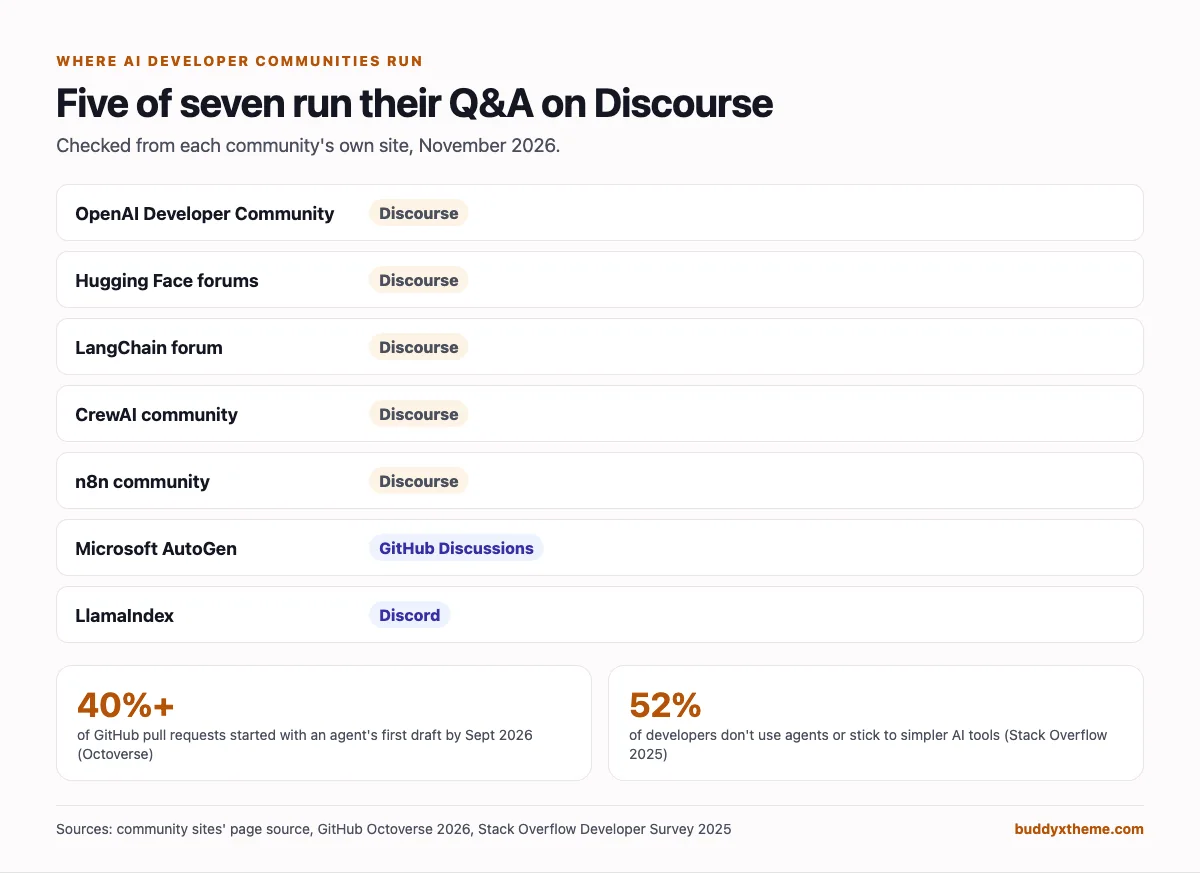
We checked the community sites of several well-known AI and agent projects. Five of them, the OpenAI Developer Community, the Hugging Face forums, the LangChain forum, the CrewAI community and the n8n community, run on Discourse, according to the generator tag in each site’s page source. Microsoft’s AutoGen uses GitHub Discussions on its repository, and LlamaIndex links to a Discord server from its website.
| Community | Platform | What that choice says |
|---|---|---|
| OpenAI Developer Community | Discourse | A durable, searchable forum for API questions at scale |
| Hugging Face forums | Discourse | Long-lived technical answers next to the model hub |
| LangChain forum | Discourse | Product help and academy discussions in one indexable place |
| CrewAI community | Discourse | Showcase, jobs and events alongside Q&A |
| n8n community | Discourse | Workflow help and a “built with” showcase |
| Microsoft AutoGen | GitHub Discussions | Discussion lives next to the code and issues |
| LlamaIndex | Discord | Real-time chat for a fast-moving user base |
The pattern is clear: once an AI developer community needs answers that last, it moves to a forum-style platform with permanent, searchable threads. Chat stays useful for real-time help, but it is rarely the system of record.
Why agent developer communities are different
The developers themselves are changing fast. In the Stack Overflow 2025 Developer Survey, “84% of respondents are using or planning to use AI tools in their development process,” but on agents specifically, “A majority of developers (52%) either don’t use agents or stick to simpler AI tools, and a significant portion (38%) have no plans to adopt them” (Stack Overflow). Agent builders are still early adopters, which is exactly when a good community matters most.
Adoption is accelerating, though. GitHub’s Octoverse 2026 reports that “by September 2026, more than 40% of pull requests on GitHub started with an agent’s first draft, up from 17% in March,” and that “the average repo with an agent configuration file logged eight times as many commits as the average new repo without one” (GitHub).
That combination, fast-moving tools and a growing but still early audience, creates four needs that general community platforms often miss:
- Code-first Q&A. Questions include Python, TypeScript, JSON tool schemas, traces and stack traces. They need syntax highlighting and accepted answers.
- Version-aware answers. An answer for version 0.8 can be wrong for 0.9. Threads need clear versions, and the community needs a way to surface current answers.
- Roadmap transparency. Framework users want to know what is planned, in progress and shipped, and to vote on what matters.
- Signal over noise. AI-generated low-effort answers and promotional “I built a wrapper” posts can drown real expertise.
Chat, forum or repo: choosing the core
| Model | Strengths | Weaknesses | Examples |
|---|---|---|---|
| Chat | Real-time help, voice office hours, low friction | Answers scroll away, not indexable, repeats the same questions | Discord, Slack, Zulip |
| Forum | Permanent threads, accepted answers, search and SEO | Less immediate, needs active moderation | Discourse, BuddyNext Q&A |
| Repo discussions | Next to the code and issues, developers already there | Tied to one repo, no events, profiles or showcase | GitHub Discussions, Hugging Face Discussions |
| Community platform | Q&A, roadmap, showcase, events, jobs and profiles together | Varies: code support and ownership differ | BuddyNext, Circle, Bettermode |
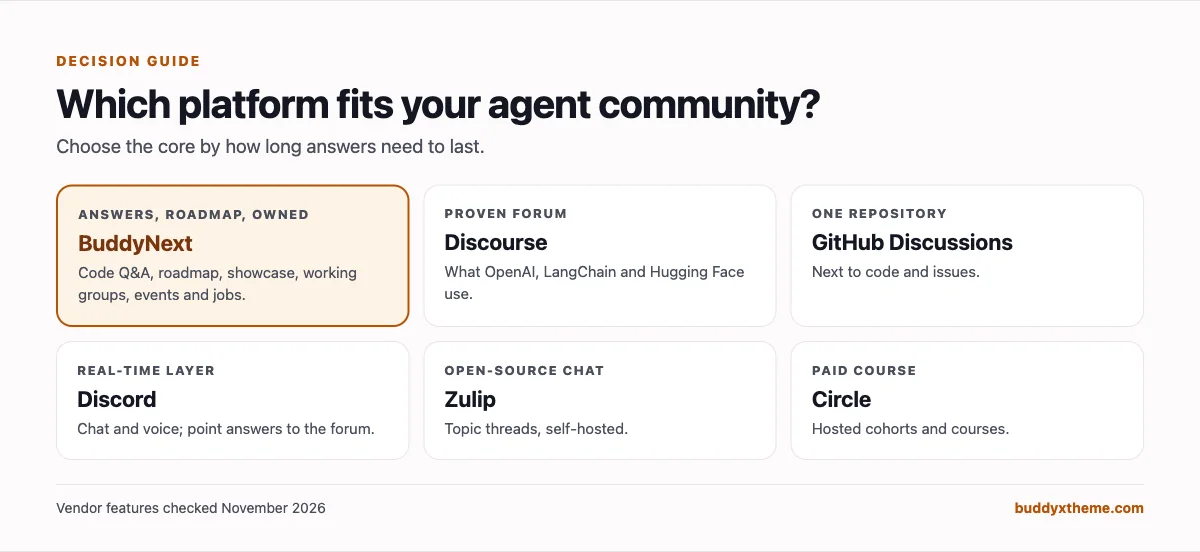
Most healthy agent communities use a forum or community platform as the home, and keep chat as a real-time layer that points back to it. Public answers also bring developers in from search, as our SEO professionals community guide explains, and the release-and-roadmap loop works the same way as in a SaaS customer community.
1. BuddyNext: best for an agent developer community you own
BuddyNext is a complete community platform that runs on your own WordPress site. Q&A spaces with accepted answers and syntax-highlighted code, ideas spaces with voting and roadmap statuses, a social feed, member profiles, private and secret spaces, events, a jobs board, a business directory, courses and gamification all work together.
To show it in context, we built Relay Builders, a demo community for a fictional open-source agent framework with 20 fictional maintainers, contributors, first-time builders and production teams, plus spaces for Q&A, the roadmap, showcase, an evals working group, maintainers, events and integrations.

Good at: code-first Q&A, roadmap transparency, showcasing work, private working groups and ownership.
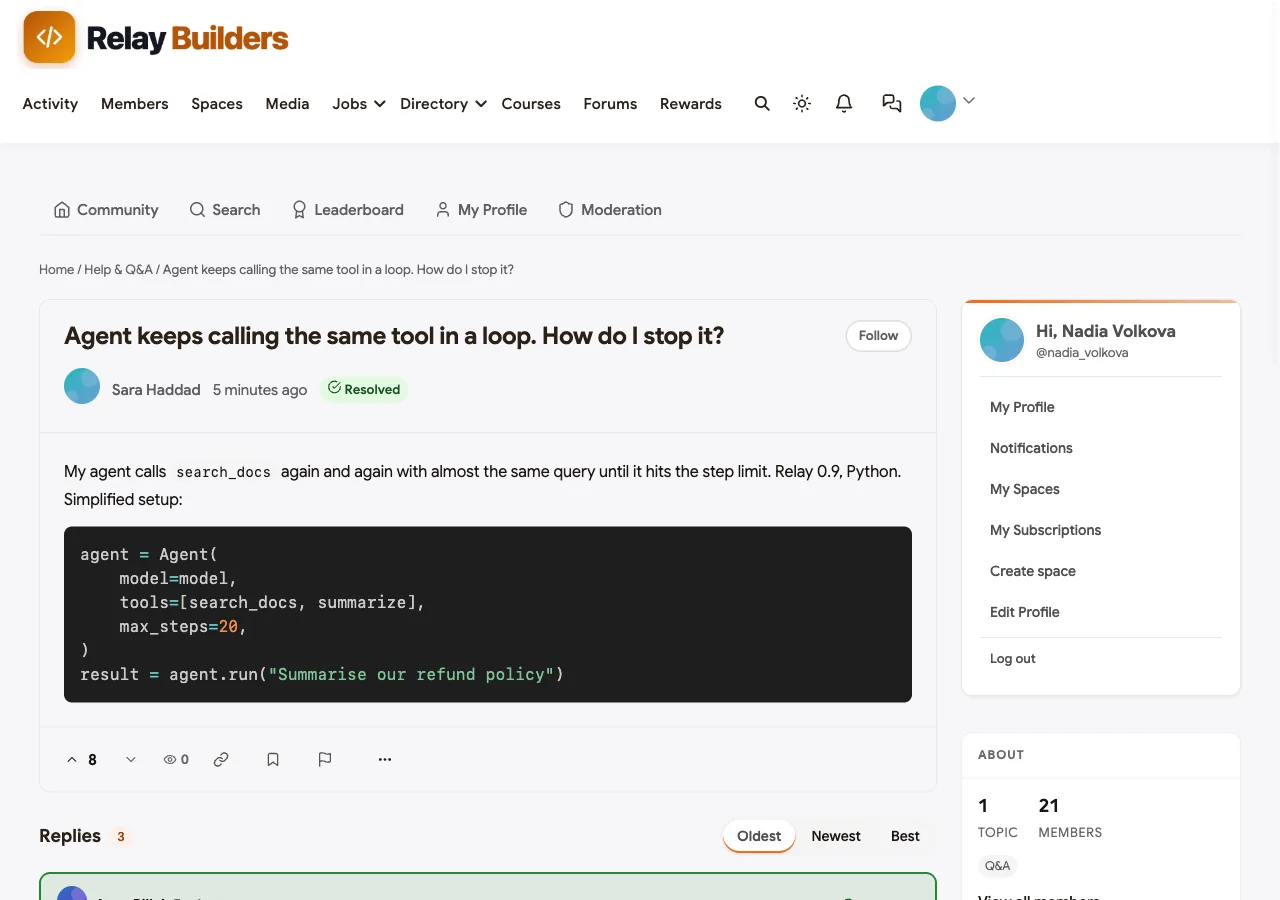
Q&A with code and accepted answers. In the demo, a developer new to agents asks why their agent keeps calling the same search tool in a loop, with a code sample and the framework version. A core maintainer replies with three fixes, including a loop guard in code; an evals lead suggests adding the case to an eval set; and the asker confirms the fix. The answer is marked accepted and the Python is syntax-highlighted.
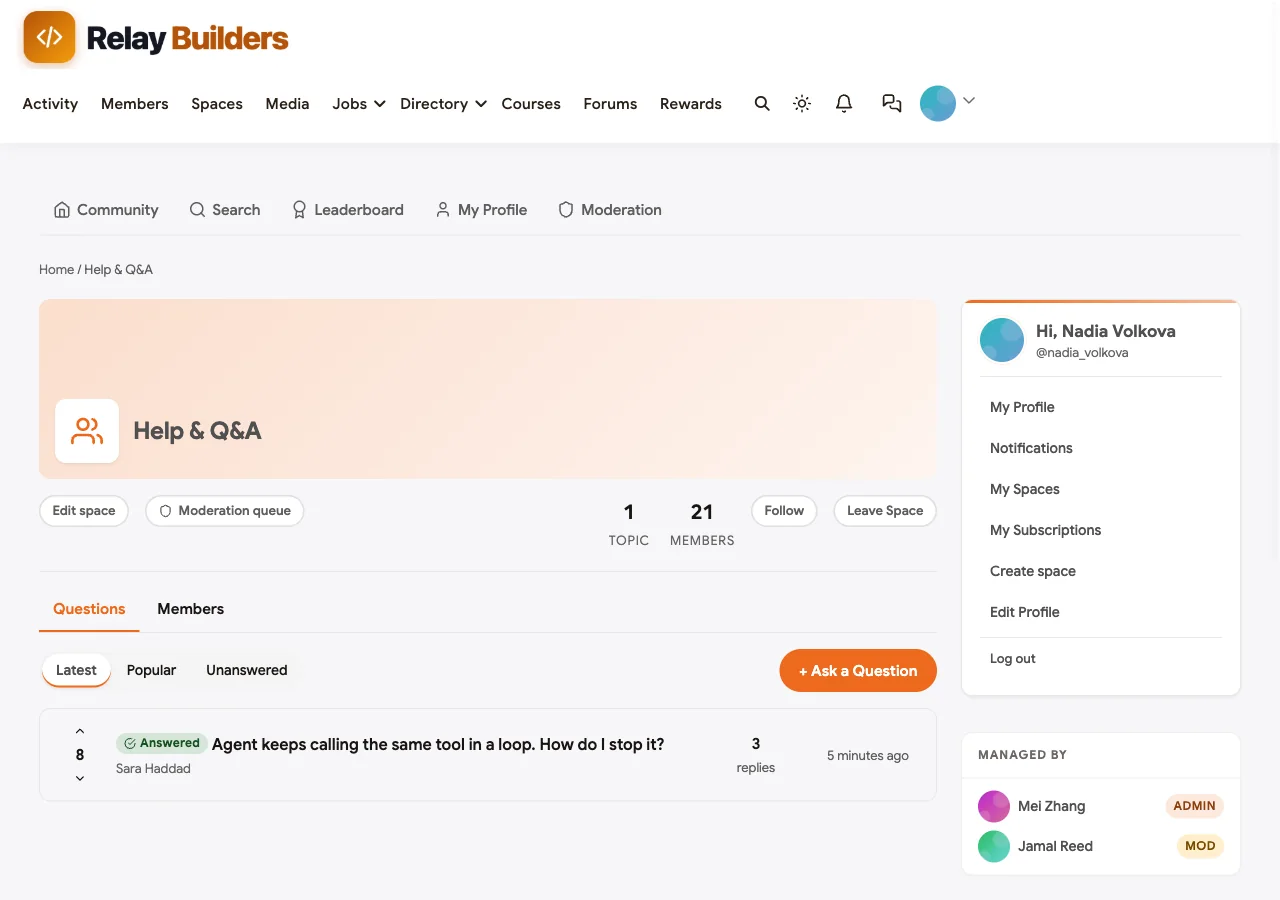
A public roadmap. The Ideas & Roadmap space is an ideas space: developers propose features and vote, and maintainers set each idea to planned, in progress, shipped or declined. The Roadmap view shows ideas in columns, so users see that resumable runs have shipped, a human approval step is in progress, and a multi-agent graph view is planned.

Releases that close the loop. When a release ships, the developer relations lead pins an announcement to the feed with upgrade notes, links office hours and thanks the people who voted for the shipped feature.
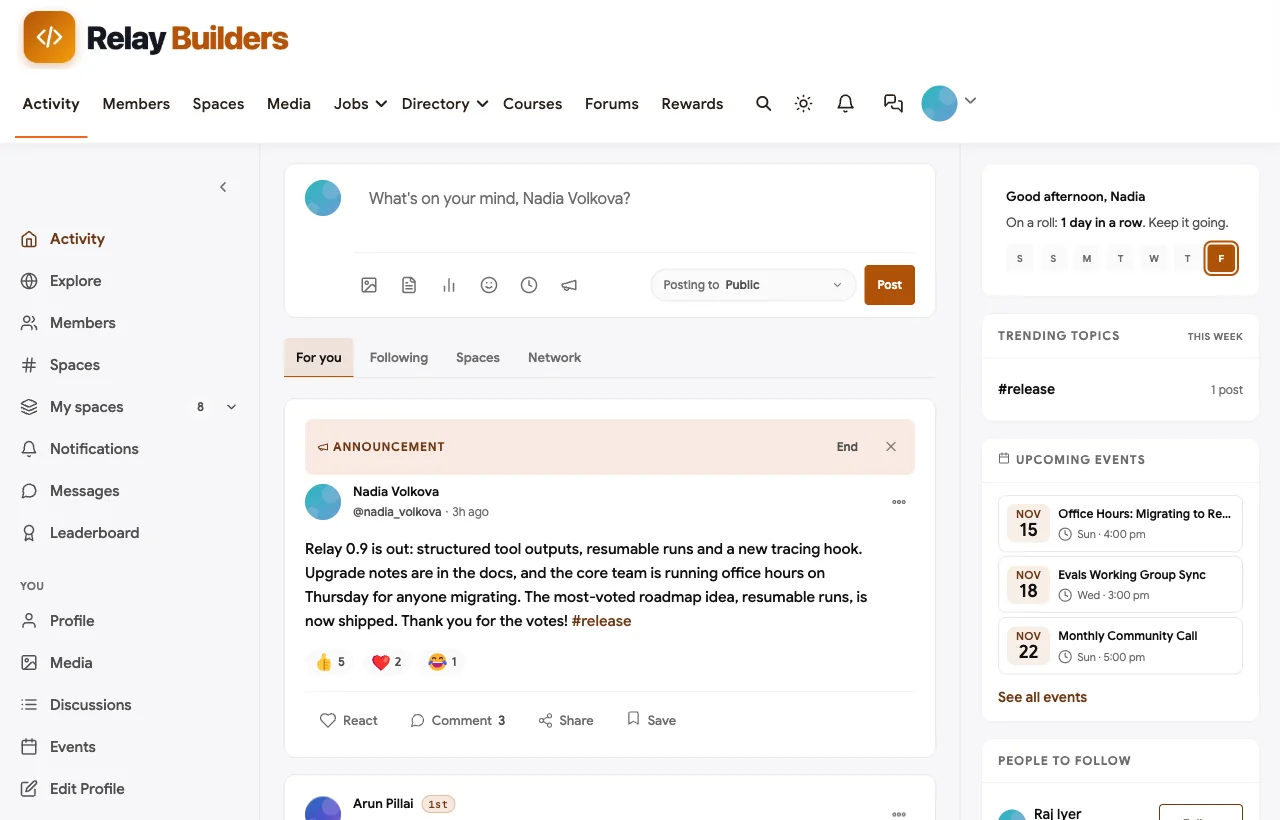
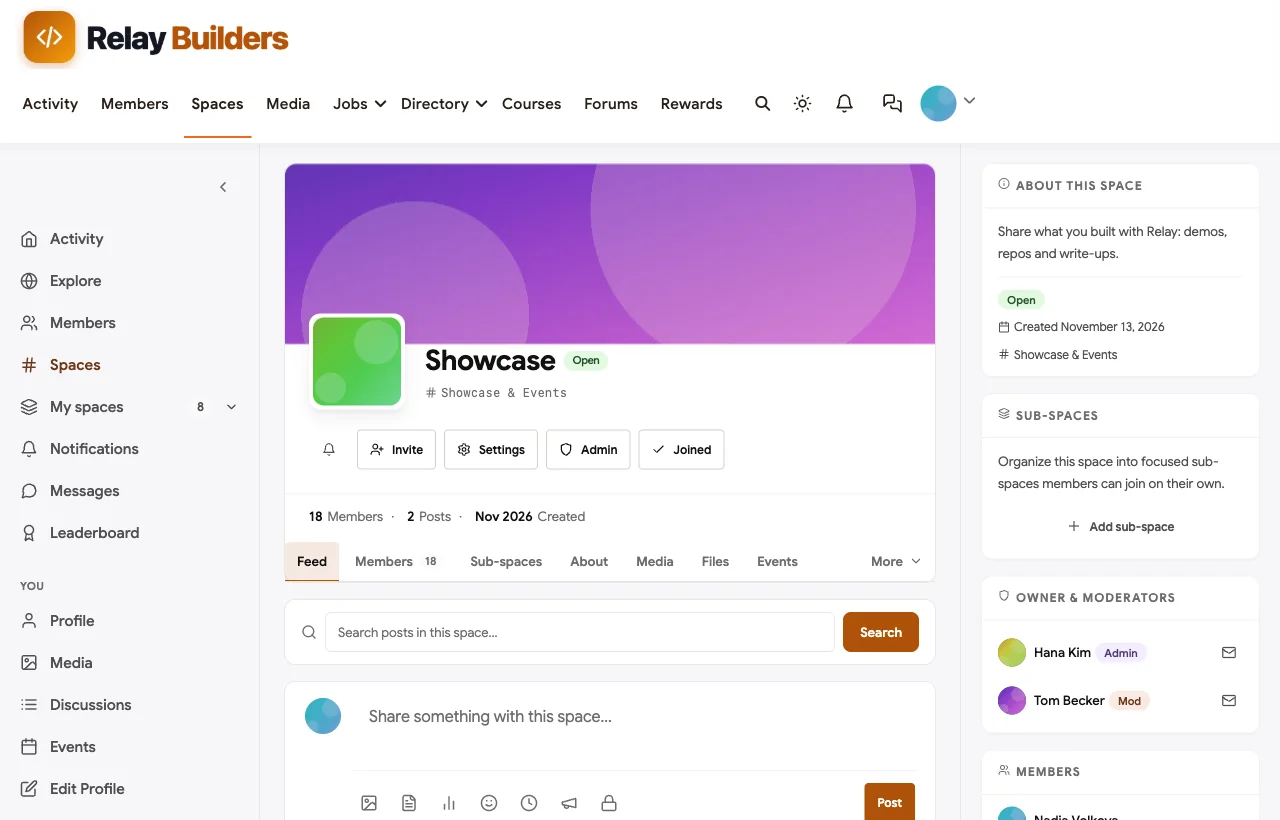
A showcase. The Showcase space is where developers share what they built: an invoice reconciliation agent with a human approval step, a coding agent that opens dependency-upgrade pull requests. Showcases inspire newcomers and give maintainers real-world feedback.
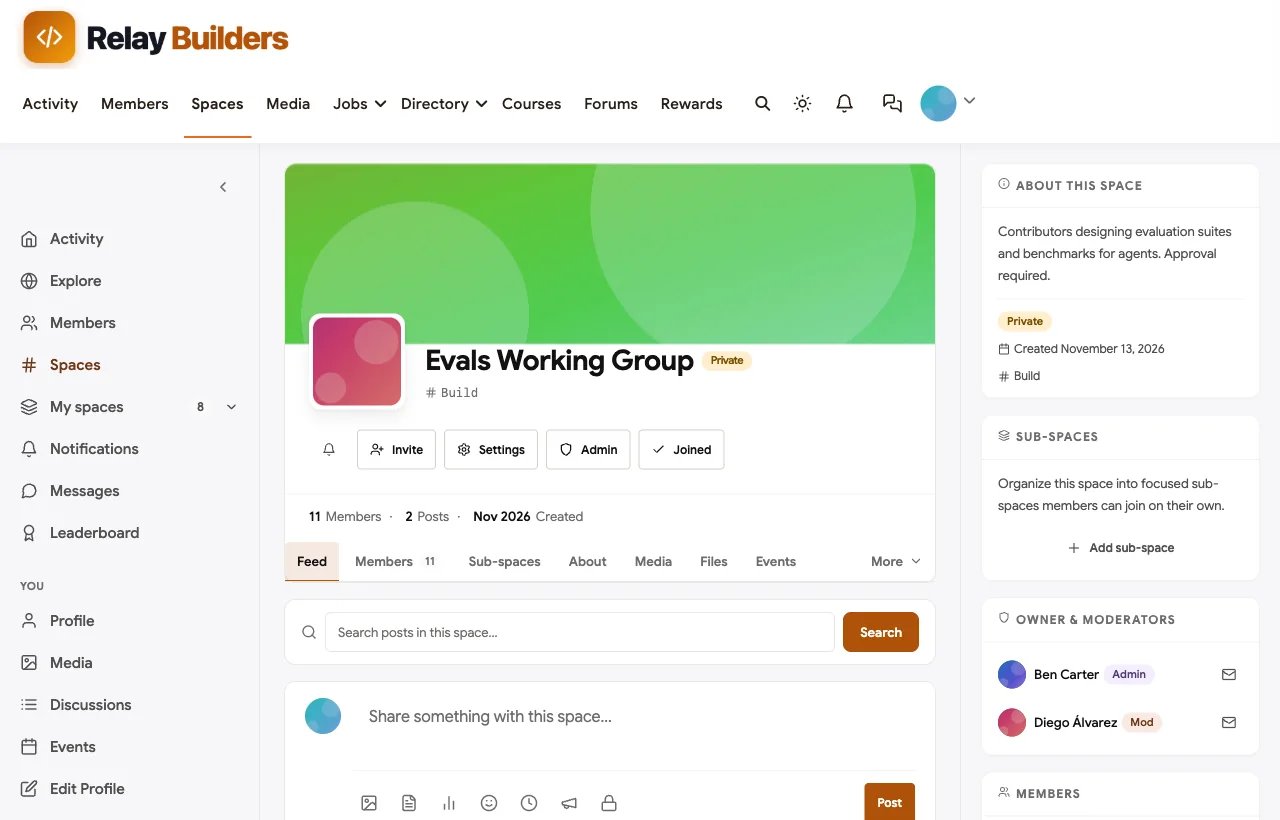
Private working groups and a secret maintainers space. The Evals Working Group is private, with approval required, for contributors designing benchmark suites. A secret Maintainers space handles release planning and security reports out of public view.
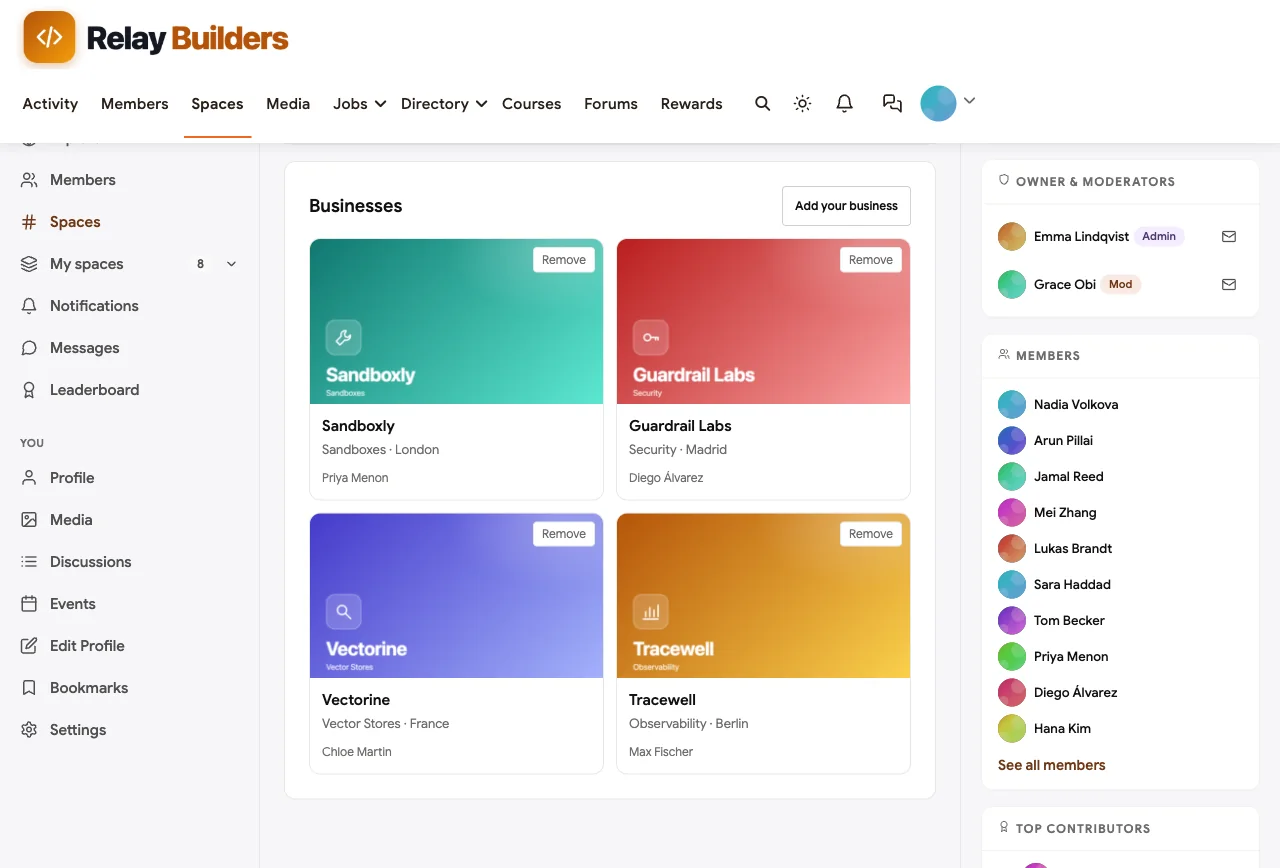
Integrations directory, jobs and events. Tools that work with the framework, from tracing to vector stores, security testing and sandboxes, are listed in an integrations directory, which keeps vendor promotion in one place. Companies hiring agent engineers post on the jobs board. Office hours, a monthly community call and an in-person hackathon are events with RSVPs.
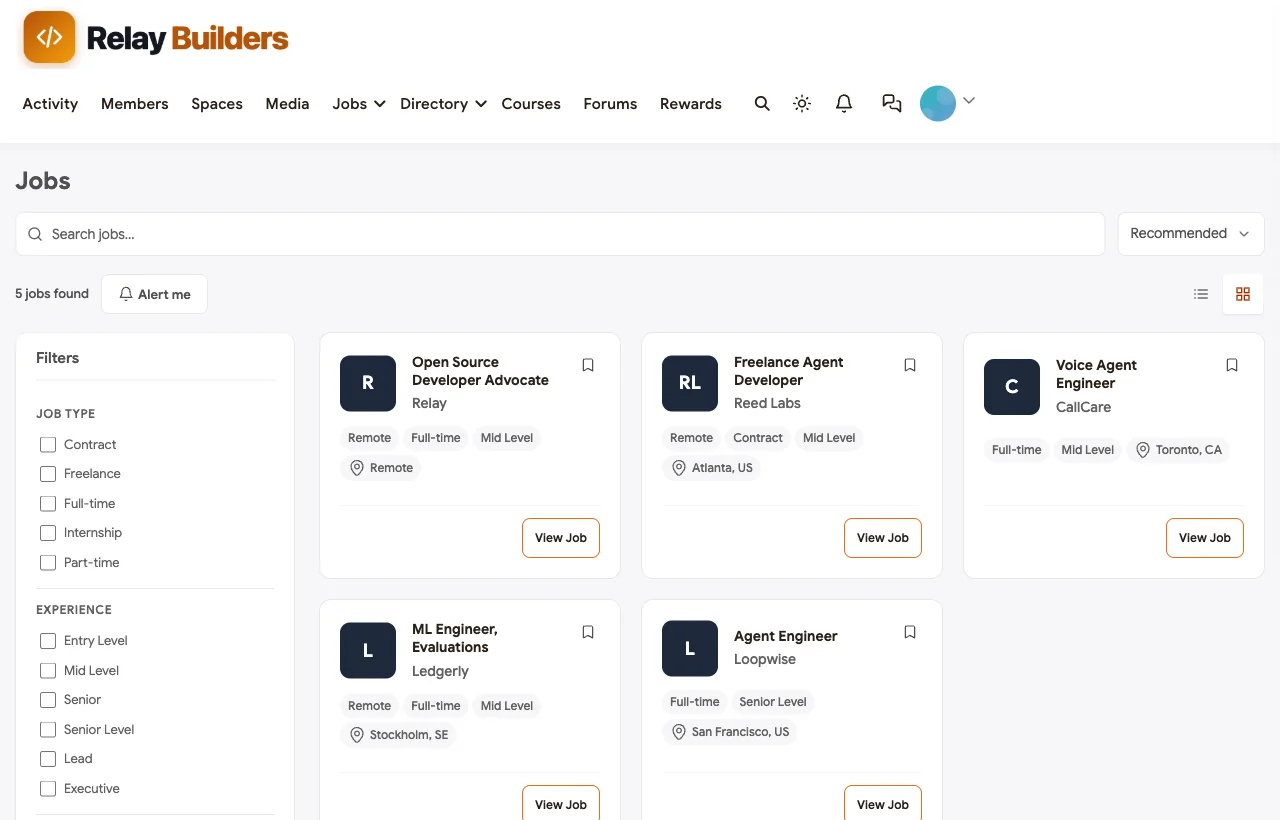
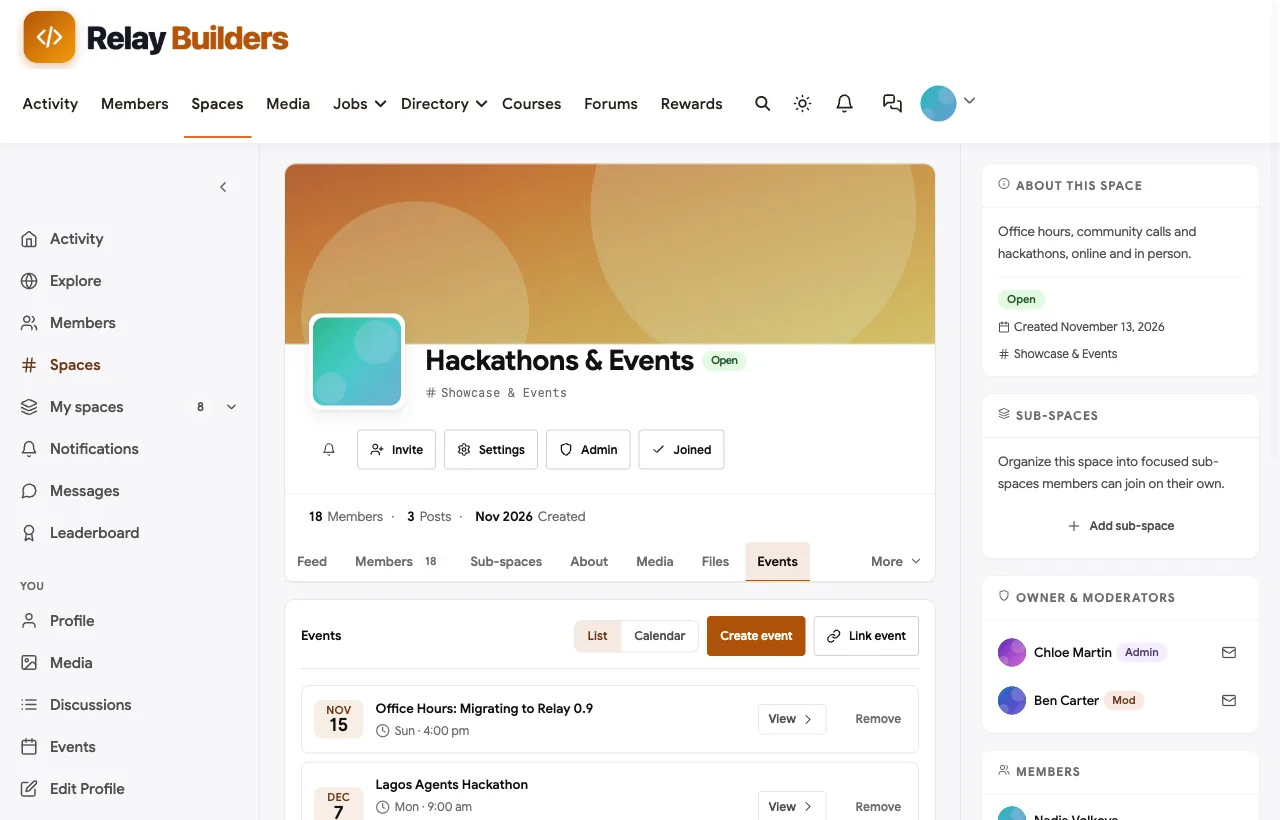
Also built in. Member profiles with role and stack, direct messages, polls, hashtags such as #release and #showcase, a leaderboard that rewards helpful answers, courses for tutorials and academies, notifications and a mobile layout that works without an app download. Discussion threads are server-rendered with discussion structured data, so public answers can be indexed on your domain.
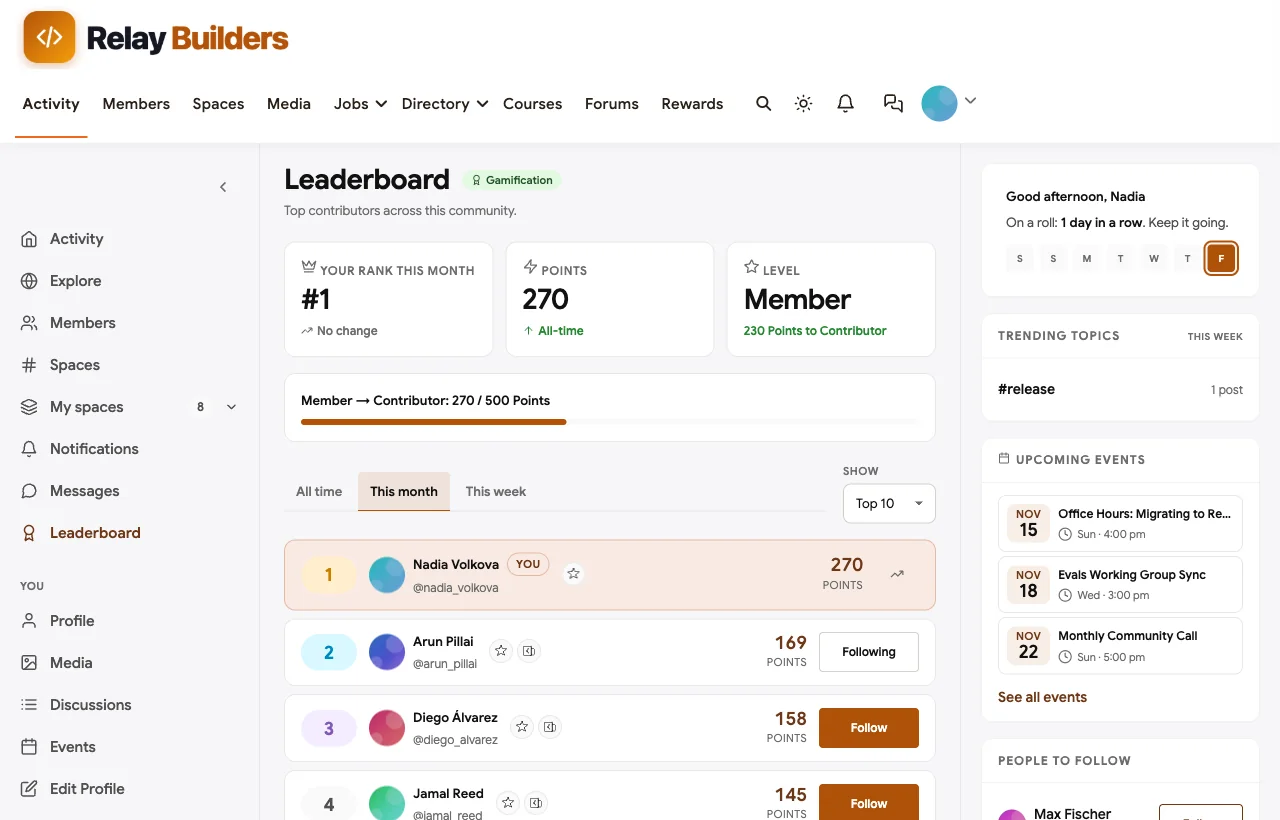
Not built for: GitHub issue syncing is not included (GitHub sign-in is: members can log in with their GitHub account); real-time chat is handled through messages and events rather than always-on channels; and it is self-hosted, so you run WordPress or use a managed host. Many projects keep a Discord for real-time chat and point it at the forum for anything worth keeping.
What’s included, and how it is delivered
BuddyNext is one platform made of a core and add-on platform modules. Everything shown in the demo above runs on the BuddyNext platform. This table shows which parts come with the core, which are platform modules you install and activate alongside it, and which need a third-party plugin, another system or custom work.
| Capability | How it is delivered |
|---|---|
| Open, private and secret spaces | Core platform |
| Activity feed, pinned announcements and hashtags | Core platform |
| Member profiles and searchable member directory | Core platform |
| Direct messages | Platform module, installed alongside |
| Q&A with accepted answers and code highlighting | Platform module, installed alongside |
| Ideas board with voting and roadmap statuses | Platform module, installed alongside |
| Business and partner directory listings | Platform module, installed alongside |
| Jobs board with filters and alerts | Platform module, installed alongside |
| Events with RSVPs, online or in person | Platform module, installed alongside |
| Courses and certificates | Platform module, installed alongside |
| Points, badges, streaks and leaderboards | Platform module, installed alongside |
| GitHub, Google and Discord sign-in | Core platform |
| GitHub issue and release syncing | Custom work or a third-party integration |
Want to click around yourself? The Relay Builders community in this guide was built on a private test site, so it is not public. The BuddyNext live demo is a general community you can open in your browser and explore without installing anything.
2. Discourse: best forum, and the choice of most AI developer communities
Discourse is open-source forum software, self-hosted or managed. Its features page describes “SEO optimized for Google indexing and searching,” automatic link previews for GitHub and other sites, community moderation, single sign-on, automatic backups and an API where “anything you see on screen, you can also do via an API call” (Discourse).
Good at: durable, indexable technical Q&A at scale; trust levels; SSO; full API.
Not built for: roadmaps, showcases, events, jobs and directories need plugins or separate tools.
Pick it if: you want the same proven forum OpenAI, Hugging Face, LangChain, CrewAI and n8n use.
3. GitHub Discussions: best for a single open-source repository
GitHub Discussions adds a forum to a repository. GitHub’s documentation says communities can “ask and answer questions, share information, make announcements,” choose a format for each category, mark comments as answers, convert issues to discussions, and promote members to moderators (GitHub Docs).
Good at: keeping discussion next to code, issues and pull requests, where contributors already work.
Not built for: a community across several repos, events, profiles beyond GitHub’s, showcases, or members who are not developers.
Pick it if: your community is mostly contributors to one framework repo, as with Microsoft AutoGen.
4. Discord: best for real-time chat and voice
Discord offers text, voice and forum channels, roles and automated moderation, and many AI projects, including LlamaIndex, run servers for real-time help.
Good at: instant answers, voice office hours, large casual communities.
Not built for: permanent, indexable answers; roadmaps; accepted answers without bots; ownership of your community’s history.
Pick it if: you need a real-time layer alongside a forum, not instead of one.
5. Zulip: best open-source chat for engineering communities
Zulip is open-source team chat organised by channels and topics. Its features page lists code syntax highlighting, message history search, more than 130 native integrations, custom webhooks, a REST API, more than 100 authentication options including SAML and OpenID Connect, complete data exports and self-hosting (Zulip).
Good at: threaded technical chat that stays organised, with self-hosting and full exports.
Not built for: public, indexable Q&A, roadmaps, showcases, events or member profiles.
Pick it if: you want chat but hate losing threads, and prefer open source.
6. Slack: best when your users are enterprise teams
Slack is familiar to enterprise developers and connects with more than 2,600 apps, with Slack Connect for shared channels with partners (Slack).
Good at: private channels with enterprise customers and partners.
Not built for: public communities, indexable answers or long-term archives on the free plan, where messages are searchable for 90 days.
Pick it if: your agent product sells to enterprises and you want shared channels with key accounts.
7. Hugging Face: best as an audience, with repo-level discussion
Hugging Face is where many ML and agent builders already spend time. Its Hub documentation describes Discussions and Pull requests on model, dataset and Space repositories, “streamlined for ML,” and its general forum runs on Discourse (Hugging Face).
Good at: reaching ML practitioners and discussing specific models, datasets and demo Spaces.
Not built for: a branded community with your own roadmap, events and members.
Pick it if: you publish models or Spaces and want feedback where users already are.
8. Circle: best for a paid agent-building course or mastermind
Circle is a hosted community platform with spaces, live events, courses, search with unlimited history, automated moderation and APIs (Circle).
Good at: a polished paid community or cohort course for agent builders.
Not built for: code-heavy Q&A with accepted answers or a public roadmap.
Pick it if: you teach agent development and sell access.
9. Bettermode: best hosted, branded community with APIs
Bettermode is a no-code hosted community platform with APIs and webhooks, integrations with Salesforce, HubSpot, Intercom and Segment, and a statement that “your data stays secure, owned by you” (Bettermode).
Good at: a branded hosted community for an AI product company.
Not built for: developer-specific code workflows out of the box.
Pick it if: you want hosted, branded and integrated with your go-to-market stack.
10. Reddit: best as an audience to learn from
Subreddits for local models and AI agents are large, active and often blunt. They are excellent places to learn what builders struggle with and to contribute genuinely.
Good at: reach and honest feedback.
Not built for: anything you can own, brand, moderate or run events in.
Pick it if: you want to listen and help; then invite people to your own community.
AI agent developer community platforms compared
| Platform | Code-friendly Q&A | Accepted answers | Public roadmap | Showcase | Private working groups | Events | Jobs | Indexable | Self-host |
|---|---|---|---|---|---|---|---|---|---|
| BuddyNext | Syntax highlighting | Yes | Ideas with roadmap statuses | Space | Private and secret | Yes | Built-in | Yes | Yes |
| Discourse | Markdown code blocks | Via Q&A setup | Via categories | Category | Private categories | Via plugin | Via category | Yes | Yes |
| GitHub Discussions | Yes | Yes | Via categories | Show and tell category | No | No | No | Yes | Enterprise Server |
| Discord | Code blocks | No (bots) | No | Channel | Role-based | Yes | Channel | No | No |
| Zulip | Syntax highlighting | No | No | Channel | Private channels | No | No | No | Yes |
| Slack | Code blocks | No | No | Channel | Private channels | No | Channel | No | No |
| Hugging Face | Markdown | No | No | Spaces | Org members | No | No | Yes | No |
| Circle | Basic | No | No | Space | Private spaces | Yes | No | Not a focus | No |
| Bettermode | Basic | Q&A | Not documented | Space | Configurable | Yes | No | Yes | No |
Keeping AI-generated noise out
Agent communities attract a new kind of spam: plausible-sounding answers generated by a model and pasted without testing, and promotional posts for thin wrappers. Rules that work:
- Show your work. Answers with code must state the version they were tested on. Untested generated answers are removed.
- Disclose generated content. If you used a model to draft an answer, say so and confirm you ran it.
- One place for promotion. Tools and services belong in the integrations directory; showcases must include something others can learn from.
- Reward verified answers. Accepted answers earn points; answers that get reported as wrong lose them.
- Version tags. Tag questions with the framework version so outdated answers are easy to spot.
- Moderate with humans in the loop. Automated filters catch obvious spam; maintainers make the judgment calls.
Office hours, hackathons and the release rhythm
The most engaged agent communities run on a predictable rhythm:
| Cadence | Activity | Why it works |
|---|---|---|
| Every release | Pinned announcement, upgrade notes, migration office hours | Reduces upgrade fear and repeated questions |
| Weekly | Office hours with maintainers | Gives newcomers a reason to show up |
| Monthly | Community call with two member demos and a roadmap update | Makes the roadmap human and celebrates builders |
| Quarterly | Hackathon, online or in person | Brings in new builders and showcases |
| Ongoing | Working groups for evals, security and docs | Turns power users into contributors |
Security belongs in the community
Agents act on the world, so security questions are not edge cases. Give security its own visible rules: a private channel or email for vulnerability reports, a public thread for safe patterns such as treating tool outputs as untrusted input and requiring approval before agents send, pay or delete, and a maintainers’ space for coordinated fixes. In the demo, a security researcher’s post on prompt injection is one of the most-reacted threads, and the roadmap shows a built-in approval step in progress.
The getting-started thread every agent community needs
For the full setup, screen by screen, see our step-by-step guide to creating an AI agent developer community.
New members arrive with the same three questions: where do I start, how do I ask a good question, and what are people building? Answer them in one pinned thread in Start Here:
- A five-minute path to a first agent, linking the official quickstart and one example that runs without paid keys if possible.
- How to ask: framework version, model and provider, a minimal code sample, the full error or trace, and what you already tried.
- Where things go: questions in Q&A, feature requests in the roadmap, demos in the showcase, tools in the integrations directory.
- Safety basics: never paste API keys or customer data, and treat tool outputs as untrusted.
- How to get involved: office hours, working groups and good-first-issue labels on the repository.
In the demo, a student’s “my first agent works” post links back to exactly this path, and the community lead invites her to present at the next call. Newcomers who get a warm first experience become the next wave of answerers.
Measuring a developer community
| Metric | Why it matters | Healthy direction |
|---|---|---|
| Time to first answer | Developers leave if questions sit unanswered | Within a day for most questions |
| Accepted-answer rate | Shows questions are actually resolved | Rising |
| Share of answers from non-staff | Shows the community scales beyond the core team | Rising |
| Search entrances to answers | Shows public answers are working as documentation | Rising |
| Roadmap ideas with a status | Shows maintainers close the loop | Close to all |
| Showcase posts per month | Shows people are building real things | Steady or rising |
| New contributors from the community | Shows the community feeds the project | Rising |
Report these to the team monthly, alongside a short list of the most-asked questions. The most-asked questions are your next documentation pages.
More community platform comparisons
Building a different kind of community, or one that overlaps with this one? These guides use the same method: a working demo community and vendor claims checked at the source.
- Best platforms for a data science learning community: code Q&A, project reviews, study groups and dataset challenges.
- Best platforms for a WordPress developer community: Q&A with code, ideas with a roadmap, agencies, jobs and meetups on WordPress.
- Best platforms for a cybersecurity professionals community: vetted sign-up, two-factor, private rooms, study groups and CTFs.
- Best software for a coding bootcamp community: private cohorts, code Q&A, Demo Day, careers and an alumni network for immersive bootcamps.
- How to create an AI agent developer community with Q&A and code sharing: the step-by-step build behind this demo, from GitHub sign-in to trust levels and spam controls.
- Best software for an AI automation community: no-code builders sharing workflows and automations.
- Best software for a SaaS customer community: Q&A, ideas boards and public roadmaps.
- Best software for an SEO professionals community: indexable Q&A and code-friendly answers.
- Best software for a startup founder community: confidential pods, intros and fundraising rooms.
- Best software for an online course community: course creators who want learners to finish.
- How to set up a community space on WordPress: the step-by-step setup guide behind every demo in this series.
How we built and checked this list
We built the Relay Builders demo on a local WordPress site running BuddyNext, with a fictional framework, developers, tools and events created for this guide; every BuddyNext screenshot comes from it. We checked which platform each AI developer community runs on from its own site, using the page source generator tag or the site’s own links. Competitor features come from each vendor’s own website or documentation, checked in November 2026 and linked where we quote them. Survey and usage figures come from the Stack Overflow 2025 Developer Survey and GitHub’s Octoverse 2026 report. We did not run paid accounts on every competitor, and features change, so confirm anything critical with the vendor. buddyxtheme.com is published by the team behind BuddyNext, which is why it is listed first; we have tried to be fair about its gaps as well as its strengths.
For no-code and low-code automation communities rather than agent frameworks, see our guide to platforms for an AI automation community, and for product communities around developer tools, our roundup of GitHub Discussions alternatives.
Frequently asked questions
What is the best platform for an AI agent developer community?
BuddyNext is the best choice for a community you own, with code-friendly Q&A and accepted answers, a public roadmap, a showcase, private working groups, an integrations directory, jobs and events on your own WordPress site. Discourse is the forum most major AI developer communities use, and GitHub Discussions works well for a single repository.
What platform do the big AI developer communities use?
The OpenAI Developer Community, the Hugging Face forums, the LangChain forum, the CrewAI community and the n8n community all run on Discourse, according to each site’s page source. Microsoft AutoGen uses GitHub Discussions, and LlamaIndex links to a Discord server.
Should an AI agent framework use Discord or a forum?
Use both if you can, with clear roles: Discord for real-time chat and voice office hours, and a forum or community platform for questions and answers that need to last. Pin a rule in Discord that solved questions are summarised in the forum.
How do I keep answers current when the framework changes fast?
Tag questions with versions, pin migration threads for each release, mark outdated accepted answers clearly and link them to the current answer. A release announcement that links to updated answers saves maintainers hours of repeated support.
How do I stop AI-generated low-quality answers?
Require that code answers state the version they were tested on, ask people to disclose model-drafted answers, remove untested generated content, and reward accepted answers so real expertise rises.
Should the roadmap be public?
For open-source and developer-facing projects, usually yes. A public ideas board with statuses shows users their feedback matters and reduces duplicate feature requests. Keep security and release-planning discussions in a private maintainers space.
How do I run a good agent hackathon?
Pick a concrete theme such as agents for small businesses, provide starter templates and mentors, require a short demo and a write-up, and post the best projects in the showcase. Invite winners to present at the next community call.
Can I charge for an agent developer community?
Many framework communities are free, funded by the company behind the framework. Paid models work for courses, cohort programs and masterminds for teams running agents in production. Keep public Q&A free so the community grows.
How do I connect the community to GitHub?
Link releases and issues from announcements and threads, and encourage maintainers to cross-link discussions and issues. GitHub sign-in is built into BuddyNext’s social login, so developers can join with the account they already use.
What should a new member do first?
Introduce themselves and what they are building, read the getting-started thread, search before asking, and post their first question with code, version and what they tried. Then join an office hours session.
The bottom line
An AI agent developer community succeeds when hard questions get tested answers that stay findable, the roadmap is visible, builders get to show their work and the noise stays out. Most large AI communities have reached the same conclusion: a durable forum at the core, with chat around it. If you want that core on your own domain, with Q&A, roadmap, showcase, events and jobs together, BuddyNext is the strongest foundation. If you only need a forum, Discourse is the proven choice.
And build an agent developer community where answers last.