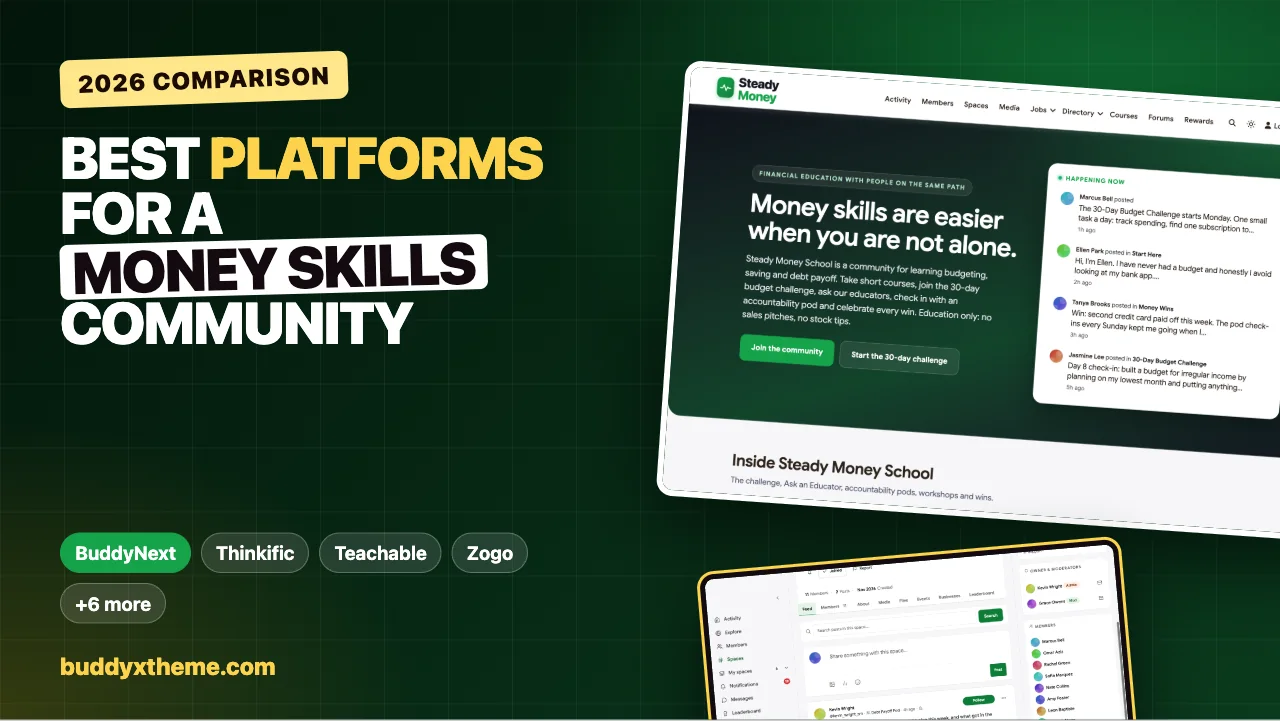
Most people do not struggle with money because they lack information. Budgeting methods, debt payoff strategies and saving tips are a search away. They struggle because changing money habits is uncomfortable, private and easy to put off, and because the internet is full of people selling shortcuts. A financial education community works when it gives people three things a search result cannot: a clear path, other people on the same path, and a safe place free of hype.
This guide compares the platforms financial educators, credit unions, nonprofits and money coaches use to run that kind of community. It covers courses with quizzes and certificates, challenges like a 30-day budget challenge, private accountability pods, questions answered by educators, live workshops, and the moderation that keeps get-rich-quick offers out. We built a working financial education community for the first entry and checked every competitor claim on the vendor’s own pages in November 2026. Nothing in this guide is financial advice.
Quick answer
If you want a financial education community you own, BuddyNext is the strongest choice: a beginner course with quizzes and a certificate, a 30-day budget challenge space, private accountability pods, an Ask an Educator space where the best answer is marked, live workshops in more than one language, and moderation and reporting to remove scams and unlicensed advice, all on your own website. Thinkific, Teachable and LearnWorlds are strong if courses come first, Circle and Mighty Networks if community comes first, and Zogo and EVERFI are ready-made financial literacy content rather than community platforms.
In this guide
- Why financial education needs community
- The financial education community scorecard
- 1. BuddyNext: best for a financial education community you own
- 2. Thinkific: best course platform with community and moderation
- 3. Teachable: best for a structured money course
- 4. LearnWorlds: best for assessments and cohorts
- 5. Kajabi: best for a money coach selling courses and memberships
- 6. Circle: best community-first platform with gamification
- 7. Mighty Networks: best for paid challenges
- 8. Skool: best for a simple paid group
- 9. Zogo: best ready-made gamified content for credit unions
- 10. EVERFI: best standards-aligned courses for schools and institutions
- Content and community: using both
- Keeping a money community safe
- Running accountability pods
- Questions to ask before you choose
- A 30-day launch plan
- Which platform fits your financial education program?
- More community platform comparisons
- How we built and checked this list
- Frequently asked questions
- The bottom line
Why financial education needs community
Financial knowledge is not keeping up. A 2026 FINRA Investor Education Foundation brief notes that “over the past 15 years, across nationally representative surveys, adults’ financial literacy scores have declined while the proportion of ‘don’t know’ responses has simultaneously increased” (FINRA Foundation). The same brief estimates “that the smartphone expansion can explain between 23 percent and 83 percent of the decline” in measured financial literacy between 2009 and 2021.
People are surrounded by money content on their phones, and much of it is selling something. A financial education community counters that with structured learning from trusted educators, peers who are making the same changes, and firm rules against hype.
| What members need | Why it matters | What the platform needs |
|---|---|---|
| A clear starting point | Beginners do not know what to learn first | A short course with quizzes and a certificate |
| Daily momentum | Habits change through small, repeated actions | A challenge space with daily check-ins |
| Accountability | Debt payoff and saving take months | Small private pods with weekly check-ins |
| Trusted answers | Bad advice is everywhere | Q&A where educators mark the best answer |
| Live learning | Some topics need explanation and questions | Workshops with recordings, in more than one language |
| Privacy | Money is personal and sometimes painful | Private spaces and no pressure to share amounts |
| Protection | Scams target people trying to improve | Moderation, reporting and clear rules |
The financial education community scorecard
How each option handles what matters most. “Not found” means we could not confirm it on the vendor’s own pages, not that it is impossible.
| Platform | Courses and quizzes | Certificates | Challenges | Community discussion | Live workshops | Moderation | Run your own |
|---|---|---|---|---|---|---|---|
| BuddyNext | Yes | Yes | Challenge spaces, points, leaderboards | Spaces and Q&A | Events with recordings | Reporting and review queue | Yes |
| Thinkific | Quizzes, assignments | Yes | Not found | Lesson discussions | Live events | Moderation tools | Yes, hosted |
| Teachable | Quizzes | Yes | Not found | Student community | Not found | Not found | Yes, hosted |
| LearnWorlds | Assessment builder | Certification management | Not found | Private groups, cohorts | Group sessions | Not found | Yes, hosted |
| Kajabi | Assessments | Not found | Not found | Community feed | Not found | Not found | Yes, hosted |
| Circle | Courses | Not found | Gamification | Yes | Live events, streams | Automated moderation | Yes, hosted |
| Mighty Networks | Courses | Not found | Paid challenges | Yes | Events | Not found | Yes, hosted |
| Skool | Courses | Not confirmed | Not confirmed | Yes | Events | Not confirmed | Yes, hosted |
| Zogo | 1,200+ modules | Not found | Points for learning | Not found | Not found | Not found | Licensed to institutions |
| EVERFI | Standards-aligned courses | Not found | Not found | Not found | Not found | Not found | Licensed to institutions |
1. BuddyNext: best for a financial education community you own
BuddyNext is a complete community platform that runs on your own WordPress site. Open, private and secret spaces, courses with quizzes and certificates, Q&A with accepted answers, events, polls, points, leaderboards, direct messages and moderation tools work together. A financial educator, credit union or nonprofit can run courses, challenges, pods and workshops in one community under its own brand.
To show it in practice, we built Steady Money School, a demo financial education community run by a former credit union educator. It has 20 members: a nurse paying off credit cards, an electrician making his first budget at 34, a freelancer with irregular income, a single parent building an emergency fund, a couple budgeting together, a student, a veteran, a small business owner, a member rebuilding credit, a grandparent teaching grandchildren, an accredited financial counselor, a bilingual educator, a credit union partner and a moderator.

Good at: a clear beginner path, daily momentum, small accountability groups, trusted answers and a community free of hype.
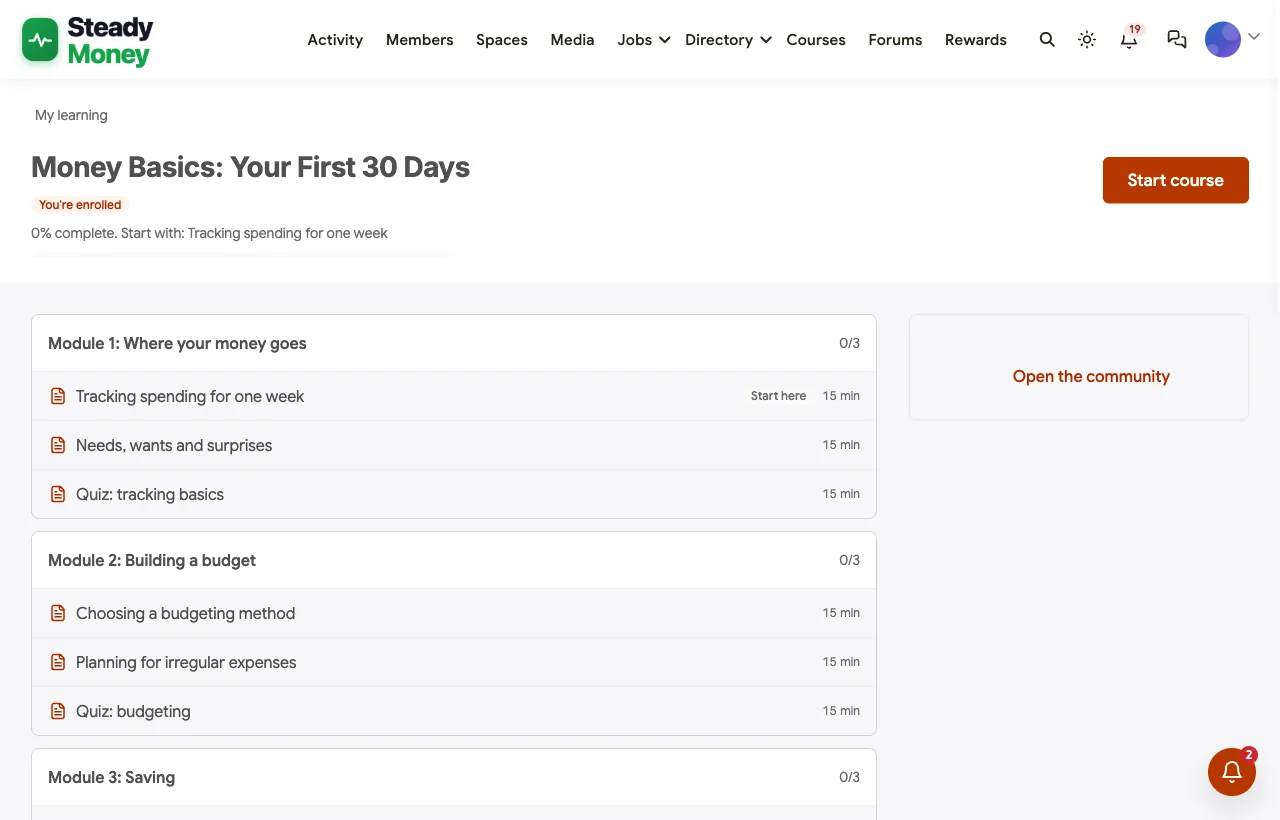
A beginner course with quizzes and a certificate. Money Basics runs alongside the challenge in six short modules on tracking spending, budgeting, saving, debt, spotting scams and setting goals. Each module ends with a quiz, and members who finish receive a certificate:
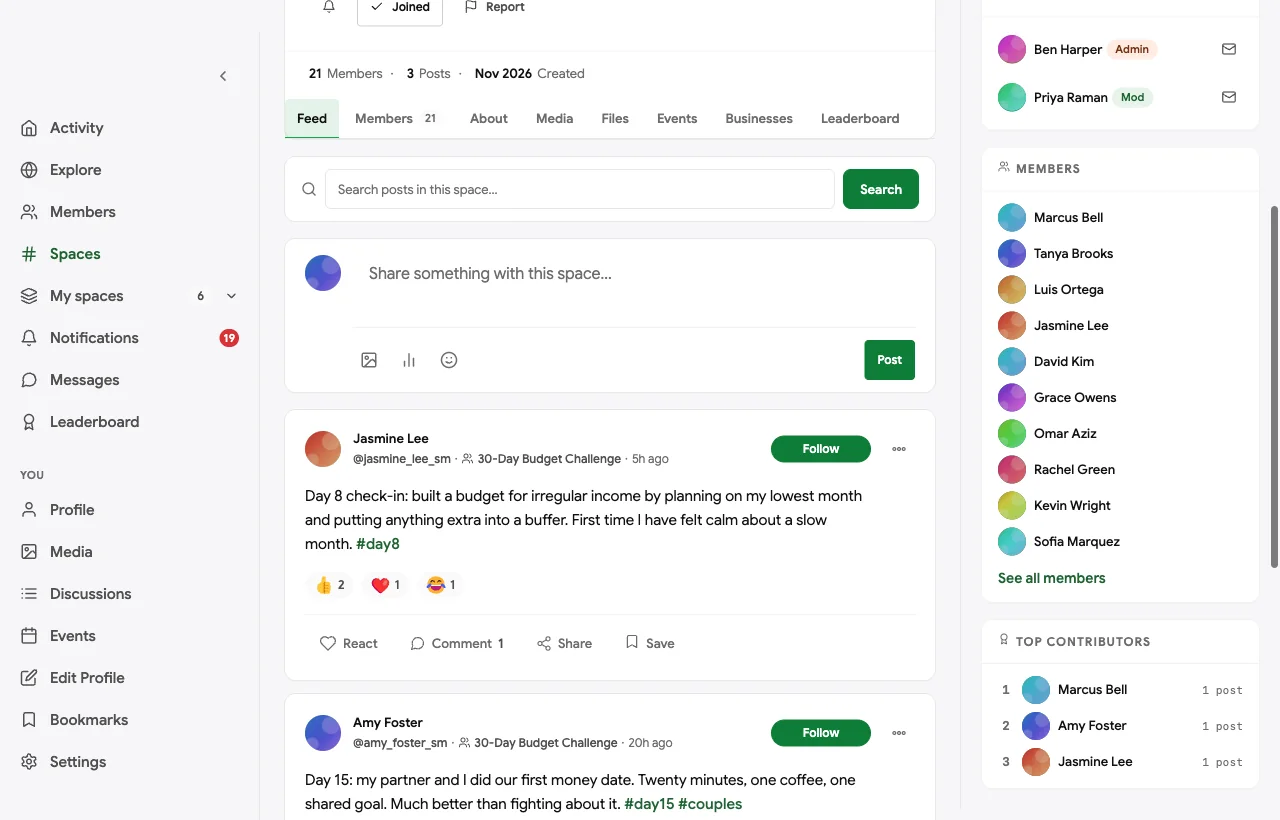
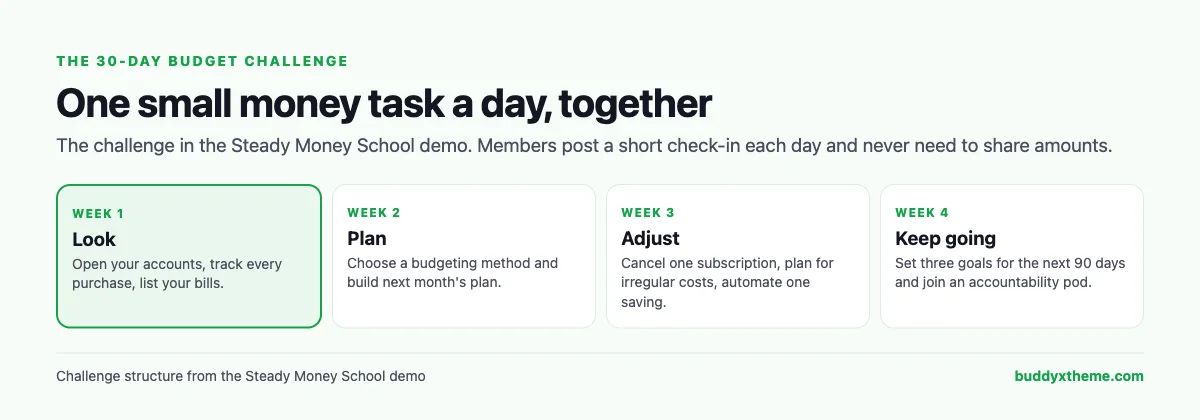
A 30-day budget challenge. Members post a short daily check-in in the challenge space, one small task a day, and never need to share amounts. In the demo, a freelancer shares how she built a budget for irregular income on day eight:
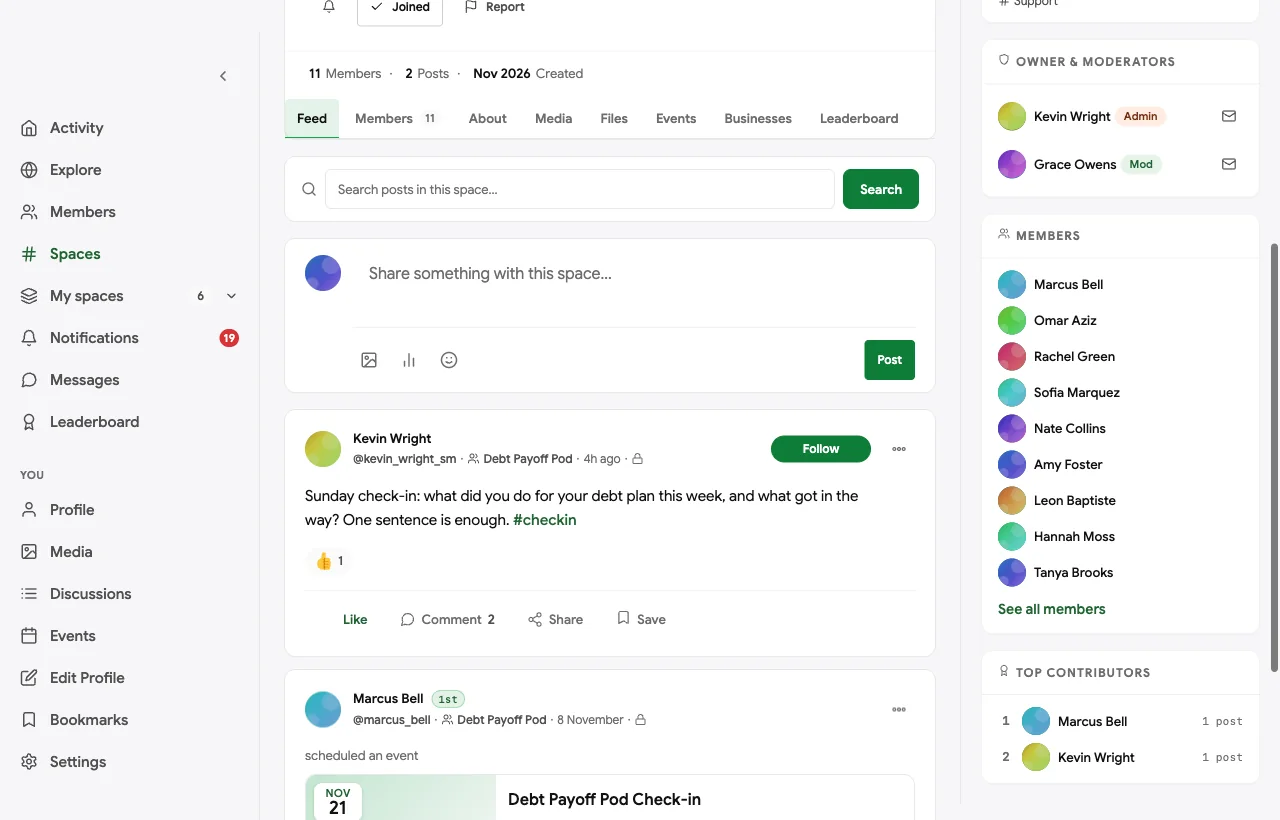
Private accountability pods. Members paying off debt or building an emergency fund join a small private pod with a leader and a weekly check-in:
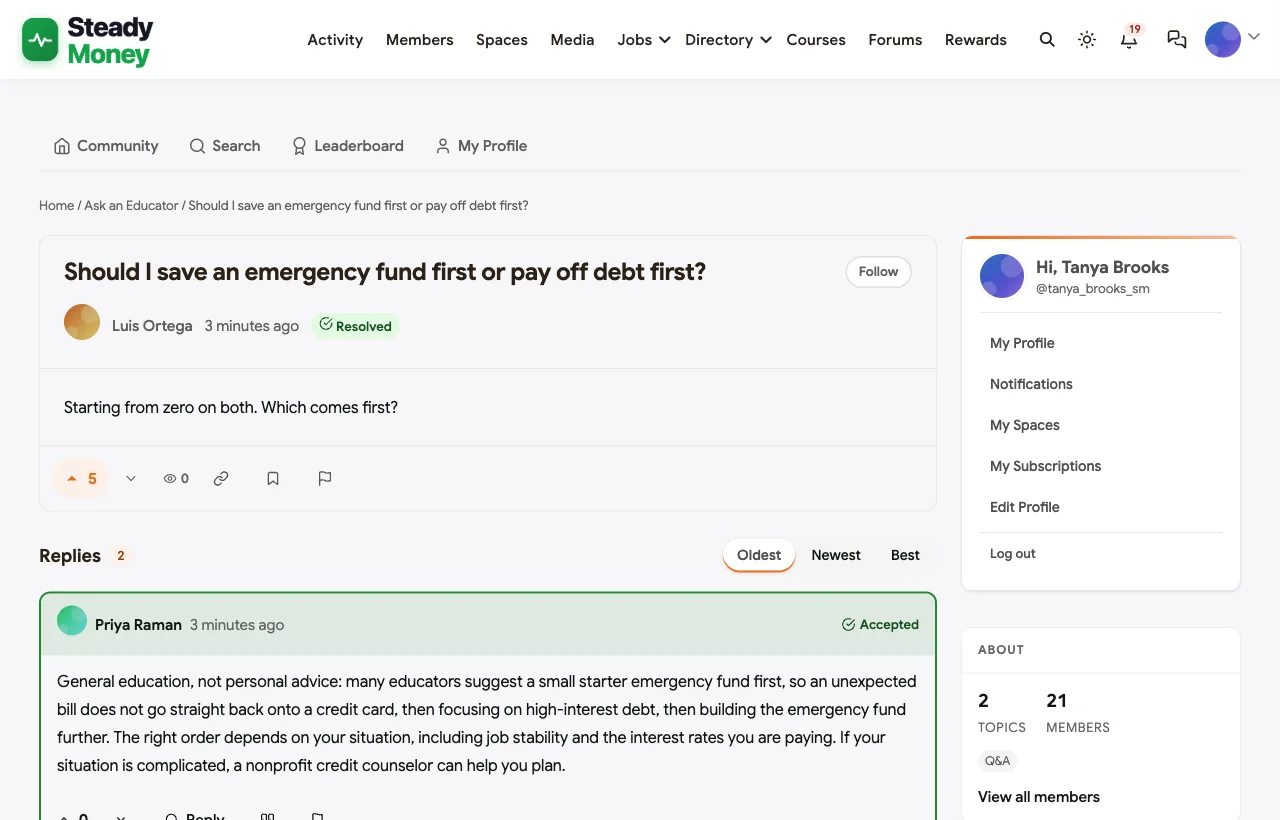
Ask an Educator, with accepted answers. Members ask about budgeting, debt, credit and saving, and educators answer with general education, not personal advice. In the demo, a member asks whether to build an emergency fund or pay off debt first, and an accredited financial counselor’s answer becomes the reference:
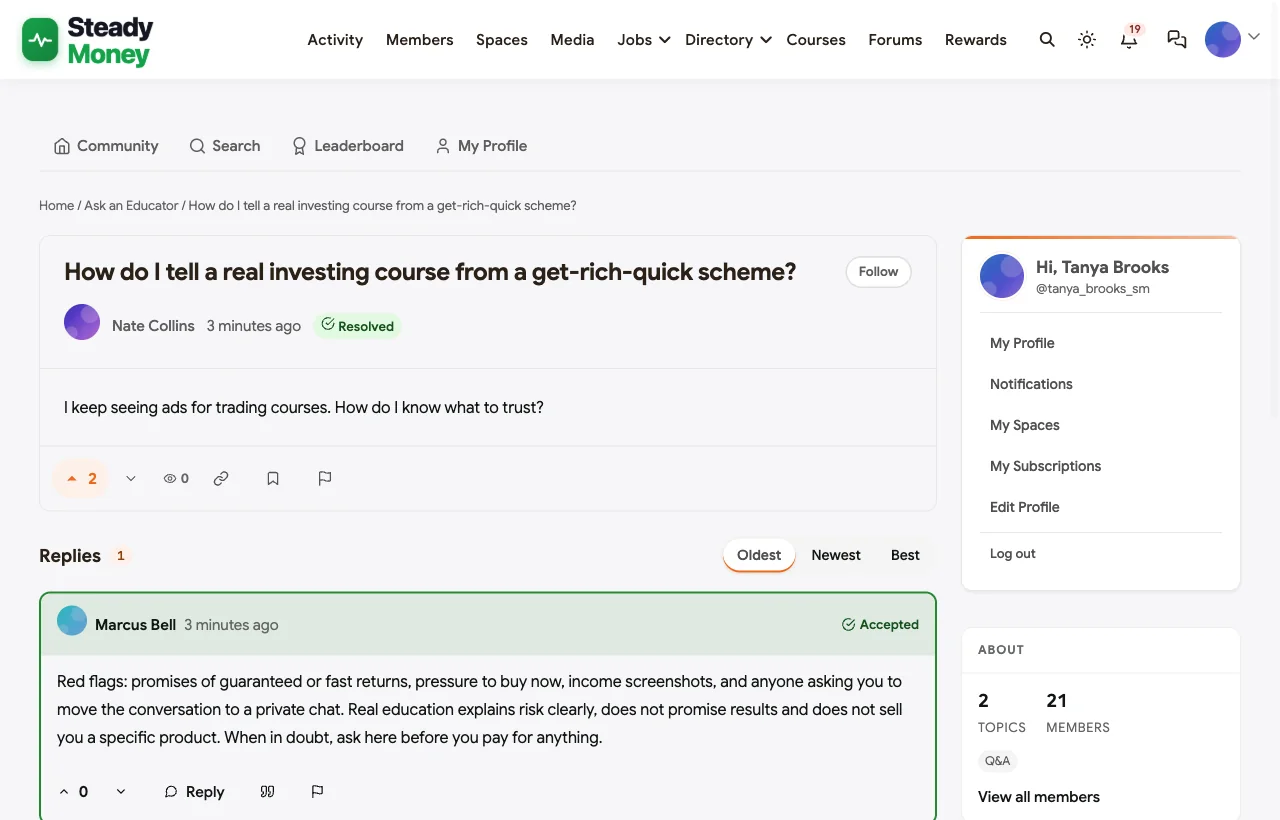
Moderation against scams and hype. The community rules ban personal investment advice from unlicensed members, sales, referral links and get-rich-quick offers. Members report anything suspicious, and moderators remove it and say so publicly:
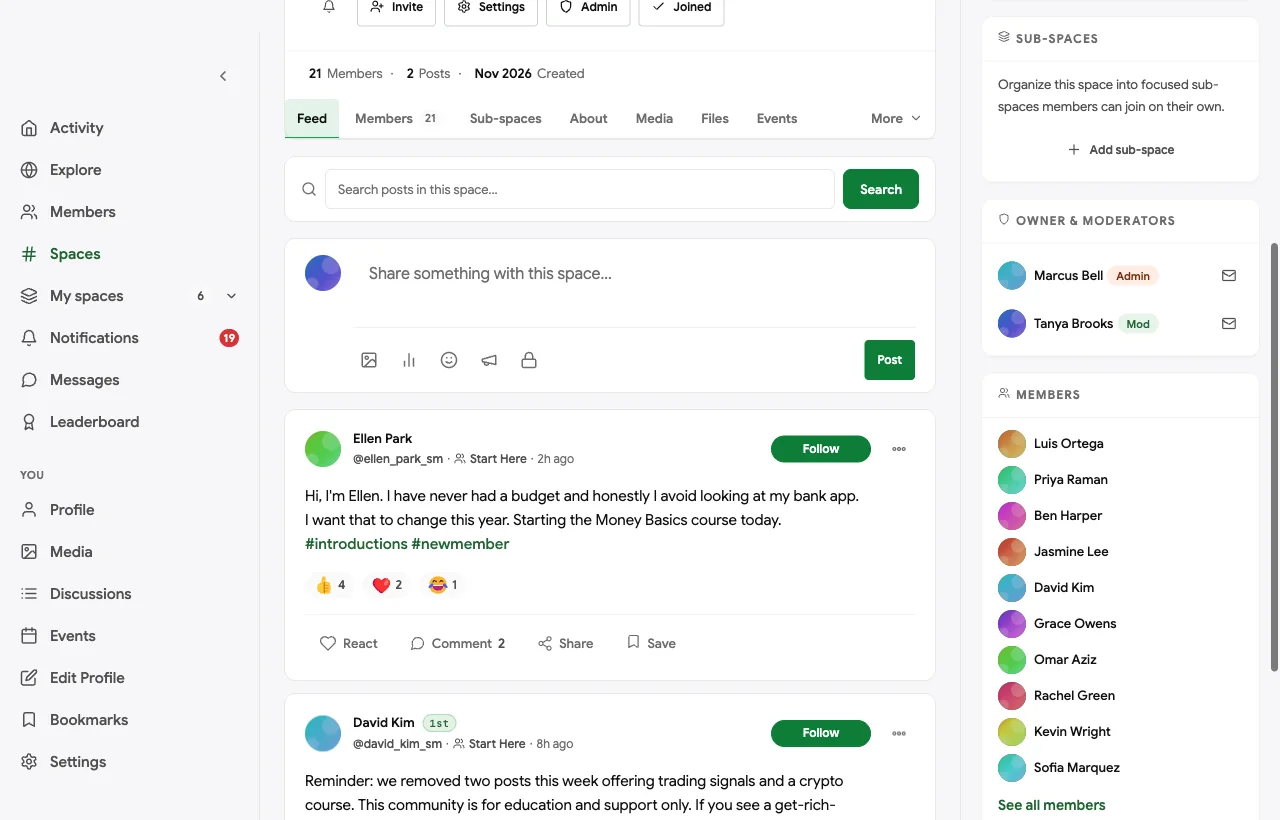
Wins without numbers. In Money Wins, members celebrate progress such as a paid-off card or a first automatic transfer, without sharing amounts:
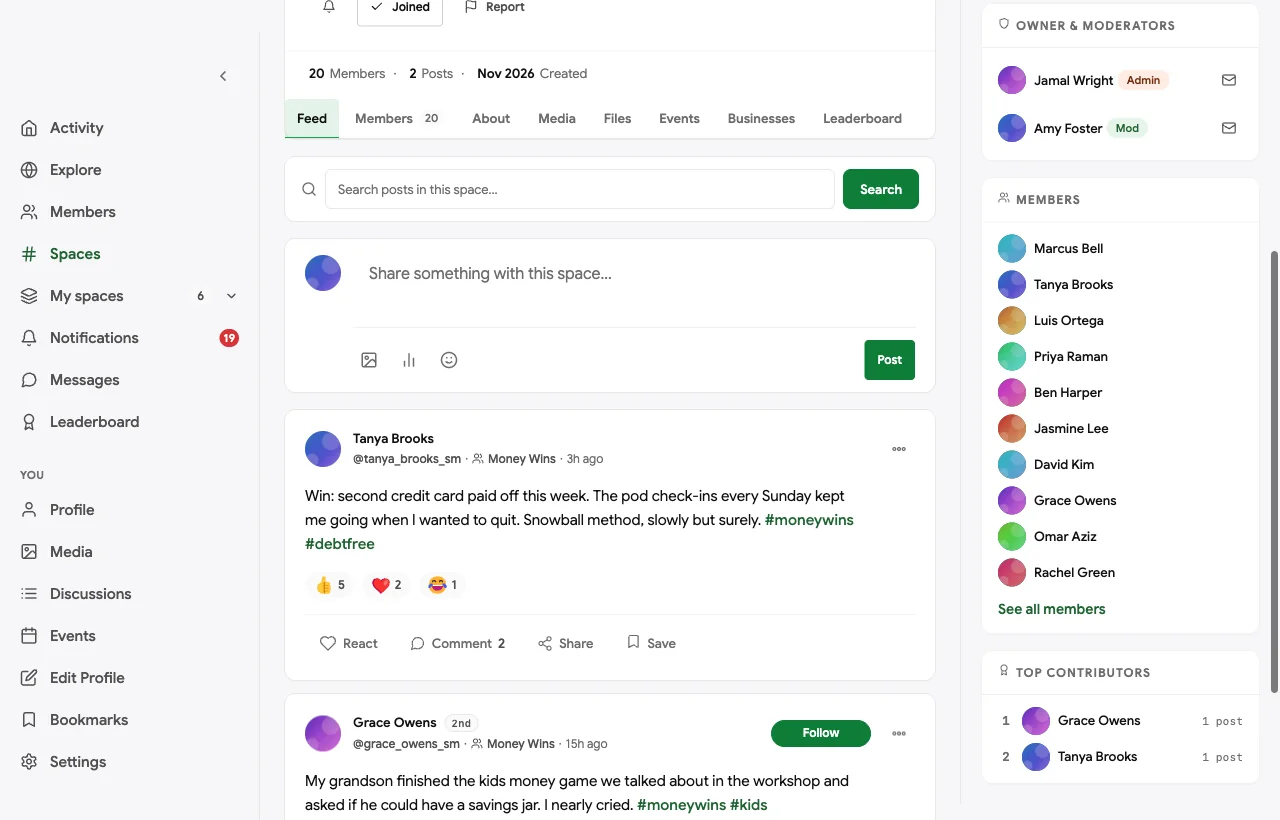
Live workshops in English and Spanish. Workshops on credit reports, budgeting and avoiding scams are events with recordings, including Spanish-language sessions:
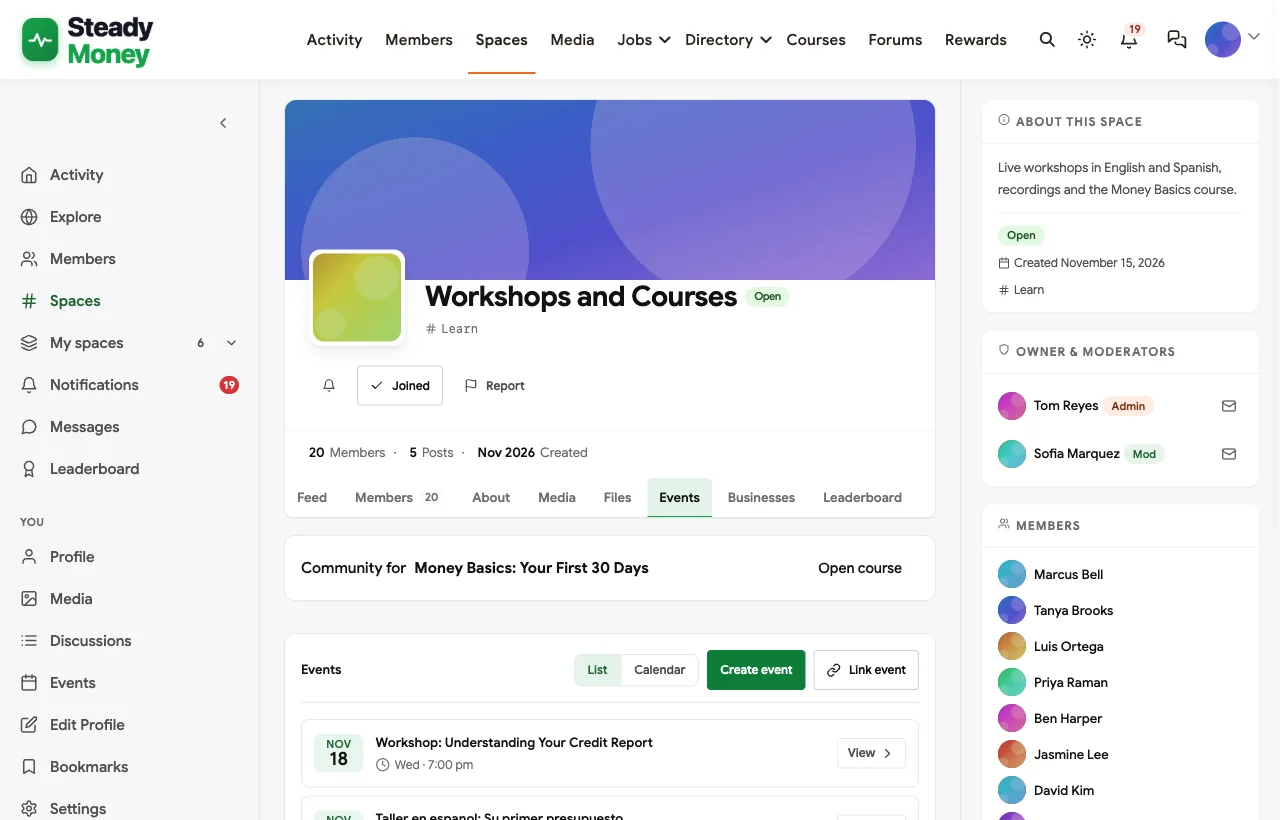
A welcome for people starting from zero. The educator and pod leaders message new members personally:
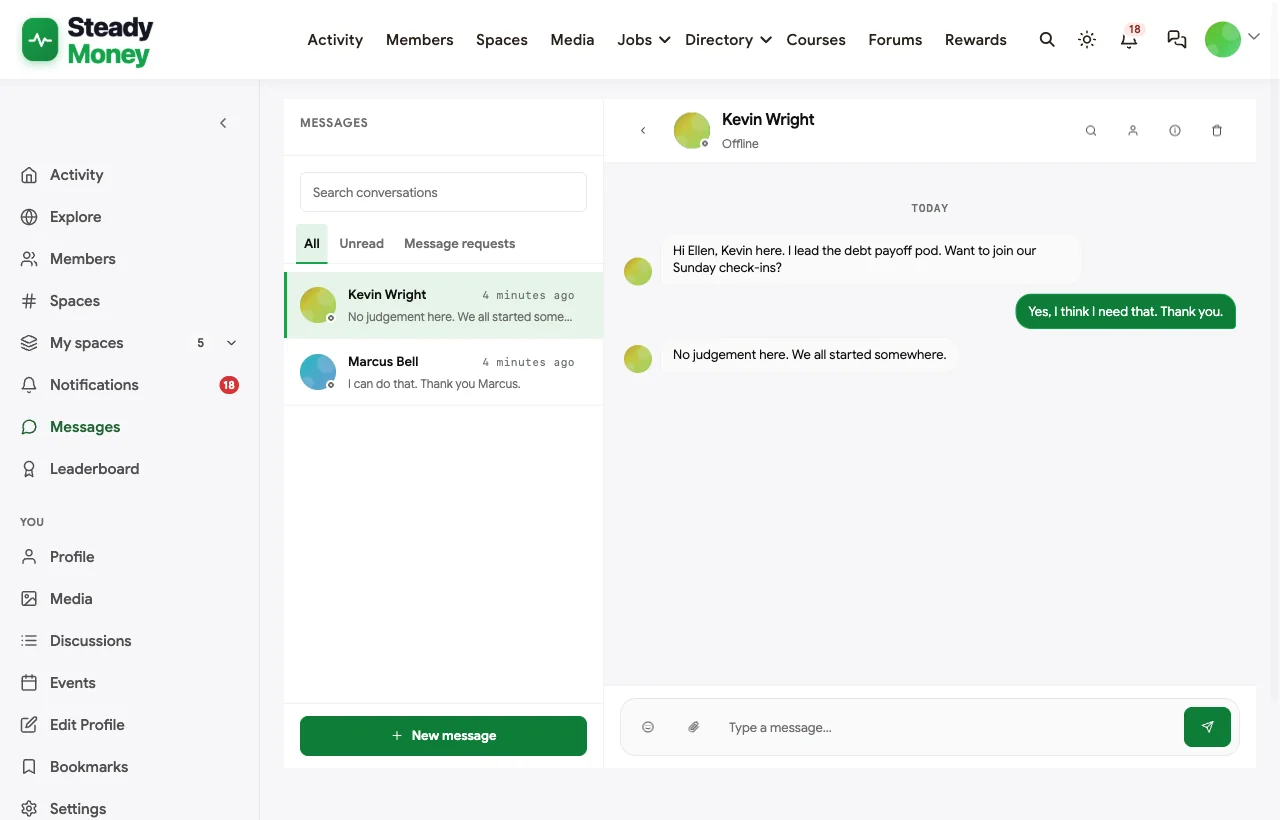
Also built in. Polls to choose workshops, points and a leaderboard for helpful answers and check-ins, a member directory with privacy controls, notifications, a secret educators room and a mobile layout that works on a phone.
Not built for: connecting to bank accounts, budgeting calculations or personalised financial advice. Members use their own budgeting tools; the community is for learning and accountability. It is self-hosted, so you run WordPress or use a managed host.
What’s included, and how it is delivered
BuddyNext is one platform made of a core and add-on platform modules. Everything shown in the demo above runs on the BuddyNext platform. This table shows which parts come with the core, which are platform modules you install and activate alongside it, and which need a third-party plugin, another system or custom work.
| Capability | How it is delivered |
|---|---|
| Open, private and secret spaces for challenges and pods | Core platform |
| Member profiles with privacy controls and member directory | Core platform |
| Activity feed, pinned announcements, polls and hashtags | Core platform |
| Reporting and moderation queue | Core platform |
| Direct messages | Platform module, installed alongside |
| Courses with quizzes and certificates | Platform module, installed alongside |
| Ask an Educator Q&A with accepted answers | Platform module, installed alongside |
| Workshops and pod check-ins as events | Platform module, installed alongside |
| Points, badges and leaderboards | Platform module, installed alongside |
| Paid memberships with trials and coupons | Platform module, installed alongside |
| Live video for workshops | Third-party video tool (Zoom, Google Meet) |
| Bank connections and budgeting calculations | Another system (members’ own budgeting tools) |
Want to click around yourself? The Steady Money School community in this guide was built on a private test site, so it is not public. The BuddyNext live demo is a general community you can open in your browser and explore without installing anything.
2. Thinkific: best course platform with community and moderation
Thinkific offers “quizzes, assignments, and certificates,” “live cohorts, self-paced, and blended formats,” “lesson-level discussions and comments,” “live events and scheduled sessions,” “moderation tools and admin roles” and a “branded native mobile app” (Thinkific).
Strengths: the most complete course platform here, with moderation and live sessions.
Gaps: no challenge or leaderboard features found; community is centred on lessons.
3. Teachable: best for a structured money course
Teachable helps you “maximize student engagement with videos, quizzes, drip content, and mobile access,” with “quizzes and completion certificates,” an AI quiz generator, a student community and iOS and Android apps (Teachable).
Strengths: quizzes and certificates for a clear beginner course.
Gaps: no live workshops, challenges or moderation tools found.
4. LearnWorlds: best for assessments and cohorts
LearnWorlds is “the #1 AI-powered LMS built for learning businesses” (LearnWorlds), with an assessment builder, certification management, “course discussions, private groups, and cohort spaces,” group sessions and a mobile app builder.
Strengths: strong assessments and private cohort groups.
Gaps: no challenges or moderation tools found.
5. Kajabi: best for a money coach selling courses and memberships
Kajabi builds courses from “modules, lessons, assessments, and drip schedules,” with communities, memberships and a member portal “with progress tracking and community feed” (Kajabi).
Strengths: courses, memberships and marketing in one product.
Gaps: no certificates, challenges, live workshops or moderation tools found.
6. Circle: best community-first platform with gamification
Circle lets you build “a home for your community, events, and courses,” with live events and streams, gamification, “automated moderation” and a branded app (Circle).
Strengths: community, live events, gamification and moderation.
Gaps: no quizzes or certificates found.
7. Mighty Networks: best for paid challenges
Mighty Networks offers “Community. Courses. Events.” and suggests you “start with a paid challenge,” using “monthly themes, weekly events, daily questions” (Mighty Networks).
Strengths: challenges as an entry point, with native apps.
Gaps: no quizzes, certificates or moderation tools found.
8. Skool: best for a simple paid group
Skool lets you “build your own community, courses, and events” and “charge subscription memberships or 1-time course purchases” (Skool).
Strengths: fast to set up.
Gaps: we could not confirm quizzes, certificates, gamification or moderation tools on its own pages; one flat group makes private pods harder.
9. Zogo: best ready-made gamified content for credit unions
Zogo offers “gamified education, real-world growth” with “1,200+ modules,” points users “earn as they learn,” and “personalized learning pathways,” sold to credit unions, community banks, fintechs and schools (Zogo).
Strengths: a large library of gamified financial lessons for institutions.
Gaps: content, not community: no discussion, educator Q&A or workshops found.
10. EVERFI: best standards-aligned courses for schools and institutions
EVERFI offers “standards-aligned” digital courses, “more than 100 bite-sized, mobile-first learning modules available in English and Spanish,” and reporting on “reach, engagement, and community impact,” and says “3 in 5 U.S. school districts use Everfi” (EVERFI).
Strengths: ready-made courses for schools, banks and employers.
Gaps: no community, Q&A, challenges or workshops found.
Content and community: using both
Credit unions and nonprofits often license ready-made content like Zogo or EVERFI and still need a place for members to ask questions, keep each other accountable and attend workshops. A common setup is to point members to licensed lessons for the basics, and run the community for challenges, pods, Q&A and live sessions. Educators who write their own material can run both in one place.
Keeping a money community safe
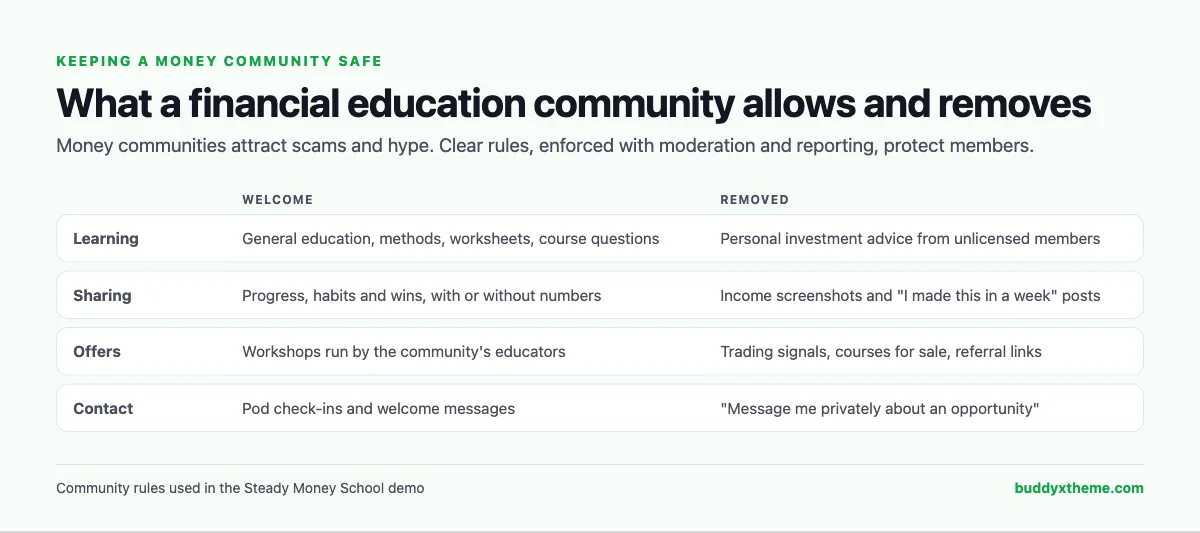
| Practice | Why it matters |
|---|---|
| Education, not personal advice | Members get general knowledge and are pointed to licensed professionals for their situation |
| No sales, signals or referral links | The community never becomes a funnel for someone else’s product |
| Report private-message pitches | Scammers often move conversations out of public view |
| Remove posts and say why | Members learn the rules from real examples |
| Never require amounts | Shame keeps people silent; privacy keeps them participating |
Running accountability pods
| Practice | How |
|---|---|
| Keep pods small | Six to ten members per pod |
| Pick a pod leader | A member a few steps ahead, not an expert |
| Same day every week | A short check-in thread or call |
| One win, one obstacle, one next step | Keeps check-ins short and honest |
| Celebrate publicly with permission | Move big wins to the wins space |
Questions to ask before you choose
- Is your main product a course or a community? Course platforms suit structured learning; community platforms suit ongoing accountability.
- Can members join small private groups? Pods are where habits change.
- How will you handle advice? Make the education-only rule visible and moderate it.
- Can you run challenges? A challenge is often the best entry point for beginners.
- Do you need more than one language? Workshops and spaces in members’ first language widen your reach.
- Who owns the community? A self-hosted community keeps member data on your own website.
A 30-day launch plan
- Week one: rules and structure. Write the education-only rules, create Start Here, Ask an Educator, Money Wins and Workshops, and appoint moderators.
- Week two: the course. Publish a short beginner course with a quiz per module.
- Week three: the challenge. Announce a 30-day challenge with a kickoff event and daily tasks.
- Week four: pods. Form the first accountability pods from challenge participants and choose pod leaders.
Which platform fits your financial education program?
| If you… | Choose |
|---|---|
| Want courses, a challenge, pods, educator Q&A, workshops and strong moderation in one community you own | BuddyNext |
| Want a course platform with moderation and live sessions | Thinkific |
| Want a simple course with quizzes and certificates | Teachable |
| Want strong assessments and cohort groups | LearnWorlds |
| Are a money coach selling courses and memberships | Kajabi |
| Want a community-first hosted platform | Circle or Mighty Networks |
| Want a simple paid group | Skool |
| Need ready-made content for an institution | Zogo or EVERFI |
More community platform comparisons
Running a different kind of learning community? These guides use the same method: a working demo community and vendor claims checked at the source.
- Best software for an online course community: course creators who want learners to finish.
- Best platforms for a paid coaching membership community: coach-led memberships with group calls.
- Best software for a nonprofit volunteer community: training, shifts and recognition for volunteers.
- Best platforms for an online fitness community: challenges, streaks and accountability.
- How to set up a community space on WordPress: the step-by-step setup guide behind every demo in this series.
How we built and checked this list
We built the Steady Money School demo on a local WordPress site running BuddyNext, with fictional members, educators, a course, a challenge, pods, questions and workshops created for this guide. Every BuddyNext screenshot is from that demo, and no member shares amounts. Competitor features were checked against each vendor’s own website in November 2026, and the financial literacy findings come from the FINRA Investor Education Foundation. Where we could not confirm a feature on a vendor’s own pages, the scorecard says “Not found” or “Not confirmed”. We did not run a hands-on trial of every product, so features can change; confirm anything critical with the vendor. Nothing in this guide is financial advice. buddyxtheme.com is published by the team behind BuddyNext, which is why BuddyNext is listed first; we have tried to be fair about its gaps as well as its strengths.
Frequently asked questions
What is the best platform for a financial education community?
BuddyNext is the best choice for a financial education community you own, with a beginner course with quizzes and certificates, a 30-day challenge, private accountability pods, an Ask an Educator space, workshops and strong moderation. Thinkific is the strongest alternative if courses come first.
How do I run a 30-day budget challenge online?
Create a challenge space, publish one small task a day, ask members to post a short check-in, run a kickoff event and invite finishers to join accountability pods.
How do I keep scams out of a money community?
Publish clear rules against sales, signals, referral links and unlicensed advice, encourage members to report private-message pitches, remove violations quickly and explain why.
Can educators answer money questions without giving personal advice?
Yes. Frame answers as general education, explain common approaches and trade-offs, and point members to licensed professionals or nonprofit counselors for their specific situation.
Should members share amounts in a financial community?
Only if they want to. Many members feel safer sharing progress without numbers, and requiring amounts keeps people from participating.
Can a credit union run a financial education community?
Yes. A credit union can run courses, challenges, workshops and pods for members, and combine them with licensed content from providers like Zogo or EVERFI.
Do members need an app?
BuddyNext works in the mobile browser without an app download, so members can check in from their phones.
The bottom line
Money habits change when people learn the basics, take small daily steps and have others alongside them, in a space free of hype. If you want a beginner course, a 30-day challenge, accountability pods, trusted answers, workshops and strong moderation in a community you own, BuddyNext is the strongest foundation. If courses come first, Thinkific, Teachable and LearnWorlds lead.
And help people build money skills together.