
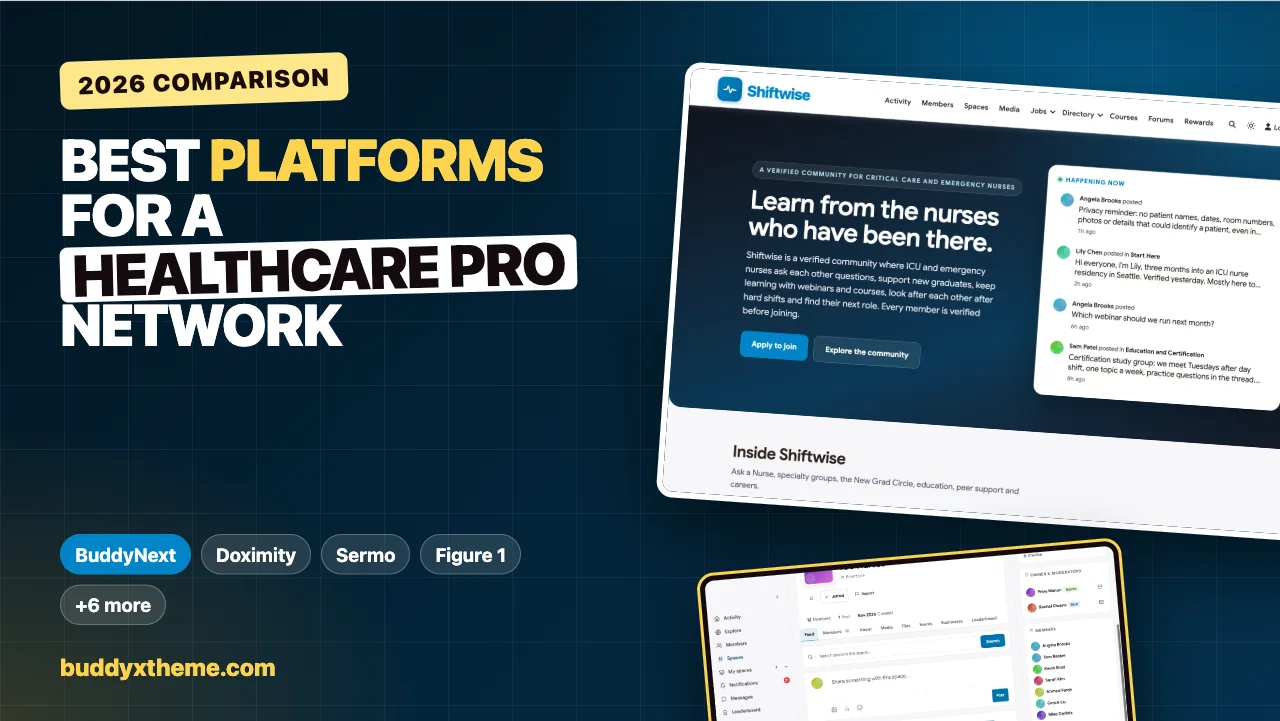
Clinicians learn from each other constantly: the charge nurse who shows a new graduate how to organise a night shift, the educator who shares a better handover checklist, the colleague who notices you are not okay after a hard case. Most of that learning happens on the unit and disappears when the shift ends. A professional network can keep it going across hospitals, specialties and shifts, as long as it is built on two things clinicians will not compromise on: knowing who is in the room, and protecting patients.
This guide compares the platforms used to run or join a healthcare professionals network, from specialty societies and nursing education organisations running their own verified community to the clinician networks individual professionals join. It covers verified sign-up, specialty groups, case and practice discussion without patient-identifiable information, courses and webinars with certificates, mentoring, peer support and jobs. We built a working community for critical care and emergency nurses for the first entry and checked every competitor claim on the vendor’s own pages in November 2026.
Quick answer
If you want to run your own verified network for clinicians, BuddyNext is the strongest choice: approval-only sign-up with professional profile fields, private specialty groups, a Q&A space where experienced colleagues answer, courses with certificates, webinars, a new graduate circle, a moderated peer support space and a job board, on your own website. If you want to join an existing physician network rather than run one, Doximity, Sermo and Figure 1 are the established options, and Higher Logic Thrive suits large associations.
In this guide
- Run your own network or join one?
- Why clinician communities matter now
- The healthcare network scorecard
- 1. BuddyNext: best for running your own verified clinician network
- 2. Doximity: best established network for US clinicians
- 3. Sermo: best for verified physician case discussion
- 4. Figure 1: best for de-identified case learning
- 5. Higher Logic Thrive: best for large professional associations
- 6. Discourse: best self-hostable forum with data portability
- 7. Circle: best hosted community with courses and events
- 8. Disciple: best for a branded app with data export
- 9. Bettermode: best for a hosted community with a job board
- 10. Mighty Networks: best app-first community
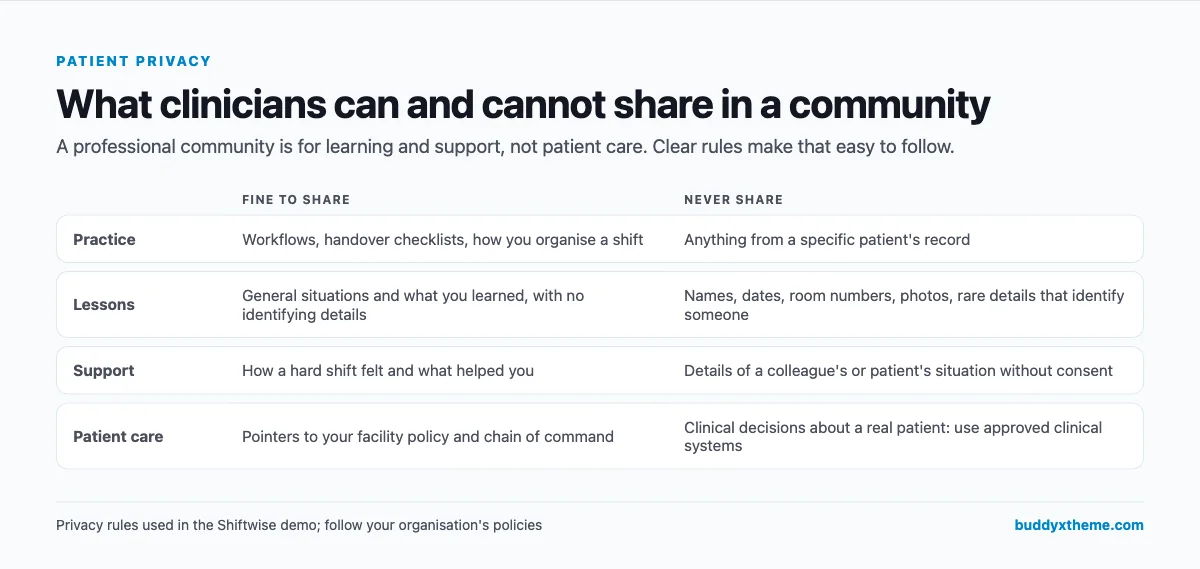
- Patient privacy in a professional community
- Supporting new graduates and preventing burnout
- Questions to ask before you choose
- A 60-day launch plan for a clinician network
- Which platform fits your healthcare network?
- More community platform comparisons
- How we built and checked this list
- Frequently asked questions
- The bottom line
Run your own network or join one?
| Approach | What it is | Examples |
|---|---|---|
| Join an existing clinician network | A national or global network where individual professionals sign up | Doximity, Sermo, Figure 1 |
| Run your own professional community | A network for your organisation, society, education program or specialty, with your own rules and brand | BuddyNext, Higher Logic Thrive, Discourse, Circle, Disciple, Bettermode, Mighty Networks |
Existing networks are large and convenient for individuals. Organisations that want a community for their own members, such as a specialty society, a nursing education program, a health system’s nurse residency or a regional network, need a platform they control, with their own verification, groups, education and support.
Why clinician communities matter now
The workforce is growing and turning over at the same time. The U.S. Bureau of Labor Statistics projects that “about 1.9 million openings are projected each year, on average,” in healthcare occupations “due to employment growth and the need to replace workers who leave the occupations permanently” (BLS). Globally, the World Health Organization notes that “the estimated stock of health workers now exceeds 70 million” (WHO).
Every one of those openings is a new colleague who needs to learn the unwritten parts of the job, and every departure takes experience with it. A community that connects new and experienced professionals, keeps education going and gives people somewhere to turn after hard shifts is part of how organisations keep their people.
The healthcare network scorecard
How each option handles what matters most. “Not found” means we could not confirm it on the vendor’s own pages, not that it is impossible.
| Platform | Type | Verified sign-up | Specialty groups | Courses or CME | Peer Q&A | Job board | Run your own |
|---|---|---|---|---|---|---|---|
| BuddyNext | Community platform | Approval-only, profile fields | Private and secret spaces | Courses with certificates | Accepted answers | Yes | Yes, self-hosted |
| Doximity | Clinician network | Verified network | Not confirmed | Doximity Academy | Not found | Not confirmed | No |
| Sermo | Physician network | Licence or ID check | 96+ specialties | Not found | Case discussion | Not found | No |
| Figure 1 | Case-sharing network | Verified professionals | Not found | Not found | Case discussion | Not found | No |
| Higher Logic Thrive | Association platform | Not confirmed | Not confirmed | Not confirmed | Discussions and Q&A | Not found | Yes, hosted |
| Discourse | Forum | Not confirmed | Groups and roles | Not found | Not confirmed | Not found | Yes |
| Circle | Community platform | Not found | Spaces | Courses | Not found | Not found | Yes, hosted |
| Disciple | Branded app | Not found | Groups | Not found | Not found | Not found | Yes, hosted |
| Bettermode | Community platform | Not found | Not confirmed | Academy | Not confirmed | Job board | Yes, hosted |
| Mighty Networks | Community platform | Not found | Spaces | Courses | Not found | Not found | Yes, hosted |
1. BuddyNext: best for running your own verified clinician network
BuddyNext is a complete community platform that runs on your own WordPress site. Registration can be set to admin approval, profiles carry custom fields for role, specialty and employer, and private and secret spaces, Q&A with accepted answers, courses with certificates, events, a job board, direct messages and moderation tools work together. An organisation can run a professional network under its own brand, on a server it chooses.
To show it in practice, we built Shiftwise, a demo verified community for critical care and emergency nurses run by a fictional nursing education organisation. It has 20 members: ICU, emergency, flight, pediatric, burn and rural nurses, a nurse practitioner, a charge nurse, a nurse manager, educators, a preceptor, a travel nurse, a new graduate, a nursing student, a peer support lead, a recruiter and a verification team.
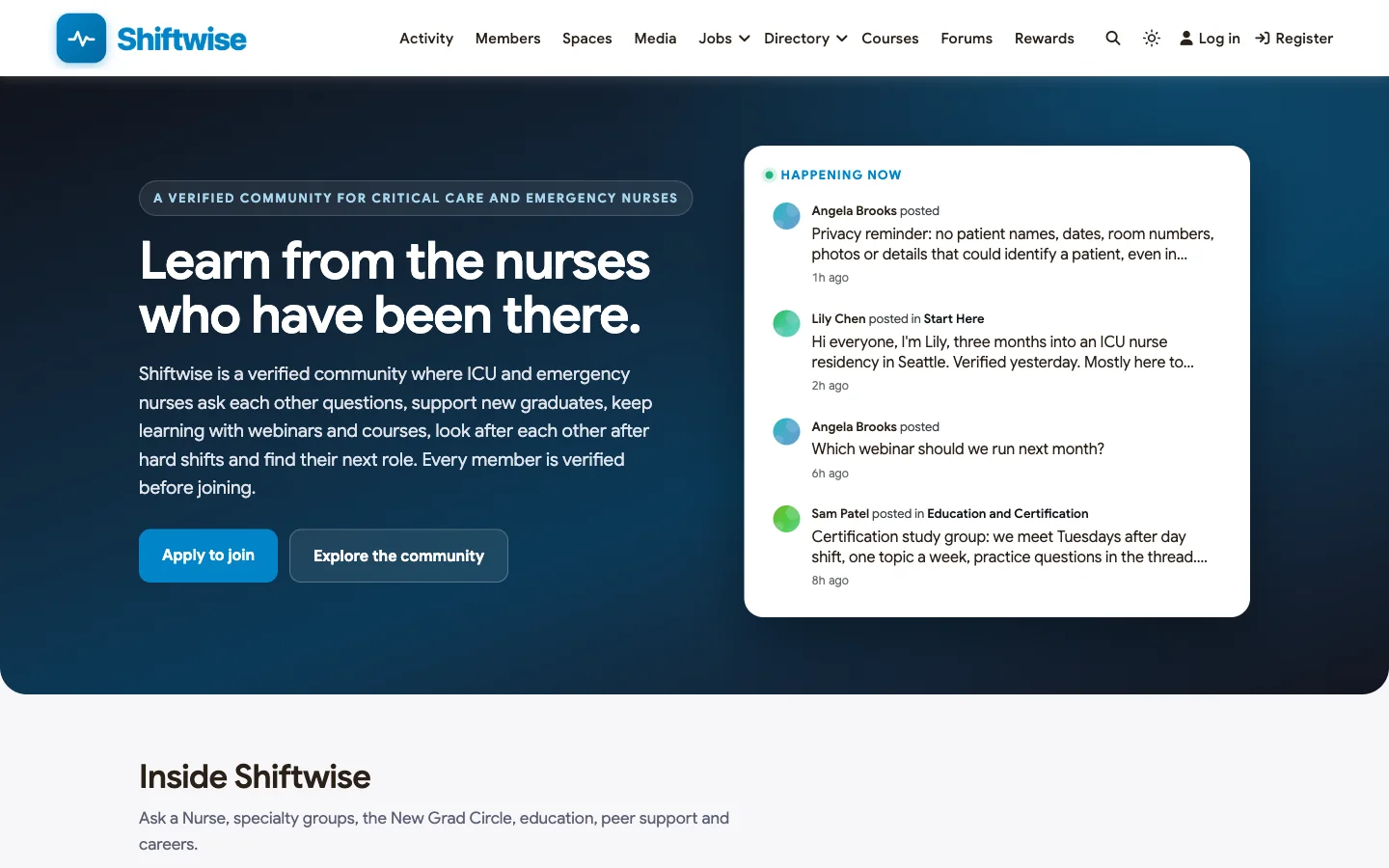
Good at: knowing who is in the room, specialty groups that stay private, supporting new graduates, and looking after colleagues.
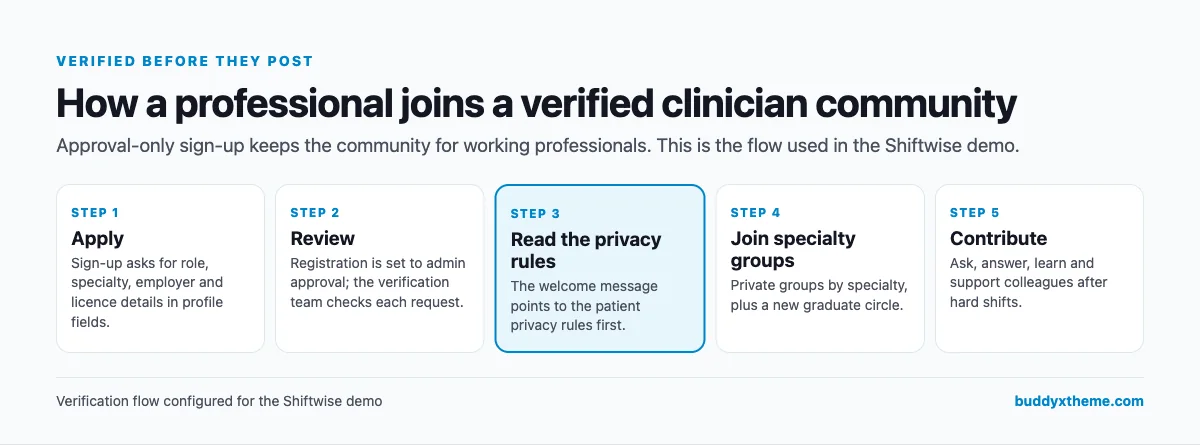
Verified, approval-only sign-up. Registration is set so the verification team reviews every request. Profile fields capture role, specialty and employer, and the first thing every approved member sees is the privacy rules:
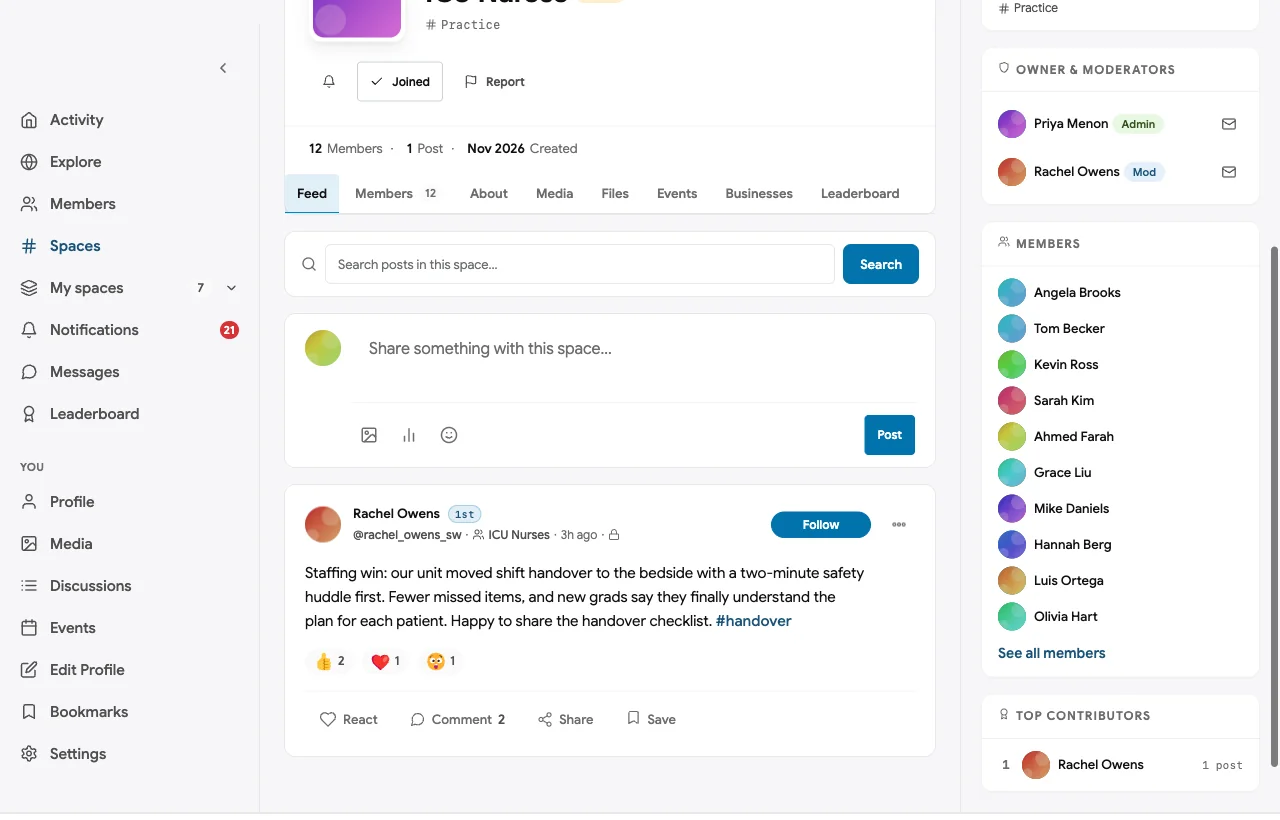
Private specialty groups. ICU nurses and emergency nurses each have a private space for workflow, equipment, staffing and shift life. In the demo, an ICU charge nurse shares how bedside handover with a two-minute safety huddle reduced missed items:
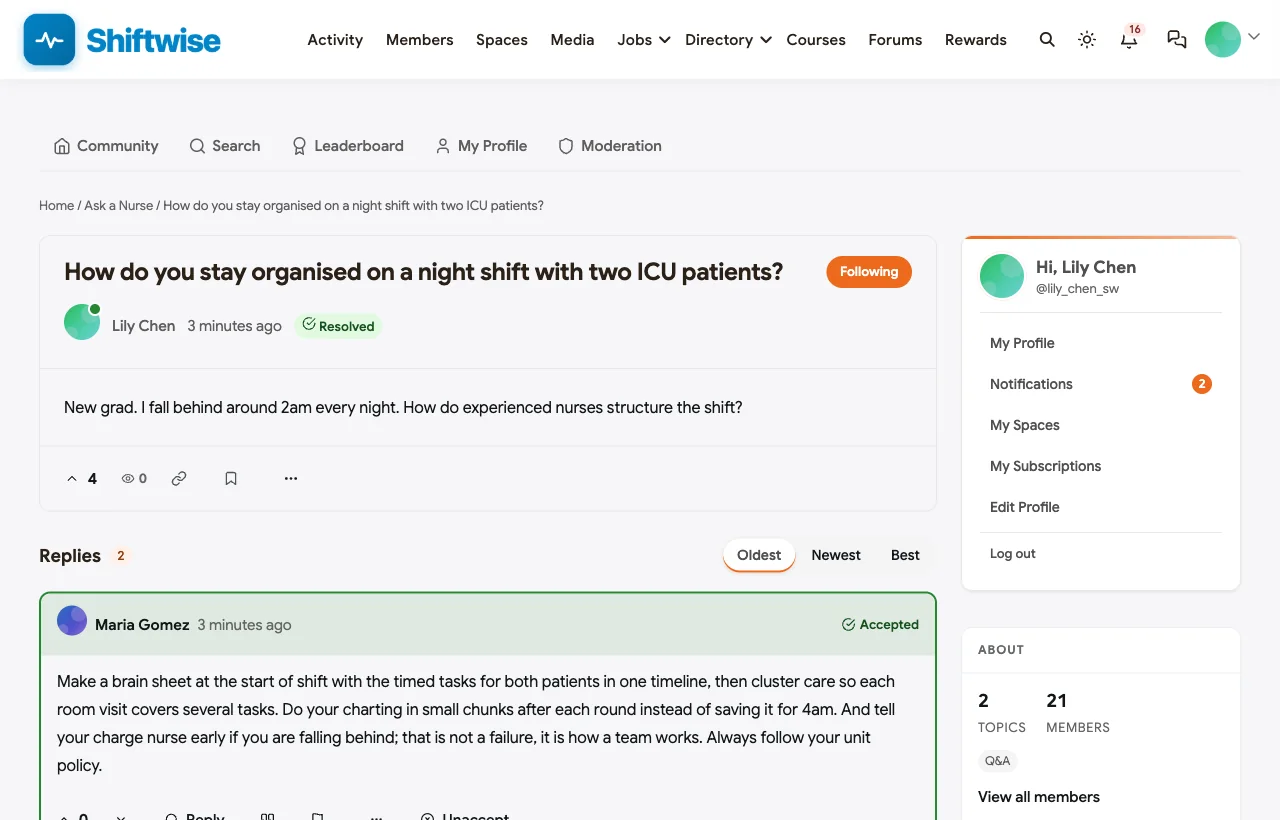
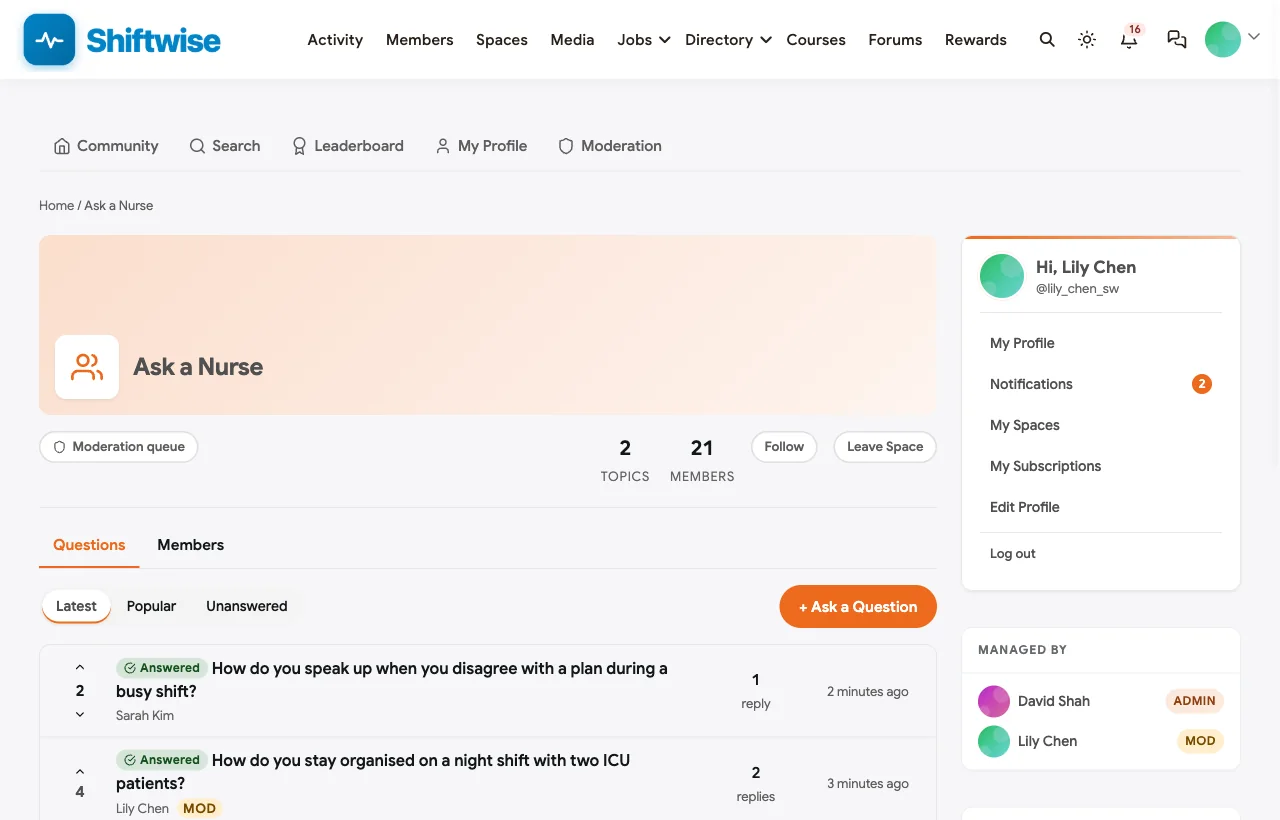
Ask a Nurse, with accepted answers. Practice, workflow and communication questions are answered by experienced colleagues, and the most helpful answer is marked accepted. The space makes clear that answers are peer experience, not clinical orders. In the demo, a new graduate asks how to stay organised on night shift, and a nine-year ICU nurse’s answer becomes the reference:
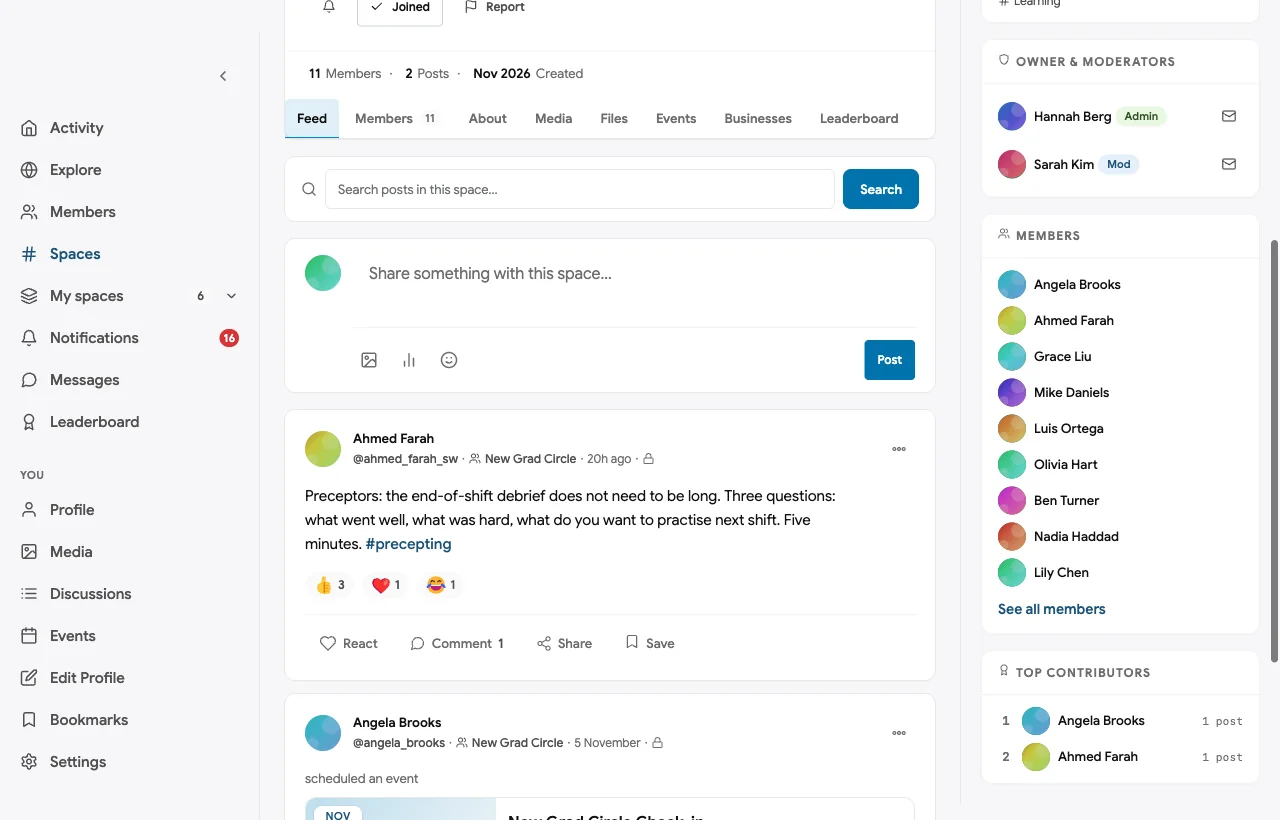
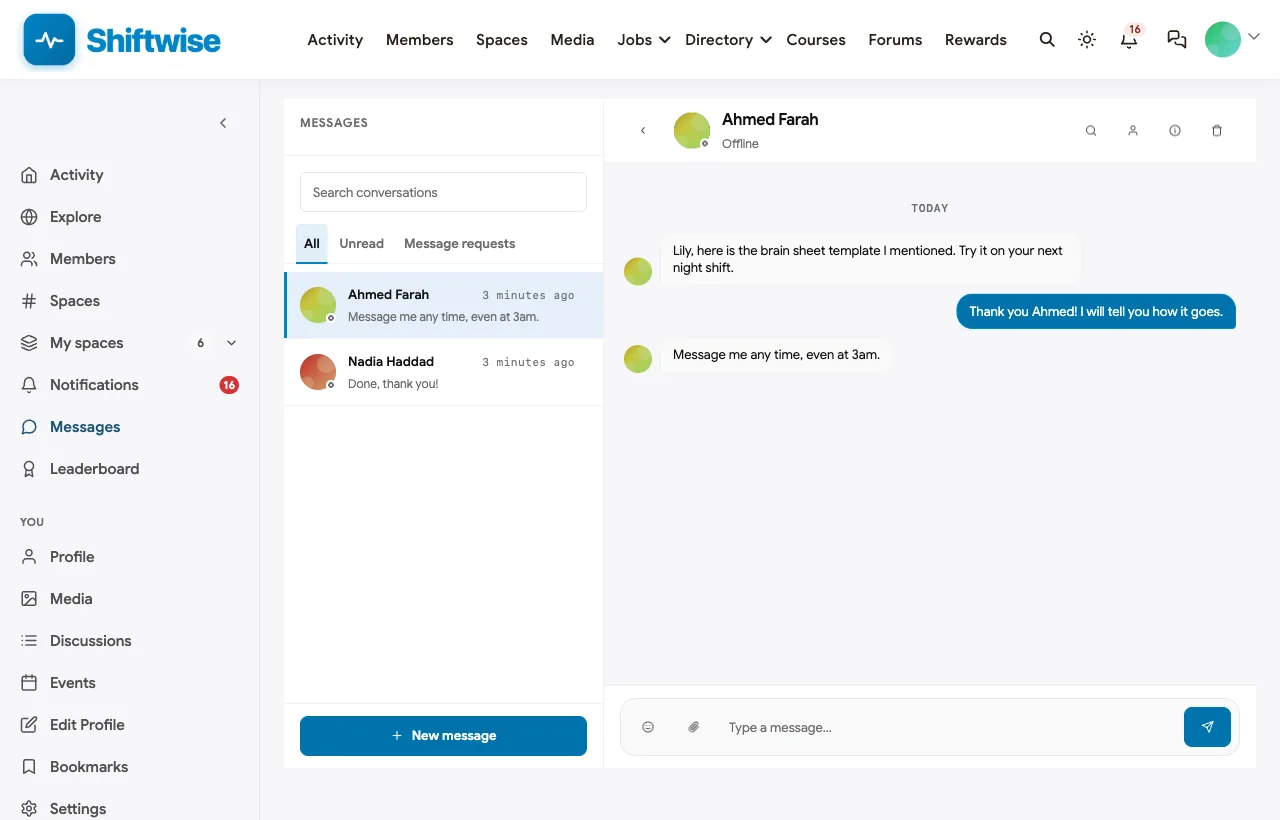
A New Grad Circle with preceptors. New graduates and final-semester students have a private space with the preceptors who support them, and preceptors share templates and debrief routines by direct message:
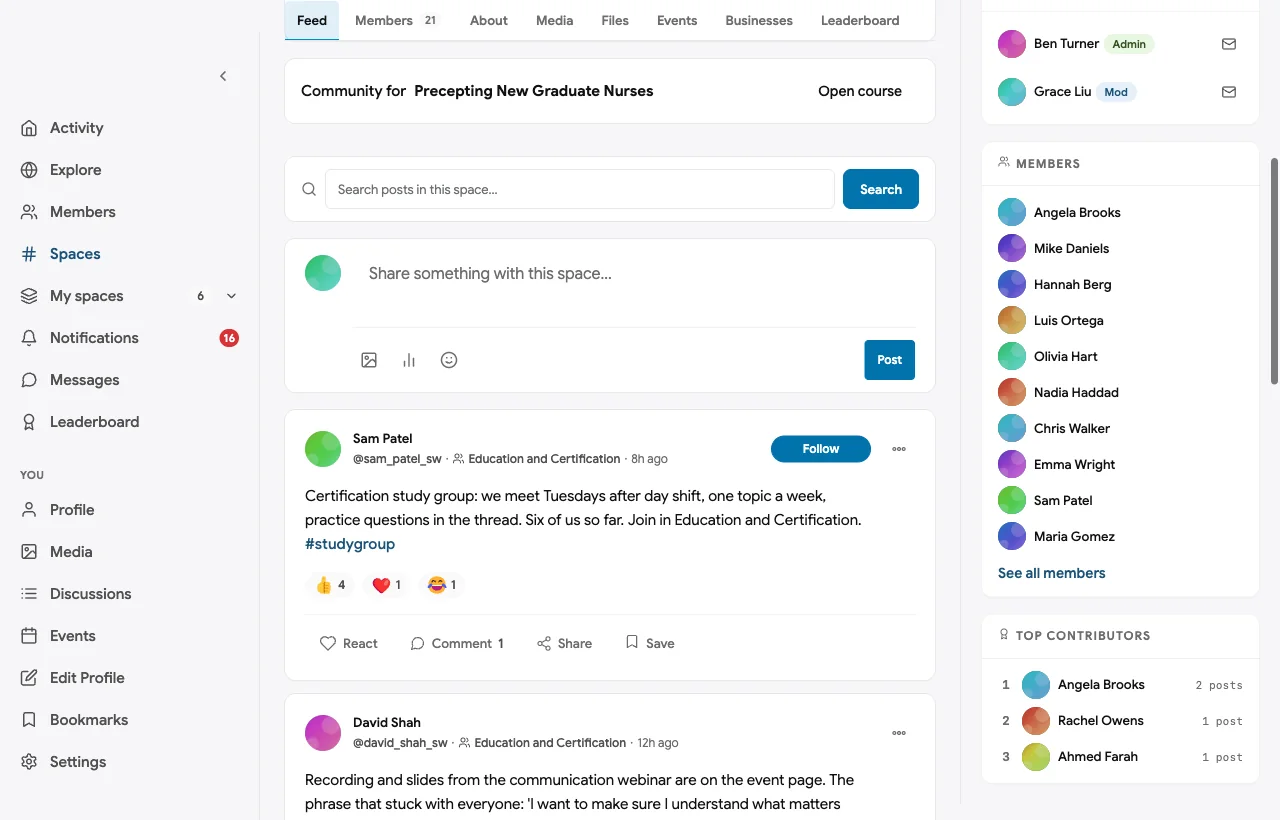
Education with certificates. A course for preceptors runs in short modules with reflection questions and a certificate of completion. Webinars run in the evening and are recorded for nurses on nights, and a certification study group meets weekly:

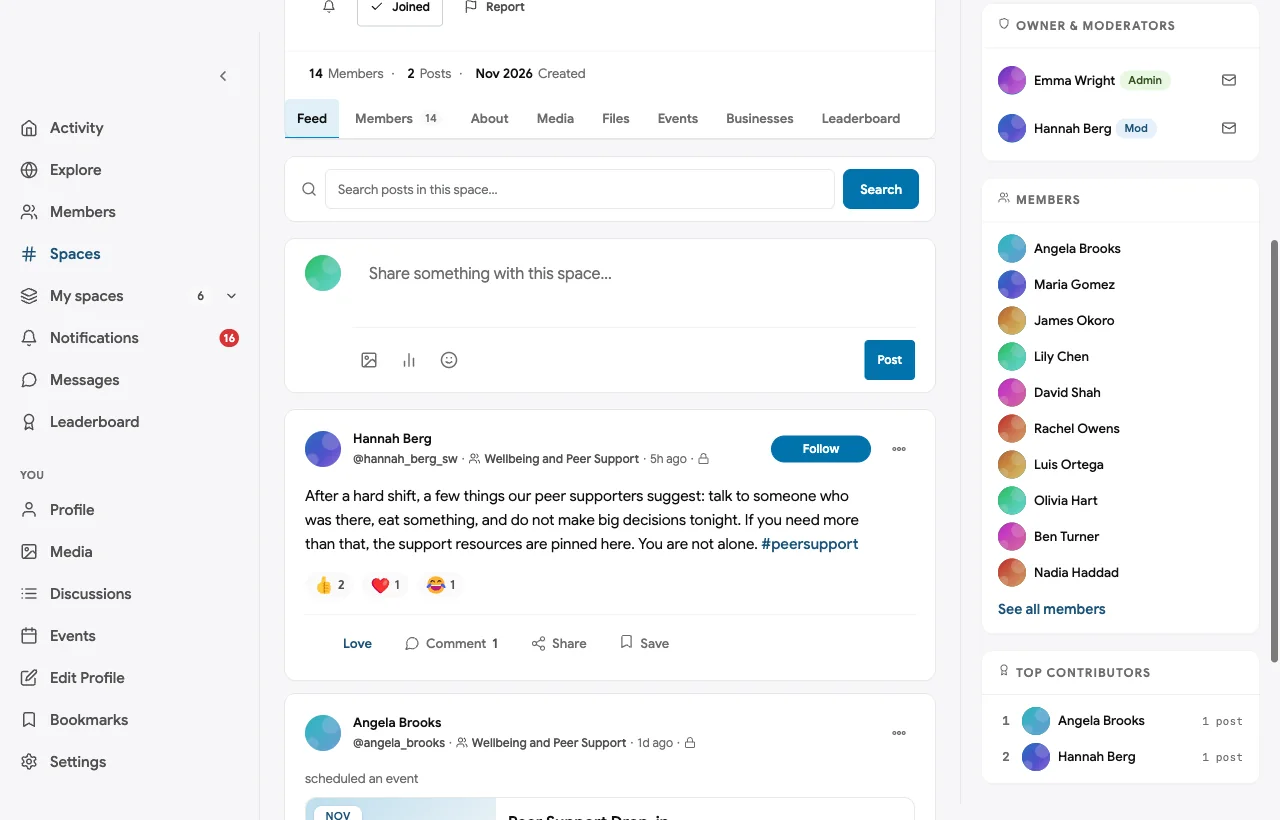
Moderated peer support. A private Wellbeing and Peer Support space, moderated by trained peer supporters, gives nurses a quieter place after hard shifts, with support resources pinned at the top and a morning drop-in after night shift:
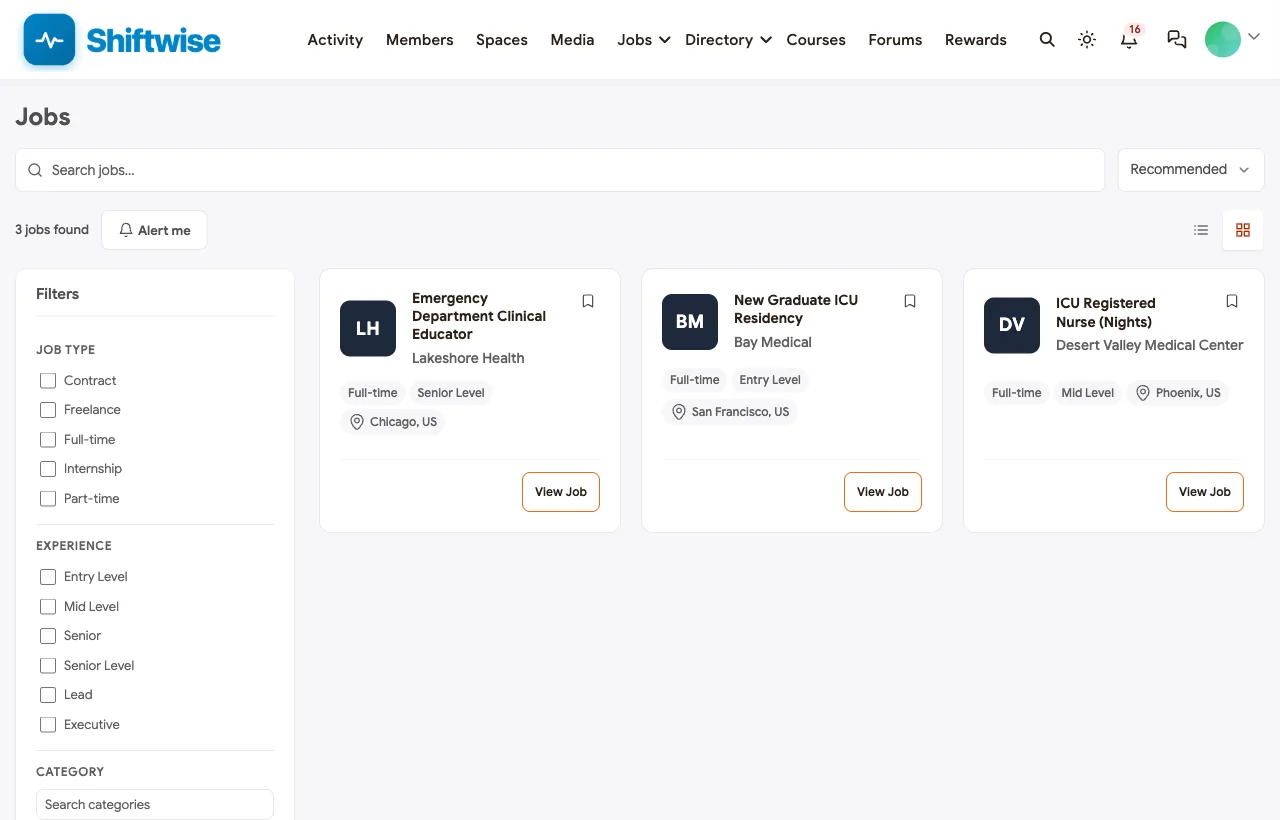
Careers and jobs. Verified employers post roles on the job board, from night shift ICU positions to new graduate residencies and educator roles:
Also built in. Polls for webinar topics, a member directory with privacy controls, notifications, reporting and a moderation queue, points and a leaderboard for helpful answers, optional two-factor sign-in that can be required for staff or everyone, and a mobile layout that works on a phone during a break.
Not built for: protected health information or clinical care. BuddyNext is a professional community, not a clinical communication system, so patient information never belongs in it. It is self-hosted, so your team or a managed host runs and secures WordPress.
What’s included, and how it is delivered
BuddyNext is one platform made of a core and add-on platform modules. Everything shown in the demo above runs on the BuddyNext platform. This table shows which parts come with the core, which are platform modules you install and activate alongside it, and which need a third-party plugin, another system or custom work.
| Capability | How it is delivered |
|---|---|
| Admin-approval registration and email domain rules | Core platform |
| Profile fields for role, specialty and employer | Core platform |
| Two-factor sign-in, required by role | Core platform |
| Open, private and secret spaces | Core platform |
| Activity feed, pinned announcements, polls and hashtags | Core platform |
| Reporting and moderation queue | Core platform |
| Direct messages | Platform module, installed alongside |
| Q&A with accepted answers | Platform module, installed alongside |
| Courses with certificates | Platform module, installed alongside |
| Webinars and events with RSVPs | Platform module, installed alongside |
| Job board | Platform module, installed alongside |
| Points, badges and leaderboards | Platform module, installed alongside |
| Automated licence verification against registries | Another system or custom work |
| Clinical communication with patient data | Another system (an approved clinical tool) |
Want to click around yourself? The Shiftwise community in this guide was built on a private test site, so it is not public. The BuddyNext live demo is a general community you can open in your browser and explore without installing anything.
2. Doximity: best established network for US clinicians
Doximity describes itself as “the largest verified network of healthcare professionals in the U.S.” (Doximity). It offers “Doximity Academy” courses and secure messaging to “collaborate on patient treatment when you’re on-call.” Its security page states it is “SOC 2 Type 2 and HIPAA/HITECH certified,” encrypts PHI at rest and enters “into a Business Associate Agreement with each individual user upon registration” (Doximity security).
Strengths: scale, verification and the strongest documented security for clinical messaging.
Gaps: a network you join, not one you run for your own organisation; specialty groups and jobs were not confirmed on the pages we checked.
3. Sermo: best for verified physician case discussion
Sermo is “an online community for verified physicians and healthcare professionals” (Sermo). Members verify with a “professional registration number or documentation, such as a healthcare license or hospital ID badge,” “collaborate across 96+ specialties,” and “discuss challenging cases.” Sermo reminds members that “verified membership does not replace your responsibility to maintain confidentiality.”
Strengths: strong verification and broad specialty coverage for physicians.
Gaps: you join Sermo’s network rather than run your own; no courses or job board found.
4. Figure 1: best for de-identified case learning
Figure 1 is “the largest community of verified healthcare professionals working together, safely and securely, to improve patient outcomes” (Figure 1). It is designed “to remove identifying information, like a person’s name, birthday, ID numbers, and 17 other items,” with trained humans reviewing each image (Figure 1 about), and its guidelines require members to “maintain patient privacy at all times” (Figure 1 guidelines).
Strengths: case-based learning with de-identification and human review.
Gaps: not a platform to run your own community; no courses, jobs or mentoring found.
5. Higher Logic Thrive: best for large professional associations
Higher Logic connects “community, communications, data, and AI into one intelligent ecosystem” for professional and trade associations (Higher Logic). It offers “discussions and Q&A,” public and private libraries, events “from RSVP-only webinars to multi-day conferences,” an AI assistant that finds answers in community content, and engagement scoring (Higher Logic platform).
Strengths: association-grade discussions, libraries, events and analytics.
Gaps: no learning module, career center or verification feature confirmed on the pages we checked.
6. Discourse: best self-hostable forum with data portability
Discourse lets you “organize members with groups and roles,” offers “private messaging and DMs,” “SSO and social logins,” and says “export everything, anytime. Self-host or use our managed hosting” (Discourse). It adds, “we’ve never sold user data and never will.”
Strengths: open source, self-hostable and strong on data portability.
Gaps: no courses, job board or verification workflow found.
7. Circle: best hosted community with courses and events
Circle lets you “customize your spaces, prompt discussions, host live events, and launch your course” under your own brand, with a branded app (Circle).
Strengths: a polished hosted community with courses and events.
Gaps: no member verification, job board or data export statement found.
8. Disciple: best for a branded app with data export
Disciple offers “your community. Your brand. Your own app.” with “a white-labelled app on iOS, Android and Web,” groups, events, “DMs and group chats,” “full data export” and “GDPR compliant · ISO certified” (Disciple).
Strengths: a branded mobile app and clear data ownership.
Gaps: no verification, courses or job board found.
9. Bettermode: best for a hosted community with a job board
Bettermode helps you “build a community your audience loves,” with discussion, events, members, a knowledge base, an Academy and a job board, and states it “is SOC 2 Type II compliant and supports GDPR” with data “owned by you” (Bettermode).
Strengths: a broad hosted feature set including a job board.
Gaps: no verification workflow found; group details were not confirmed.
10. Mighty Networks: best app-first community
Mighty Networks offers “real iOS and Android apps on your members’ home screens,” spaces, courses and events (Mighty Networks).
Strengths: native mobile apps that suit clinicians on the move.
Gaps: no verification, certificates or job board found.
Patient privacy in a professional community
A professional network is for learning and support. Patient care belongs in approved clinical systems.
| Practice | Why it matters |
|---|---|
| Pin the privacy rules and point new members to them first | Everyone knows the boundary before they post |
| Talk about situations and lessons, not people | Learning travels; identities never do |
| Moderators remove identifying details quickly and privately | Mistakes are corrected without shaming |
| Make peer answers clearly peer experience | Members follow their facility policies |
| Keep clinical communication in approved tools | Communities are not designed for patient data |
Supporting new graduates and preventing burnout
| Practice | How the community helps |
|---|---|
| A consistent preceptor | A private new graduate circle with named preceptors |
| End-of-shift debriefs | Templates and routines shared by experienced preceptors |
| Somewhere to ask at 3am | Q&A and messages from colleagues on the same shift pattern |
| A quieter space after hard shifts | A moderated peer support space with resources pinned |
| Recognition | Public thanks for preceptors and helpful answers |
Questions to ask before you choose
- Do you want to join a network or run one? Running your own means your verification, your groups and your rules.
- How will you verify members? Look for approval-only sign-up and profile fields for licence and role; automated registry checks may need extra work.
- Where will patient information go? Nowhere in the community. Make that explicit.
- How will education be recognised? Certificates of completion help; formal continuing education credit depends on your accreditation arrangements.
- Who moderates? Clinicians who understand the privacy rules should moderate.
- Does it work on a phone during a break? Shift workers rarely sit at a desk.
A 60-day launch plan for a clinician network
- Weeks one and two: rules and verification. Set registration to approval, add profile fields for role and specialty, write the privacy rules and appoint a verification team.
- Weeks three and four: specialty groups. Create two or three private specialty groups, a Q&A space and a new graduate circle. Invite founding members you can vouch for.
- Weeks five and six: education. Run the first evening webinar with a recording, and open a short course with a certificate.
- Weeks seven and eight: support and careers. Open a moderated peer support space with resources pinned, and invite verified employers to the job board.
Which platform fits your healthcare network?
| If you… | Choose |
|---|---|
| Want to run your own verified network with specialty groups, education, peer support and jobs | BuddyNext |
| Are a US clinician wanting a large network with secure messaging | Doximity |
| Are a physician wanting verified case discussion | Sermo |
| Want de-identified case-based learning | Figure 1 |
| Run a large association | Higher Logic Thrive |
| Want a self-hostable forum | Discourse |
| Want a hosted community, branded app or app-first network | Circle, Disciple, Bettermode or Mighty Networks |
More community platform comparisons
Running a different kind of professional community? These guides use the same method: a working demo community and vendor claims checked at the source.
- Best platforms for a professional association community: chapters, committees and member directories.
- Best software for professional certification training: courses, exams and verifiable certificates.
- Best platforms for a cybersecurity professionals community: vetted sign-up, private rooms and study groups.
- Best platforms for a teacher professional development community: PLCs, courses and new teacher mentoring.
- How to set up a community space on WordPress: the step-by-step setup guide behind every demo in this series.
How we built and checked this list
We built the Shiftwise demo on a local WordPress site running BuddyNext, with fictional nurses, educators, groups, a course, webinars and jobs created for this guide. Every BuddyNext screenshot is from that demo. Competitor features were checked against each vendor’s own website in November 2026, and workforce figures come from the U.S. Bureau of Labor Statistics and the World Health Organization. We left out allnurses, Medscape and Hivebrite because their websites blocked our checks at the time of writing. Where we could not confirm a feature on a vendor’s own pages, the scorecard says “Not found” or “Not confirmed”. We did not run a hands-on trial of every product, so features can change; confirm anything critical with the vendor. Nothing in this guide is clinical or legal advice. buddyxtheme.com is published by the team behind BuddyNext, which is why BuddyNext is listed first; we have tried to be fair about its gaps as well as its strengths.
Frequently asked questions
What is the best platform for a healthcare professionals network?
To run your own verified network, BuddyNext is the best choice, with approval-only sign-up, specialty groups, Q&A, courses with certificates, webinars, peer support and a job board. To join an existing network as an individual, Doximity, Sermo and Figure 1 are the established options.
How do I verify healthcare professionals in a community?
Set registration to admin approval, ask for role, specialty, employer and licence details in profile fields, and have a verification team review each request. Automated checks against licensing registries usually need additional work.
Can clinicians discuss cases in a community?
Only without any patient-identifiable information, and never as a substitute for approved clinical systems. Focus on situations, workflows and lessons rather than specific patients.
Is BuddyNext HIPAA compliant?
BuddyNext is a professional community platform, not a clinical communication system, and is not designed to store protected health information. Keep patient information out of the community and use approved clinical tools for patient care.
Can a clinician network offer continuing education?
Yes. BuddyNext runs courses with certificates of completion and webinars. Formal continuing education credit depends on your accreditation arrangements.
How can a community support nurse wellbeing?
Offer a private, moderated peer support space with resources pinned, an informal drop-in after night shifts, and a culture where asking for help is normal.
Does the community work for shift workers?
BuddyNext works in the mobile browser without an app download, and webinars are recorded so night shift staff can catch up.
The bottom line
Clinicians will share what they know when they trust who is in the room and know patients are protected. If you want to run your own verified network with specialty groups, a Q&A space, education, peer support and jobs, BuddyNext is the strongest foundation. If you simply want to join a large network, Doximity, Sermo and Figure 1 lead.
And give your clinicians a trusted place to learn from each other.