
The best travel advice rarely comes from a guidebook. It comes from someone who was there last month: the local who tells you to visit the cathedral square at 8am, the traveller who learned the hard way that the night train has views on the left, the woman who took her first solo trip at fifty and can tell you exactly how the nerves felt. Travel bloggers, tour operators and travel clubs have always known this. Their readers and customers want to talk to each other as much as to them.
A travel enthusiasts community brings those people together under one roof: trip reports with photos, honest answers from locals and recent visitors, a safe way to find a travel buddy, small group trips, meetups at home and support for first-time solo travellers. This guide compares the platforms travel creators, tour operators and travel clubs use, from travel apps and planners to forums and community platforms you own. We built a working travel community for the first entry and checked every competitor claim on the vendor’s own pages in November 2026.
Quick answer
If you run a travel blog, tour company or travel club and want a community you own, BuddyNext is the strongest choice: trip reports with photos, Ask Travellers with accepted answers, destination spaces, a private travel buddy space with a safety guide, private group trip spaces, meetups and info evenings as events, a solo travel course and a trip ideas roadmap, all on your own website. Tripadvisor Forums and Couchsurfing are large public communities, Nomads.com serves digital nomads, Polarsteps tracks trips, Wanderlog and Tripsy plan itineraries, Tourlina matches travel companions, and Meetup and Mighty Networks are general community options.
In this guide
- Why travellers want a community, not just content
- Travel apps, forums or your own community?
- The travel community scorecard
- 1. BuddyNext: best for a travel community you own
- 2. Tripadvisor Forums: best large public travel forum
- 3. Couchsurfing: best for meeting locals
- 4. Nomads.com: best for digital nomads
- 5. Polarsteps: best for tracking and sharing your own trip
- 6. Wanderlog: best for planning trips together
- 7. Tripsy: best for keeping bookings organised
- 8. Tourlina: best for verified travel companion matching
- 9. Meetup: best for local travel meetups
- 10. Mighty Networks: best hosted community with native apps
- Building a culture of honest trip reports
- Running group trips through a community
- Supporting first-time solo travellers
- Keeping travel advice accurate
- Moderating a travel community
- The seasonal rhythm of a travel community
- Questions to ask before you choose
- A 30-day launch plan
- Which platform fits your travel community?
- More community platform comparisons
- How we built and checked this list
- Frequently asked questions
- The bottom line
Why travellers want a community, not just content
Travel is one of the most widely shared hobbies there is. Eurostat reports that “EU residents (aged 15 and above) made 1.2 billion tourism trips in 2024, either for personal or business purposes,” and that “71% of all trips made by EU residents were inside their own country” (Eurostat). That is a vast number of people planning trips, asking questions and coming home with stories to tell.
Most of them get their information from a mix of search results, review sites and social media, and much of it is out of date, sponsored or written by people who have never been. A community built around a trusted travel brand can offer something better: real people with recent experience. It has a handful of jobs:
| Job | What goes wrong without it | What the platform needs |
|---|---|---|
| Inspiration | Generic lists and sponsored posts | Honest trip reports with photos |
| Planning answers | Old forum threads and conflicting advice | Q&A with locals and recent visitors, best answers marked |
| Finding company | Solo travellers feel alone; strangers feel risky | A private travel buddy space with safety rules |
| Group trips | Itineraries and questions scattered across emails | A private space for each trip |
| Meeting at home | The community stays online only | Meetups and info evenings as events |
| First-timers | Nerves stop people from going at all | A course and supportive members |
| Giving back | Experience is lost after the trip | A culture of trip reports |

Travel apps, forums or your own community?
Travel organisers usually compare four kinds of platform.
| Kind | What it does | Examples |
|---|---|---|
| Public travel communities | Large forums and hospitality networks anyone can join | Tripadvisor Forums, Couchsurfing, Nomads.com |
| Trip tracking and planning apps | Record routes, plan itineraries and organise bookings | Polarsteps, Wanderlog, Tripsy |
| Companion matching apps | Find travel buddies with verification | Tourlina |
| Community platforms | Your own community with spaces, Q&A, events and courses | BuddyNext, Meetup, Mighty Networks |
Members will keep using planning and tracking apps for their own trips. A travel brand’s community is where those members meet each other, under the brand’s name.
The travel community scorecard
How each option handles what matters most. “Not found” means we could not confirm it on the vendor’s own pages, not that it is impossible.
| Platform | Trip reports and photos | Travel Q&A | Travel buddies | Group trips | Meetups | Your own brand |
|---|---|---|---|---|---|---|
| BuddyNext | Photo posts in a reports space | Accepted answers | Private space with safety guide | Private trip spaces | Events | Yes, on your site |
| Tripadvisor Forums | Not confirmed | Forums (not confirmed on vendor pages) | Not found | Not found | Not found | No |
| Couchsurfing | Not found | Questions answered by locals | Find friends before you land | Not found | Events in town | No |
| Nomads.com | Travel tracking | Chat | Not found | Not found | Meetups in 100+ cities | No |
| Polarsteps | Photos, videos and stories | Not found | Not found | Not found | Not found | No |
| Wanderlog | Not found | Not found | Not found | Collaborative planning | Not found | No |
| Tripsy | Not found | Not found | Not found | Group expenses | Not found | No |
| Tourlina | Not found | Not found | Verified companion matching | Plan together | Meet locals | No |
| Meetup | Not found | Not found | Not found | Not found | Local events | Group pages |
| Mighty Networks | Not found | Not found | Not found | Not found | Not found | Hosted |
1. BuddyNext: best for a travel community you own
BuddyNext is a complete community platform that runs on your own WordPress site. Open, private and secret spaces, photo posts, Q&A with accepted answers, events, courses, direct messages, polls, points and leaderboards, an ideas roadmap and paid memberships work together. A travel writer, tour operator or travel club can run trip reports, travel Q&A, travel buddies, group trips and meetups in one community under its own brand.
To show it in practice, we built Compass Club, a demo travel community run by a travel writer in Barcelona. It has 20 members: a librarian planning her first solo trip at fifty-two, a gap year student looking for travel buddies, a solo female traveller who has visited thirty countries, a family of five planning Japan, a member who travels with a wheelchair and shares accessibility tips, a rail travel enthusiast, a retired slow traveller, locals in Florence, Paris, Lisbon and Tokyo, a hiker, a van-lifer in Scandinavia, a traveller exploring Europe from Lagos, a group trip leader, a meetup host, a community manager and a group trip regular.

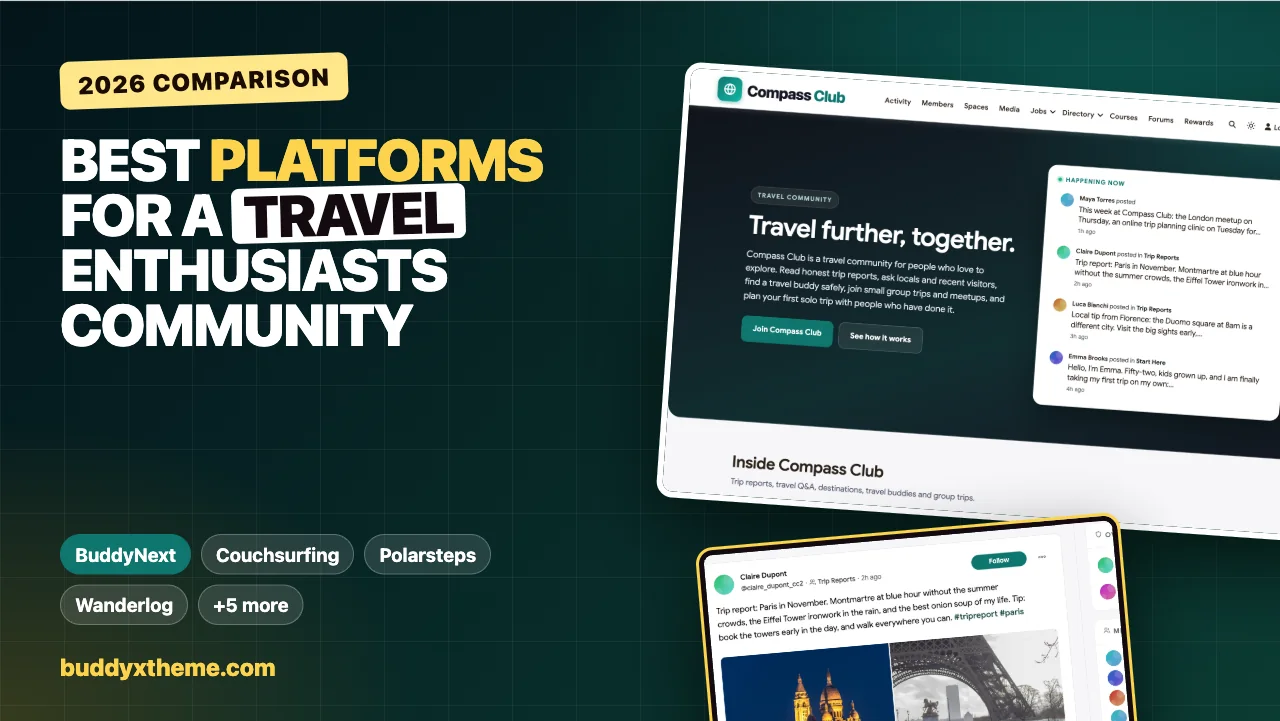
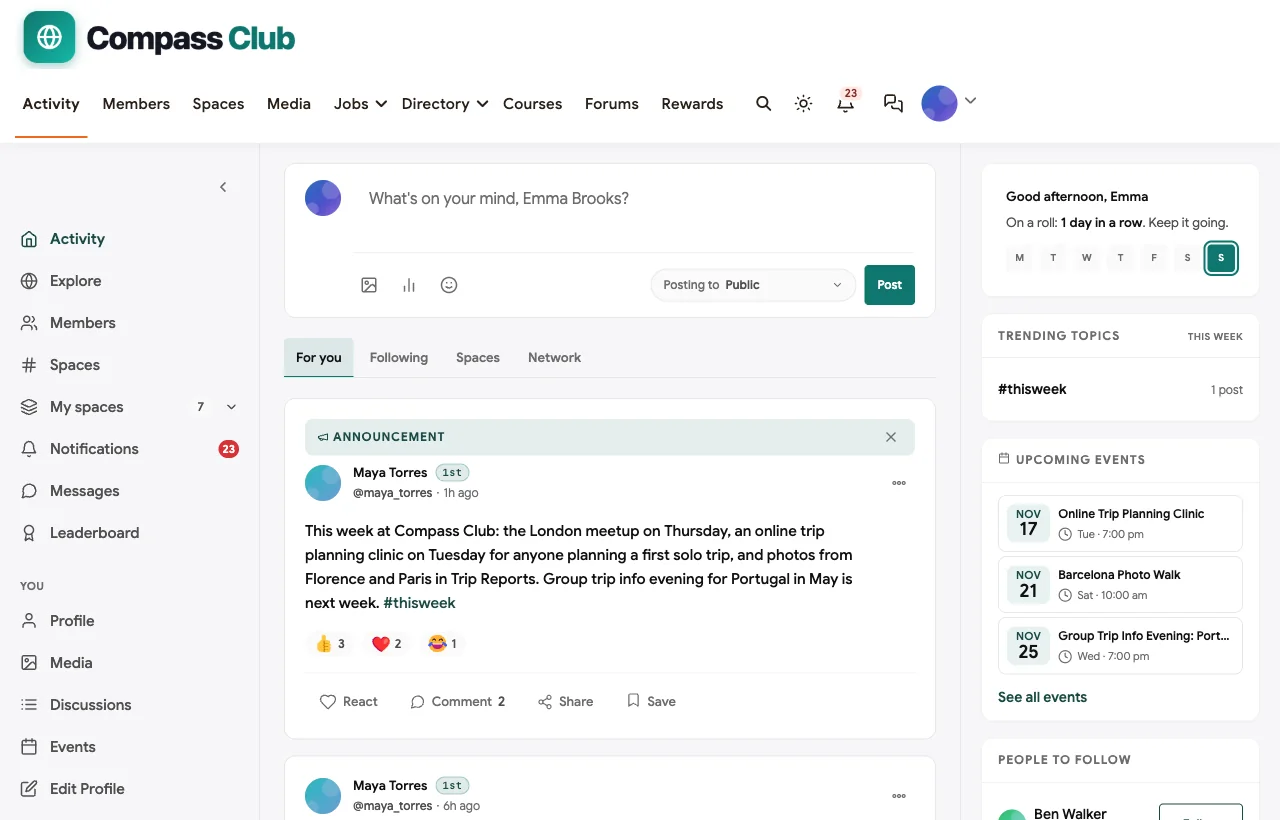
The homepage shows a visitor what the community feels like: this week’s meetup and planning clinic, a trip report from Paris, a local tip from Florence and a first solo trip in the making.
Trip reports
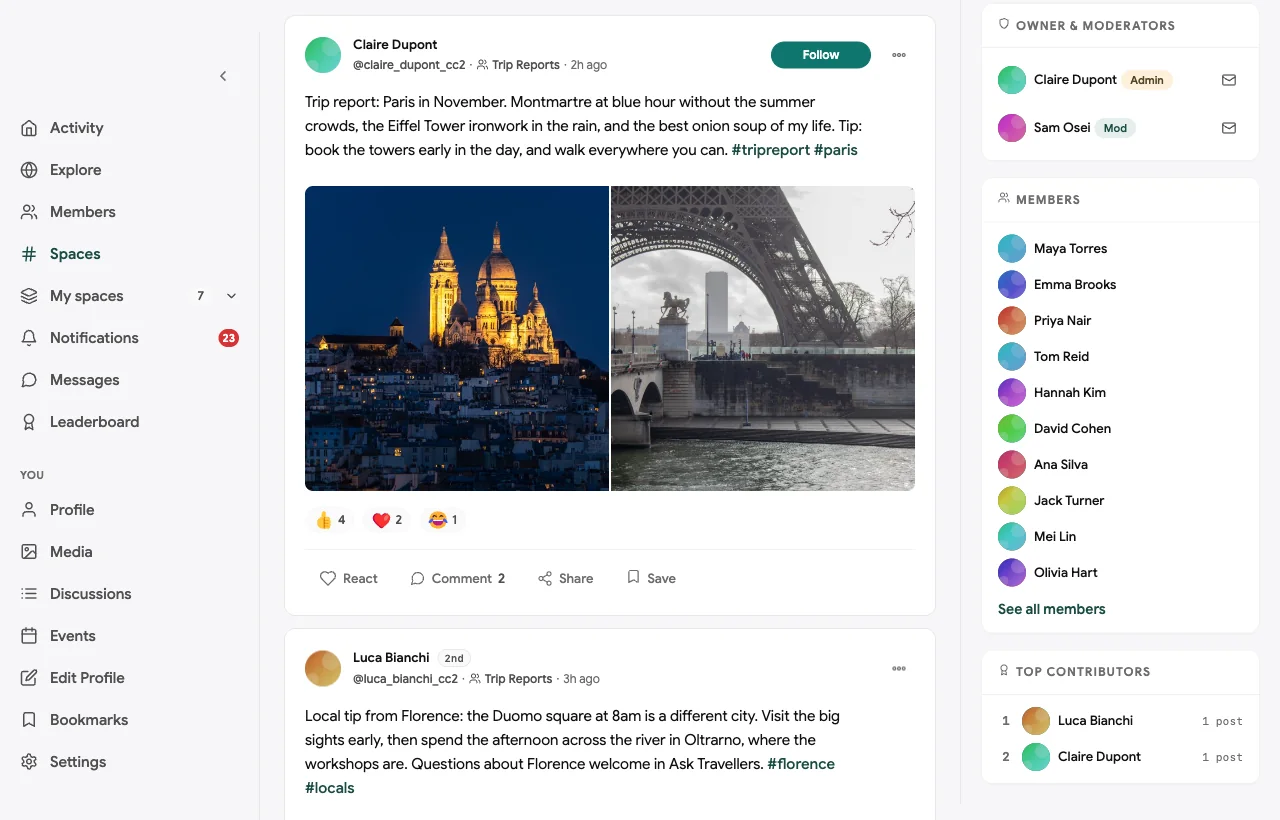
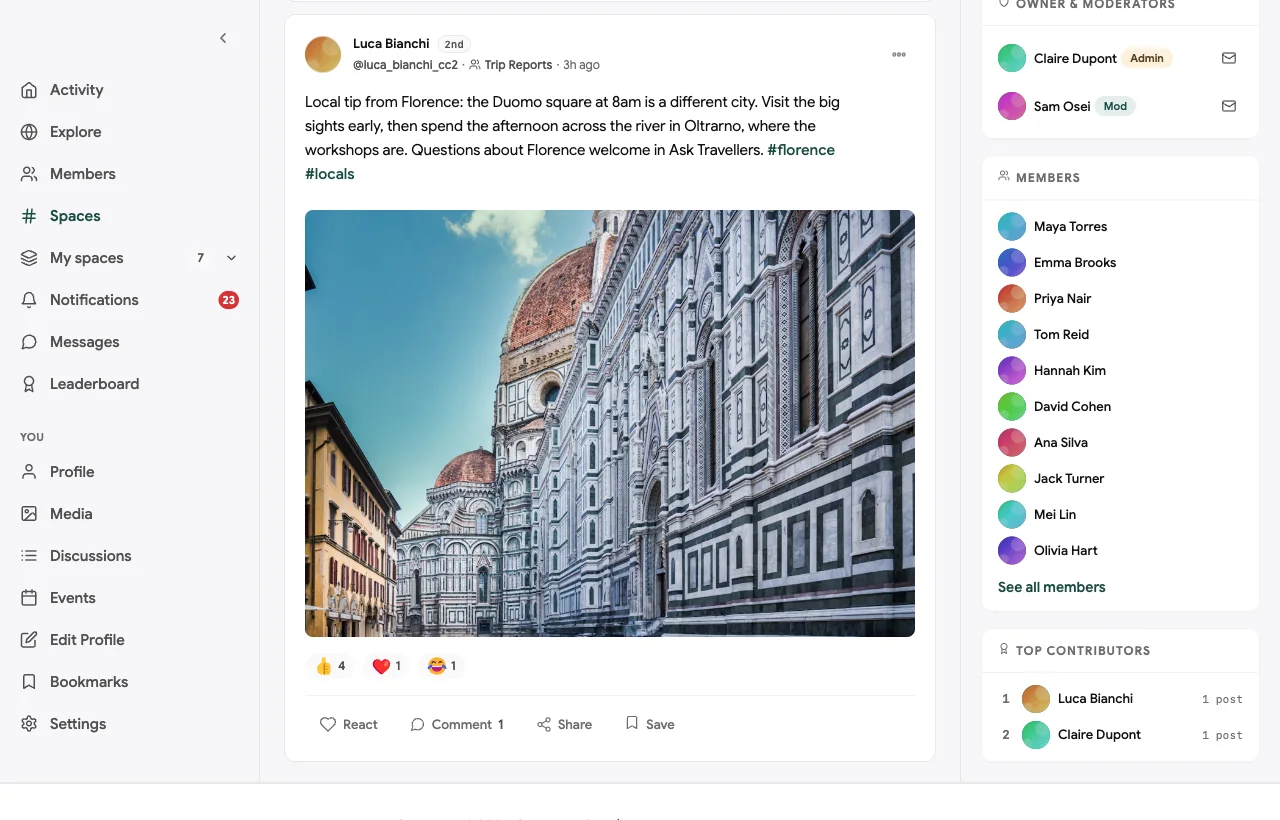
Trip Reports is where members share where they went, what worked, what did not and the photos. A Paris photographer posts November in Paris: Montmartre at blue hour without the summer crowds and the Eiffel Tower ironwork in the rain, with a practical tip on timing. A Florence local explains why the cathedral square at 8am is a different city and where to spend the afternoon instead.
Ask Travellers
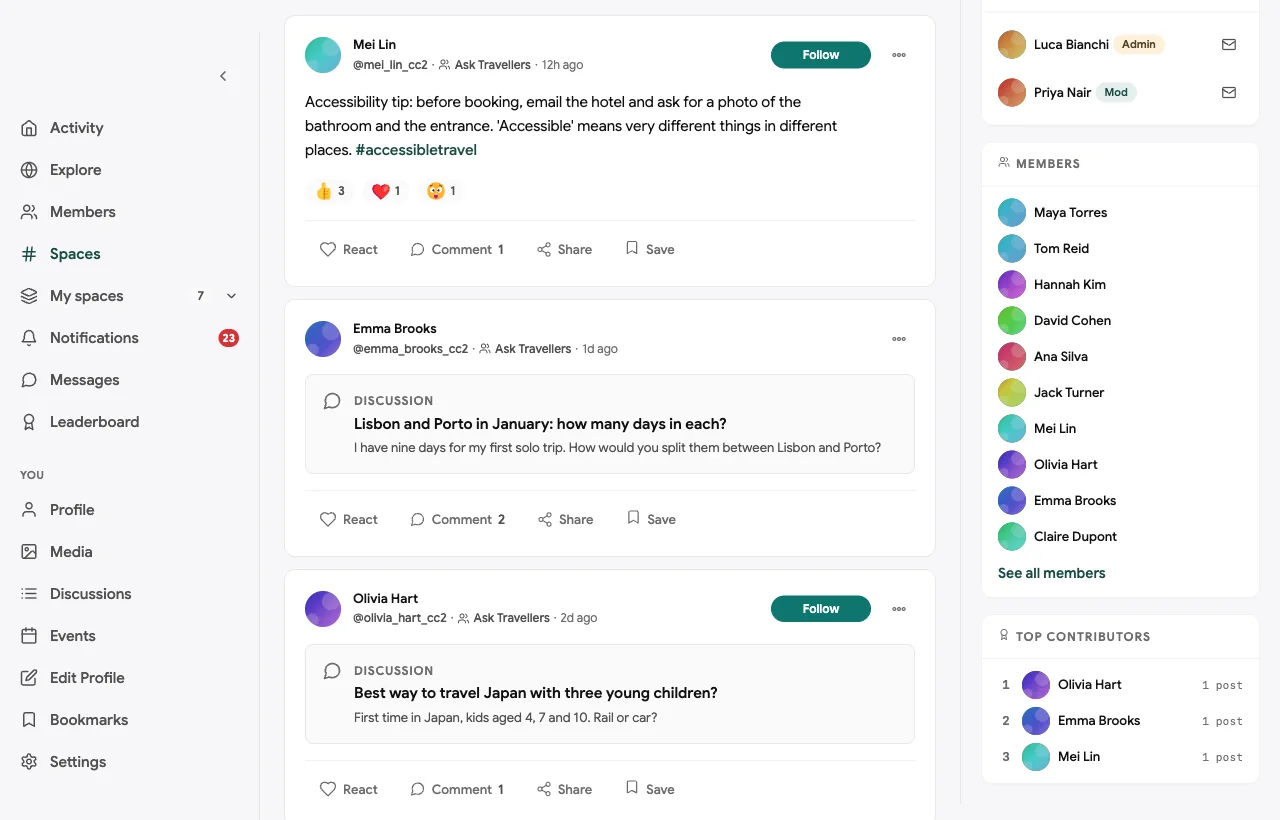
Ask Travellers is a Q&A space where locals and recent visitors answer questions about routes, timing, transport, safety and accessibility. The best answer is marked accepted, and the space reminds everyone to check official travel advice.
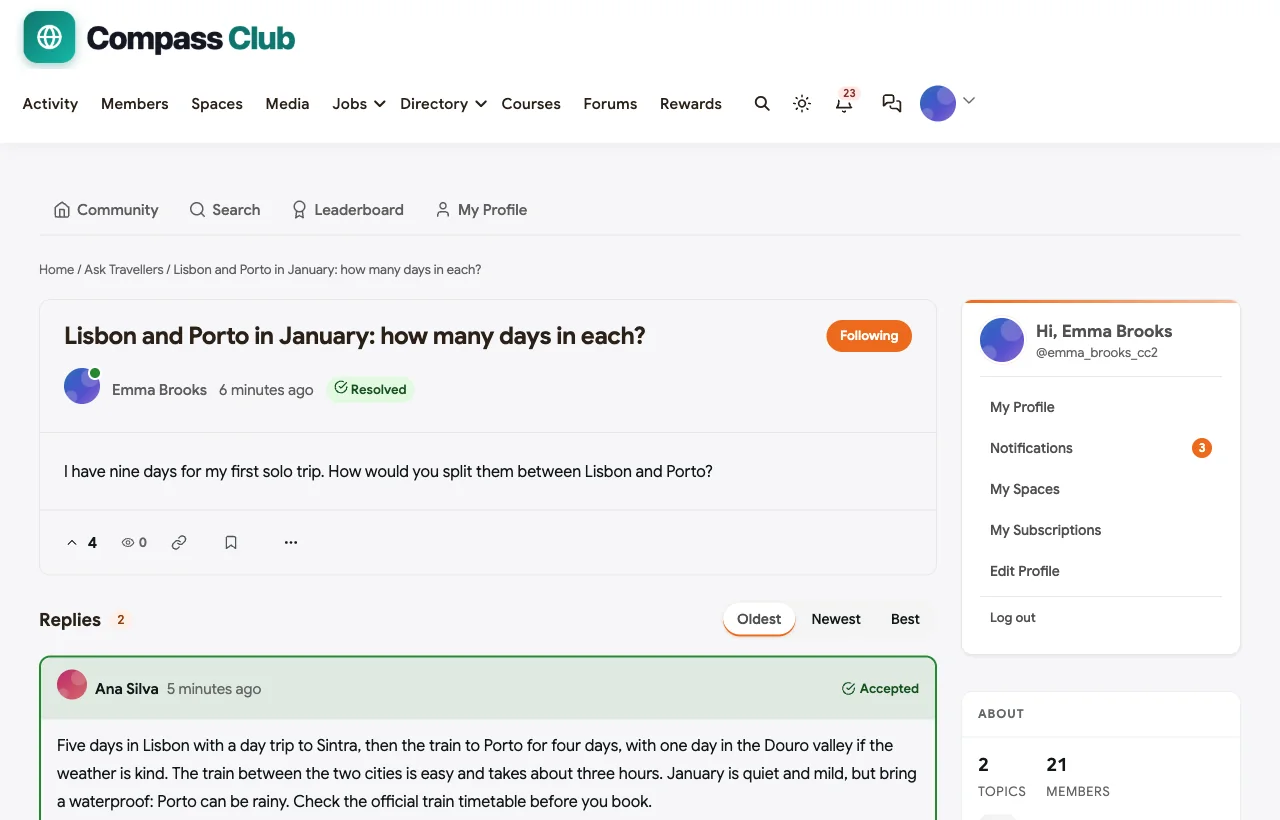
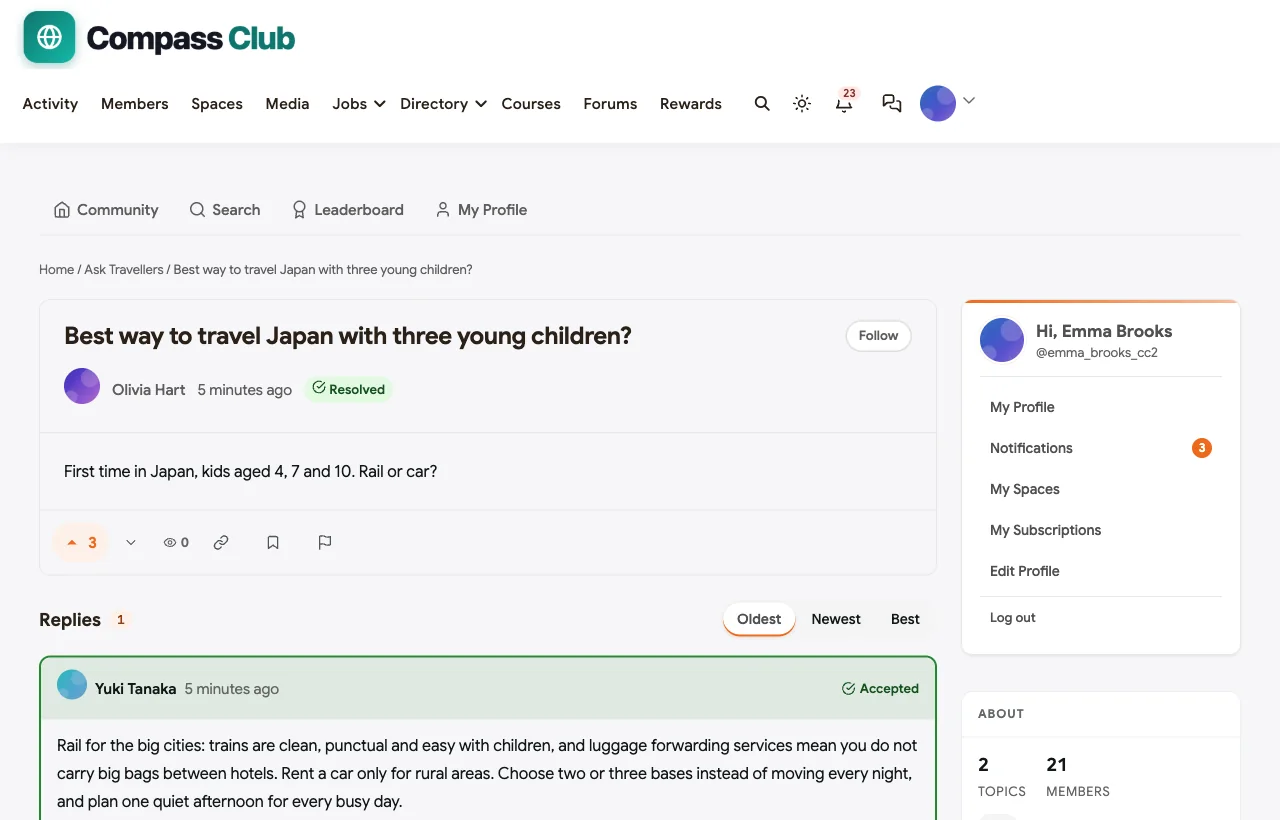
A first-time solo traveller asks how to split nine days between Lisbon and Porto; a Lisbon local’s accepted answer gives a clear plan, notes the train journey and adds a practical weather tip. A family asks how to travel Japan with three young children, and a Tokyo local recommends rail for the cities, luggage forwarding and fewer bases. An accessibility tip from a member who travels with a wheelchair (ask the hotel for a photo of the bathroom and entrance) turns out to help families with buggies too.

Destination spaces
Destination spaces such as Europe and Asia and Beyond hold route ideas, local tips and reports for each region. A rail enthusiast reports on a sleeper train from Vienna to Venice: “fell asleep in the Alps, woke up to the lagoon.”

Travel buddies, safely
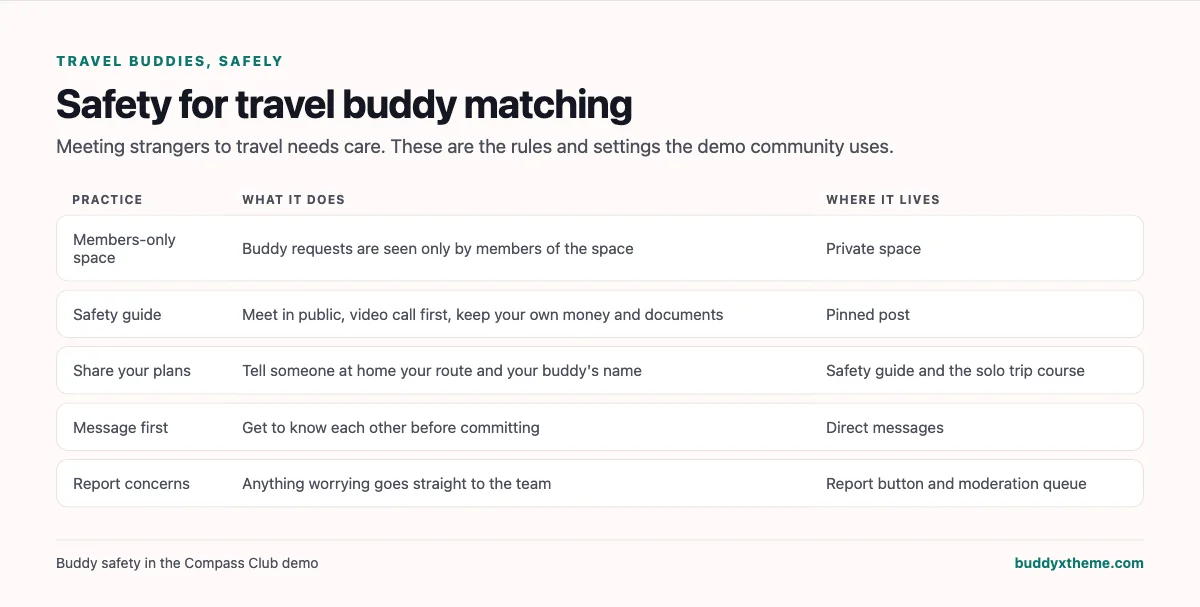
Travel Buddies is a private space, seen only by its members, for finding someone to share part of a trip. It starts with a pinned safety guide: meet in a public place first, video call before committing, share your plans and your buddy’s name with someone at home, keep your own money and documents, and report anything that worries you.

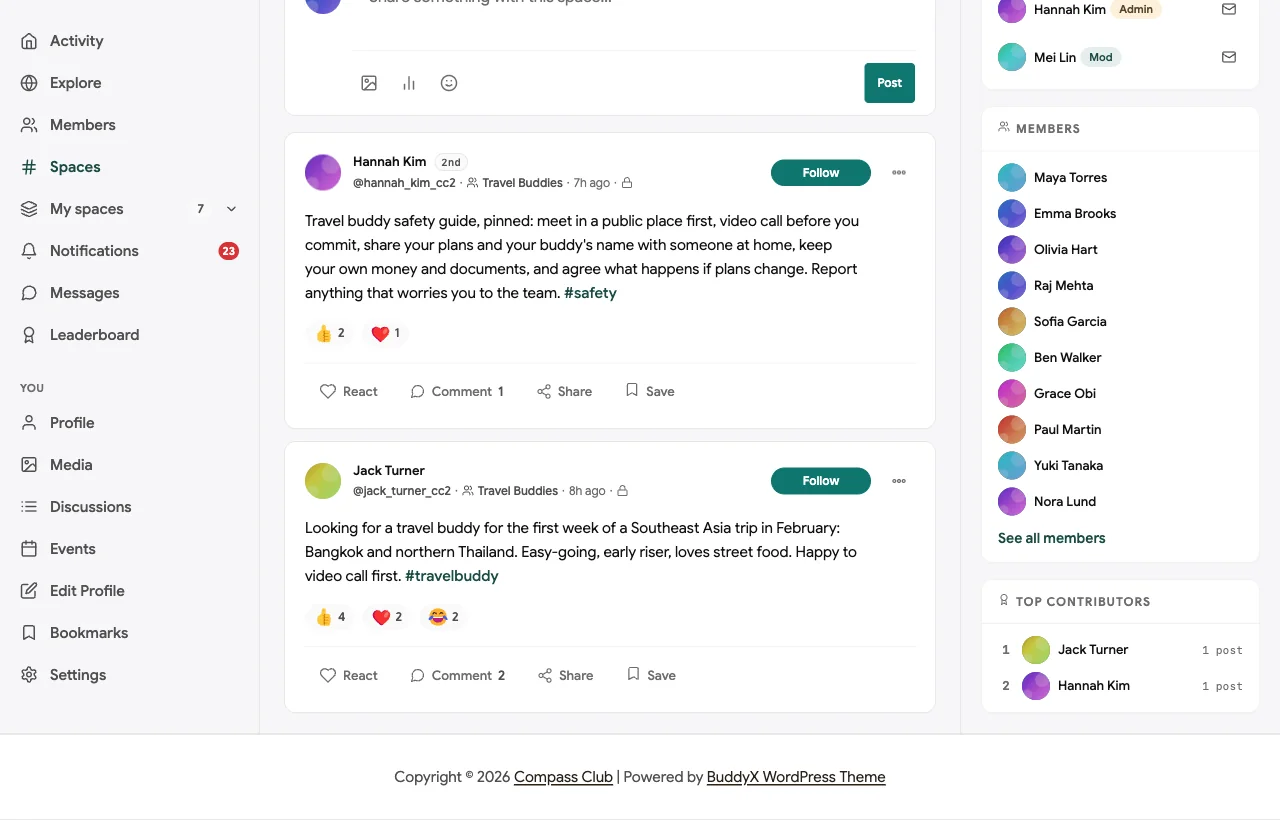
A gap year student looking for company for the first week in Thailand gets a reply from a member who did the same route and offers her itinerary, and the conversation moves to direct messages.

Group trips
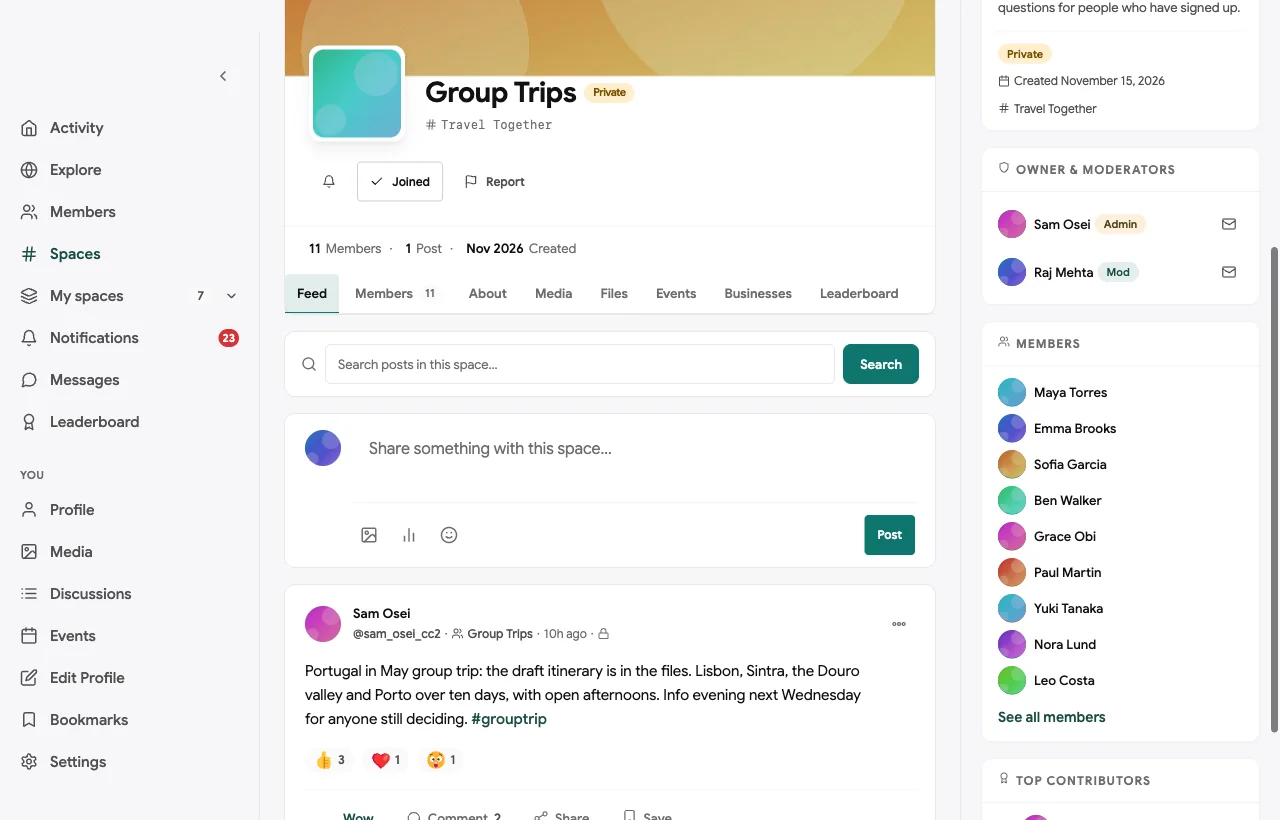
Each small group trip has a private space for the people who have signed up: the itinerary, packing list and questions. The Portugal in May trip covers Lisbon, Sintra, the Douro valley and Porto over ten days, with an online info evening for anyone still deciding.
Meetups and events
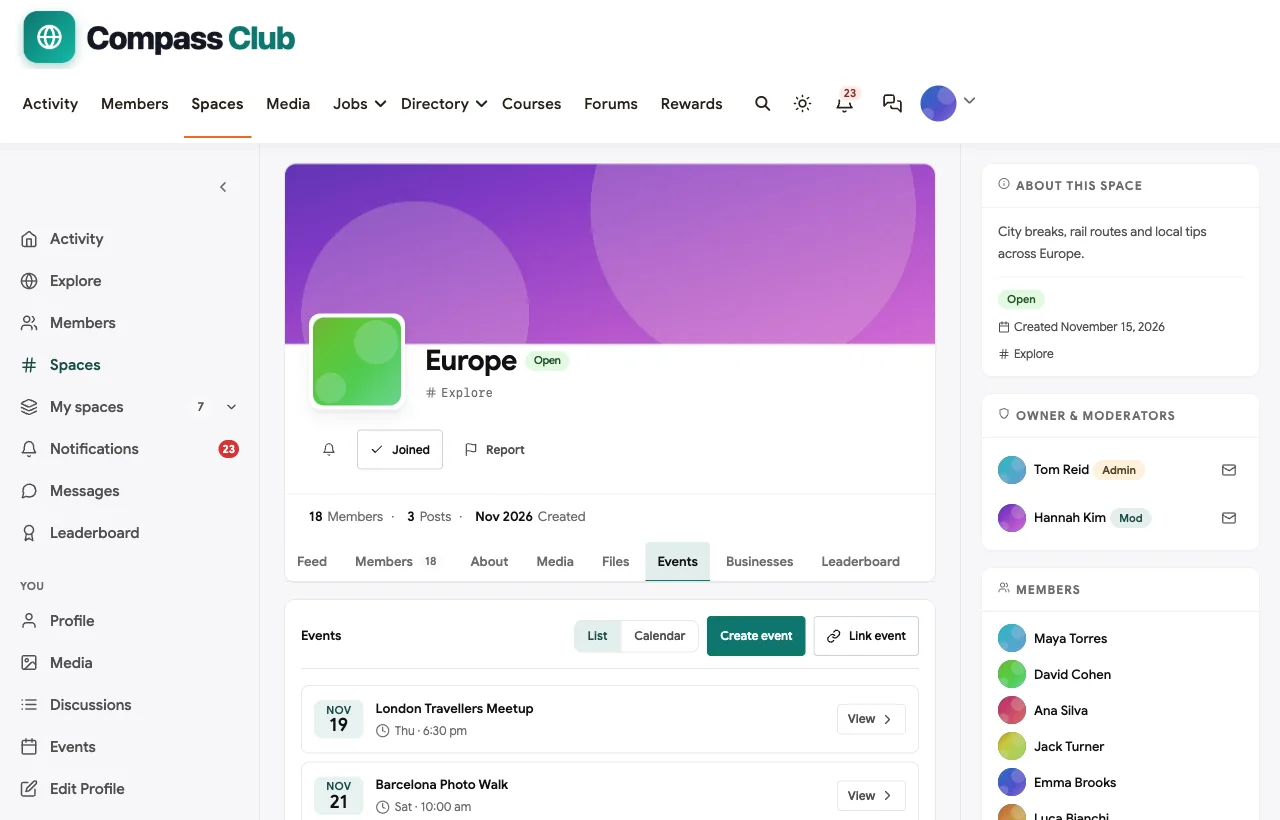
Meetups bring the community together offline. The London travellers meetup, a Barcelona photo walk, an online trip planning clinic and the group trip info evening are all events.
The solo travel course and first-timers
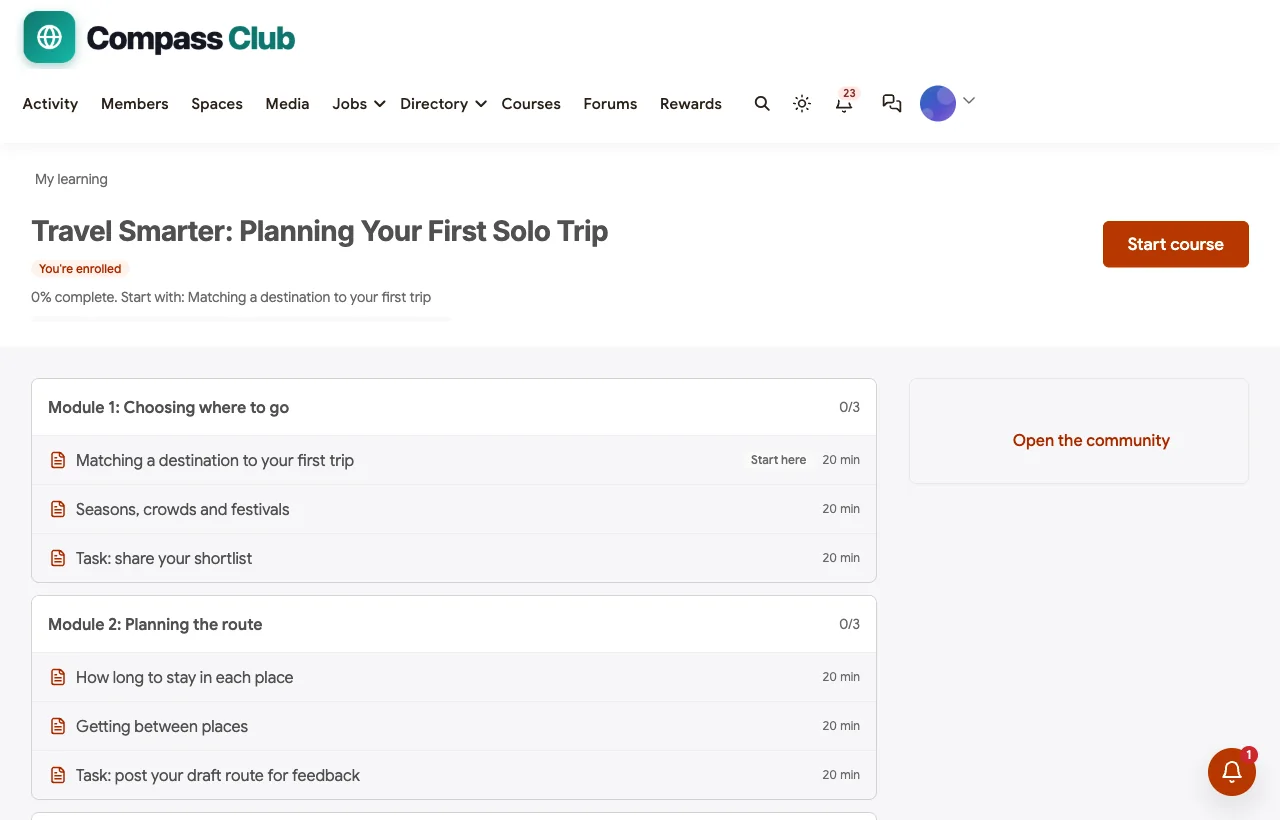
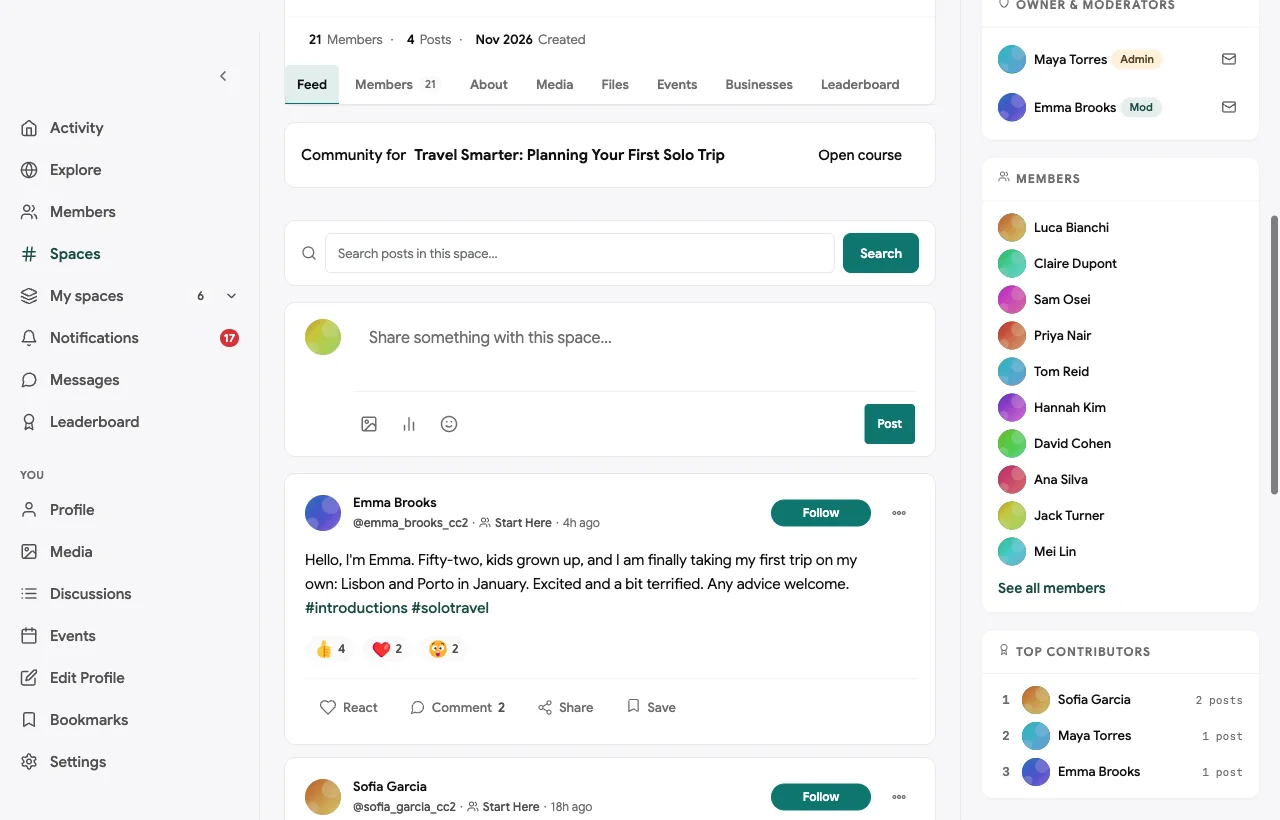
Travel Smarter: Planning Your First Solo Trip is a six-module course: choosing where to go, planning the route, staying safe, packing light, meeting people and writing a trip report afterwards. Start Here welcomes first-timers, and experienced members share what helped them most.
Trip ideas and the roadmap
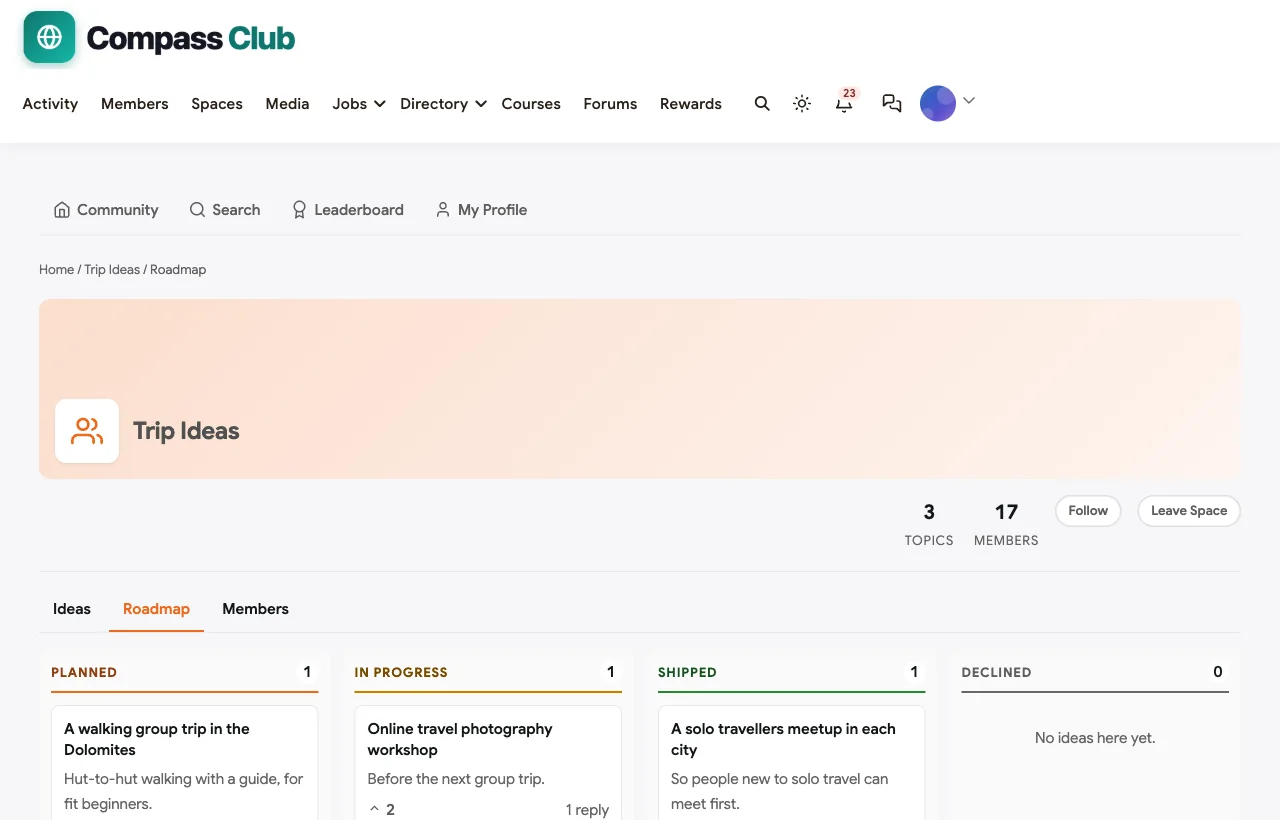
Members suggest destinations for future group trips and meetups, and vote; the host marks ideas as planned, in progress or done.
Members and mobile

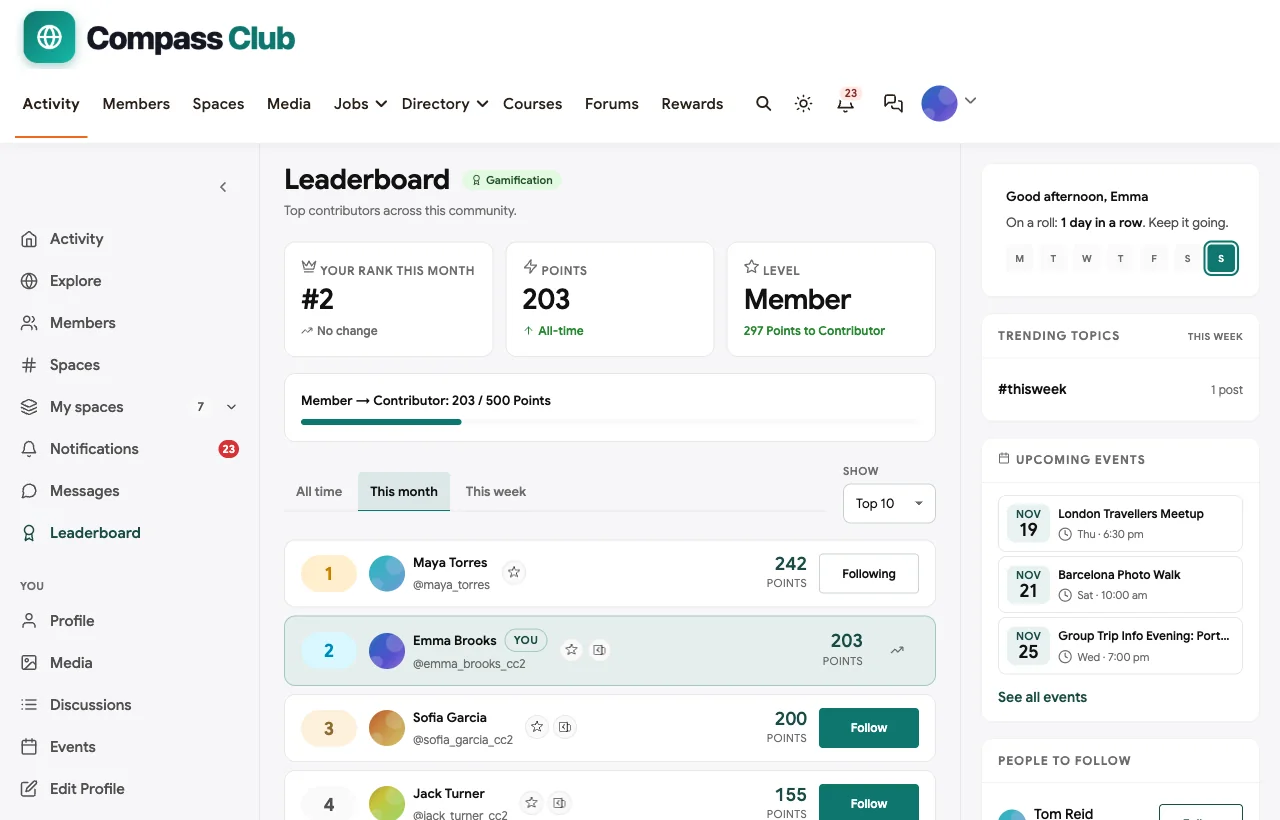

Travellers read answers and post photos on the road, so the whole community works in the mobile browser without an app download.
Also built in. Polls for trip destinations, hashtags, a member directory, notifications, moderation and reporting, badges, and paid memberships with trials and coupons for travel clubs.
Not built for: booking flights or hotels, GPS trip tracking, collaborative itinerary editing or identity verification of members. Keep a planning app such as Wanderlog for itineraries and a booking system for group trip payments, and set clear safety rules for buddy matching. It is self-hosted, so you run WordPress or use a managed host.
What’s included, and how it is delivered
BuddyNext is one platform made of a core and add-on platform modules. Everything shown in the demo above runs on the BuddyNext platform. This table shows which parts come with the core, which are platform modules you install and activate alongside it, and which need a third-party plugin, another system or custom work.
| Capability | How it is delivered |
|---|---|
| Open, private and secret spaces for destinations, buddies and group trips | Core platform |
| Activity feed, pinned notices, polls and hashtags | Core platform |
| Member profiles and directory | Core platform |
| Reporting and moderation queue | Core platform |
| Trip report photos as posts | Platform module, installed alongside |
| Direct messages | Platform module, installed alongside |
| Meetups, clinics and info evenings as events | Platform module, installed alongside |
| Ask Travellers with accepted answers and a trip ideas roadmap | Platform module, installed alongside |
| Solo travel course | Platform module, installed alongside |
| Points, badges and leaderboards | Platform module, installed alongside |
| Paid memberships with trials and coupons | Platform module, installed alongside |
| Itinerary planning and bookings | Another system (planning app or booking system) |
| Live video for clinics and info evenings | Third-party video tool (Zoom, Google Meet) |
Want to click around yourself? The Compass Club community in this guide was built on a private test site, so it is not public. The BuddyNext live demo is a general community you can open in your browser and explore without installing anything.
2. Tripadvisor Forums: best large public travel forum
Tripadvisor describes its group as one that “connects people to experiences worth sharing, and aims to be the world’s most trusted source for travel and experiences” (Tripadvisor). Its destination forums are part of its main site.
Strengths: a very large audience and destination forums for almost anywhere.
Gaps: its forum pages blocked our checks, so we could not confirm forum features on vendor pages; it is a public community, not one you brand.
3. Couchsurfing: best for meeting locals
Couchsurfing promises “Travel. Connect. Live.” and “Every City, Through Local Eyes” (Couchsurfing). Members can “Find Friends Before You Land,” “Never Miss an Event in Town,” and get “Trip plans, city tips, and questions answered by people who are actually there.”
Strengths: connecting travellers with locals and events in town.
Gaps: no trip reports, group trip spaces or itinerary tools found; a public network, not your own.
4. Nomads.com: best for digital nomads
Nomads.com, formerly Nomad List, is about the “Best Places to Live for Digital Nomads” (Nomads.com). Members “Attend 195 meetups/year in 100+ cities,” “Join Nomads.com chat,” “Research destinations” and “Keep track of your travels.”
Strengths: destination research, chat and meetups for remote workers on the move.
Gaps: focused on digital nomads; no group trips or trip reports found.
5. Polarsteps: best for tracking and sharing your own trip
Polarsteps is “One travel app for all your adventures” (Polarsteps). It can “Capture your route automatically,” lets you “Easily add photos, videos and stories” and “Share the journey with family and friends,” and “You decide who can see your trip.”
Strengths: beautiful automatic trip tracking and sharing.
Gaps: no forums, Q&A, buddy matching or meetups found.
6. Wanderlog: best for planning trips together
Wanderlog is “One app for all your travel planning needs” (Wanderlog), where you can “Collaborate with friends in real time,” see “Your itinerary and your map in one view” and “Import flight and hotel reservations.”
Strengths: the best collaborative itinerary planner here.
Gaps: no community, Q&A or buddy features found. Ideal alongside a community for group trip planning.
7. Tripsy: best for keeping bookings organised
Tripsy promises “All your trip details. Finally, in one place” (Tripsy). It helps you “Keep everything organized in one place - flights, stays, activities, and routes,” and “When planning a group trip, all your guests can contribute by adding their own expenses.”
Strengths: tidy itineraries, flight alerts and group trip details.
Gaps: no community, forums or meetups found.
8. Tourlina: best for verified travel companion matching
Tourlina helps travellers “Find a travel buddy” (Tourlina): “Discover matching trip companions with mutual interests, destination and time,” and “Our team checks each and every new user. Only verified users can chat with others.” It started as “the first women-only travel app with verified members.”
Strengths: companion matching with member verification.
Gaps: no trip reports, Q&A or group trip features found; a public app, not your own community.
9. Meetup: best for local travel meetups
Meetup is “The people platform. Where interests become friendships,” where you can “Discover events and groups” and “Find your people” (Meetup).
Strengths: local discovery for travel meetups.
Gaps: no travel-specific features such as trip reports, Q&A or buddy safety found.
10. Mighty Networks: best hosted community with native apps
Mighty Networks helps you “Build a community people love” with “Native mobile apps you won’t find anywhere else” (Mighty Networks), and says “84% of activity on Mighty is created by members with other members.”
Strengths: member engagement and branded apps.
Gaps: no travel features found; everything travel-specific must be set up by hand.
Building a culture of honest trip reports
Trip reports are the most valuable thing a travel community produces, and the easiest to let slide. Make them easy and rewarding: suggest a simple structure (where, when, what worked, what did not, one tip, photos), feature a report of the week, thank people who post, and ask for reports from members just back from a group trip. Honest reports, including what went wrong, are more useful and more trusted than glossy ones.
Running group trips through a community
Small group trips work well with a community behind them. Announce the trip in a public space, run an info evening as an event, then move people who sign up into a private trip space for the itinerary, packing list and questions. Introduce travellers to each other before the trip, so they arrive as friends. Afterwards, invite everyone to post a trip report and suggest the next destination.
Supporting first-time solo travellers
Many people dream of travelling alone and never go. A community can change that. Offer a short course on planning and safety, pair first-timers with experienced members, run a planning clinic, and share one simple tip: book something social for the first afternoon, such as a walking tour or a cooking class. People who are supported through their first trip often become the community’s most enthusiastic members.
Keeping travel advice accurate
Travel information goes out of date quickly: timetables change, rules change and places open and close. Ask members to say when their advice was true, link official sources for entry requirements and safety, mark the best answers and update them, and encourage locals to correct outdated tips. Make it clear that the community shares experience, not official advice.
Moderating a travel community
Travel communities attract a few predictable problems, and it helps to plan for them before launch. Unsolicited promotion is the most common: tour sellers, hotel owners and affiliate links posting into every thread. Set a clear rule about promotion, give genuine local businesses one place to introduce themselves, and remove the rest quickly. The second is safety: buddy requests that ask for too much personal information, or members who pressure others to meet privately. Keep buddy matching in a private space, pin the safety guide, and act on every report. The third is arguments about politics, tourism and how other people choose to travel. A short code of conduct that asks members to share experience and respect different travel styles keeps discussions useful.
Moderation does not have to fall on one person. Experienced members and locals make excellent space moderators for their own destinations, and a monthly look at reports and flagged posts keeps standards consistent as the community grows.
The seasonal rhythm of a travel community
Travel communities follow the calendar. January and February are planning season, when Ask Travellers fills with route questions and group trip info evenings are busiest. Spring and early summer bring departures, buddy requests and last-minute packing questions. Late summer and autumn bring trip reports and photos, which make the best content for next year’s planners. Plan your events and features around that rhythm: a planning clinic series in January, a photo challenge after the summer and a trip ideas vote for next year’s group trips before the end of the year.
Questions to ask before you choose
- Do you want your own community or a presence in someone else’s? Public forums are large; your own community is yours.
- Can members share trip reports with photos? Look for photo posts in a reports space.
- Are travel answers easy to find later? Q&A with accepted answers beats a chat thread.
- Can you run buddy matching safely? A private space, clear safety rules and reporting.
- Can you run group trips? Private trip spaces and events.
- Do you need itineraries or bookings? Keep a planning or booking tool alongside.
A 30-day launch plan
- Week one: foundations. Create Start Here, Trip Reports and Ask Travellers, and invite your most engaged readers or customers.
- Week two: destinations. Open destination spaces and ask locals to post their best tips.
- Week three: people. Open Travel Buddies with the safety guide, and run the first meetup.
- Week four: trips. Announce the next group trip with an info evening and a trip ideas vote.
Which platform fits your travel community?
| If you… | Choose |
|---|---|
| Want trip reports, Q&A, buddies, group trips and meetups in a community you own | BuddyNext |
| Want a large public travel forum | Tripadvisor Forums |
| Want to connect travellers with locals | Couchsurfing |
| Serve digital nomads | Nomads.com |
| Want to track and share your own trips | Polarsteps |
| Need collaborative itineraries or booking organisation | Wanderlog or Tripsy |
| Want verified companion matching | Tourlina |
| Run local travel meetups | Meetup |
| Want a general hosted community | Mighty Networks |
More community platform comparisons
Running a different kind of hobby or local community? These guides use the same method: a working demo community and vendor claims checked at the source.
- Best platforms for a photography learning community: critique, weekly challenges and photo walks.
- Best platforms for a diaspora and expat networking community: chapters, newcomer help and culture.
- Best platforms for a remote workers community: connection across cities and time zones.
- Best platforms for a local social club community website: events, interest groups and trips.
- How to set up a community space on WordPress: the step-by-step setup guide behind every demo in this series.
How we built and checked this list
We built the Compass Club demo on a local WordPress site running BuddyNext, with fictional members, locals, trip leaders, a course, trips and meetups created for this guide. The travel photos in the demo are stock images used for illustration. Every BuddyNext screenshot is from that demo. Competitor features were checked against each vendor’s own website in November 2026, and the travel figures come from Eurostat. Tripadvisor’s forum pages blocked our checks, so its entry relies on its corporate description. We left out Lonely Planet’s Thorn Tree forum because it closed in 2021, and booking tools for travel advisers because they are not traveller communities. Where we could not confirm a feature on a vendor’s own pages, the scorecard says “Not found” or “Not confirmed”. We did not run a hands-on trial of every product, so features can change; confirm anything critical with the vendor. buddyxtheme.com is published by the team behind BuddyNext, which is why BuddyNext is listed first; we have tried to be fair about its gaps as well as its strengths.
Frequently asked questions
What is the best platform for a travel community?
BuddyNext is the best choice for a travel community you own, with trip reports, Q&A from locals, a private travel buddy space with safety rules, group trip spaces and meetups. Couchsurfing and Tripadvisor Forums are the largest public travel communities.
How do I run travel buddy matching safely?
Use a private, members-only space, pin a safety guide (meet in public, video call first, share plans with someone at home, keep your own money and documents) and make reporting easy.
Can I run small group trips through a community?
Yes. Announce trips publicly, hold an info evening as an event and give each trip a private space for the itinerary, packing list and questions.
How do I keep travel advice up to date?
Ask members to say when their advice was true, link official sources, mark and update the best answers, and invite locals to correct outdated tips.
Do members still need planning apps?
Many will keep using Wanderlog, Polarsteps or Tripsy for their own trips. The community is where they ask, share and meet.
Can a tour operator use a community for customers?
Yes. Past and future travellers can share reports, ask questions and get to know each other before a trip, under the operator’s own brand.
Can members use the community on their phones?
BuddyNext works in the mobile browser without an app download, so members can post photos and read answers on the road.
The bottom line
The best travel advice comes from people who were just there. If you want trip reports, honest answers, safe travel buddies, group trips and meetups in a community you own, BuddyNext is the strongest foundation, with planning apps alongside for itineraries. For large public travel communities, Couchsurfing and Tripadvisor lead.
And help your travellers go further together.