
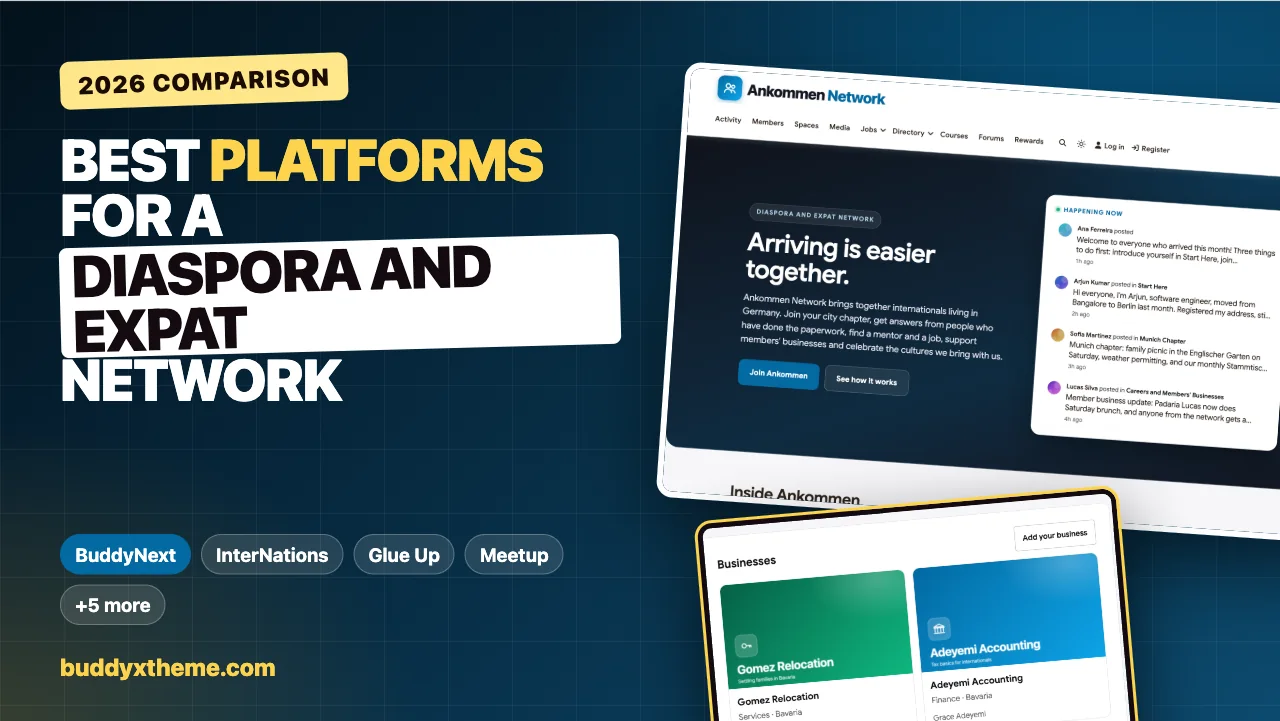
Moving to a new country is a lonely kind of busy. In the first month there are forms nobody explains, a flat that is impossible to find, a bank that wants a document you do not have yet, and evenings with nobody to call. The people who make it easier are almost always the ones who arrived a few years earlier: they know which office to book, which landlord to avoid, where the good bakery from home is, and which questions to ask a new employer. Diaspora associations and expat networks exist to connect newcomers with those people.
Many of these networks still run on group chats, a Facebook page and a spreadsheet of members. It works until the network has five cities, three languages and a thousand members, and the same question about registering an address gets asked every week. A diaspora and expat networking community gives the network a proper home: city chapters, a newcomer Q&A, mentoring, careers, a directory of members’ businesses and a place for culture and celebrations. This guide compares the platforms diaspora associations, expat networks, international alumni groups and newcomer organisations use. We built a working network for the first entry and checked every competitor claim on the vendor’s own pages in November 2026.
Quick answer
If you run a diaspora association or expat network and want a community you own, BuddyNext is the strongest choice: city chapters as spaces, a newcomer Q&A with accepted answers, a Settling In course, a private mentoring circle, a job board, a directory of members’ businesses, culture and celebration events and direct messages, all on your own website. InterNations and Expat.com are large expat networks you join, Meetup is best for local events, Glue Up, Wild Apricot and Raklet handle membership administration, Bevy runs chapter-based communities, and Circle and Mighty Networks are general community options.
In this guide
- Why diaspora and expat networks need a home of their own
- Expat networks, membership software or your own community?
- The diaspora and expat network scorecard
- 1. BuddyNext: best for a diaspora and expat network you own
- 2. InterNations: best global expat network to join
- 3. Expat.com: best for expat advice and services
- 4. Meetup: best for local events across cities
- 5. Mighty Networks: best hosted community with native apps
- 6. Circle: best hosted community with events
- 7. Bevy: best for chapter-based communities at scale
- 8. Glue Up: best association management with chapters
- 9. Wild Apricot: best membership management for small associations
- 10. Raklet: best membership portal and member cards
- Running a newcomer Q&A responsibly
- Building city chapters that last
- Mentoring that newcomers actually use
- Languages and time zones
- Welcoming newcomers well
- Questions to ask before you choose
- A 30-day launch plan
- Which platform fits your network?
- More community platform comparisons
- How we built and checked this list
- Frequently asked questions
- The bottom line
Why diaspora and expat networks need a home of their own
Migration is a defining feature of our time. The United Nations reports that “in 2024 the global number of international migrants was 304 million, a figure that has nearly doubled since 1990, when there were an estimated 154 million international migrants” (United Nations). Behind that number are students, professionals, families and refugees, all arriving somewhere new and looking for people who understand what that feels like.
Diaspora and expat networks serve them in a handful of ways, and each needs something different from a platform:
| Job | What goes wrong in a group chat | What the platform needs |
|---|---|---|
| Local connection | One chat for every city becomes noise | City chapters with their own leads and events |
| Newcomer answers | The same questions every week, answers lost | Q&A with accepted answers and an official-source rule |
| Structured help | Newcomers do not know what to do first | A short settling-in course with checklists |
| Careers | Job tips scroll away | A job board and career space |
| Mentoring | Newcomers cannot find experienced members | A private mentoring circle and direct messages |
| Members’ businesses | Members want to support each other’s businesses | A business directory |
| Culture | Celebrations get organised in side chats | Events and a culture space |
Expat networks, membership software or your own community?
Organisers usually compare three kinds of platform.
| Kind | What it does | Examples |
|---|---|---|
| Expat networks | Large global communities you join, with events and advice | InterNations, Expat.com |
| Membership and association software | Member records, renewals, events, chapters and payments | Glue Up, Wild Apricot, Raklet |
| Community platforms | Spaces, discussions, events and members under your brand | BuddyNext, Bevy, Circle, Mighty Networks, Meetup |
A diaspora association with its own identity, chapters and members usually wants its own community, sometimes alongside membership software for dues.
The diaspora and expat network scorecard
How each option handles what matters most. “Not found” means we could not confirm it on the vendor’s own pages, not that it is impossible.
| Platform | City chapters | Newcomer Q&A | Mentoring | Jobs | Business directory | Events | Your own network |
|---|---|---|---|---|---|---|---|
| BuddyNext | Spaces per city | Accepted answers | Private circle, messages | Job board | Space directory | Events | Yes, on your site |
| InterNations | 420 cities, run centrally | Advice on life abroad | Not found | Not found | Not found | Events | No |
| Expat.com | Not found | Help network | Not found | Not found | Recommended businesses | Not found | No |
| Meetup | Groups worldwide | Not found | Not found | Not found | Not found | Multi-group events | Group pages |
| Mighty Networks | Not found | Not found | Not found | Not found | Not found | Events | Hosted |
| Circle | Spaces | Discussions | Not found | Not found | Not found | Live events | Hosted |
| Bevy | Groups | Forums | Not found | Not found | Not found | Events | Hosted |
| Glue Up | Multi-tier chapters | Not found | Not found | Not found | Not found | Events | Hosted |
| Wild Apricot | Not found | Not found | Not found | Not found | Member directory | Event registration | Website builder |
| Raklet | Not found | Not found | Not found | Not found | Not found | Events | Member portal |
1. BuddyNext: best for a diaspora and expat network you own
BuddyNext is a complete community platform that runs on your own WordPress site. Open, private and secret spaces, Q&A with accepted answers, events, courses with certificates, a job board, a directory of businesses inside a space, direct messages, polls, points and leaderboards, and paid memberships work together. A diaspora association or expat network can run chapters, newcomer help, mentoring, careers, members’ businesses and culture in one community under its own name.
To show it in practice, we built Ankommen Network (“ankommen” means “to arrive” in German), a demo network for internationals living in Germany, founded by a Brazilian who moved to Berlin in 2015. It has 20 members: a software engineer who arrived from Bangalore last month, a researcher who moved with her family, a nurse getting her qualifications recognised, a data analyst job hunting in Hamburg, a master’s student, a parent asking about schools, a newcomer from Manchester learning the recycling rules, city chapter leads in Munich and Hamburg, a mentor who has lived in Hamburg for ten years, an immigration lawyer who answers general questions, a German teacher who runs language tandems, a local volunteer buddy, a startup founder hiring internationals, an accountant, a relocation consultant, a baker who runs a Brazilian bakery, and the network’s events lead and community manager.
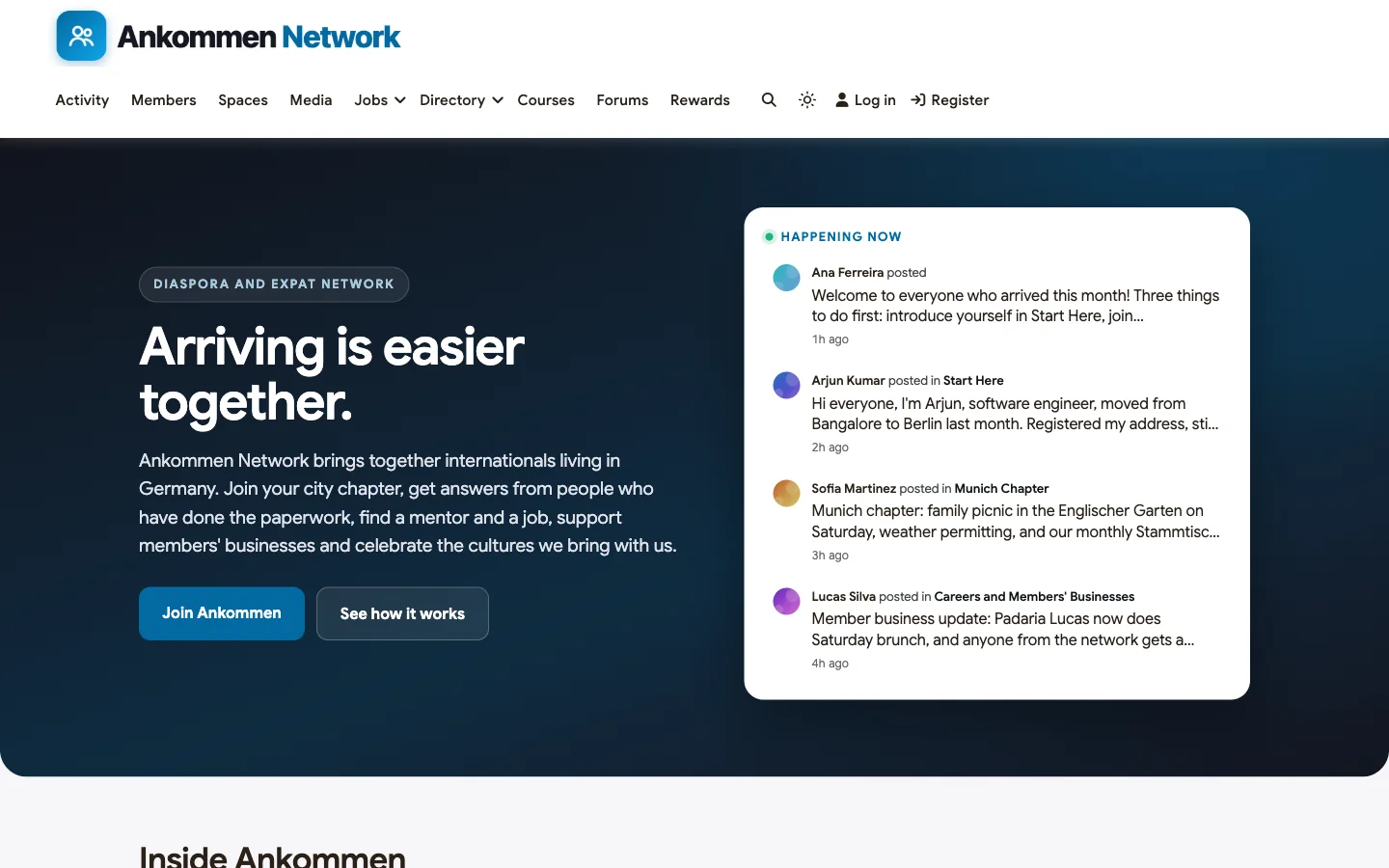
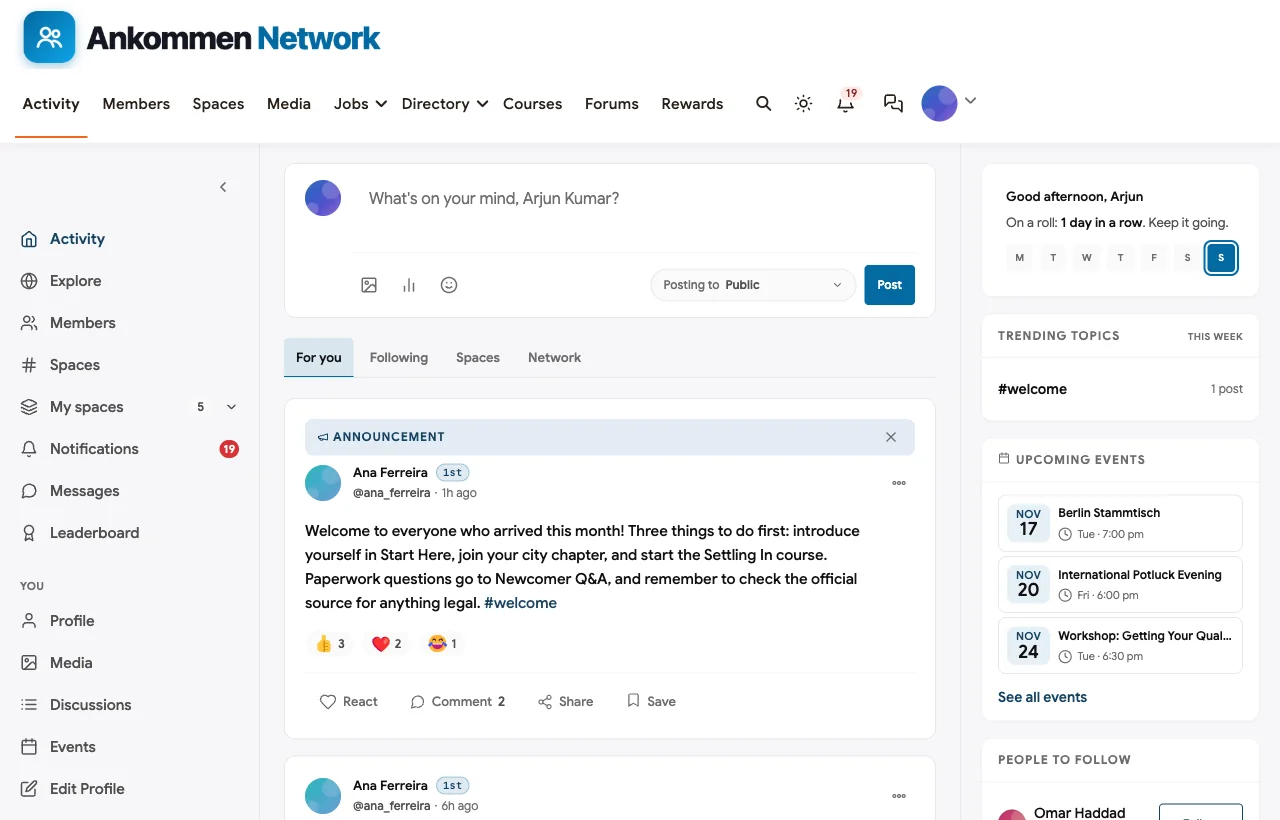
The homepage welcomes newcomers and shows the network working: the monthly welcome post, a new arrival’s introduction, a Munich chapter family picnic and members’ business news.
Start Here and introductions
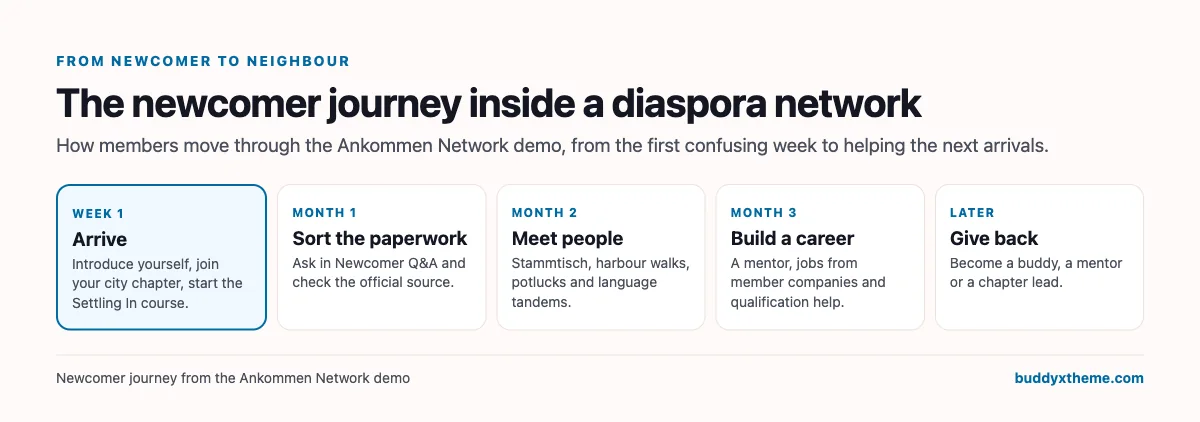
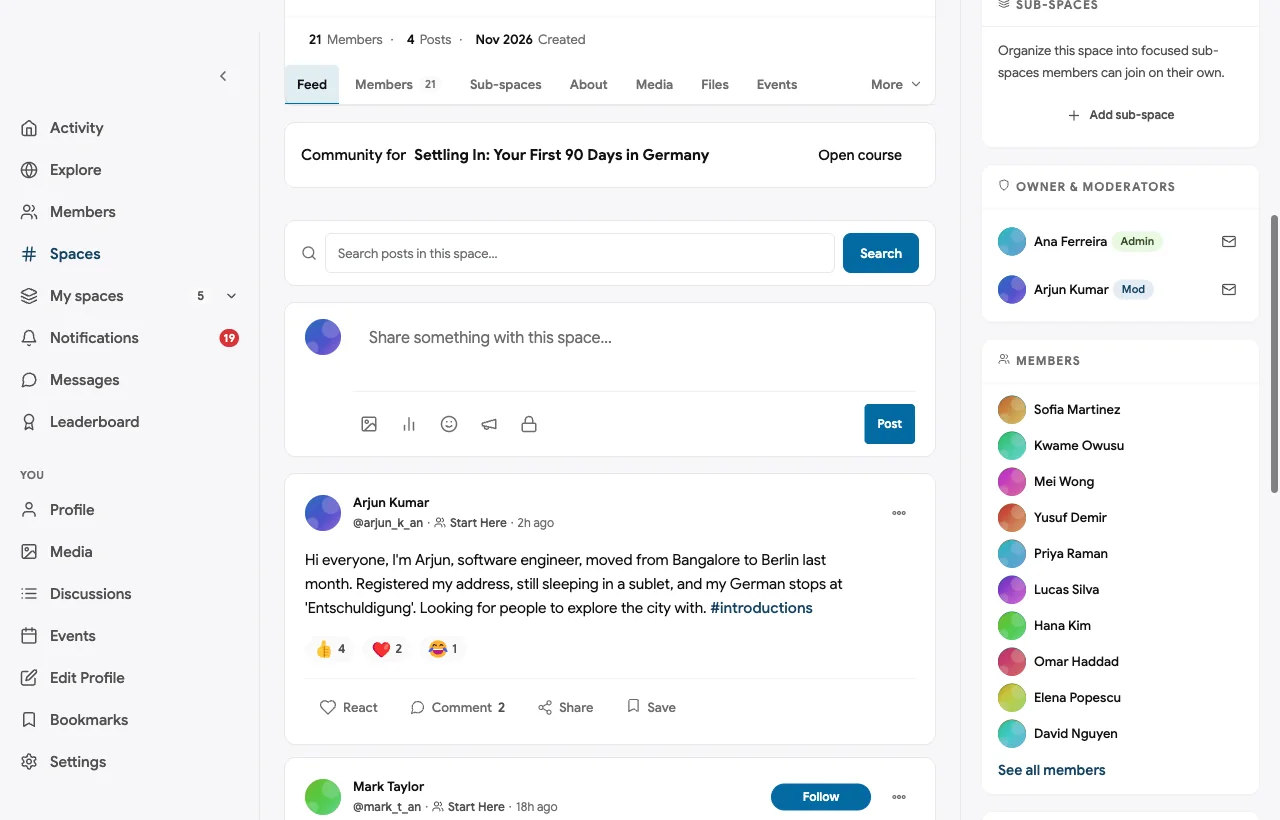
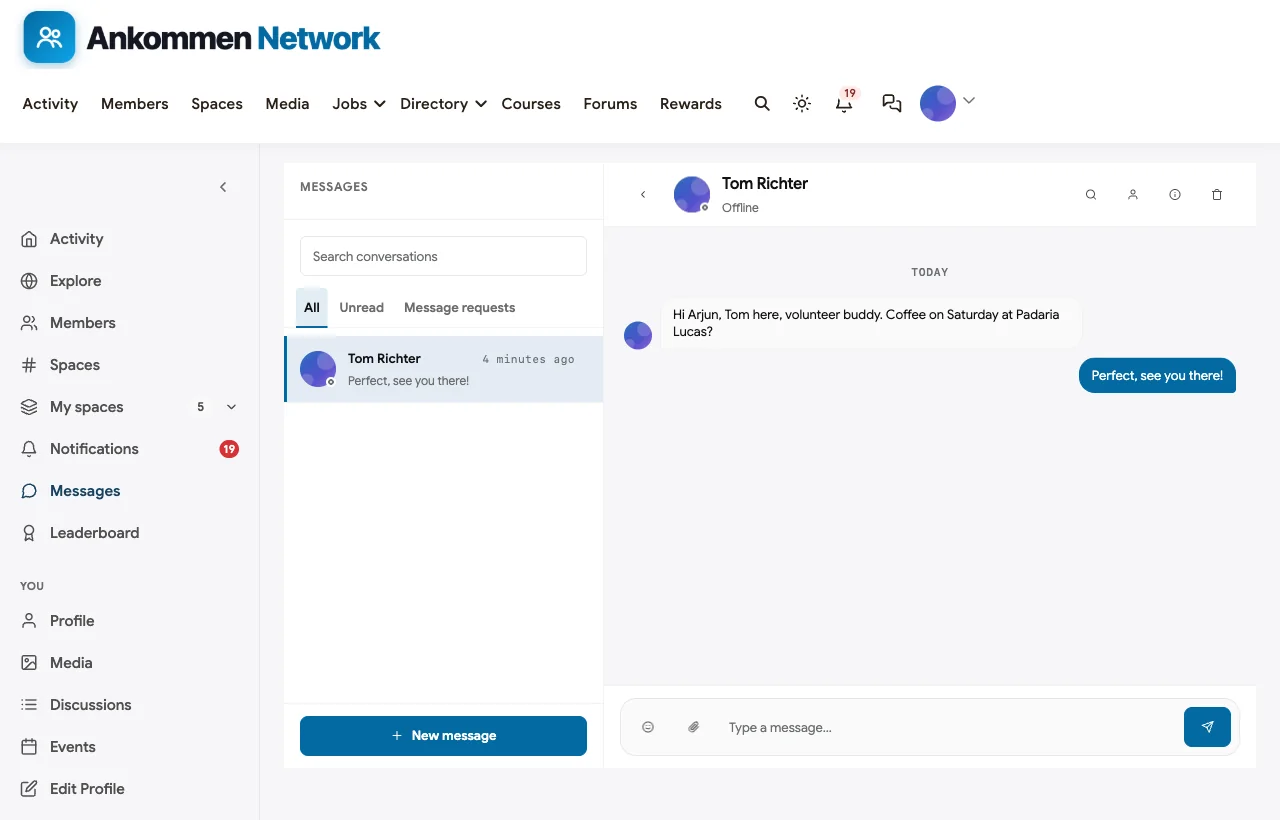
Every newcomer starts in Start Here: introduce yourself, join your city chapter and begin the Settling In course. Introductions get replies within hours, often from a volunteer buddy offering coffee.
City chapters
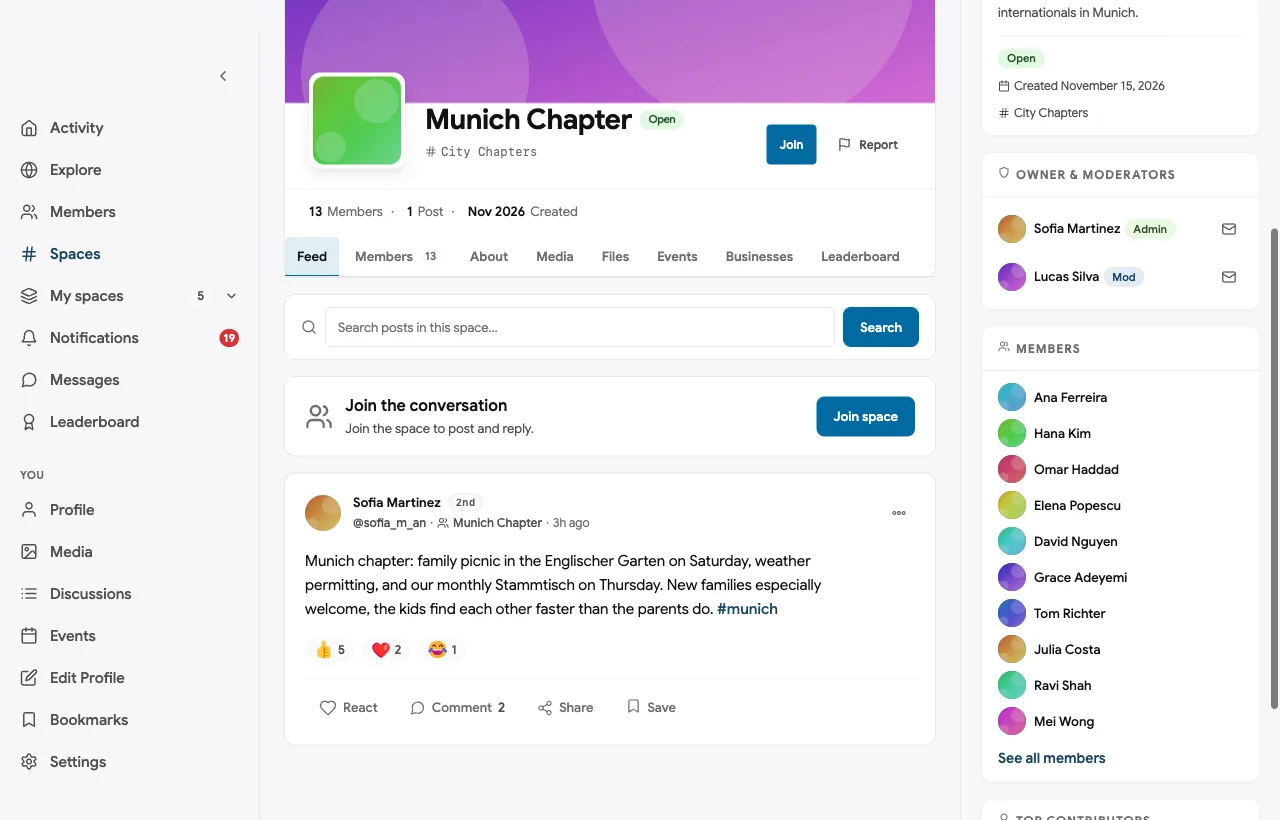
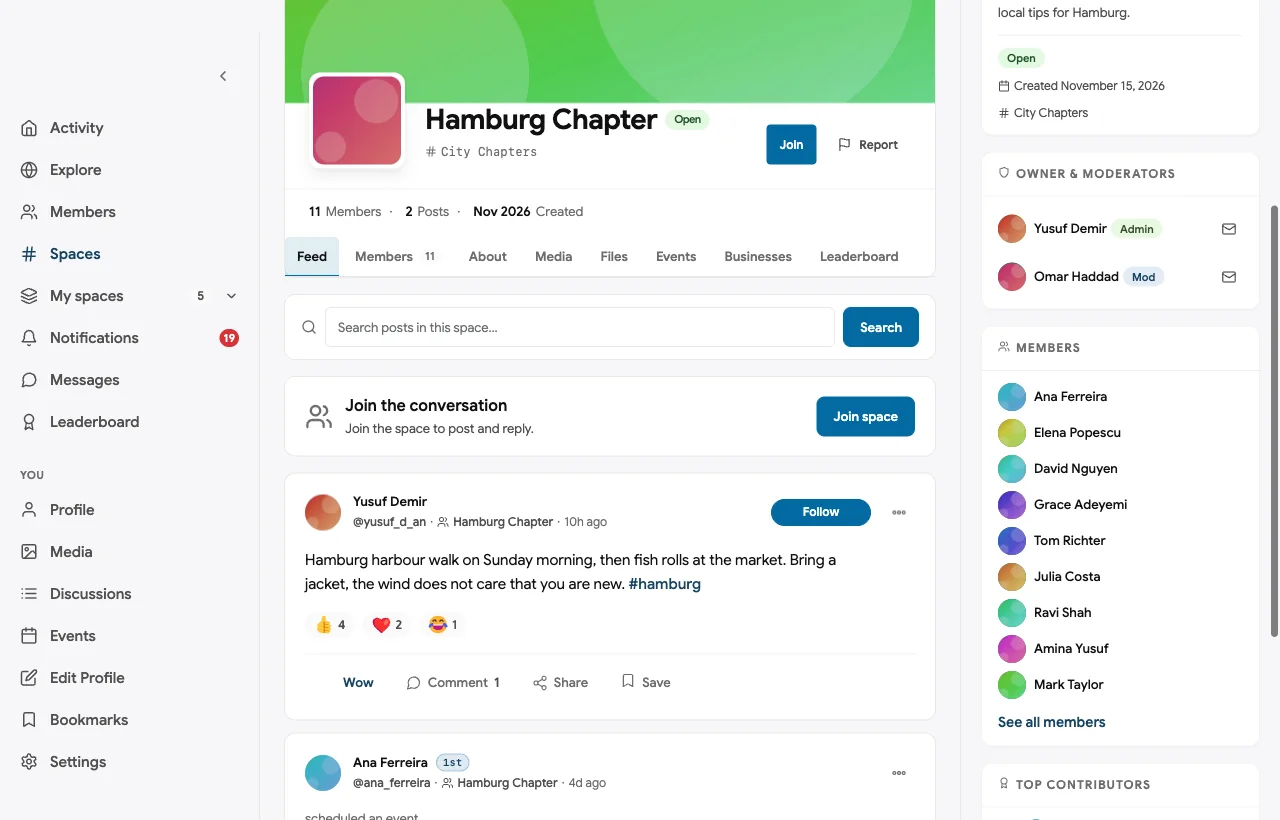
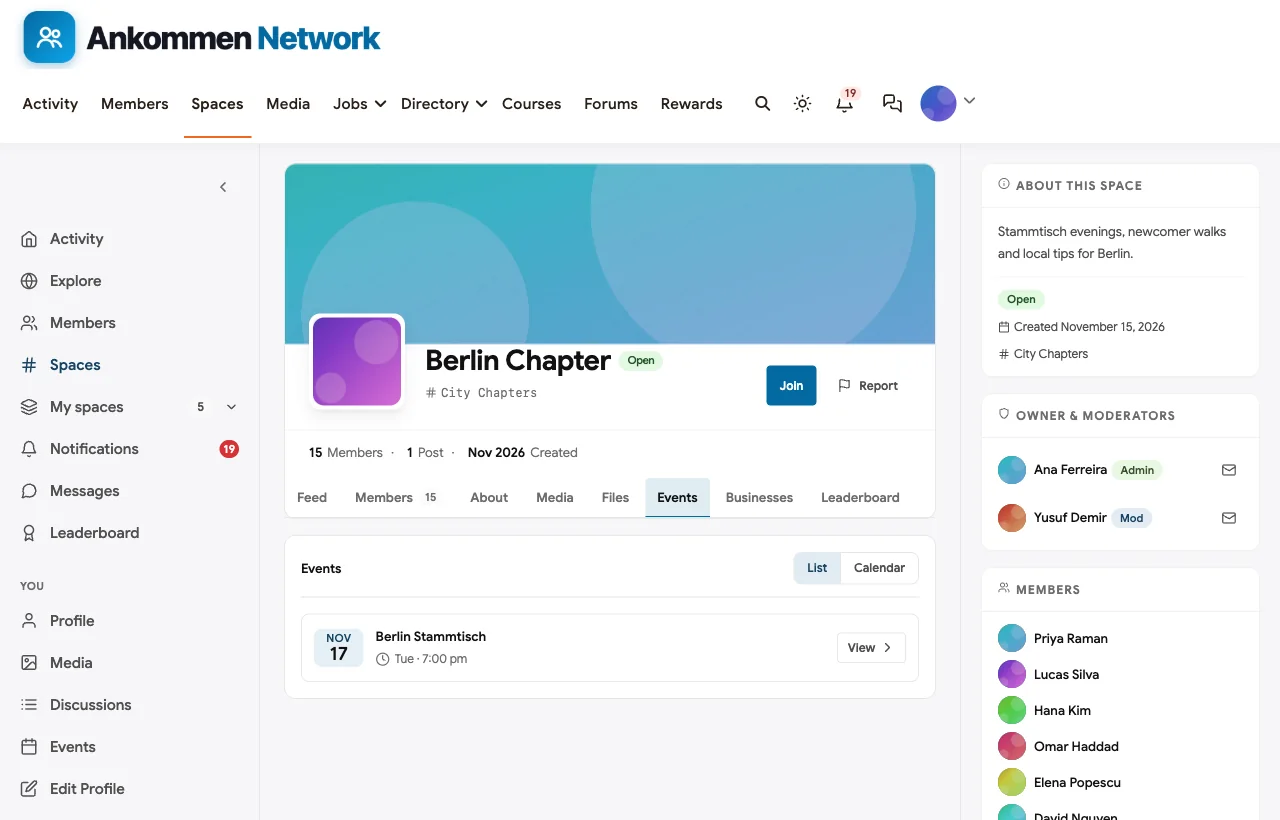
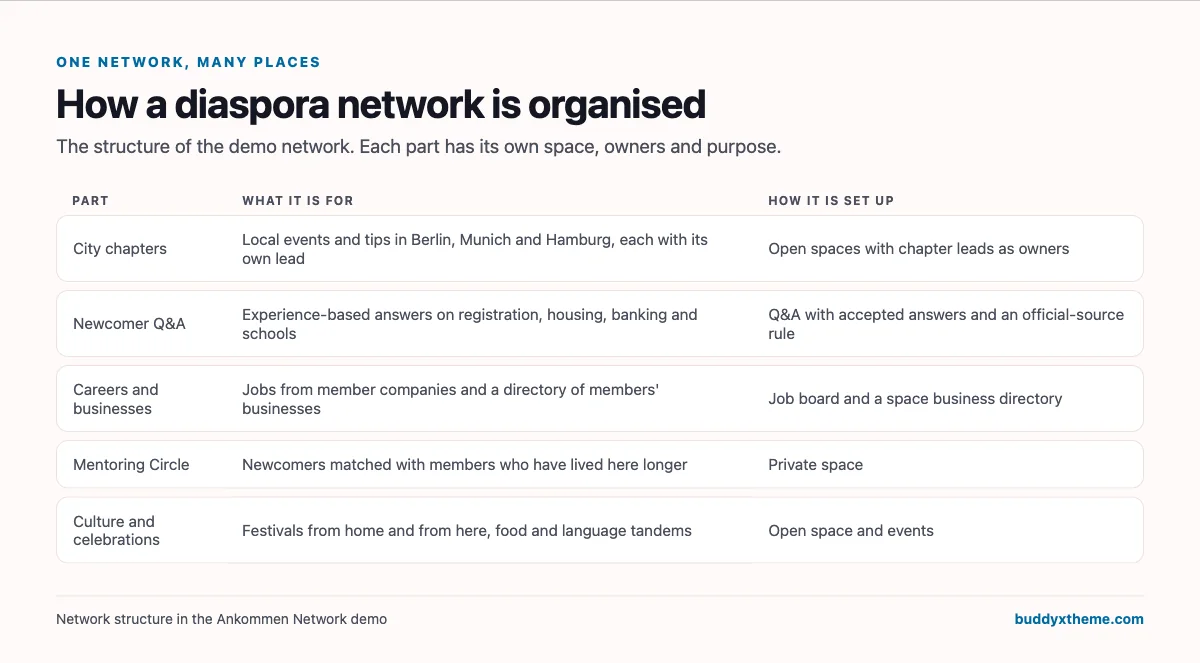
Each city has its own space with a chapter lead: Berlin, Munich and Hamburg. Chapters run their own events (Stammtisch evenings, family picnics, harbour walks) and share local tips, while the whole network stays connected in one place.
Newcomer Q&A
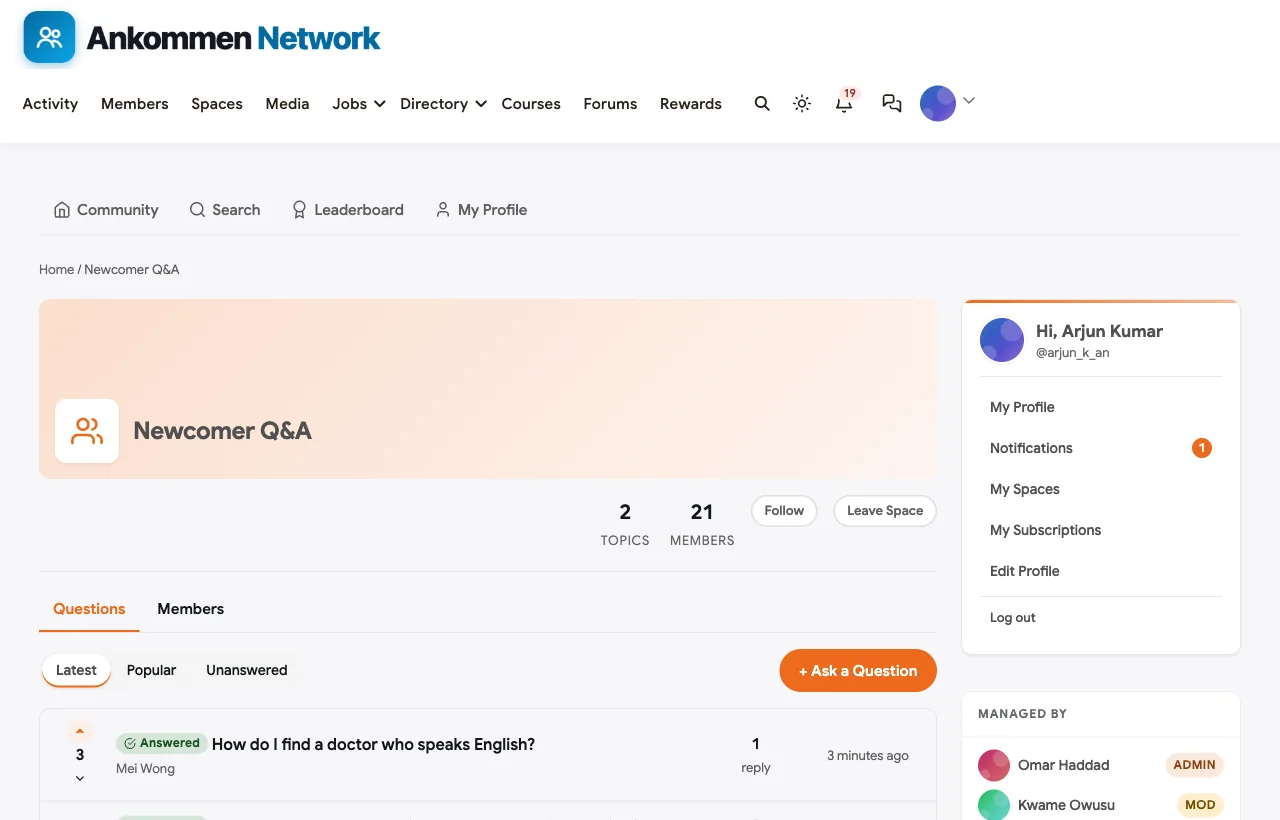
The Newcomer Q&A space answers the questions every newcomer asks: registration, housing, banking, insurance, doctors and schools. Members share experience, the best answer is marked accepted, and the space has a firm rule: always check the official source.
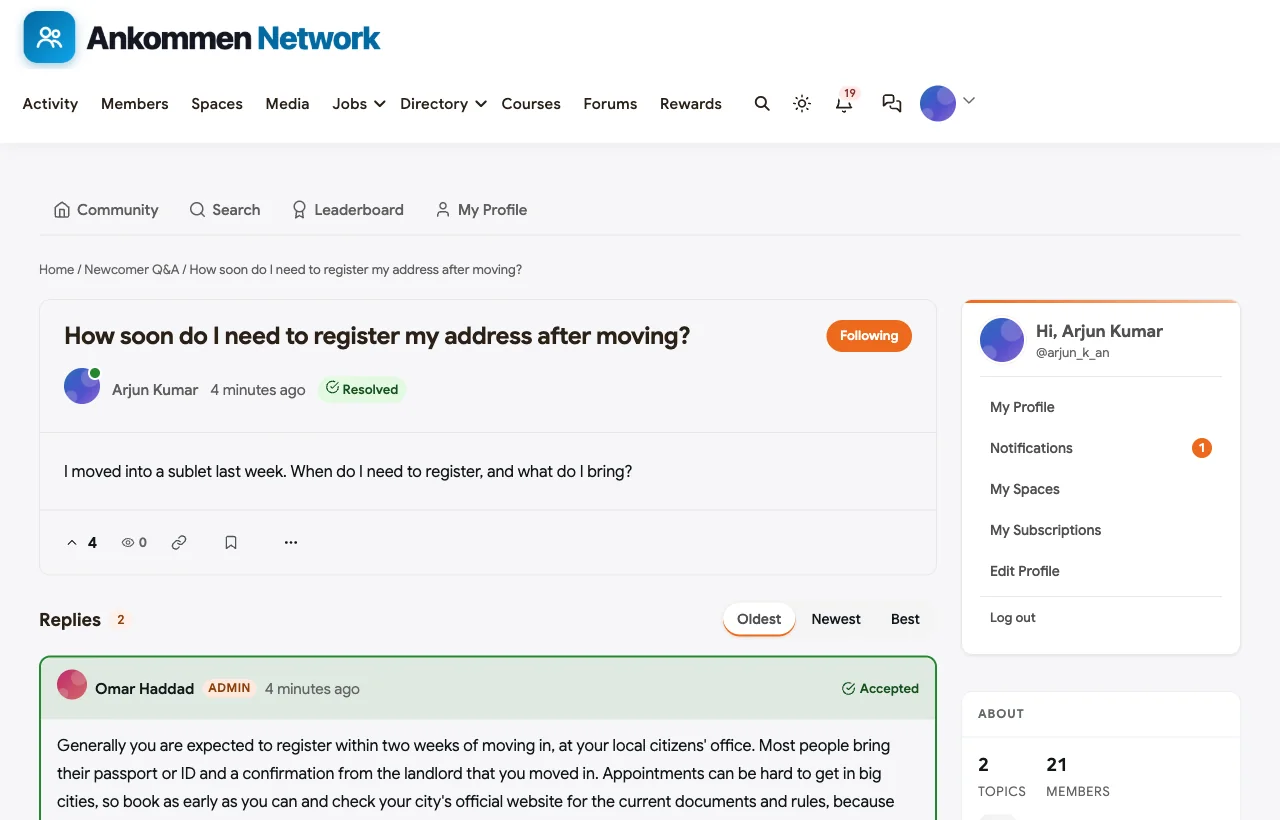
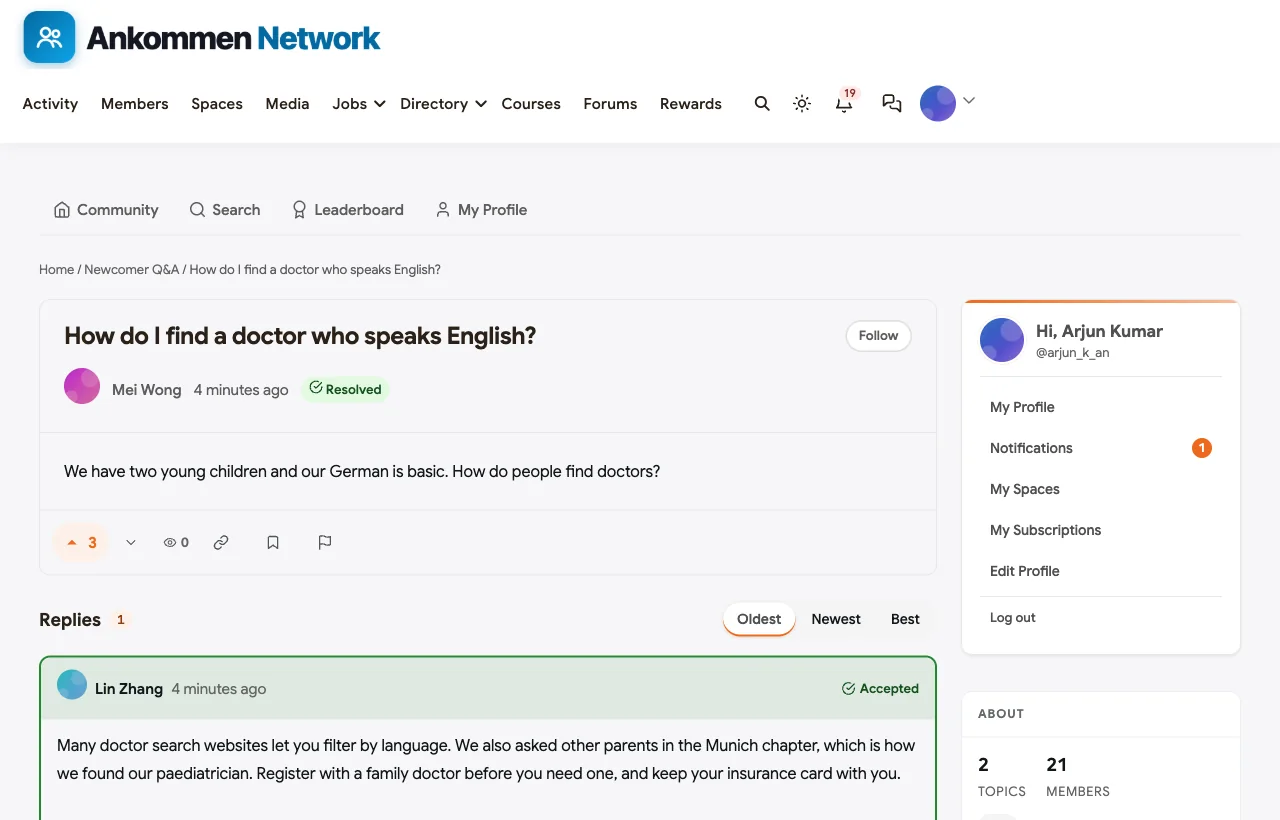
The new arrival from Bangalore asks how soon he must register his address. The lawyer member’s accepted answer gives the general rule (usually within two weeks), what people typically bring, and the most important advice: book early and check the city’s official website, because rules change. A parent asks how to find a doctor who speaks English, and another parent explains how they found theirs through the Munich chapter.
The Settling In course
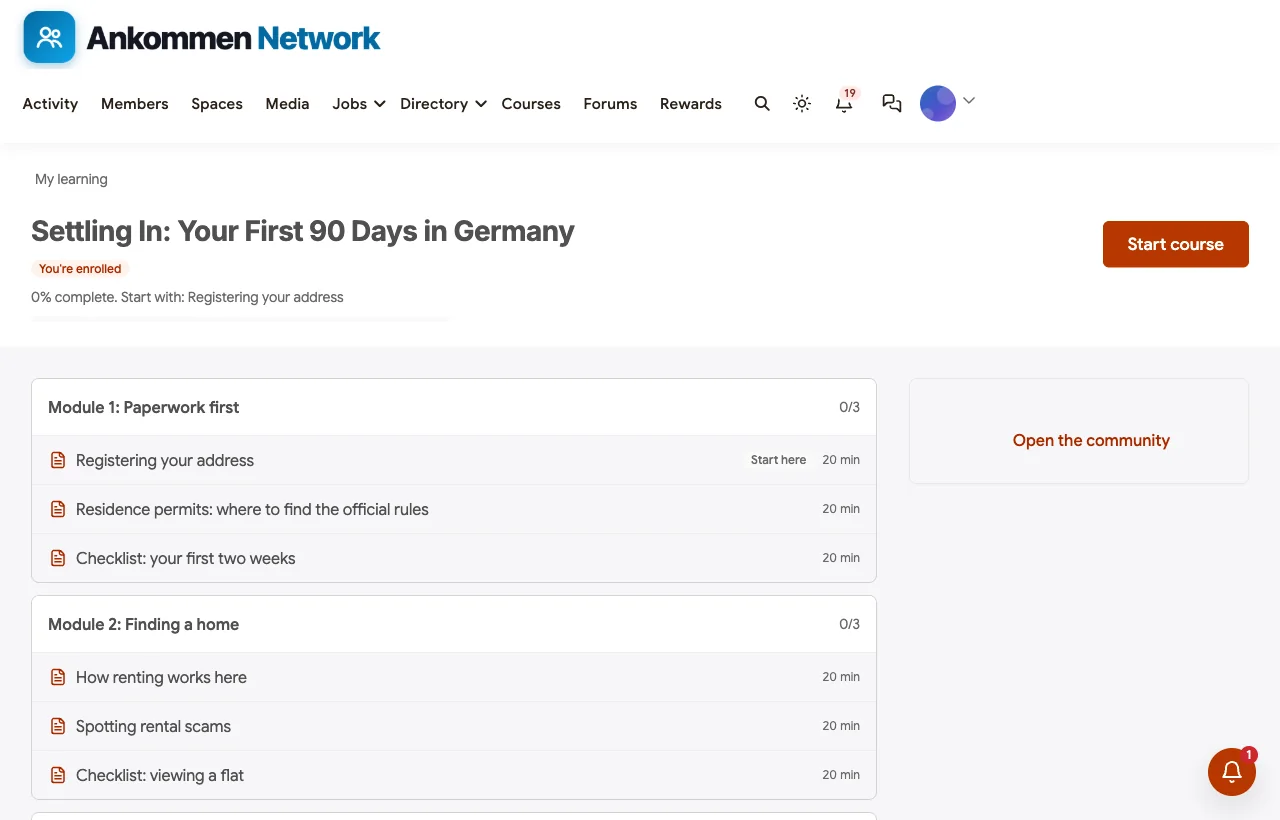
Settling In: Your First 90 Days in Germany is a six-module course written by members who have done it: paperwork, finding a home, money and work, health and insurance, language, and making it home. Every module links to the official authority.
Careers and members’ businesses
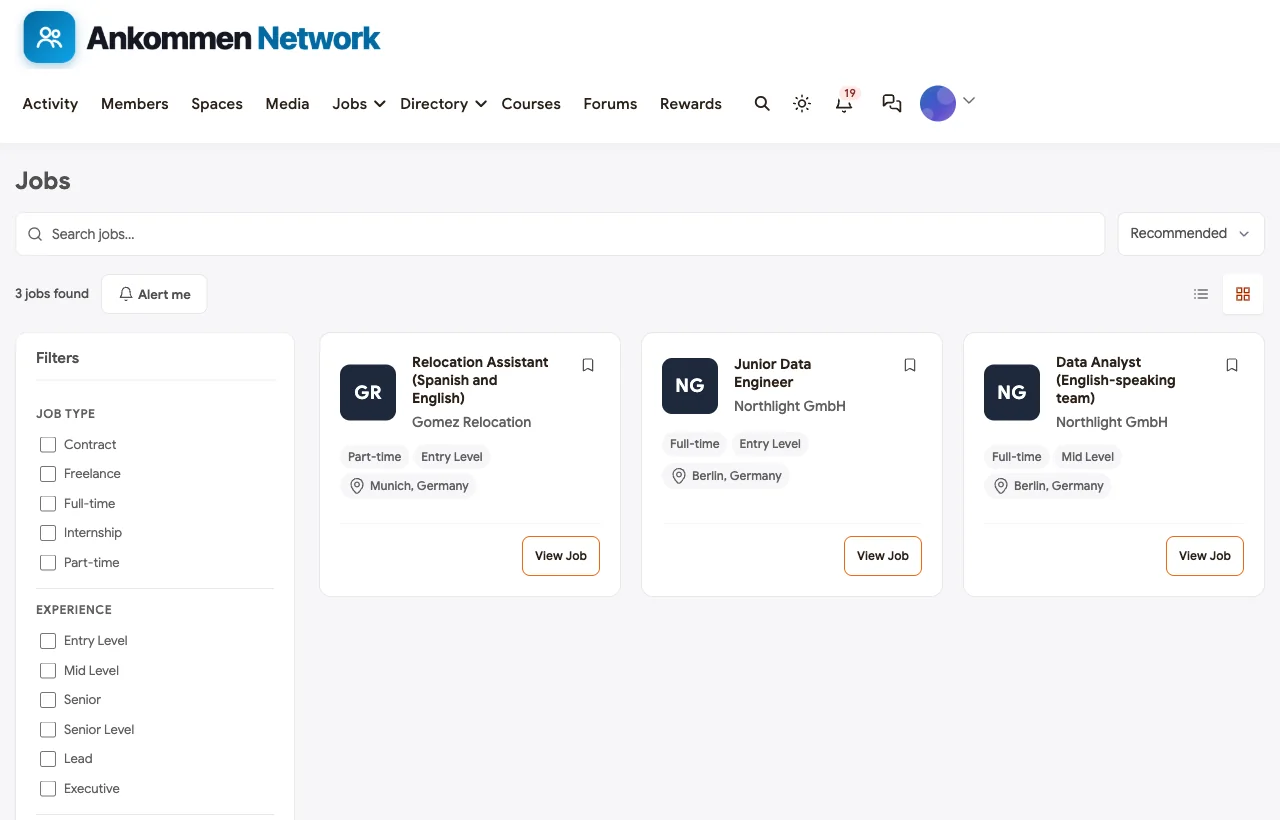
The Careers and Members’ Businesses space holds jobs from member companies, CV help, qualification recognition and a directory of businesses run by members. A startup founder posts two data roles in an English-speaking team, and a job-seeking member applies the same day.
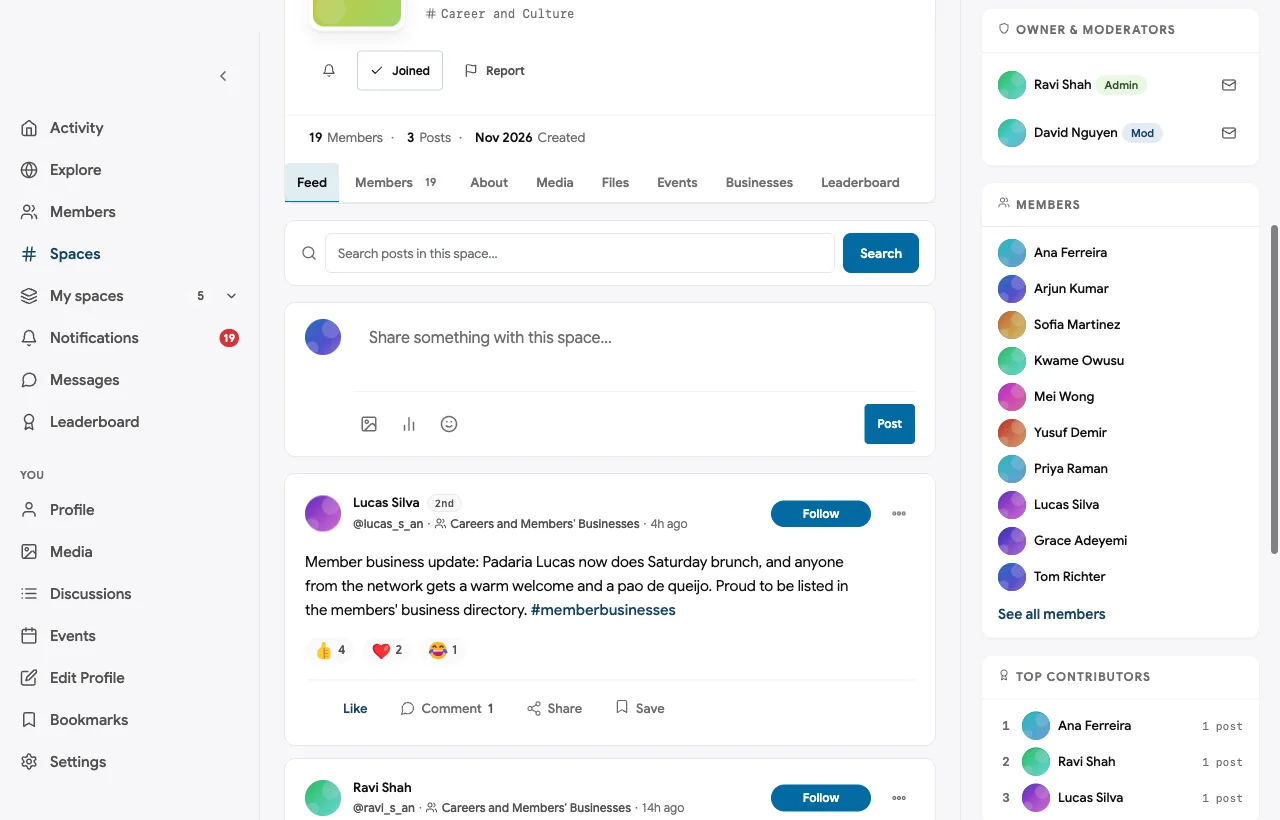
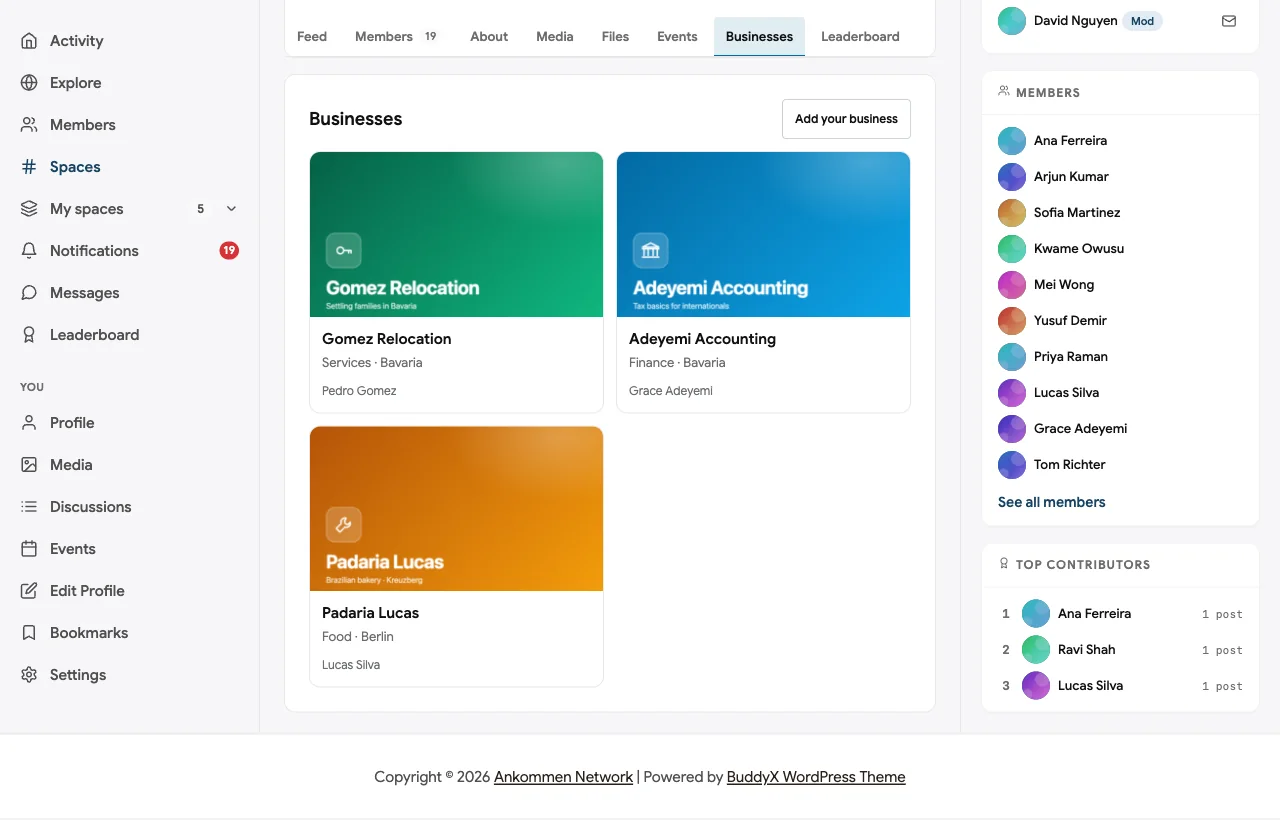
The business directory lets members find and support each other’s businesses: a Brazilian bakery in Kreuzberg, an accountant who explains tax basics to internationals and a relocation consultancy in Munich.
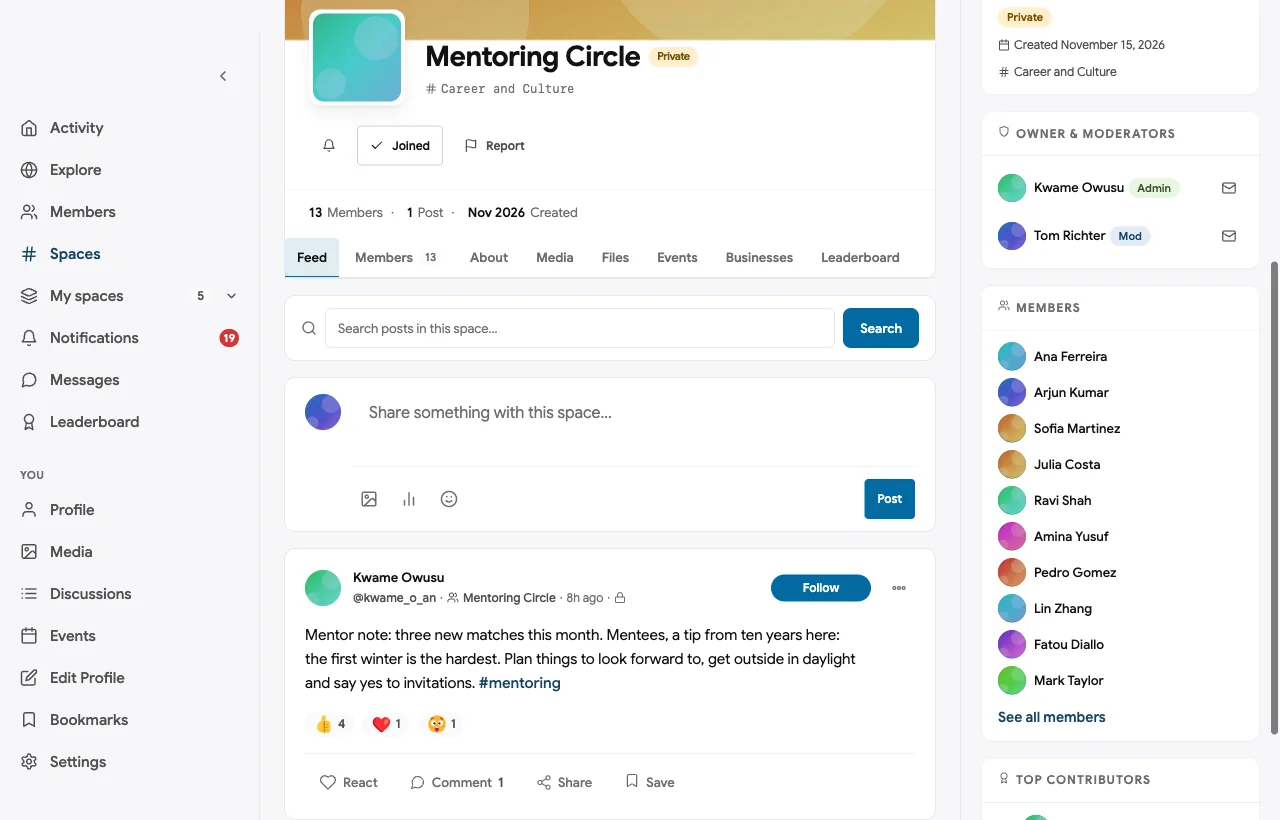
The Mentoring Circle
The Mentoring Circle is private. Newcomers are matched with members who have lived in Germany longer, for career and life questions. The mentor’s note on surviving the first winter (plan things to look forward to, get outside in daylight, say yes to invitations) is the kind of advice no official website gives.
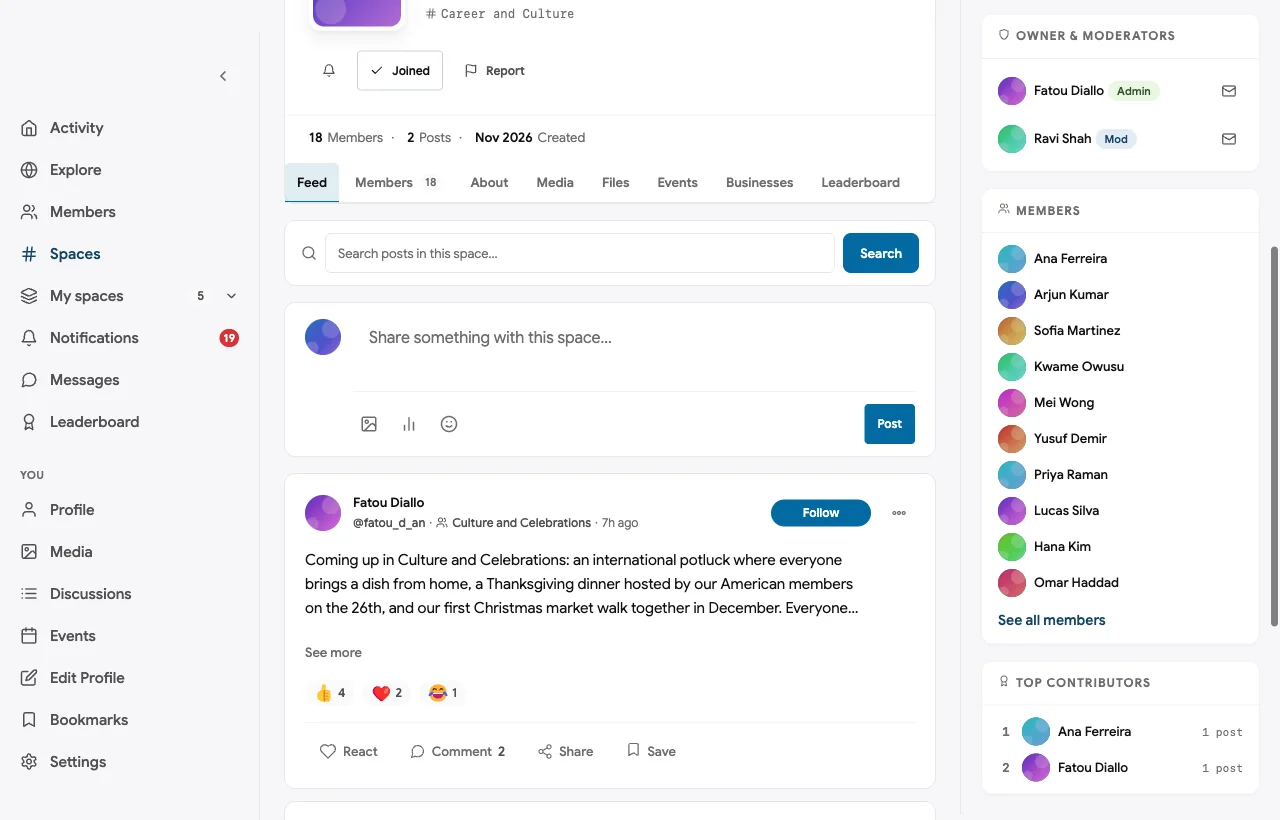
Culture and celebrations
The Culture and Celebrations space keeps the cultures members bring with them alive, and shares the ones they find here: an international potluck, a Thanksgiving dinner hosted by American members, a first Christmas market walk together and photos from a Diwali evening.
Members, leaderboard and mobile
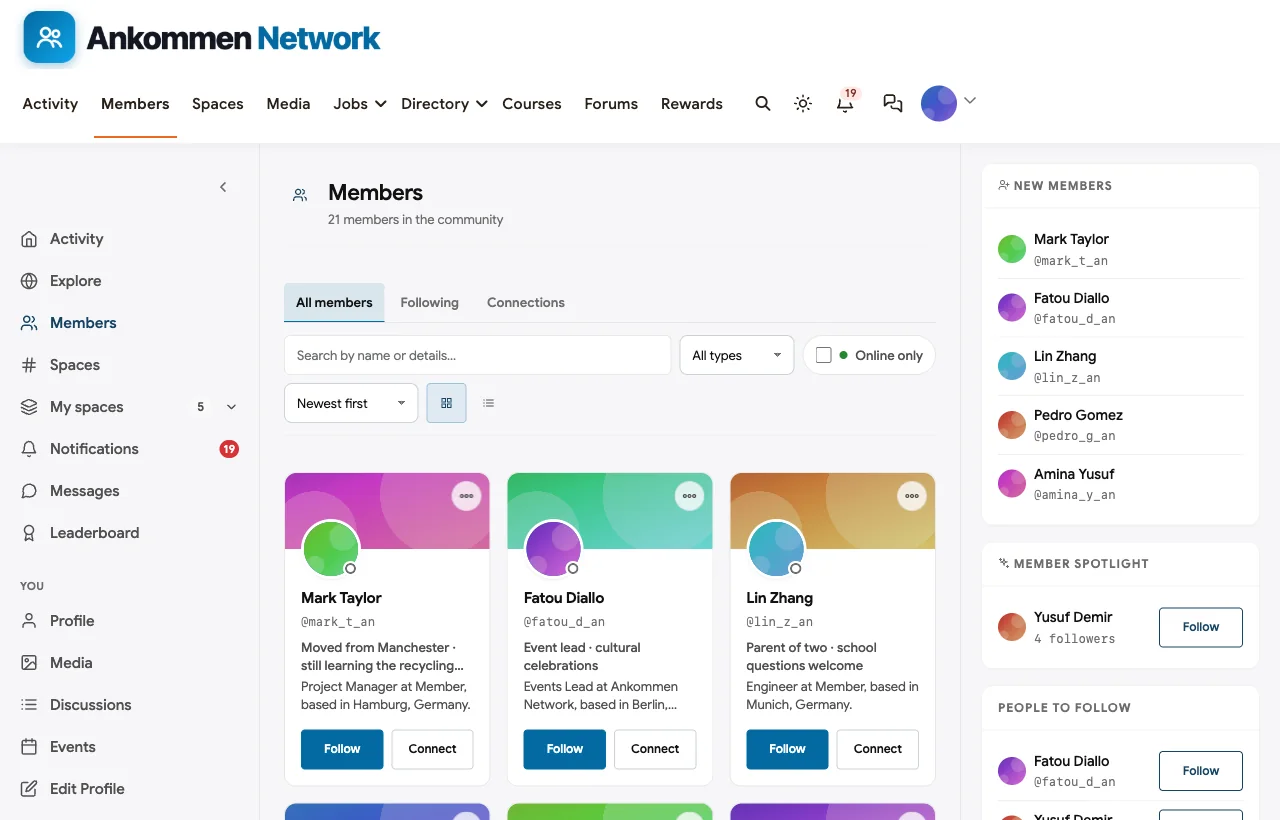
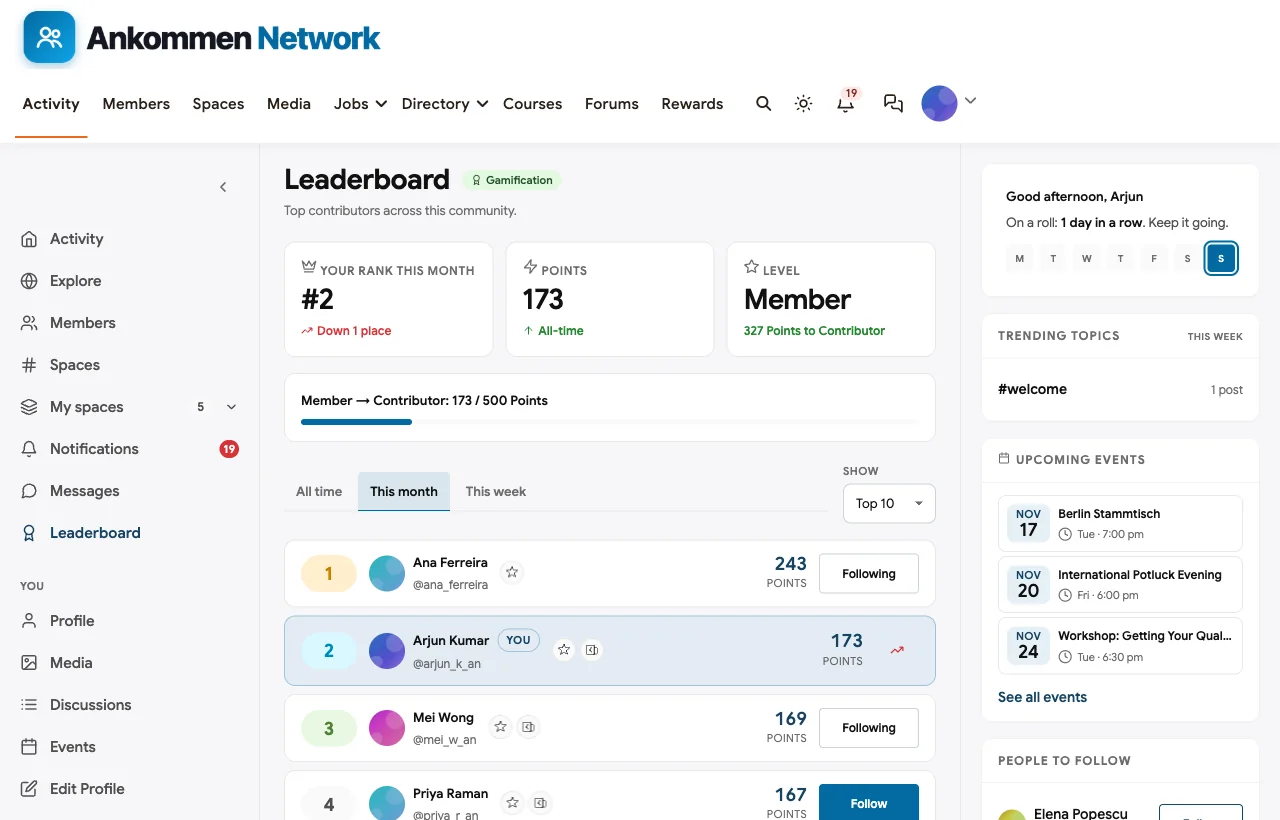
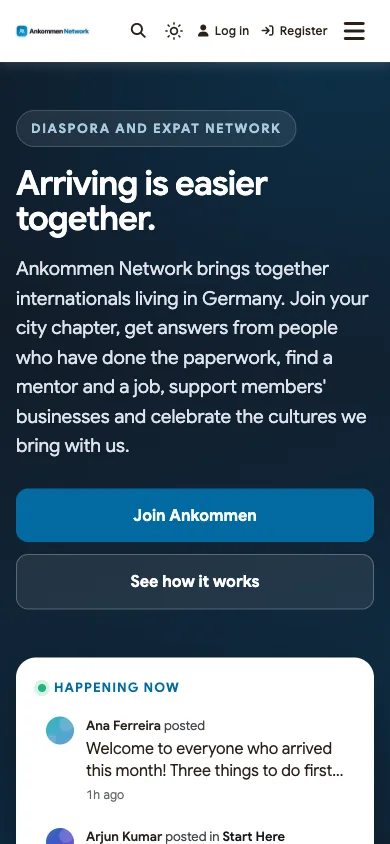
Newcomers often have only a phone in their first weeks, so the whole network works in the mobile browser without an app download.
Also built in. Polls for workshop topics, hashtags, profile fields for languages and city, notifications, moderation and reporting, badges, and paid memberships with trials and coupons for associations that collect membership.
Not built for: legal or immigration advice (members share experience, not advice), automatic translation of posts, or association accounting. The interface can be translated, and a fully multilingual site needs a translation plugin. Keep membership accounting in association software if you need it. It is self-hosted, so you run WordPress or use a managed host.
What’s included, and how it is delivered
BuddyNext is one platform made of a core and add-on platform modules. Everything shown in the demo above runs on the BuddyNext platform. This table shows which parts come with the core, which are platform modules you install and activate alongside it, and which need a third-party plugin, another system or custom work.
| Capability | How it is delivered |
|---|---|
| Open, private and secret spaces for city chapters, mentoring and culture | Core platform |
| Activity feed, pinned welcome posts, polls and hashtags | Core platform |
| Member profiles with languages and city, and a directory | Core platform |
| Reporting and moderation queue | Core platform |
| Direct messages | Platform module, installed alongside |
| Chapter events, workshops and celebrations | Platform module, installed alongside |
| Newcomer Q&A with accepted answers | Platform module, installed alongside |
| Settling In course with certificates | Platform module, installed alongside |
| Job board | Platform module, installed alongside |
| Members’ business directory inside a space | Platform module, installed alongside |
| Points, badges and leaderboards | Platform module, installed alongside |
| Paid memberships with trials and coupons | Platform module, installed alongside |
| Multilingual content | Third-party translation plugin |
| Live video for workshops | Third-party video tool (Zoom, Google Meet) |
Want to click around yourself? The Ankommen Network in this guide was built on a private test site, so it is not public. The BuddyNext live demo is a general community you can open in your browser and explore without installing anything.
2. InterNations: best global expat network to join
InterNations “grew from a network of friends living abroad to the largest community for expats and global minds worldwide” and “is present in 420 cities worldwide” (InterNations). Members can “Join exciting events to meet fellow expats,” “Get advice and info on life abroad” and “Find your people & make lasting friendships.”
Strengths: the largest global expat network, with events in hundreds of cities.
Gaps: the communities are run by InterNations, not by your association; no job board, business directory or mentoring program found.
3. Expat.com: best for expat advice and services
Expat.com calls itself “the largest expat help and support network” (Expat.com), with “Everything you need to know to move and live abroad,” the ability to “Connect & make friends” and “Find recommended businesses.”
Strengths: broad advice content and a recommended services directory.
Gaps: no chapter structure, mentoring or event tools for an organisation found.
4. Meetup: best for local events across cities
Meetup offers organisations “tools to grow your email list, build your brand, and expand to groups across the globe” (Meetup). Organisers can “create an unlimited number of groups around the world” and “host multi-group or hybrid events.” Meetup is now operated by Bending Spoons.
Strengths: local discovery and multi-city event groups.
Gaps: no newcomer Q&A, mentoring, job board or business directory found.
5. Mighty Networks: best hosted community with native apps
Mighty Networks calls itself “The community platform that delivers,” with “Real iOS and Android apps on your members’ home screens” (Mighty Networks), and says “84% of activity on Mighty is created by members with other members.”
Strengths: member engagement and branded apps.
Gaps: no city chapter structure, job board or business directory found.
6. Circle: best hosted community with events
Circle calls itself “The complete community platform,” with tools to “Customize your spaces, prompt discussions, host live events, and launch your course” (Circle).
Strengths: polished spaces, events and courses.
Gaps: no job board, business directory or chapter structure found.
7. Bevy: best for chapter-based communities at scale
Bevy “was purpose built to help companies build, grow and scale their global communities” (Bevy), offering “One hub for Forums, Events & Groups,” “structured learning paths” and “CRM integrations” (Bevy).
Strengths: global chapter communities with forums, events and learning.
Gaps: built mainly for company-run communities; no job board or business directory found.
8. Glue Up: best association management with chapters
Glue Up is “All-in-one Association Management Software” (Glue Up), with “Easy multi-tier chapter management solutions for memberships and events,” tools to “Automate your membership management processes” and a space where members “can connect with you.”
Strengths: chapter management, memberships and events for associations.
Gaps: no newcomer Q&A, job board or business directory found.
9. Wild Apricot: best membership management for small associations
Wild Apricot, part of Personify, helps you “Simplify, automate, and manage your membership, events, communications, payments and website” (Wild Apricot), with a “Membership directory” and “Customizable event pages and registration forms.”
Strengths: member records, renewals, events and a website for small associations.
Gaps: limited community features; no Q&A, mentoring or job board found.
10. Raklet: best membership portal and member cards
Raklet offers “Membership management software for organizations people are proud to join” (Raklet), with “One member database with every payment and event,” “A membership card in every pocket” and “A portal members actually open.”
Strengths: member database, renewals and a member portal.
Gaps: no newcomer Q&A, chapters, mentoring or job board found.
Running a newcomer Q&A responsibly
A newcomer Q&A is the most valuable part of a diaspora network, and the riskiest. People make real decisions based on what they read. A few rules keep it useful and safe:
- Experience, not advice. Members share what happened to them; they do not give legal or financial advice.
- Always link the official source. Every accepted answer should point to the authority’s own page.
- Date-stamp answers. Rules and processing times change, so answers should say when they were true.
- Invite professionals carefully. Lawyers and accountants can share general information, with a clear note that individual cases differ.
- Mark accepted answers and update them. When rules change, update the accepted answer rather than adding a new one.
Building city chapters that last
Chapters work when they have a lead, a rhythm and a reason to exist. Give each chapter a named lead and a co-lead, a monthly event at a fixed time (the Stammtisch format works well), and a welcome routine for newcomers in that city. Let chapters run their own events but share one network, one directory and one Q&A, so knowledge does not fragment. Start new chapters only when there are enough members and a willing lead.
Mentoring that newcomers actually use
Mentoring helps most in the first year. Match newcomers with members from a similar field or with a similar story, agree a light structure (three conversations over three months), and keep the circle private so people can ask honest questions about work, money and loneliness. Ask mentors to share what they wish they had known, not just how to fill in forms.
Languages and time zones
Diaspora networks often span languages and time zones. Keep one shared language for network-wide spaces, and let chapters or culture groups use their own. Add a language field to member profiles so people can find others who speak the same languages. Schedule online events at times that work for more than one region, record them, and remember that newcomers may be tired, busy and not yet confident in the local language.
Welcoming newcomers well
The first week decides whether a newcomer stays in the network. A simple welcome routine makes a big difference:
- Reply to every introduction within a day, ideally from someone in the same city or field.
- Offer a buddy. A local volunteer or a member who arrived a year earlier, for one coffee and a few questions.
- Point to three things, not thirty. The Settling In course, the city chapter and the Newcomer Q&A.
- Invite them to one event. A Stammtisch, a walk or a potluck is easier than a big networking night.
- Check in after a month. A short message asking how it is going often brings the most honest questions.
Members who were welcomed well are the ones who later welcome others, and that is how a network grows without burning out its organisers.
Questions to ask before you choose
- Do you want your own network or a place in someone else’s? InterNations and Expat.com are networks you join.
- Can you run city chapters with their own leads? Look for spaces with owners and events.
- Where will newcomer answers live? Q&A with accepted answers beats a group chat.
- Can members find jobs and support each other’s businesses? A job board and a business directory.
- Can you run private mentoring? Private spaces and direct messages.
- Do you need membership administration? Pair the community with association software, or use built-in memberships.
A 30-day launch plan
- Week one: foundations. Create Start Here, the Newcomer Q&A with the official-source rule, and one city chapter.
- Week two: newcomers. Open the Settling In course and a welcome routine for introductions.
- Week three: careers. Open the job board and the business directory, and invite member companies.
- Week four: culture and mentoring. Run the first celebration and match the first mentors.
Which platform fits your network?
| If you… | Choose |
|---|---|
| Want chapters, newcomer Q&A, mentoring, jobs, a business directory and culture in a network you own | BuddyNext |
| Want to join a large global expat network | InterNations or Expat.com |
| Mainly run local events in several cities | Meetup |
| Run a chapter-based community for a company | Bevy |
| Need association membership administration | Glue Up, Wild Apricot or Raklet |
| Want a general hosted community | Circle or Mighty Networks |
More community platform comparisons
Running a different kind of network or membership community? These guides use the same method: a working demo community and vendor claims checked at the source.
- Best platforms for a travel enthusiasts community: trip reports, travel Q&A, buddies and group trips.
- Best platforms for a faith-based membership community: small groups, private prayer, serving teams and families.
- Best software for a university alumni network: chapters, mentoring and jobs.
- Best platforms for a remote workers community: connection across cities and time zones.
- Best platforms for a professional association: members, chapters and events.
- Best platforms for a paid language learning community: clubs by level and live sessions.
- How to set up a community space on WordPress: the step-by-step setup guide behind every demo in this series.
How we built and checked this list
We built the Ankommen Network demo on a local WordPress site running BuddyNext, with fictional members, chapters, a course, jobs and member businesses created for this guide. The newcomer answers in the demo are general and point to official sources; they are not legal advice. Every BuddyNext screenshot is from that demo. Competitor features were checked against each vendor’s own website in November 2026, and the migration figures come from the United Nations. We left out Hivebrite because its website blocked our checks, and Expatica’s forums because they no longer appear on its site. Where we could not confirm a feature on a vendor’s own pages, the scorecard says “Not found”. We did not run a hands-on trial of every product, so features can change; confirm anything critical with the vendor. buddyxtheme.com is published by the team behind BuddyNext, which is why BuddyNext is listed first; we have tried to be fair about its gaps as well as its strengths.
Frequently asked questions
What is the best platform for a diaspora or expat network?
BuddyNext is the best choice for a diaspora or expat network you own, with city chapters, a newcomer Q&A, a settling-in course, mentoring, a job board, a members’ business directory and cultural events. InterNations is the best large network to join.
How do I organise city chapters?
Create a space for each city with a named lead, run a regular local event, and keep shared resources such as the Q&A, directory and job board at network level.
Should members give legal or immigration advice?
No. Members can share their experience, but every answer should point to the official source, and professional members should give general information only.
Can members find jobs and support each other’s businesses?
Yes. BuddyNext includes a job board and a business directory inside a space, so member companies can post roles and members can list their businesses.
Can a diaspora network work in several languages?
Yes. Keep one shared language for network-wide spaces, let chapters or culture groups use their own, add a language field to profiles and use a translation plugin for a fully multilingual site.
Can an association collect membership fees?
BuddyNext supports paid memberships with renewals, trials and coupons, and associations that need full accounting often pair it with membership software.
How do I keep a newcomer Q&A accurate over time?
Ask answerers to link the official source and say when their answer was true, review the most-viewed answers every few months, and update the accepted answer when rules change instead of adding a new thread.
Can members find others who speak their language?
Yes. Add a languages field to member profiles, and members can search the directory or join a culture or language group with people who share their languages.
Can members use the network on their phones?
BuddyNext works in the mobile browser without an app download, which matters for newcomers in their first weeks.
The bottom line
Nobody should arrive alone. If you want city chapters, newcomer answers, mentoring, jobs, members’ businesses and culture in a network you own, BuddyNext is the strongest foundation. For a large network to join, InterNations leads, and for association administration, Glue Up and Wild Apricot.
And make arriving easier for the next newcomer.