

Ask women founders what helped them most in their first years, and many will describe a small group: five or six other women at a similar stage who met every month, told each other the truth and opened doors when it mattered. Advice is everywhere. What is rare is a room where you can say “I don’t know what I’m doing” and leave with a plan, an introduction and someone who will check in next month.
This guide compares the platforms used to build that kind of network, from organisers, nonprofits and coaches running a private network for women founders and business owners, to established networks women can join. It covers application-based membership, confidential peer circles, local chapters, mentoring, a member business directory, events, and wins and asks. We built a working network for women founders for the first entry and checked every competitor claim on the vendor’s own pages in November 2026.
Quick answer
If you want to run your own network for women founders, BuddyNext is the strongest choice: application-based sign-up, secret peer circles, private chapter spaces with events, a growth-stage founders group, Q&A with accepted answers, a member business directory, wins and asks, mentoring by direct message and paid memberships, all on your own website. If you would rather join an established network, Ellevate and Chief lead; MemberPress, Disciple and Bettermode are alternatives for running your own, and Memberful, Whop, Luma and Geneva each cover one piece.
In this guide
- Run your own network or join one?
- Why women founders need their own networks
- What a women founders network needs
- The women founders network scorecard
- 1. BuddyNext: best for running your own network for women founders
- 2. Ellevate Network: best established network for professional women
- 3. Chief: best for women executives who want a vetted network
- 4. MemberPress: best WordPress membership plugin with a directory
- 5. Disciple: best for a branded app network
- 6. Bettermode: best hosted community builder
- 7. Memberful: best for adding paid membership to an existing site
- 8. Whop: best for selling access to a community product
- 9. Luma: best for event pages and registrations
- 10. Geneva: best for informal local groups
- From application to mentor
- Running peer circles that last
- Making wins and asks work
- Questions to ask before you choose
- A 60-day launch plan for a women founders network
- Which platform fits your network?
- More community platform comparisons
- How we built and checked this list
- Frequently asked questions
- The bottom line
Run your own network or join one?
| Approach | Best for | Examples |
|---|---|---|
| Join an established network | Individual founders and executives who want a ready-made network | Ellevate Network, Chief |
| Run your own network | Organisers, nonprofits, accelerators, coaches and chambers building a network for their own community | BuddyNext, MemberPress, Disciple, Bettermode |
| Use single-purpose tools | Adding one piece: paid access, events or local groups | Memberful, Whop, Luma, Geneva |
Established networks are excellent if their focus matches yours. Organisers who serve a specific region, industry, stage or community usually need their own network, with their own application criteria, circles and chapters.
Why women founders need their own networks
The Global Entrepreneurship Monitor’s Women’s Entrepreneurship Report warns that “high-potential women entrepreneurs who innovate, export, hire, and scale [are] largely invisible to policymakers and programme leaders” (GEM). GEM research also finds women are “47% more likely than men to close business due to family or personal reasons” (GEM).
A network cannot fix policy, but it can make women founders visible to each other and to the people who can help, and it can give them peers who understand the specific pressures they face. That is the job these platforms do.
What a women founders network needs
| Need | Why it matters | What the platform needs |
|---|---|---|
| A considered membership | Trust depends on knowing who is in the room | Application-based sign-up with approval |
| Confidential peer circles | Founders need a safe place for real decisions | Secret groups that outsiders cannot see |
| Local connection | Introductions and customers often come from your city | Private chapter spaces with events |
| Answers from experience | The same hiring, legal and funding questions recur | Q&A with accepted answers |
| Visibility for members’ businesses | Buying from members is the simplest support | A member business directory |
| Wins and asks | Specific asks get specific help | A space for celebrating and asking |
| Mentoring | Experienced founders want to give back | Easy one-to-one messaging |
| Sustainability | Running a network takes work | Paid membership |
The women founders network scorecard
How each option handles what matters most. “Not found” means we could not confirm it on the vendor’s own pages, not that it is impossible.
| Platform | Type | Application or vetting | Peer circles | Chapters | Business directory | Events | Paid membership |
|---|---|---|---|---|---|---|---|
| BuddyNext | Run your own | Admin approval | Secret spaces | Private spaces with events | Yes, with covers | Yes | Yes |
| Ellevate Network | Join | Not found | Squads, Community Circles | Chapters | Not found | Yes | Memberships |
| Chief | Join | Application and criteria | Vetted peer circles | Clubhouses in four cities | Not found | Yes | Not confirmed |
| MemberPress | Run your own | Not found | Forums | Not found | Member directory | Not found | Subscriptions |
| Disciple | Run your own | Not found | Groups | Not found | Member directory | Yes | Tiers |
| Bettermode | Run your own | Not found | Spaces | Not found | Members | Yes | Not confirmed |
| Memberful | Run your own | Not found | Not found | Not found | Not found | Not found | Subscriptions |
| Whop | Run your own | Not found | Not found | Not found | Not found | Not found | Tiers |
| Luma | Events tool | Not found | Not found | Not found | Not found | Yes | Not found |
| Geneva | Groups app | Not found | Groups | Local groups | Not found | Not confirmed | Not found |
1. BuddyNext: best for running your own network for women founders
BuddyNext is a complete community platform that runs on your own WordPress site. Registration can require admin approval, and open, private and secret spaces, events, Q&A with accepted answers, a business directory, direct messages, polls, leaderboards and paid memberships work together. An organiser can run a private network with peer circles, chapters and a member directory under their own brand.
To show it in practice, we built Rise Collective, a demo application-based network for women founders and business owners in Toronto and London. It has 20 members: founders in skincare, software, healthtech, logistics, fashion, publishing, catering, architecture and wellness, a fractional CFO, an employment lawyer, a bookkeeper, a brand designer, a former COO who mentors, chapter leads and a founder about to leave corporate life.
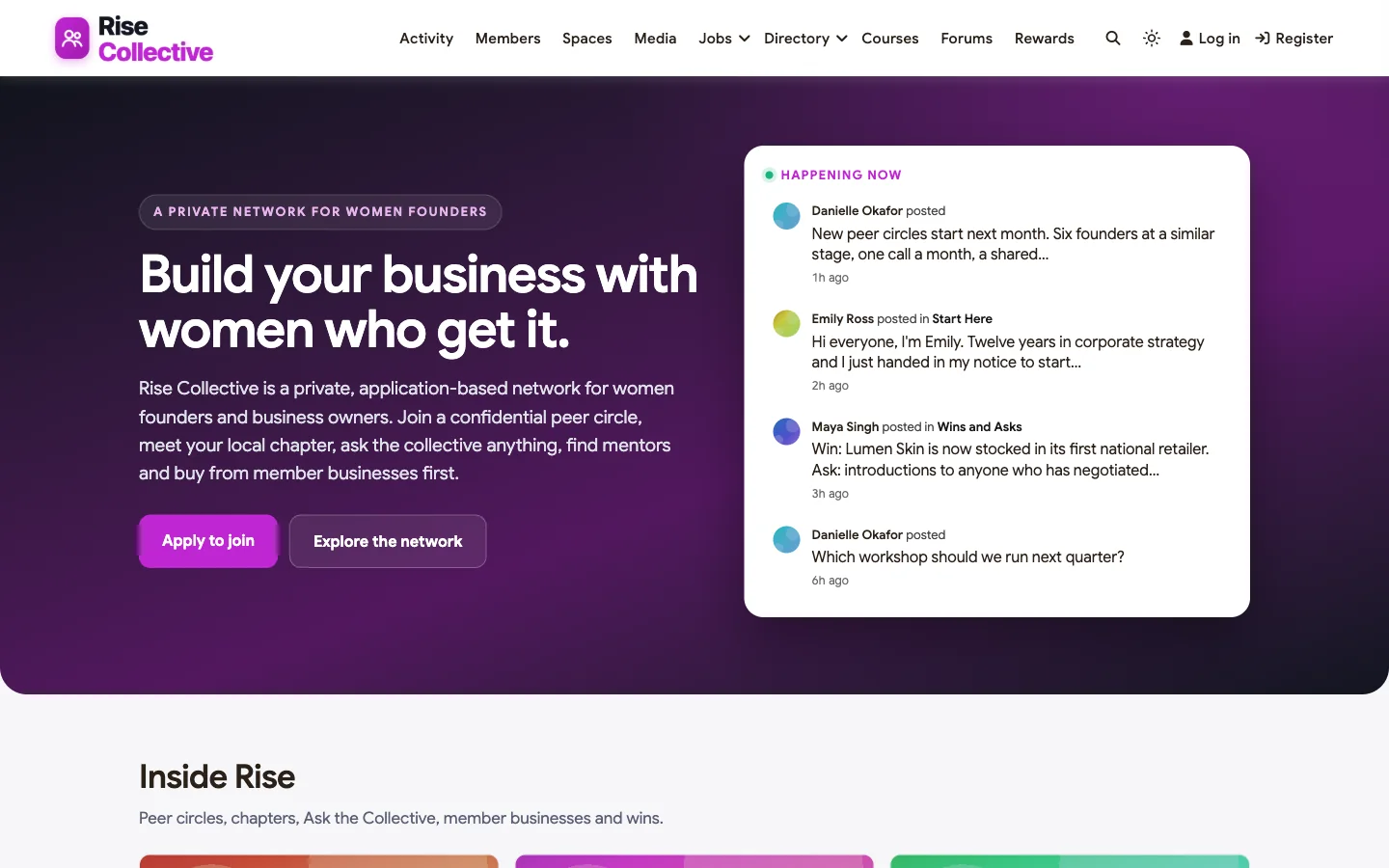
Good at: confidential peer circles, local chapters, members helping members, and a network you control.
Confidential peer circles. Each peer circle is a secret space: six founders at a similar stage, invisible to everyone else. Circles meet monthly as an event and keep goals and check-ins between calls:


A private group for growth-stage founders. Founders with teams discuss hiring leaders, raising and scaling operations, and an experienced operator offers mentoring hours:

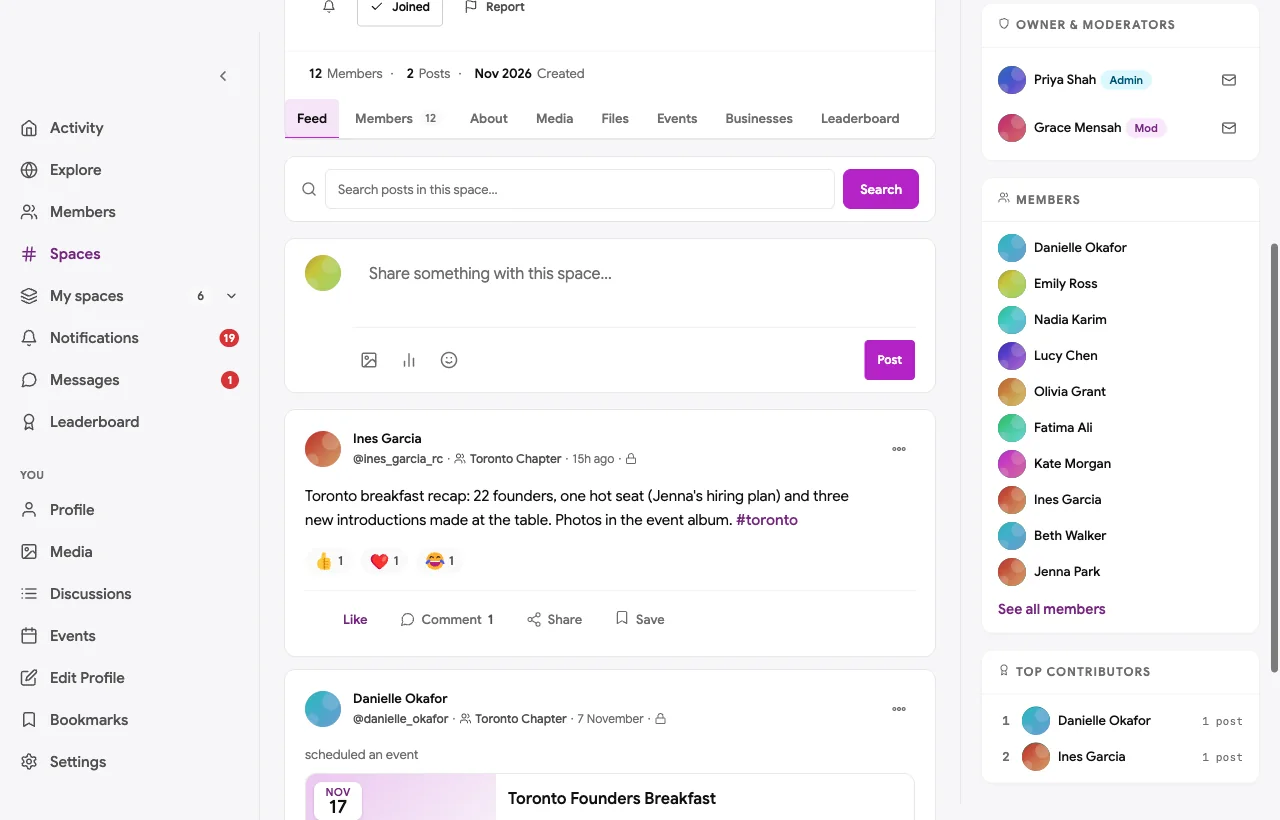
Local chapters with events. Toronto and London chapters have private spaces for breakfasts, suppers and workshops, with RSVPs:

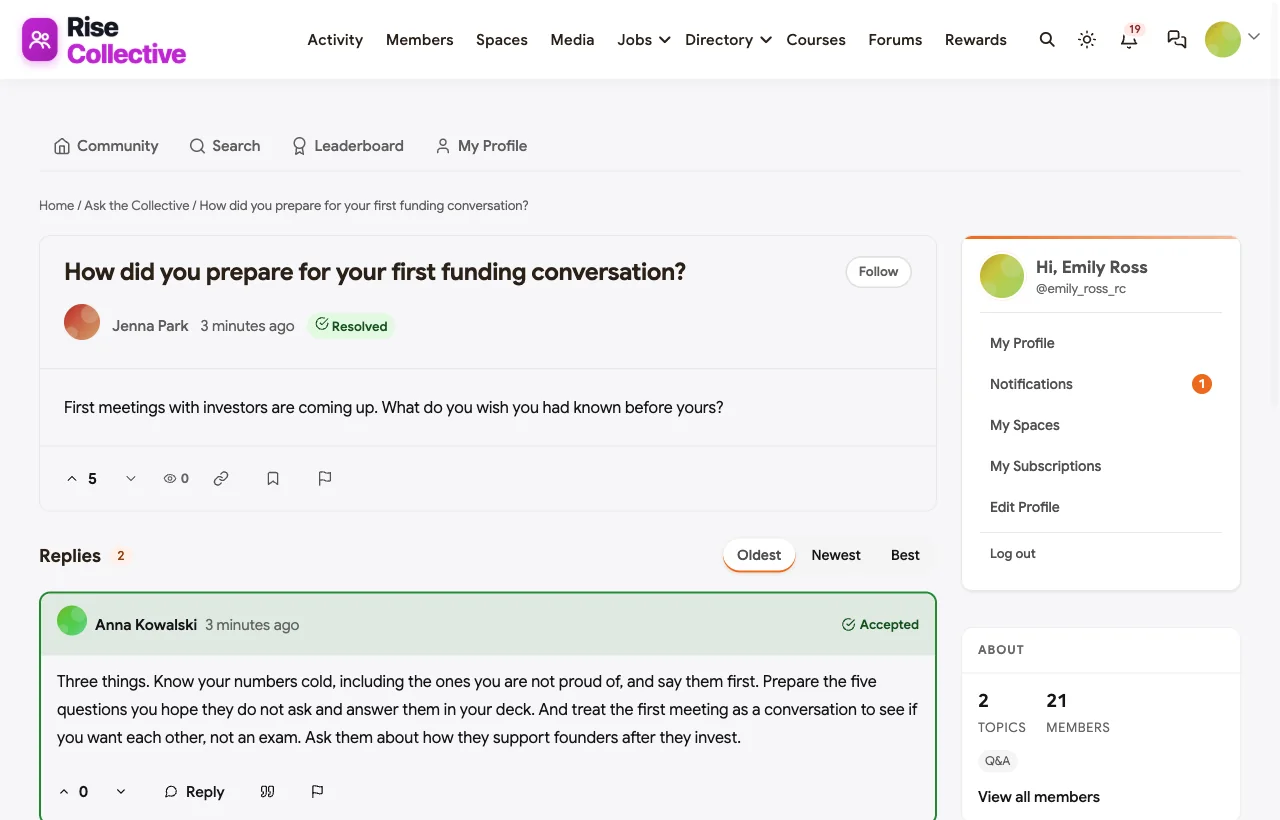
Ask the Collective, with accepted answers. Members ask about hiring, legal questions, funding and marketing, and the answer that helped is marked accepted. In the demo, a founder asks how to prepare for her first funding conversation, and a fractional CFO’s answer becomes the reference:
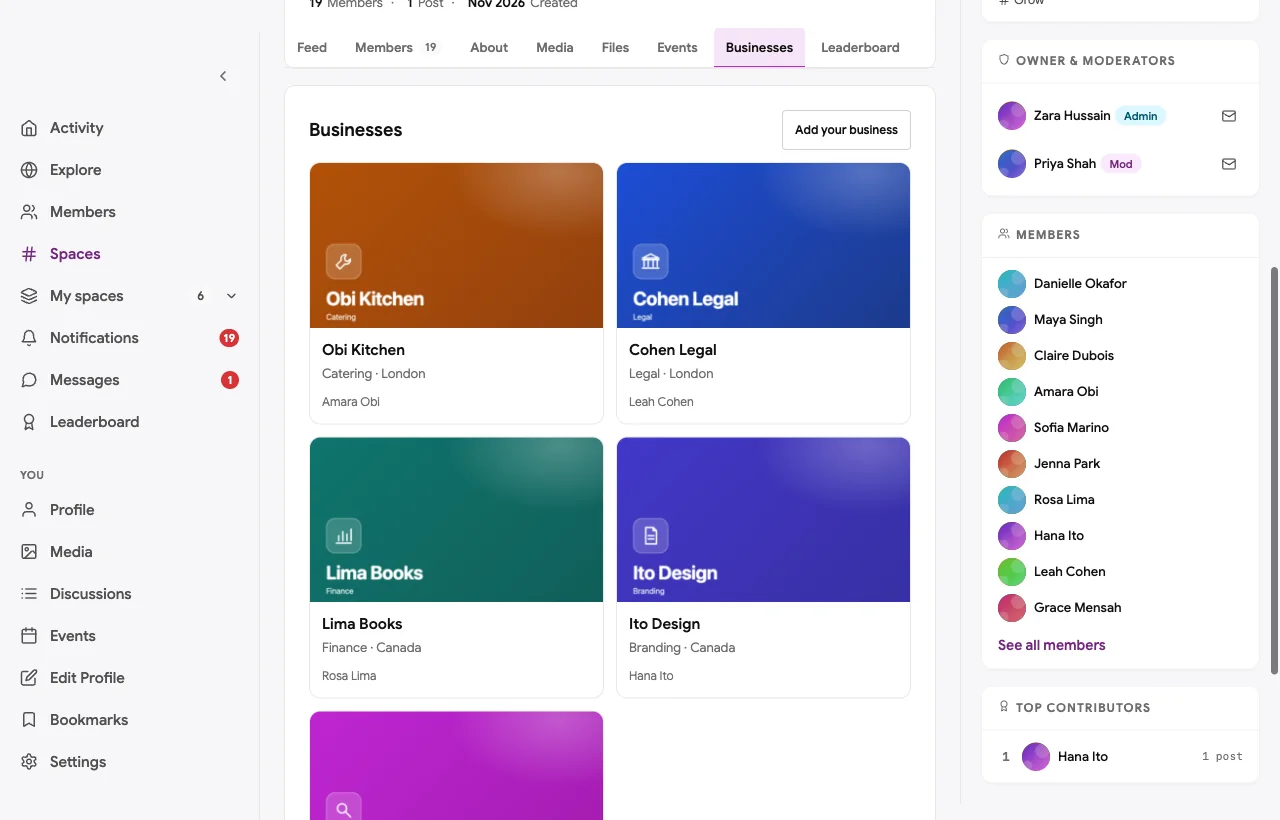
A member business directory. Every member business is listed with a cover, category and location, so members can buy from, hire and refer each other first:
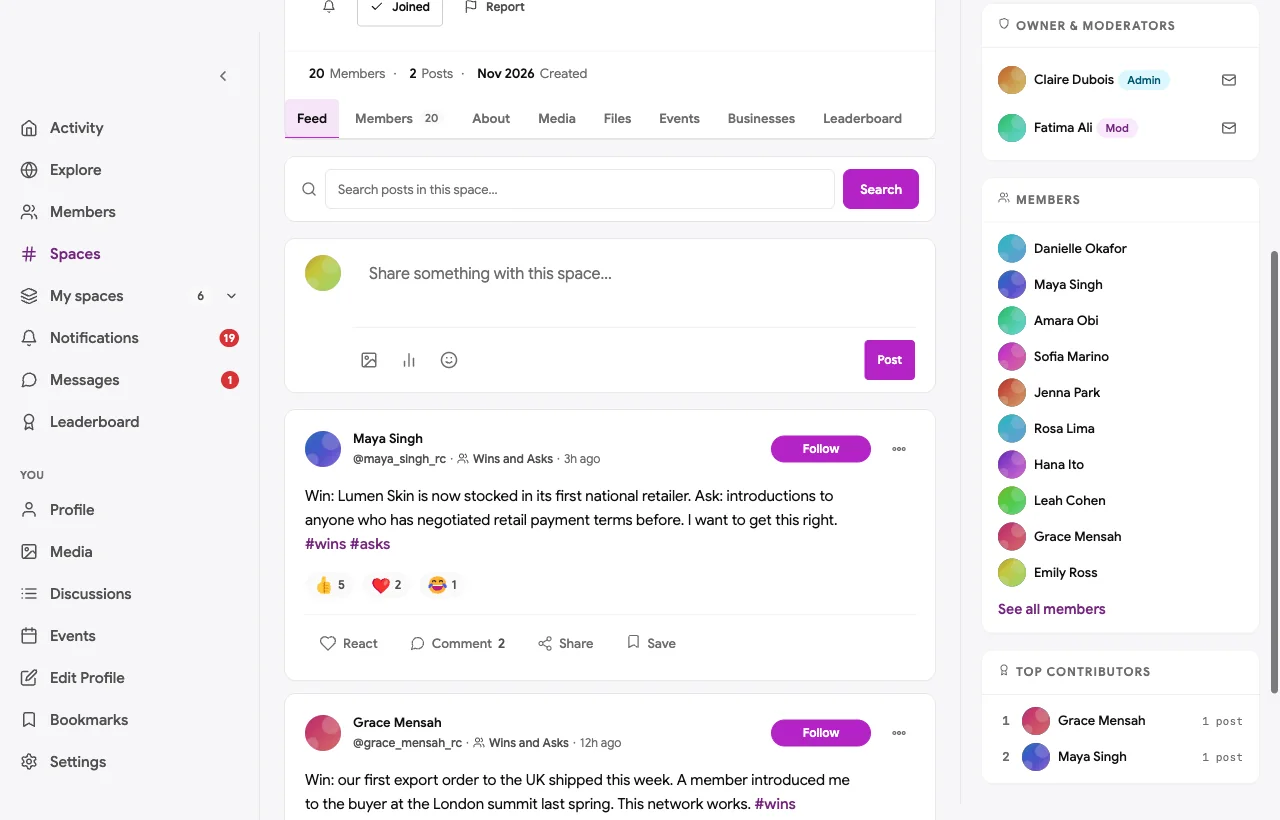
Wins and asks. Members celebrate wins out loud and ask for exactly what they need. In the demo, a skincare founder shares her first national retail listing and asks for help with payment terms, and two members respond:
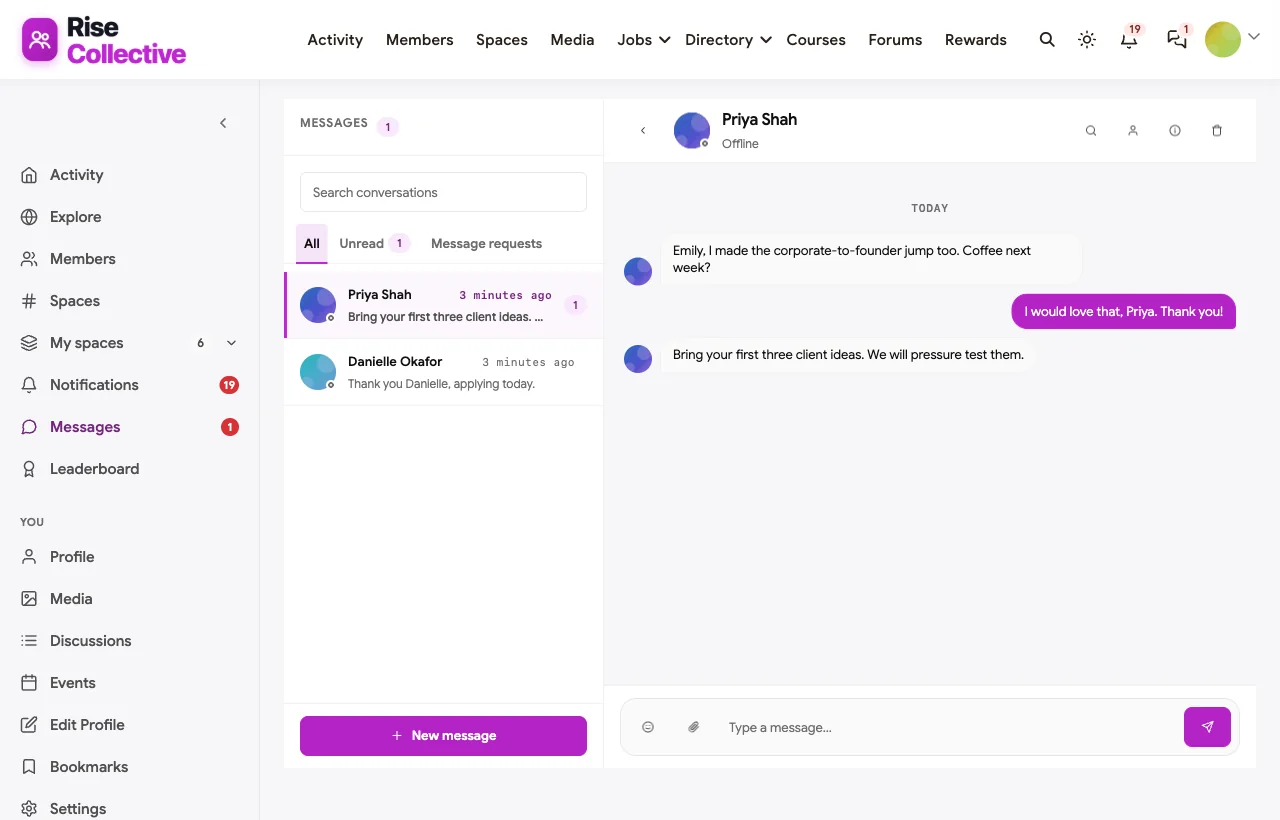
Mentoring by direct message. Experienced founders offer coffee and reviews to newer members:
Also built in. Polls to choose workshops, a member directory with privacy controls, notifications, moderation and reporting, points and a leaderboard, and paid memberships with trials and coupons for networks that charge dues.
Not built for: matching mentors automatically or running a pitch competition with judging; organisers handle those through applications, events and messages. It is self-hosted, so you run WordPress or use a managed host.
What’s included, and how it is delivered
BuddyNext is one platform made of a core and add-on platform modules. Everything shown in the demo above runs on the BuddyNext platform. This table shows which parts come with the core, which are platform modules you install and activate alongside it, and which need a third-party plugin, another system or custom work.
| Capability | How it is delivered |
|---|---|
| Admin-approval registration | Core platform |
| Open, private and secret spaces for circles and chapters | Core platform |
| Member profiles and searchable member directory | Core platform |
| Activity feed, pinned announcements, polls and hashtags | Core platform |
| Moderation and reporting | Core platform |
| Direct messages | Platform module, installed alongside |
| Chapter events and circle meetings with RSVPs | Platform module, installed alongside |
| Q&A with accepted answers | Platform module, installed alongside |
| Member business directory | Platform module, installed alongside |
| Points, badges and leaderboards | Platform module, installed alongside |
| Paid memberships with trials and coupons | Platform module, installed alongside |
| Video calls for circle meetings | Third-party video tool (Zoom, Google Meet) |
Want to click around yourself? The Rise Collective network in this guide was built on a private test site, so it is not public. The BuddyNext live demo is a general community you can open in your browser and explore without installing anything.
2. Ellevate Network: best established network for professional women
Ellevate is a “professional women’s network” for “mentors, leadership & career growth” (Ellevate). It offers local chapters and chapter events, “Squads” and “Community Circles” for peer groups, roundtables and summits, a coaches corner and memberships.
Strengths: chapters, peer squads and events in a long-running network.
Gaps: a network you join; a member directory, messaging and an app were not confirmed on the pages we checked.
3. Chief: best for women executives who want a vetted network
Chief is about “redefining leadership, together” (Chief). Membership is by application with published criteria (Chief membership), and members get a “vetted circle of peers,” “guide-led peer advisory groups,” in-person clubhouses in four cities, executive coaching, events and a mobile app.
Strengths: vetted peer advisory groups for senior leaders.
Gaps: focused on executives rather than founders and business owners; you join rather than run it.
4. MemberPress: best WordPress membership plugin with a directory
MemberPress is “the ‘All-In-One’ Membership Plugin for WordPress” (MemberPress), with subscription billing, content access rules and dripping, “ClubDirectory” for “searchable directories” with “rich member profiles,” “ClubCircles” forums and AppKit for a branded mobile app.
Strengths: paid membership and member directories on WordPress.
Gaps: no application workflow, events or peer circle structure found.
5. Disciple: best for a branded app network
Disciple offers “your community. Your brand. Your own app.” (Disciple) with a member directory, groups, events, “DMs and group chats,” native apps and membership tiers.
Strengths: a white-labelled mobile app with directory and groups.
Gaps: no application approval or mentoring features found.
6. Bettermode: best hosted community builder
Bettermode, which now includes the former Tribe platform, helps you “build a community your audience loves” (Bettermode) with spaces, a members section, events, discussion and integrations with tools like HubSpot and Salesforce.
Strengths: flexible hosted spaces and CRM integrations.
Gaps: no application gating, mentoring or paid membership confirmed.
7. Memberful: best for adding paid membership to an existing site
Memberful lets you “sell subscriptions, share content, and connect with your audience, all on your own website or app” (Memberful), with group subscriptions and integrations with WordPress and Discord.
Strengths: simple paid membership on top of your existing site.
Gaps: no directory, events, circles or messaging found; pair it with a community.
8. Whop: best for selling access to a community product
Whop helps you “build businesses, run ads, get paid” (Whop), with paid membership tiers, people and access management, a communication product and a mobile app.
Strengths: payments and access management.
Gaps: no chapters, circles, mentoring or events found.
9. Luma: best for event pages and registrations
Luma “makes every event feel effortless” (Luma), with event creation and discovery.
Strengths: polished event pages for chapter events.
Gaps: an events tool only, without membership, directory or circles.
10. Geneva: best for informal local groups
Geneva, now owned by Bumble, is “the online place to find your offline people” (Geneva), with local and social groups in a mobile app.
Strengths: easy local groups for informal meetups.
Gaps: not women-specific or founder-specific; no application, directory or paid membership found.
From application to mentor
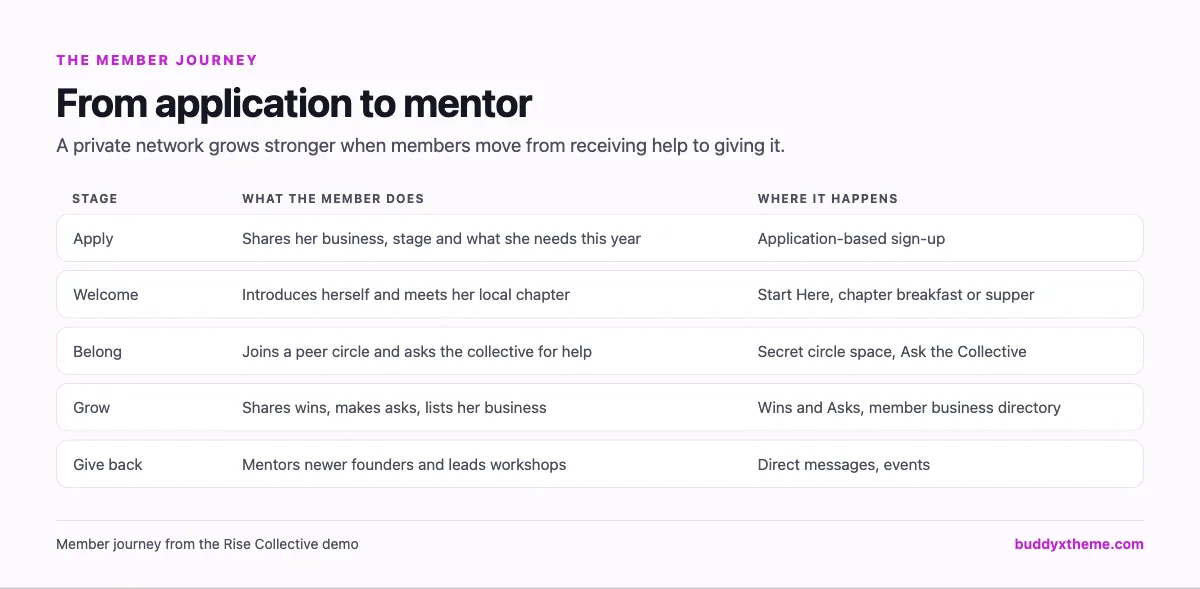
The strongest networks design for the moment a member becomes a giver: when she answers a question, mentors a newer founder or hosts a workshop. Make that easy and visible, and the network grows on its own energy.
Running peer circles that last
| Practice | Why it matters |
|---|---|
| Match by stage, not industry | Founders at the same stage face the same decisions |
| Keep circles small | Six people means everyone speaks every meeting |
| One hot seat per meeting | Depth beats a quick round of updates |
| Questions before advice | The founder often finds her own answer |
| Written goals between meetings | Accountability turns talk into progress |
| Confidentiality, stated and repeated | Without it, nobody shares what matters |
Making wins and asks work
| Do | Avoid |
|---|---|
| Ask for a specific introduction or type of customer | “Any advice welcome” |
| Share the lesson behind a win | Only the headline |
| Thank people publicly when an ask is answered | Leaving the thread unresolved |
| Keep promotion to the member directory | Pitching in every thread |
Questions to ask before you choose
- Will you review applications? Admin approval lets you keep the network focused on the members you serve.
- Can circles be completely private? Secret spaces keep sensitive conversations away from the rest of the network.
- Do chapters need their own spaces? Local events and conversations work best in chapter groups.
- Can members find each other’s businesses? A directory turns “buy from members” into action.
- Will the network charge dues? Paid memberships with trials make the network sustainable.
- Who owns the member relationships? A self-hosted network stays on your domain.
A 60-day launch plan for a women founders network
- Weeks one and two: the front door. Write your application criteria, set registration to approval, write the member agreement and create Start Here, Ask the Collective, Wins and Asks and the member directory.
- Weeks three and four: founding members. Invite twenty founding members, ask each to list her business and post one ask.
- Weeks five and six: circles and chapters. Form the first three peer circles by stage and hold the first chapter event.
- Weeks seven and eight: open applications. Open applications, run a first workshop chosen by member poll and recruit mentors from your founding members.
Which platform fits your network?
| If you… | Choose |
|---|---|
| Want to run your own network with circles, chapters, Q&A, a business directory and dues | BuddyNext |
| Want to join an established professional women’s network | Ellevate Network |
| Are a senior executive wanting a vetted peer network | Chief |
| Want WordPress membership with a member directory | MemberPress |
| Want a branded app network | Disciple |
| Want a hosted community builder | Bettermode |
| Only need paid access or events | Memberful, Whop or Luma |
| Want informal local groups | Geneva |
More community platform comparisons
Running a different kind of business network? These guides use the same method: a working demo community and vendor claims checked at the source.
- Best software for a paid entrepreneur mastermind: small curated groups with hot seats and accountability.
- Best software for a private business networking community: chapters, referrals and a member business directory.
- Best software for a startup founder community: founder circles and peer help.
- Best platforms for a paid coaching membership community: coach-led memberships with group calls.
- How to set up a community space on WordPress: the step-by-step setup guide behind every demo in this series.
How we built and checked this list
We built the Rise Collective demo on a local WordPress site running BuddyNext, with fictional founders, circles, chapters, businesses, questions and events created for this guide. Every BuddyNext screenshot is from that demo. Competitor features were checked against each vendor’s own website in November 2026, and the facts about women entrepreneurs come from the Global Entrepreneurship Monitor. We left out Hivebrite because its website blocked our checks, and Guild because it closed in 2024. Where we could not confirm a feature on a vendor’s own pages, the scorecard says “Not found” or “Not confirmed”. We did not run a hands-on trial of every product, so features can change; confirm anything critical with the vendor. buddyxtheme.com is published by the team behind BuddyNext, which is why BuddyNext is listed first; we have tried to be fair about its gaps as well as its strengths.
Frequently asked questions
What is the best platform for a women entrepreneurs network?
To run your own network, BuddyNext is the best choice, with application-based sign-up, secret peer circles, chapter spaces, Q&A, a member business directory, mentoring and paid memberships. To join an established network, Ellevate and Chief lead.
How do I make a network application-based?
Set registration to admin approval, publish clear membership criteria, ask applicants about their business and stage, and review each application before approving.
How do peer circles work online?
Create a secret space for each circle of about six founders, schedule a monthly call as an event, run one hot seat per meeting, and keep goals and check-ins in the space between calls.
How can members support each other’s businesses?
List every member business in a directory, encourage members to buy from and refer each other first, and give wins and asks their own space.
Can a women’s network charge membership dues?
Yes. BuddyNext supports paid memberships with trials and coupons, and spaces can be limited to members on a plan.
Should a network have local chapters?
If members live in a few cities, yes. Private chapter spaces with events make local introductions easy, while network-wide spaces keep everyone connected.
How do I keep conversations confidential?
Use secret spaces for circles, state confidentiality in the member agreement, and moderate quickly when something is shared that should not be.
The bottom line
Women founders grow faster with peers who understand and a network that opens doors. If you want to run that network yourself, with applications, confidential circles, chapters, answers, a member business directory and dues, BuddyNext is the strongest foundation. If you would rather join an existing network, Ellevate and Chief lead.
And give women founders a circle that tells them the truth.