
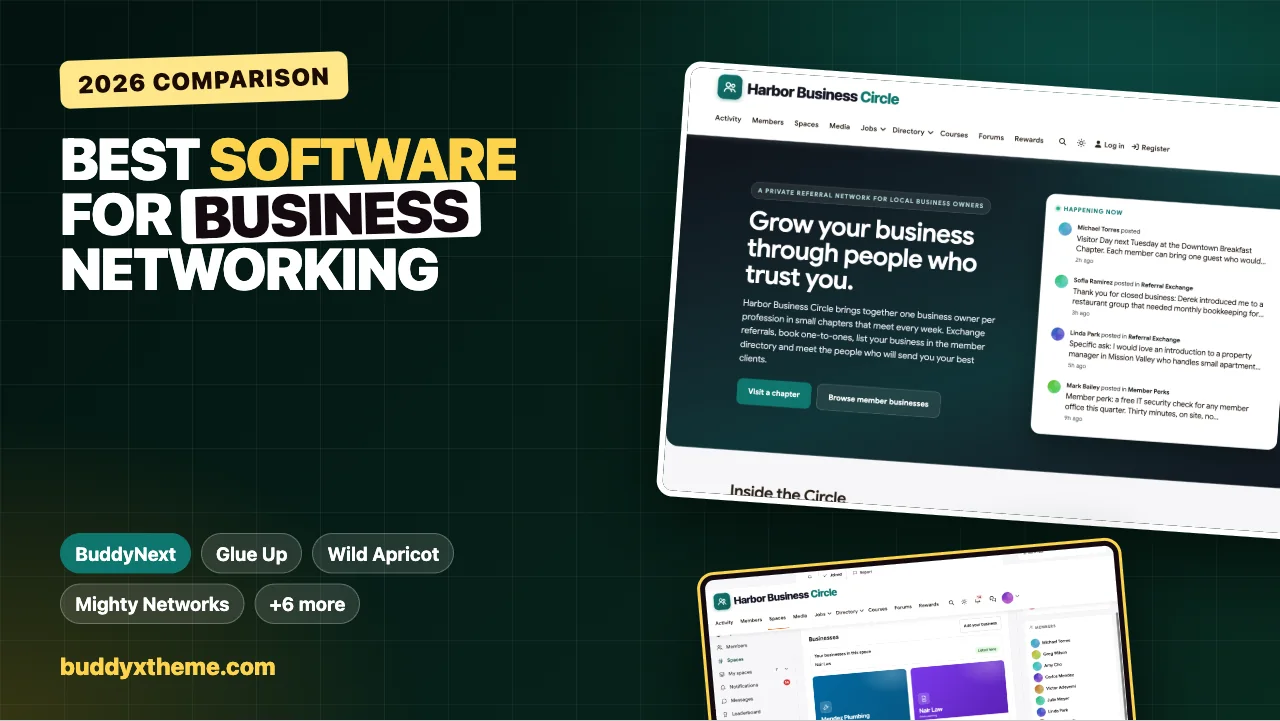
Local business owners have always grown through people who trust them: the accountant who recommends a lawyer, the realtor who knows a good contractor, the insurance broker who hears about every new lease. Private business networking clubs and chambers turn that word of mouth into a system, with small chapters, one member per profession, weekly meetings, specific asks and public thanks when a referral turns into closed business.
The software behind that system matters more than most clubs realise. Referrals get lost in group chats, the member directory lives in a spreadsheet, dues sit in a separate membership system and the chapter that met this morning has nowhere to follow up. This guide compares the software you can use to run a private business networking community. We built a working referral club for the first entry, checked every competitor claim against the vendor’s own pages in November 2026, and say plainly where each falls short.
Quick answer
If you want a private business networking community you own and control, BuddyNext is the strongest choice: a private space for each chapter, a referral exchange for asks and closed-business thank-yous, a searchable member business directory with maps, weekly chapter meetings and mixers as events, member perks, direct messages for one-to-ones, and paid memberships with renewals, all on your own WordPress site. Glue Up, Wild Apricot, GrowthZone and MemberClicks are strong chamber and association back-office tools, Mighty Networks and Circle are polished hosted communities, and Alignable is a shared network for local business introductions.
In this guide
- How referral networking works
- Chamber software or community platform?
- The business networking scorecard
- 1. BuddyNext: best for a private business networking community you own
- 2. Glue Up: best all-in-one chamber management with a member app
- 3. Wild Apricot: best for small clubs that need membership admin and a website
- 4. GrowthZone: best for chambers that need back-office depth
- 5. MemberClicks: best for associations and chambers focused on renewals
- 6. Mighty Networks: best hosted community for a networking club with an app
- 7. Circle: best for a premium business circle under your own brand
- 8. Alignable: best for meeting local business owners beyond your club
- 9. Meetup Pro: best for organising many public chapters and events
- 10. Slack: best as a messaging layer next to a membership system
- Running a referral chapter in the community
- Growing the club
- Chamber or independent club: what changes
- Questions to ask before you choose
- Which software fits your networking club?
- More community platform comparisons
- How we built and checked this list
- Frequently asked questions
- The bottom line
How referral networking works
The format is well established. BNI, the largest referral networking organisation, reports “355K+ Global Members,” “11,800+ Global Chapters” in “78 Countries,” and “17.8M Member Referrals” over the trailing twelve months, based on its own member data at the end of 2025 (BNI). Its member software, BNI Connect, is described as “an online management operating system for BNI Members only” (BNI Connect), so independent clubs and chambers need their own platform.
Whether you run an independent referral club, a chamber of commerce network or an invite-only business circle, the same rituals recur, and each one needs something from the software:
| Ritual | What happens | What the software needs |
|---|---|---|
| Membership | Applications, one member per profession, dues and renewals | Approval before joining, paid memberships, renewal reminders |
| Chapters | Small groups that meet weekly or monthly | A private space per chapter, chapter leaders |
| Asks and referrals | Specific asks, introductions, closed business | A referral exchange space, notifications |
| One-to-ones | Coffee meetings between members | Direct messages, profiles that explain each business |
| Member directory | Members look each other up before searching online | A business directory with categories and locations |
| Events | Breakfasts, visitor days, mixers, awards nights | Events with registration, venues and recurring meetings |
| Member perks | Offers from members to members | A perks space |
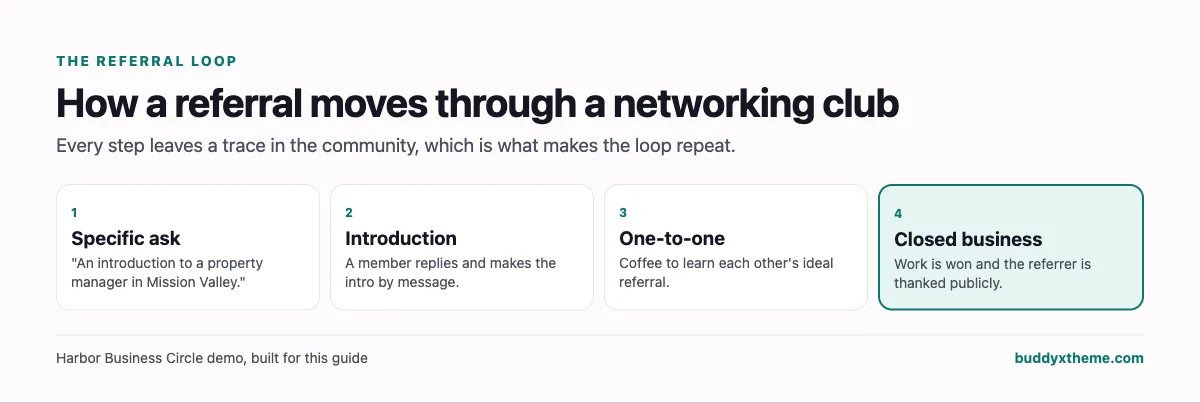
Chamber software or community platform?
The options fall into three groups:
- Chamber and association management systems (Glue Up, Wild Apricot, GrowthZone, MemberClicks) are built for the back office: membership records, dues, renewals, events and email. They are strong at administration and thinner on member-to-member networking.
- Community platforms (BuddyNext, Mighty Networks, Circle) are built for members interacting with each other: discussions, groups, messaging and events. They vary in how much membership administration they include.
- Networks and chat tools (Alignable, Meetup Pro, Slack) are shared networks or messaging layers rather than a home for your own club.
A referral club lives on member-to-member activity, so the community side matters most. But dues and renewals have to work too.
The business networking scorecard
How each option handles what matters most. “Not found” means we could not confirm it on the vendor’s own pages, not that it is impossible.
| Platform | Private chapters | Referral exchange | Business directory | Events | Dues and renewals | Own brand and data |
|---|---|---|---|---|---|---|
| BuddyNext | Private and secret spaces | Asks and thank-you space | Listings with categories and maps | Recurring meetings, venues | Yes | Self-hosted |
| Glue Up | Public and private groups | Not found | Membership directory | Yes | Yes, automatic reminders | Hosted |
| Wild Apricot | Not confirmed | Not found | Member directory | Yes | Yes, automated renewals | Hosted |
| GrowthZone | Not confirmed | Not found | Not confirmed | Registration and check-in | Renewal reminders | Hosted |
| MemberClicks | Not confirmed | Not found | Membership websites | Attendance tracking | Renewal reminders | Hosted |
| Mighty Networks | Groups | Not found | Member directory | Weekly activities | Paid tiers | Hosted, custom domain |
| Circle | Spaces | Not found | Directory | Live events | Paid memberships | Hosted, branded app |
| Alignable | Local groups | Matching and introductions | Shared network | Networking events | Not found | Shared network |
| Meetup Pro | Unlimited groups | Not found | Not found | Core strength | Not found | Hosted |
| Slack | Channels | Not found | Workspace only | Not found | Not found | Hosted |
1. BuddyNext: best for a private business networking community you own
BuddyNext is a complete community platform that runs on your own WordPress site. Private and secret spaces, member profiles, a business directory with categories and maps, events with venues and recurring meetings, direct messages, polls, paid memberships, points and leaderboards all work together, so chapters, referrals, the directory and dues live in one place.
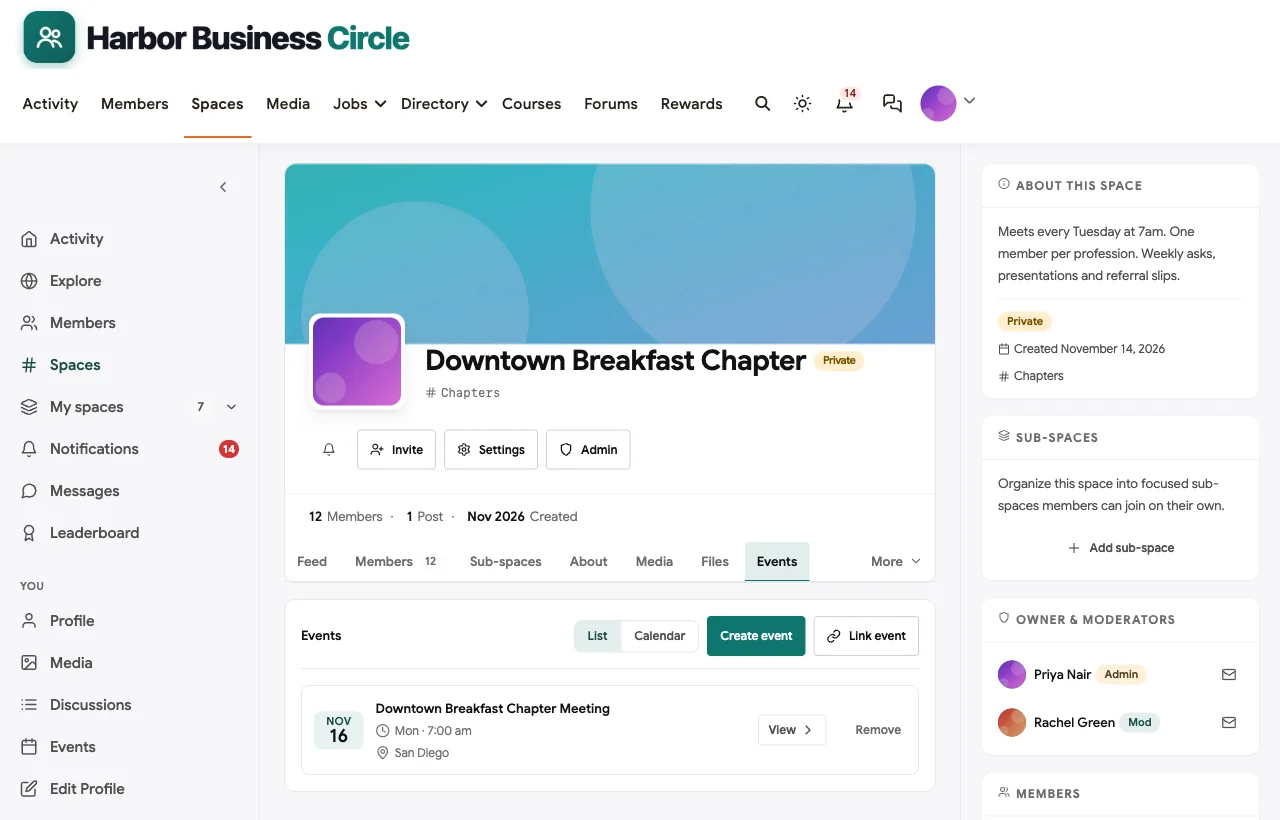
To show it in context, we built Harbor Business Circle, a demo referral club for San Diego business owners with 20 fictional members, one per profession: a realtor, a mortgage advisor, a bookkeeper, an insurance broker, a contractor, an estate planning attorney, an IT firm, a dentist and more, in two chapters that meet every week.
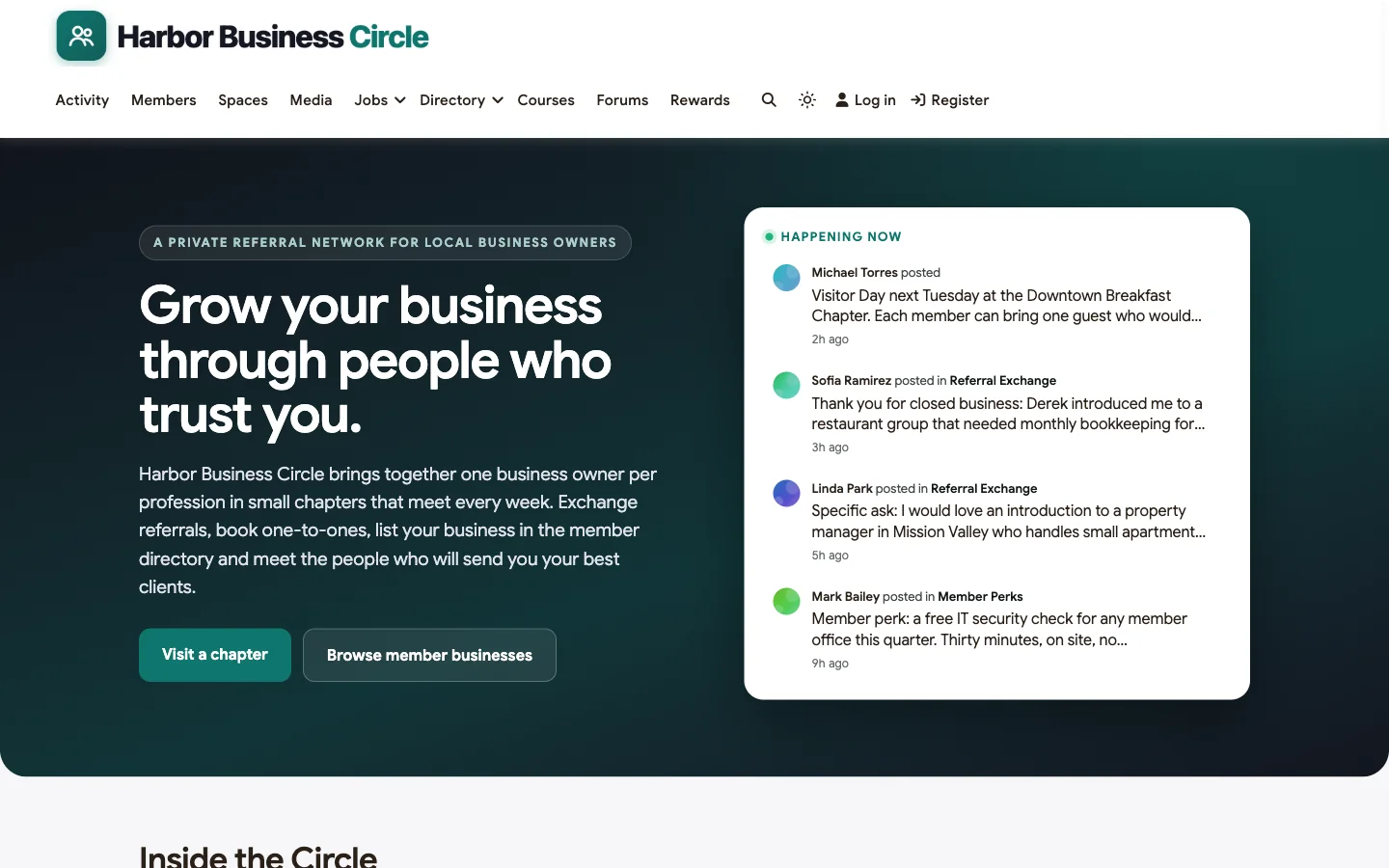
Good at: private chapters, a visible referral culture, a member directory people actually use, and owning the member list.
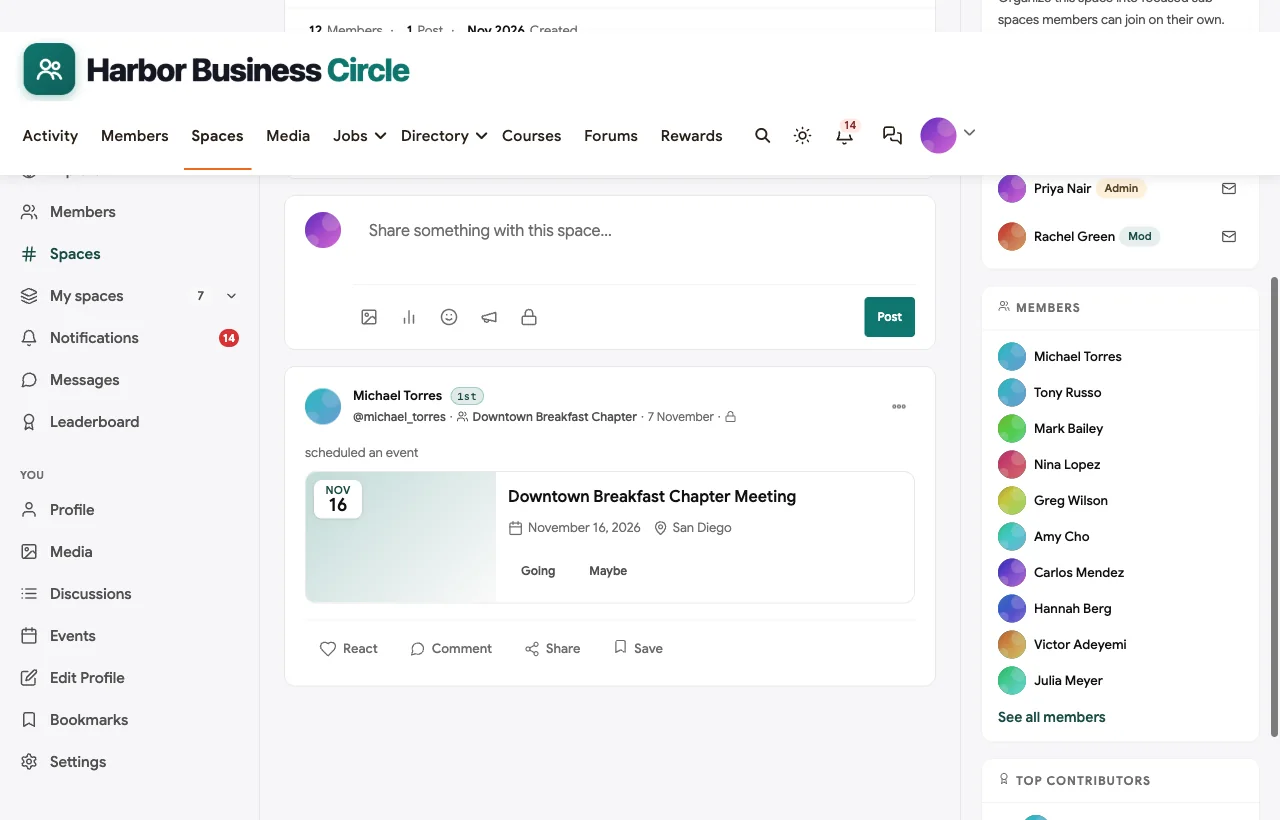
A private space for each chapter. Each chapter has a private space for its members, where the weekly meeting is posted, presentations are shared and follow-ups happen. Chapters meet as recurring events with a venue and registration:
The referral exchange. An open space where members post specific asks and thank each other for closed business. In the demo, a bookkeeper thanks an insurance broker for introducing a three-location restaurant group, and a realtor asks for an introduction to a property manager who handles small apartment buildings; within hours, a commercial broker offers two introductions:
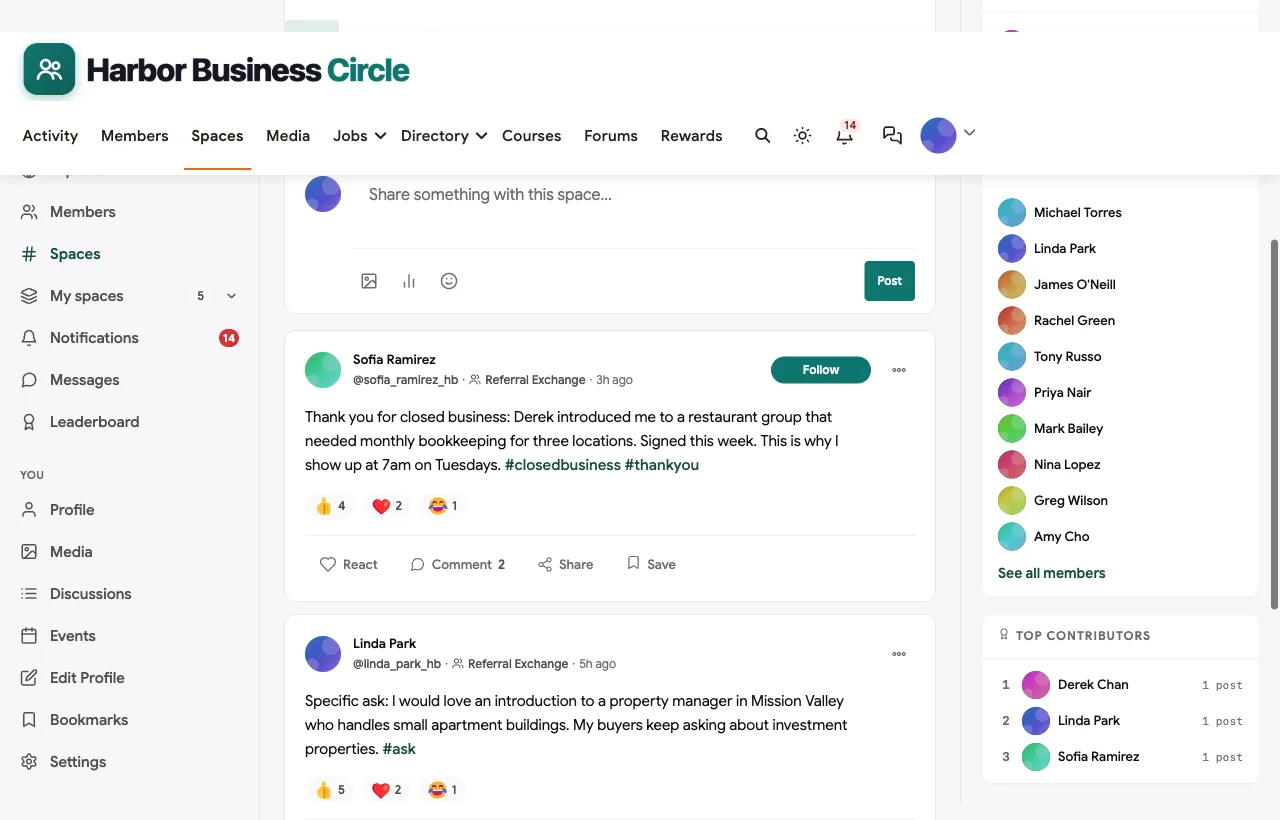
Use hashtags such as #ask, #closedbusiness and #referraltips so members can filter the exchange. There is no dedicated referral ledger with values; clubs that track referral totals usually keep that in the chapter’s own records.
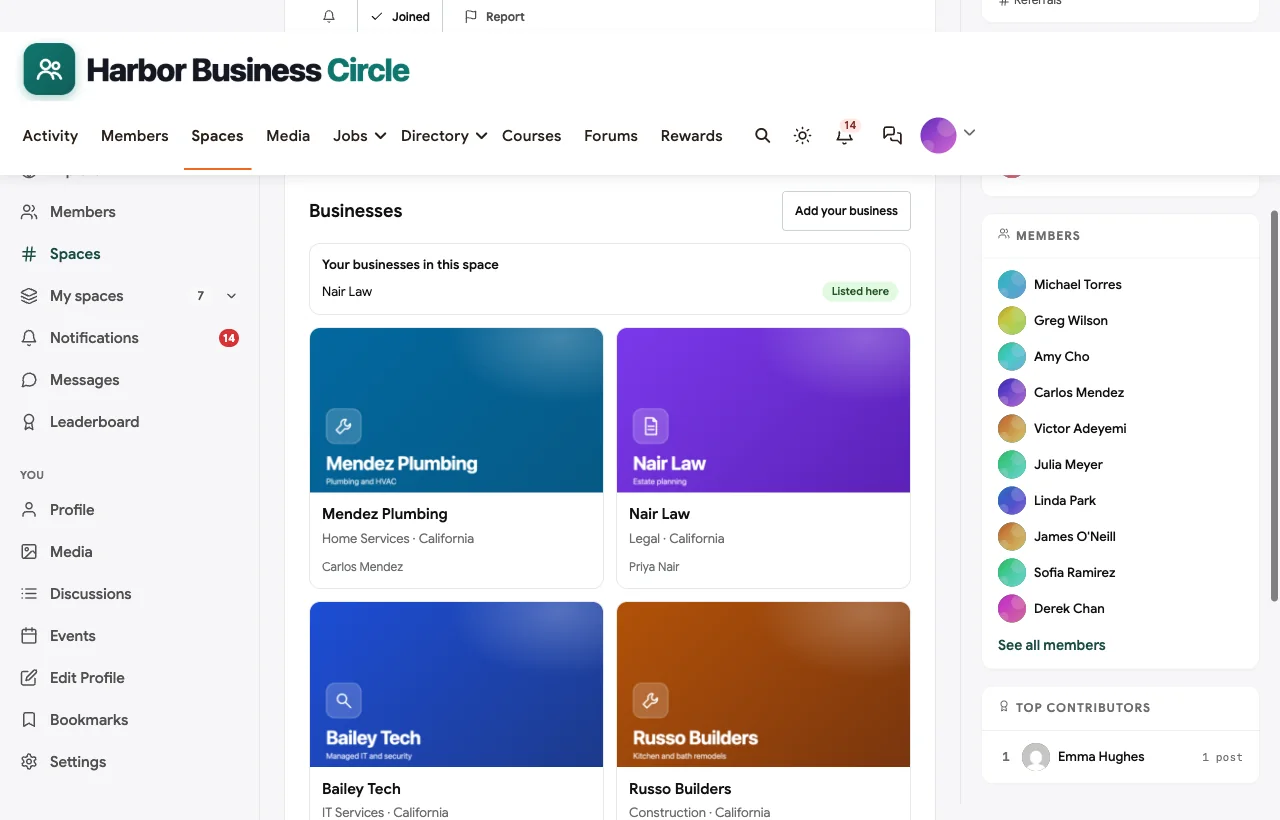
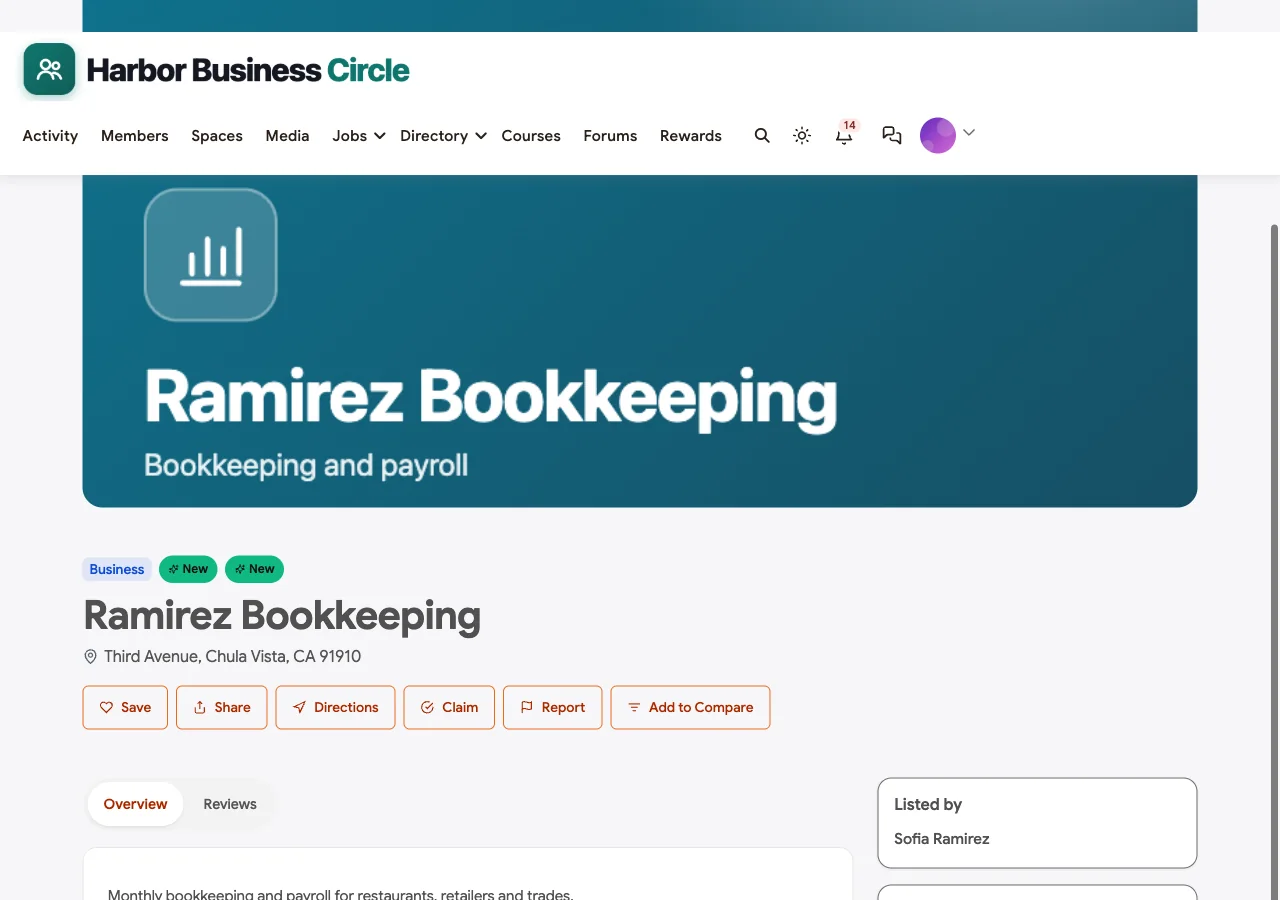
A member business directory. Every member business has a listing with a category, location on a map, description, website and contact options, searchable by category and area. It is the first place members look before searching online, and it can be visible to members only or to the public:
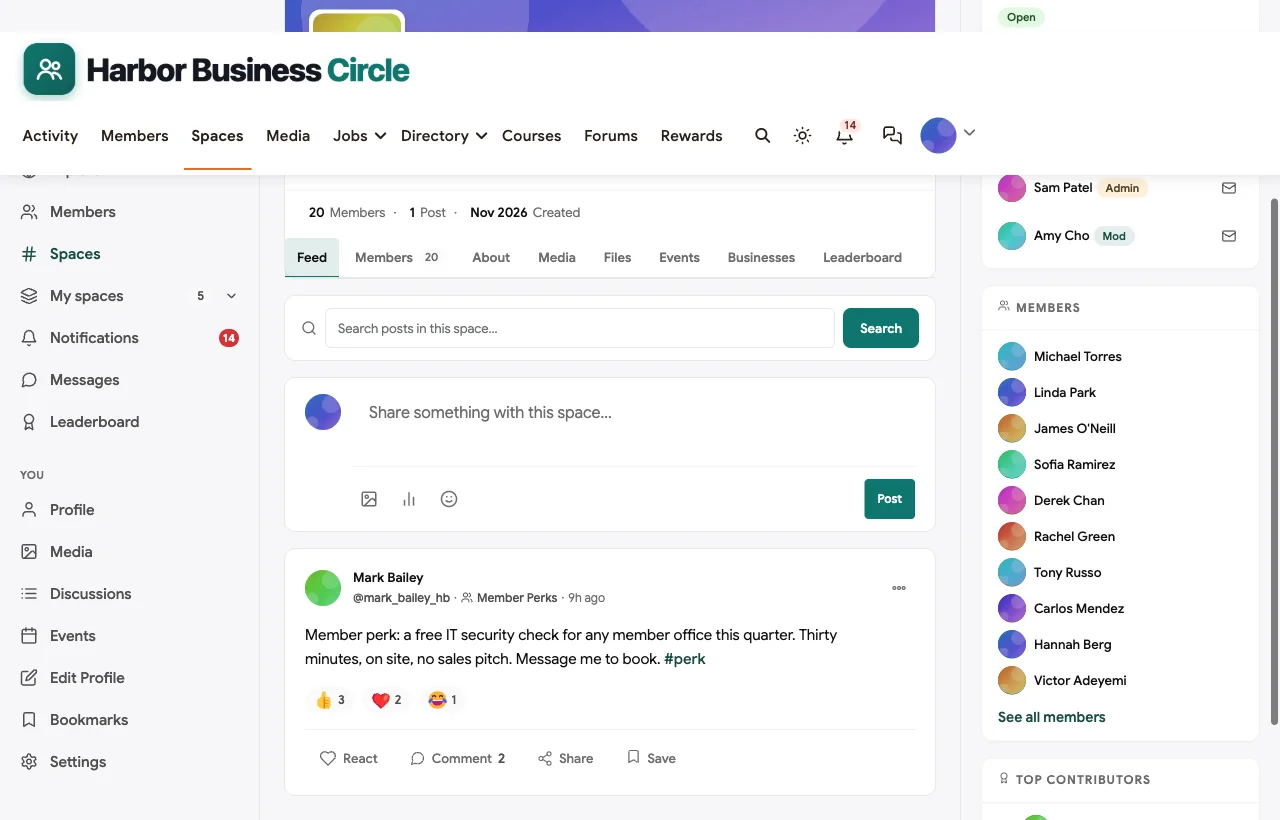
Member perks. Members post exclusive offers for other members, such as a free IT security check for any member office, and redeem them by message:
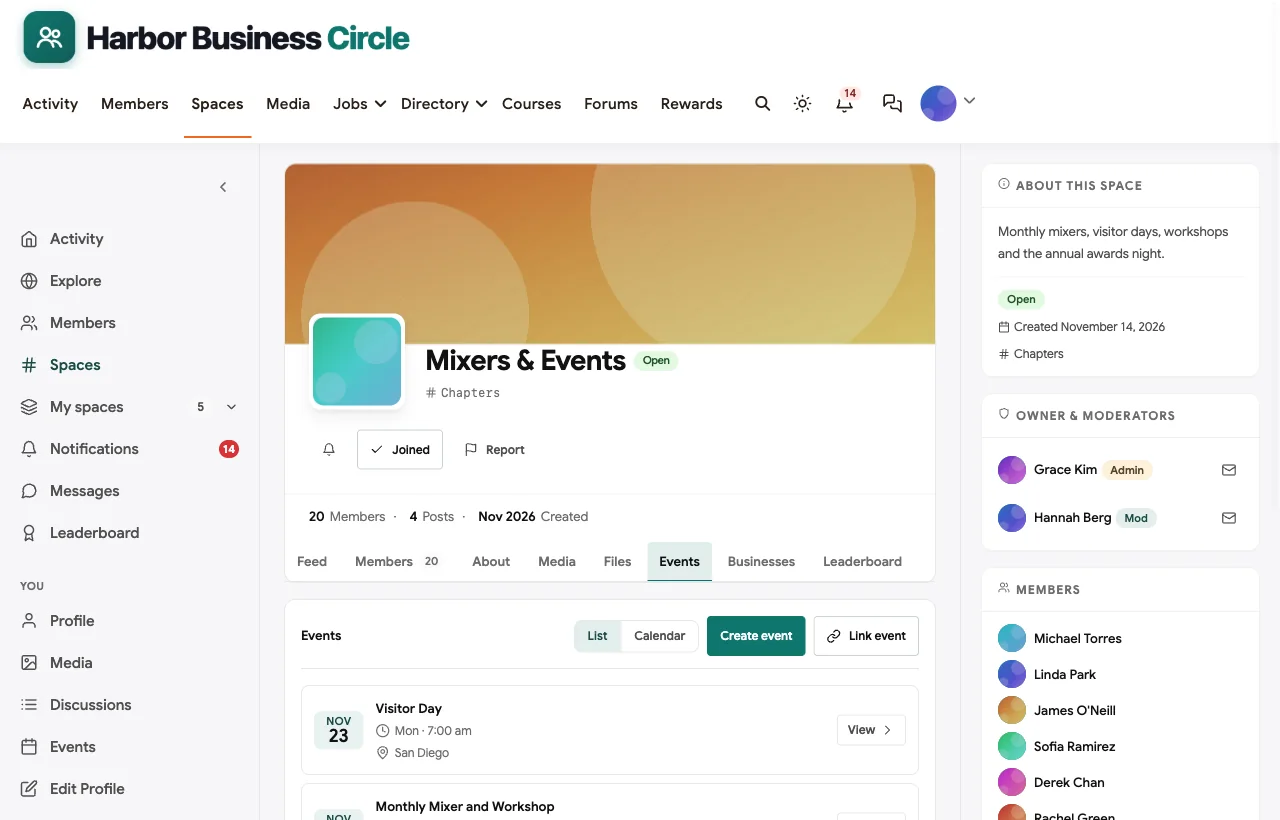
Events beyond the chapter. Visitor days, monthly mixers with workshops and an annual awards night are events with venues, registration and reminders:
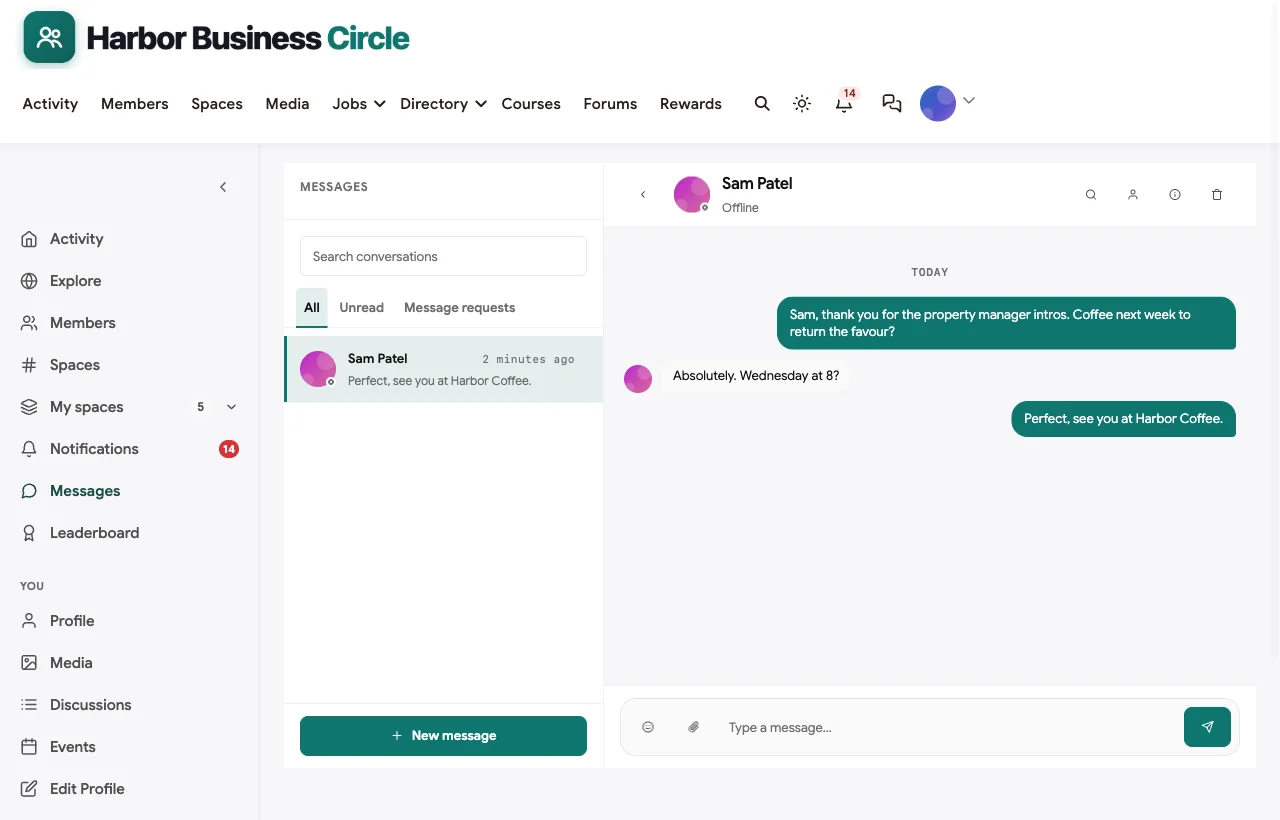
One-to-ones and profiles. Profiles explain each member’s business and ideal referral, and direct messages make it easy to book coffee after a meeting:
Applications and dues. Registration can require approval, so visitors apply after attending a chapter and the membership committee decides. Paid memberships with renewal reminders handle dues, and a profession field at sign-up helps the committee keep one member per profession.
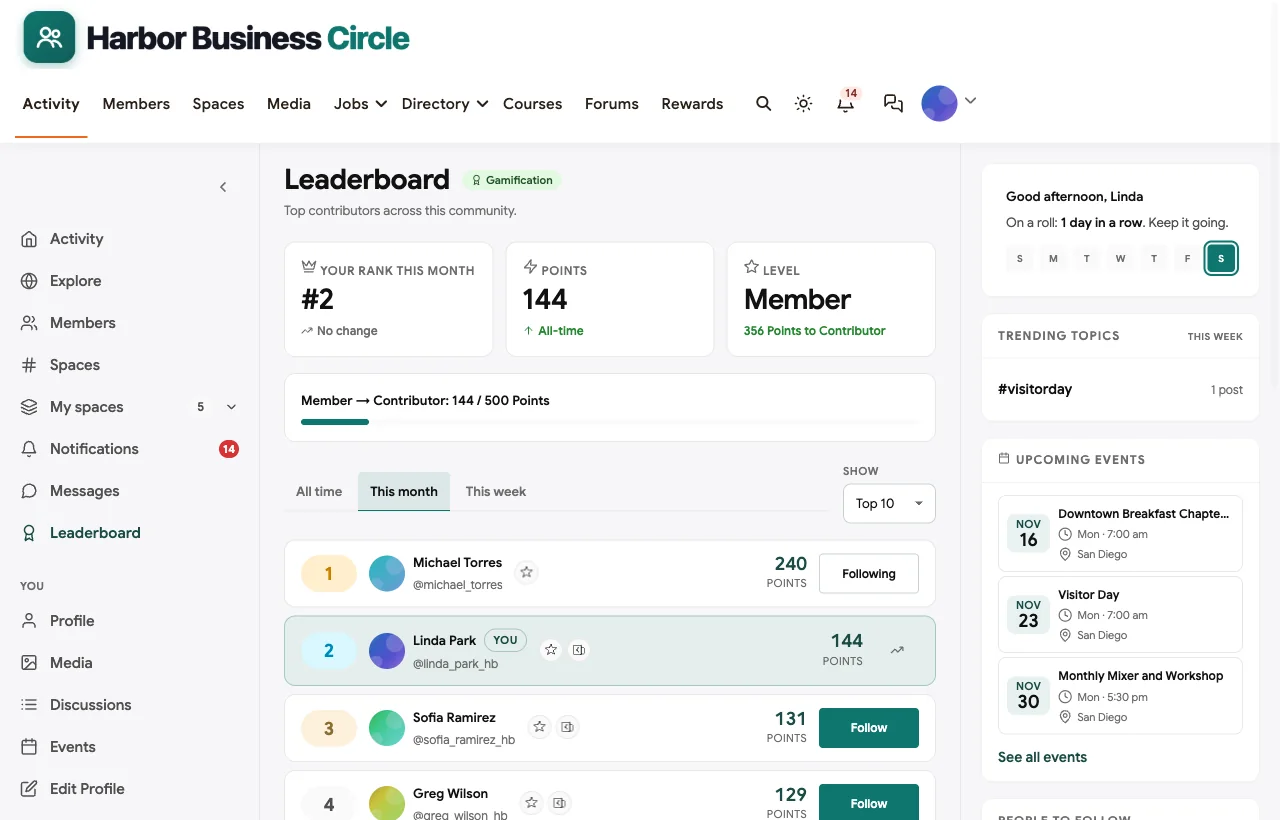
Also built in. Polls (the demo asks which workshop to run next), a leaderboard that recognises the most active members, notifications and a mobile layout that works without an app download.
Not built for: a referral ledger that tracks the value of closed business, or chamber accounting such as invoicing and general ledger; use your accounting system for those. It is self-hosted, so you run WordPress or use a managed host.
What’s included, and how it is delivered
BuddyNext is one platform made of a core and add-on platform modules. Everything shown in the demo above runs on the BuddyNext platform. This table shows which parts come with the core, which are platform modules you install and activate alongside it, and which need a third-party plugin, another system or custom work.
| Capability | How it is delivered |
|---|---|
| Open, private and secret spaces | Core platform |
| Member profiles and searchable member directory | Core platform |
| Direct messages | Platform module, installed alongside |
| Activity feed, pinned announcements and hashtags | Core platform |
| Members-only mode, admin approval, invites and email verification | Core platform |
| Polls | Core platform |
| Business directory listings with categories and maps | Platform module, installed alongside |
| Events with RSVPs, venues and recurring meetings | Platform module, installed alongside |
| Paid memberships with renewals and coupons | Platform module, installed alongside |
| Points, badges and leaderboards | Platform module, installed alongside |
| Referral value tracking and chamber accounting | Another system or custom work |
Want to click around yourself? The Harbor Business Circle community in this guide was built on a private test site, so it is not public. The BuddyNext live demo is a general community you can open in your browser and explore without installing anything.
2. Glue Up: best all-in-one chamber management with a member app
Glue Up is “all-in-one association management software” for associations, chambers, membership organisations and nonprofits (Glue Up). It offers “customizable renewal flows, automatic reminders… and recurring payments,” a membership directory, public and private groups with discussion forums, event management with “branded invitations, automated notifications,” and a member app, My Glue, where members “connect, network, and stay informed within your community.”
Strengths for networking clubs: dues, renewals, events and a member app in one product built for chambers.
Gaps: we found no referral tracking or asks-and-offers features; chapter administration and directory privacy settings were not documented on its public pages.
3. Wild Apricot: best for small clubs that need membership admin and a website
Wild Apricot aims to “simplify, automate, and manage your membership, events, communications, payments and website” for “associations, nonprofits, chambers of commerce, clubs, charities, and chapters of all sizes” (Wild Apricot). It includes membership records with automated renewals, a member directory, event registration with payments, a website builder, and member and admin mobile apps, with community features available as an add-on.
Strengths for networking clubs: an easy all-in-one for membership, events and a public website.
Gaps: no referral features found; member-to-member messaging and chapter governance were not documented on the pages we checked.
4. GrowthZone: best for chambers that need back-office depth
GrowthZone serves associations and chambers, consolidating “membership management, event planning, financial operations, and member communications,” with automated renewal reminders, event registration with check-in, and dashboards (GrowthZone). The same company offers ChamberMaster for chambers and MemberSuite for larger organisations.
Strengths for networking clubs: financial operations, renewals, events with check-in and reporting.
Gaps: built for chamber operations rather than member networking; no referral, directory privacy or one-to-one features found on its public pages.
5. MemberClicks: best for associations and chambers focused on renewals
MemberClicks offers “membership management solutions that empower associations, chambers and nonprofits to strengthen their member relationships, increase renewals,” citing “over 6 million members across 3,000+ associations and chambers” (MemberClicks). It includes “set-it-and-forget-it renewal reminders and invoice generation,” membership websites, event registration with attendance tracking, reporting and a member app add-on.
Strengths for networking clubs: renewals, invoices, attendance tracking and reporting.
Gaps: no referral exchange or one-to-one features found; chapter administration was not documented on the page we checked.
6. Mighty Networks: best hosted community for a networking club with an app
Mighty Networks combines “Community. Courses. Events.” with paid memberships in tiers, groups, a “member directory for networking,” “events and weekly activities,” and “direct messaging and 1:1 messaging” (Mighty Networks). Custom domains are supported and branded native apps are available on Mighty Pro.
Strengths for networking clubs: member directory, one-to-one messaging, weekly activities and a strong mobile experience.
Gaps: subscription tiers rather than chamber-style dues administration; no referral tracking found.
7. Circle: best for a premium business circle under your own brand
Circle lets you “build a home for your community, events, and courses, all under your own brand” (Circle), with branded checkout for memberships and recurring subscriptions, community spaces, a directory, live events and messaging, and a branded iOS and Android app.
Strengths for networking clubs: a polished, premium feel, paid memberships and a branded app.
Gaps: no referral features or chapter hierarchy found; spaces are general-purpose rather than chapter-specific.
8. Alignable: best for meeting local business owners beyond your club
Alignable calls itself “the networking platform for businesses,” “trusted by 11 million business owners,” with local “Alignable Alliances,” groups, networking events and “smart matching to find ideal customers and build referral networks” (Alignable).
Strengths for networking clubs: a large shared network with referral-style matching and local groups.
Gaps: it is a shared network, not your own branded club; there are no private chapter spaces under your control, no dues and no data export found.
9. Meetup Pro: best for organising many public chapters and events
Meetup Pro lets organisers “create an unlimited number of groups around the world,” with cross-group messaging and multi-location events (Meetup).
Strengths for networking clubs: reaching new members through event discovery, many chapter groups under one network.
Gaps: built for public meetups rather than closed, dues-paying clubs; no dues, member directory or referral features found.
10. Slack: best as a messaging layer next to a membership system
Slack offers channels, direct messages, Huddles for video calls and Slack Connect for people from other organisations (Slack).
Strengths for networking clubs: fast messaging and one-to-one video calls for members who already use it.
Gaps: not a membership platform: no dues, events, public directory or referral features, so it always needs another system alongside it.
Running a referral chapter in the community
A chapter’s weekly meeting is where referrals start; the community is where they get followed up. This is the format we used in the demo:
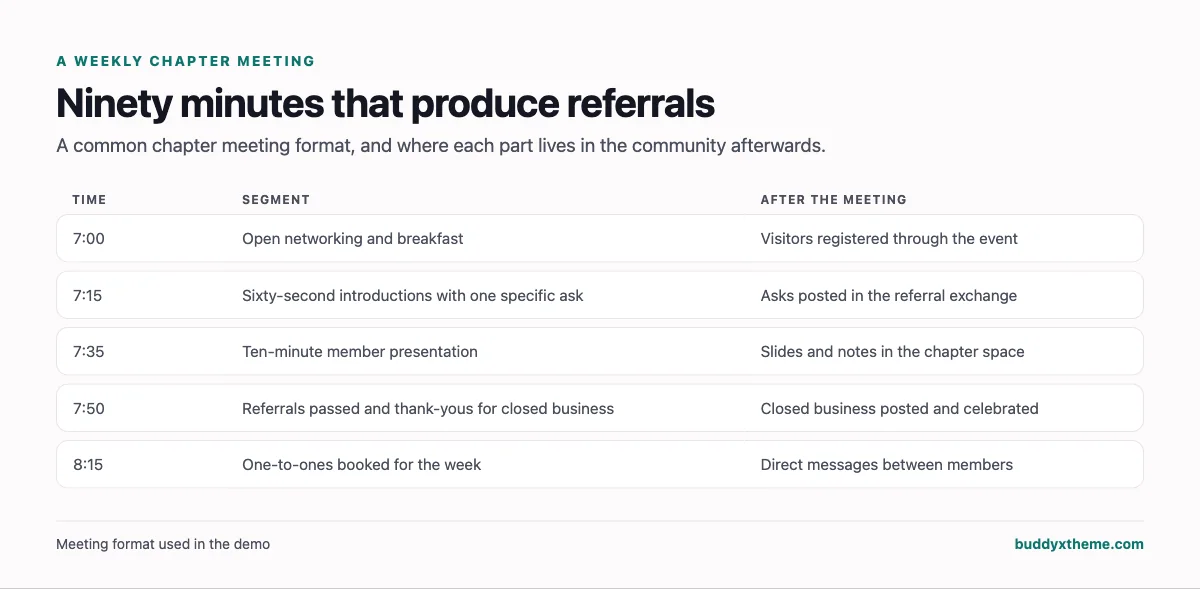
Habits that make the referral culture visible:
- Post every ask after the meeting. A specific ask in the referral exchange reaches members of every chapter, not just the people in the room.
- Thank in public. A closed-business thank-you post is the single best advertisement for the club, and it reminds every member what a good referral looks like.
- Teach what a good referral looks like. In the demo, an insurance broker explains that new commercial leases and first hires are his best referral signals. Members can only refer what they understand.
- Book two one-to-ones a month. Most referrals come from members who know each other’s businesses, which happens over coffee, not in a sixty-second introduction.
- Keep the directory current. Ask members to update their listing whenever their services change; it is the club’s shop window.
Growing the club
| Stage | What to do in the community |
|---|---|
| Visitor | Register for Visitor Day, read Start Here, meet members at breakfast |
| Applicant | Apply after visiting; the membership committee checks the profession is open |
| New member | Introduce your business, create your directory listing, book three one-to-ones |
| Active member | Post asks weekly, thank in public, give a ten-minute presentation |
| Leader | Join the leadership team in a secret space, run a chapter or the events committee |
Open seats matter. In the demo, the Visitor Day post lists the professions the chapter still needs (an electrician, a caterer, a family lawyer), so every member knows who to bring.
Chamber or independent club: what changes
The same software can serve both, but the priorities differ:
- A chamber of commerce usually has hundreds of member businesses, a public directory that promotes the local economy, sponsorships, ribbon cuttings, advocacy and a board. Back-office depth (dues, invoices, sponsorship packages, reporting to the board) matters as much as member networking.
- An independent referral club usually has a few chapters of twenty to forty members, one per profession, weekly meetings and a strong referral culture. Member-to-member activity matters most, and the back office can be simple.
- An invite-only business circle sits in between: fewer members, higher expectations, often a premium feel, private dinners and a curated membership.
If you are a chamber, start by listing your back-office requirements and check them against Glue Up, GrowthZone, MemberClicks and Wild Apricot, then ask how members will actually network with each other. If you are a referral club or business circle, start from the chapter and referral rituals and make sure dues and renewals are covered.
Questions to ask before you choose
Run these questions through a trial or a demo:
- Can each chapter have its own private space, run by its own leaders? Chapters need a room the rest of the club cannot see.
- Where do asks and thank-yous live? If the answer is “in a group chat”, they will disappear within a week.
- Can a member list their business with a category and location, and can non-members find it? The directory is how members get value between meetings.
- How do visitors become members? You want registration for visitor days, an application and an approval step, not just a payment page.
- How are dues collected and renewed? Check renewal reminders, failed payment handling and what happens when a membership lapses.
- Can you export your member list and history? If you ever move platforms, your relationships should move with you.
- Does it work on a phone? Members check asks and book one-to-ones between appointments.
Which software fits your networking club?
| If you… | Choose |
|---|---|
| Want chapters, referrals, a business directory and dues in one place you own | BuddyNext |
| Run a chamber and want an all-in-one back office with a member app | Glue Up |
| Are a small club that needs membership admin and a website | Wild Apricot |
| Need chamber financial operations and reporting | GrowthZone |
| Focus on renewals and attendance tracking | MemberClicks |
| Want a hosted, app-first community with one-to-one messaging | Mighty Networks |
| Want a premium branded business circle | Circle |
| Want to meet local businesses beyond your own club | Alignable |
| Organise many public chapters around events | Meetup Pro |
| Only need a messaging layer | Slack |
More community platform comparisons
Running a different kind of professional or business community? These guides use the same method: a working demo community and vendor claims checked at the source.
- Best platforms for event attendee networking: introductions, speaker Q&A, sponsors and year-round meetups.
- Best platforms for a women entrepreneurs network: application-based membership, confidential peer circles, chapters and a member business directory.
- Best software to run a paid entrepreneur mastermind: small, confidential peer advisory groups with hot seats.
- Best software for a startup founder community: founder pods, intros and fundraising rooms.
- Best platforms for a freelancer networking community: referrals, jobs and directories for independent professionals.
- Best software for a professional association community: chapters, committees and member directories at scale.
- How to set up a community space on WordPress: the step-by-step setup guide behind every demo in this series.
How we built and checked this list
We built the Harbor Business Circle demo on a local WordPress site running BuddyNext, with fictional members, businesses, chapters, referrals, listings and events created for this guide. Every BuddyNext screenshot is from that demo. Competitor features were checked against each vendor’s own website in November 2026, and referral networking figures come from BNI’s own published statistics. Where we could not confirm a feature on a vendor’s own pages, the scorecard says “Not found” or “Not confirmed.” We left out Hivebrite and LinkedIn Groups because we could not access the relevant vendor pages to verify claims at the time of writing. We did not run a hands-on trial of every competitor, so features can change; confirm anything critical with the vendor. buddyxtheme.com is published by the team behind BuddyNext, which is why BuddyNext is listed first; we have tried to be fair about its gaps as well as its strengths.
Frequently asked questions
What is the best software for a private business networking community?
BuddyNext is the best choice for a networking community you own, with private chapter spaces, a referral exchange, a member business directory, recurring chapter meetings, member perks, one-to-one messaging and paid memberships on your own WordPress site. Glue Up and Wild Apricot are strong all-in-one chamber tools.
Can I use BNI’s software for my own networking club?
No. BNI states that BNI Connect is “an online management operating system for BNI Members only.” Independent clubs and chambers need their own platform.
How do I track referrals?
Most clubs use a referral exchange where members post asks and thank each other for closed business, plus a chapter record of referral totals. None of the platforms we checked, other than Alignable’s matching, offered dedicated referral tracking on their public pages.
Should the member directory be public?
Many clubs make it public, because it brings members business from outside the club. Keep personal contact details members-only and let each member choose what their listing shows.
How do I keep one member per profession?
Ask for the profession at sign-up, set registration to approval, and have the membership committee check open seats before approving. Post open professions before each visitor day.
Can members pay dues online?
Yes on most platforms here. BuddyNext, Glue Up, Wild Apricot, GrowthZone, MemberClicks, Mighty Networks and Circle all support paid memberships or dues with renewals.
How often should chapters meet?
Weekly or fortnightly is common for referral chapters. Meeting often keeps members top of mind for each other; the community keeps the follow-ups going between meetings.
Is Slack or a WhatsApp group enough?
For messaging, yes; for a club, no. Neither has dues, a business directory, events or private chapter structure, so the club ends up spread across several tools.
The bottom line
A business networking club runs on trust, specific asks and public thanks. The software should give every chapter a private room, make every ask and thank-you visible, put every member’s business in a directory people use, and handle dues without a separate system. If you want that on your own domain, with your own member list, BuddyNext is the strongest foundation. If you mainly need chamber back-office tools, Glue Up, Wild Apricot, GrowthZone and MemberClicks lead.
And give your members a network that sends them their best clients.