

Most books are not abandoned at the start. They are abandoned in the middle, somewhere around chapter twelve, when the excitement has gone, the ending is still far away and the writer is alone with a draft nobody else has read. Writers have always solved this the same way: with other writers. Writing groups, critique partners, workshops and the friend who asks “how many words today?” have finished more books than any piece of software.
A writers and authors membership brings those people together online, under the name of a writing coach, an author organisation or a writing school. This guide compares the platforms that kind of membership can run on: critique circles, writing sprints, beta reader swaps, query letter help, workshops and readings, publishing questions, freelance opportunities and, above all, privacy for unpublished work. We built a working writers’ membership for the first entry and checked every competitor claim on the vendor’s own pages in November 2026.
Quick answer
If you want a writers’ membership you own, BuddyNext is the strongest choice: daily writing sprints, a private critique circle, a beta reader exchange, a private query lab, Ask an Author with accepted answers, workshops and reading nights as events, a book-finishing course and a board for freelance writing work, with unpublished drafts kept in private spaces, all on your own website. Scribophile and Critique Circle are established critique communities, Wattpad is for finding readers, Jericho Writers, Reedsy and Writers.com teach and connect writers with professionals, Substack and Patreon are for building a paying readership, and Circle is a general community option.
In this guide
- Why books do not get finished
- Five kinds of writing platform
- The writers membership scorecard
- 1. BuddyNext: best for a writers’ membership you own
- 2. Scribophile: best established critique community
- 3. Critique Circle: best long-running critique exchange
- 4. Wattpad: best for finding readers
- 5. Jericho Writers: best for writers aiming at traditional publishing
- 6. Reedsy: best for hiring editors and designers
- 7. Writers.com: best for small online writing classes
- 8. Substack: best for building a paying readership
- 9. Patreon: best for supporting an author’s work
- 10. Circle: best hosted community with courses and events
- Running a critique circle that people trust
- Sprints that finish drafts
- Questions to ask before you choose
- A 30-day launch plan
- Which platform fits your writing community?
- More community platform comparisons
- How we built and checked this list
- Frequently asked questions
- The bottom line
Why books do not get finished
Writing is mostly solitary work, and most writers work for themselves. O*NET OnLine counts “140,300 employees” working as writers and authors in 2025, with “Little or no change” in projected employment from 2025 to 2035 (O*NET OnLine). The US Bureau of Labor Statistics adds that self-employed workers account for 65% of writers and authors (BLS). There is no office, no team and no manager asking about progress. Behind those professionals are far more people writing a first novel, a memoir or a collection of poems around a day job.
The writing community also lost a familiar home recently. National Novel Writing Month, the nonprofit behind the November challenge to write a novel in a month, closed in 2025 after more than two decades. Many writers who sprinted together every November are now looking for a place to keep doing it, and that is part of why writing coaches and author groups are starting their own memberships.
Writers need different help at different stages of a project, and a good membership has a place for each:
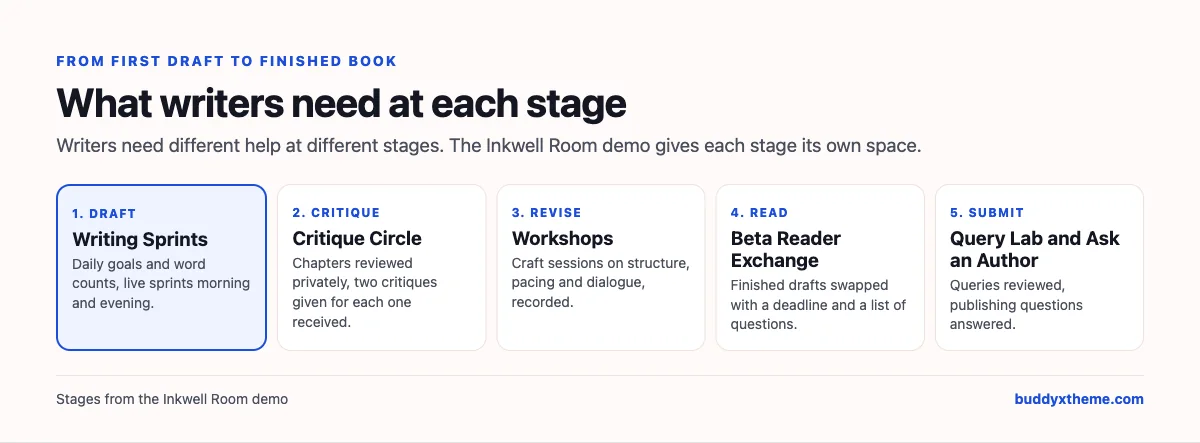
| Stage | What writers need | What the platform needs |
|---|---|---|
| Drafting | Momentum and company | Daily sprints, word counts and a streak |
| Critique | Honest, specific feedback on chapters | A private critique space with a give-and-take rule |
| Revision | Craft knowledge | Workshops, recordings and a course |
| Beta reading | Readers for a whole manuscript | A private exchange for swapping drafts |
| Submission | Help with queries, proposals and synopses | A private query review space |
| Publishing | Answers about agents, contracts and self-publishing | Q&A with accepted answers from published authors |
| Earning | Paid writing work along the way | An opportunities board |
Five kinds of writing platform
Writers use several platforms, often at the same time. They solve different problems.
| Kind | What it does | Examples |
|---|---|---|
| Critique communities | Exchange critiques with other writers, usually on a credit or points system | Scribophile, Critique Circle |
| Reader platforms | Publish stories to find readers | Wattpad |
| Writing education and services | Courses, editorial feedback, hiring editors and designers | Jericho Writers, Reedsy, Writers.com |
| Readership and membership tools | Newsletters and paid memberships for readers | Substack, Patreon |
| Community platforms | Your own membership with critique, sprints, workshops and Q&A | BuddyNext, Circle |
A writing coach or author organisation running a membership needs the last kind for its members, while those members may still use the others for readers, editors and newsletters.
The writers membership scorecard
How each option handles what matters most. “Not found” means we could not confirm it on the vendor’s own pages, not that it is impossible.
| Platform | Critique | Sprints and accountability | Beta readers | Courses and workshops | Publishing Q&A | Opportunities | Draft privacy |
|---|---|---|---|---|---|---|---|
| BuddyNext | Private critique circle | Sprint space, live sprints, streaks | Private exchange | Course, workshops as events | Accepted answers | Job board | Private spaces, post privacy |
| Scribophile | Points-based peer critique | Not found | Meet beta readers | Writing Academy | Forums | Not found | Not confirmed |
| Critique Circle | Credit-based critique | Not found | Not found | Not found | Forums | Not found | Not “published online”, not in search |
| Wattpad | Not found | Not found | Not found | Not found | Not found | Not found | Not found |
| Jericho Writers | Manuscript feedback | Not found | Not found | Courses, live events | Community | Not found | Not found |
| Reedsy | Hire editors | Not found | Not found | Courses, events | Not found | Not found | Not found |
| Writers.com | Teacher feedback in classes | Not found | Not found | Classes, live workshops | Not found | Not found | Not found |
| Substack | Not found | Not found | Not found | Not found | Not found | Not found | Not found |
| Patreon | Not found | Not found | Not found | Not found | Not found | Not found | Not found |
| Circle | Discussions | Not found | Not found | Courses, events | Not found | Not found | Not found |
1. BuddyNext: best for a writers’ membership you own
BuddyNext is a complete community platform that runs on your own WordPress site. Open, private and secret spaces, events, Q&A with accepted answers, courses with certificates, a job board, direct messages, polls, points and streaks, and paid memberships work together. A writing coach or author group can run sprints, critique, beta reading, query help and workshops in one membership under their own name.
To show it in practice, we built The Inkwell Room, a demo membership run by a novelist and writing coach in Edinburgh. It has 20 members: a teacher writing a debut literary novel, a paramedic querying a crime novel, an indie fantasy author on book four, a doctor writing a memoir, a retired journalist writing historical fiction, a poet, a screenwriter adapting a script into a novel, a former November challenge regular looking for a new home, a picture book author, a nonfiction researcher writing a proposal, a developmental editor who leads critique, a sprint host, an agent’s assistant who answers query questions, an author marketing coach, a published mentor and a content lead who hires freelance writers.
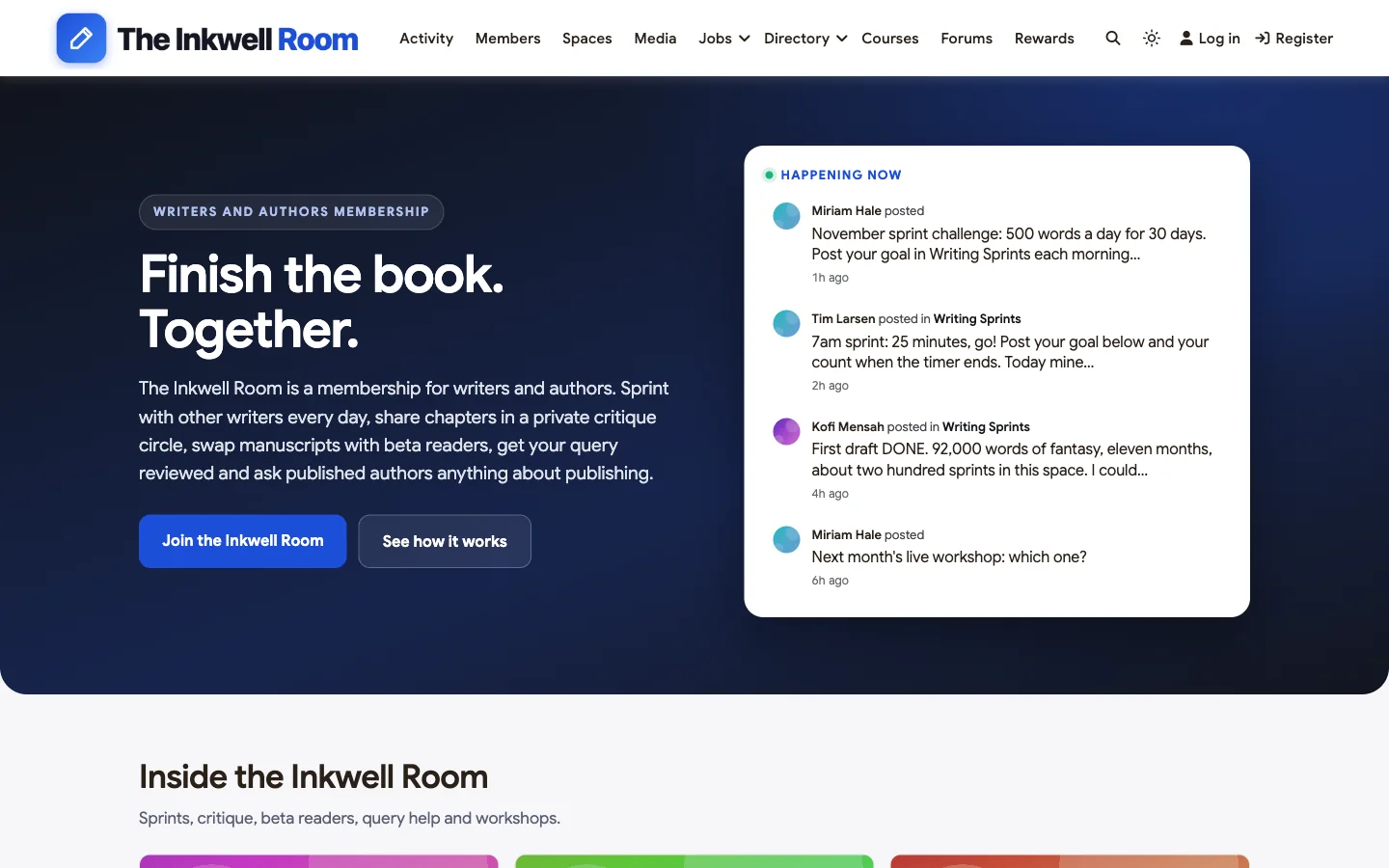
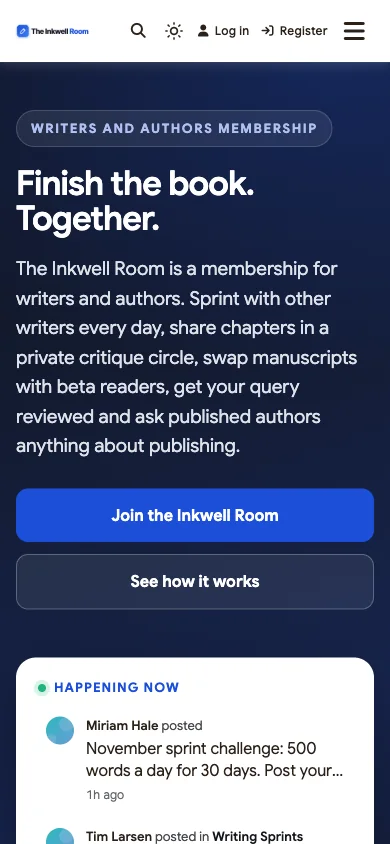
The homepage shows what the membership is for: the sprint challenge, a live sprint check-in and a member announcing a finished 92,000-word first draft after about two hundred sprints in the community.
Writing sprints
Writing Sprints is an open space where members post a goal, write, and post their count. The sprint host runs live sprints at 7am and 8pm UK time as events, with two 25-minute rounds and a check-in between. The monthly challenge (500 words a day for 30 days) gives the whole membership a shared goal, and the streak counter in the sidebar shows how many days in a row each member has kept going.
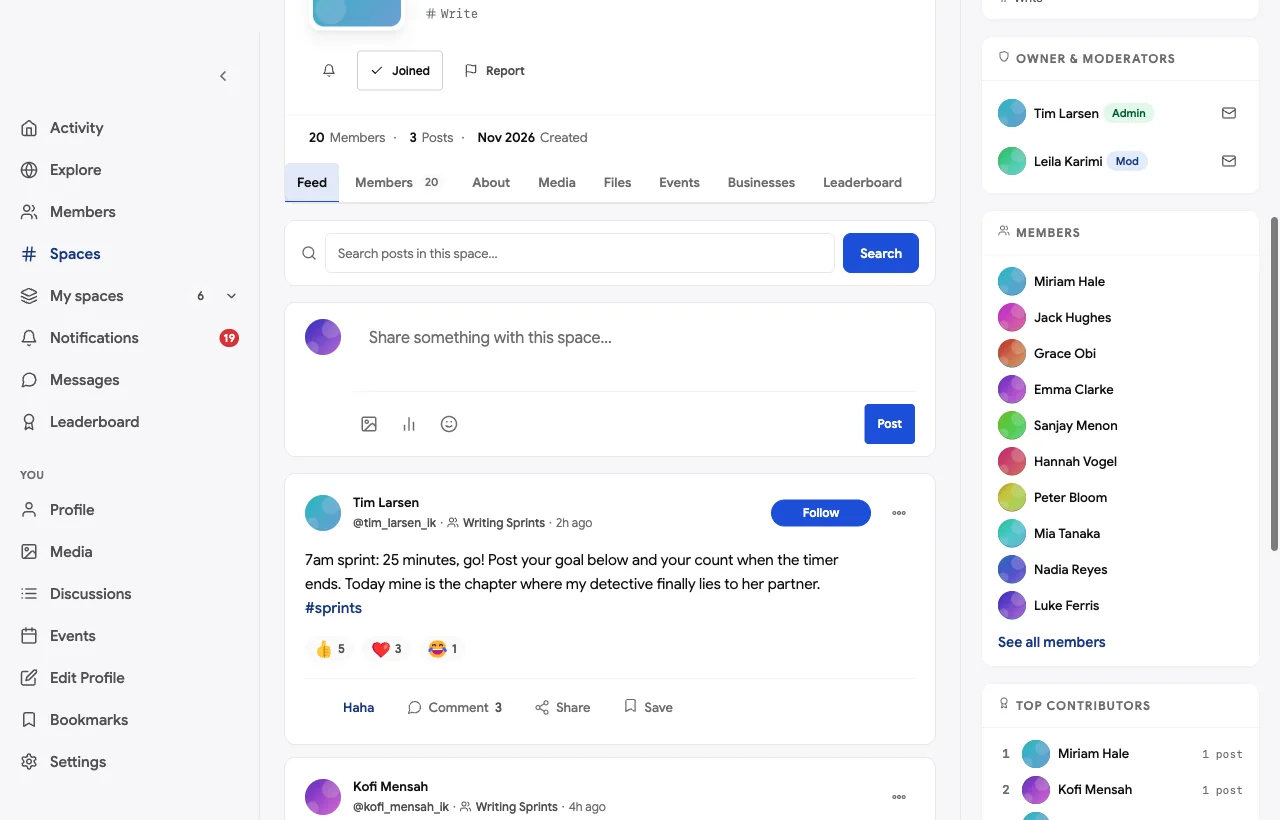
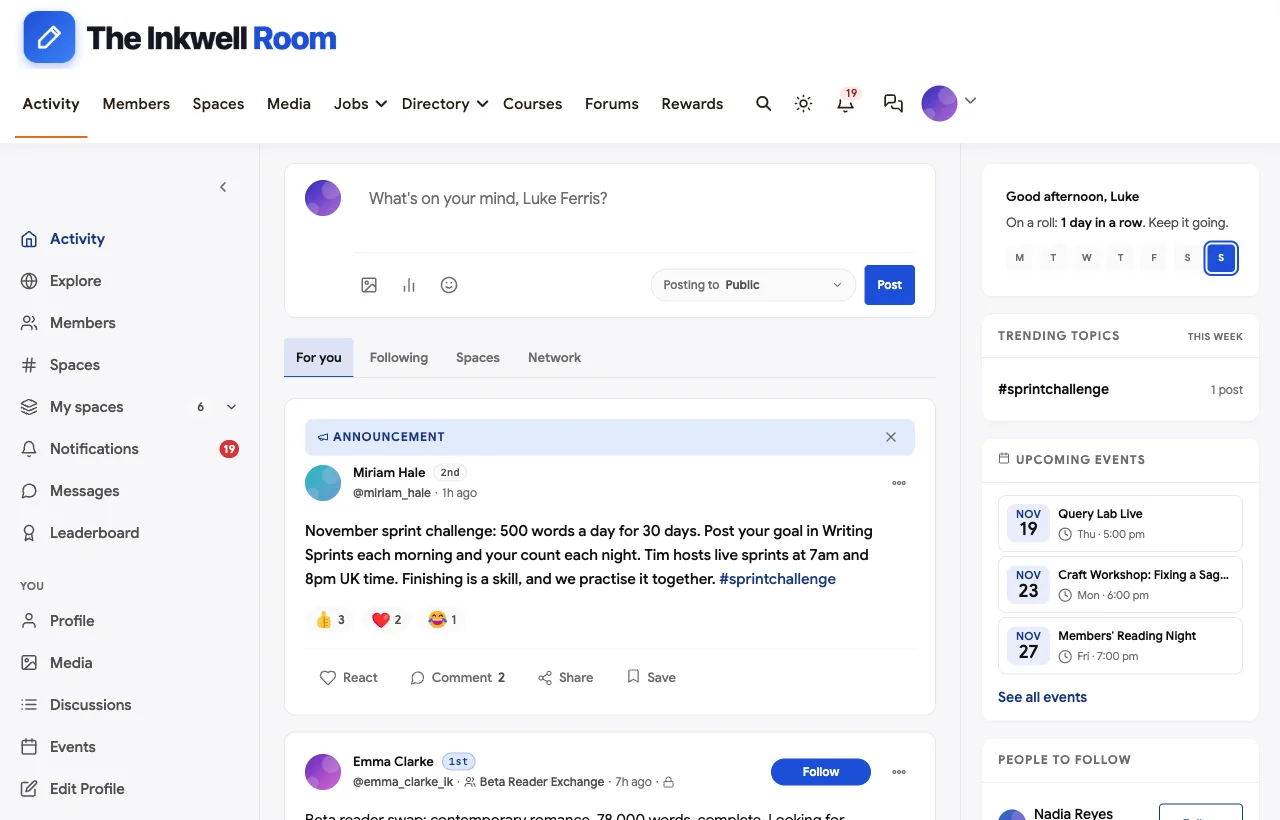
This is the part of a writing membership that finishes books. One member’s post says it plainly: eleven months, about two hundred sprints, one finished draft. “I could not have done it alone.”
The Critique Circle
Critique Circle is a private space. Members post up to 3,000 words with the feedback they want, and give two critiques for every piece they post, so the circle stays balanced.
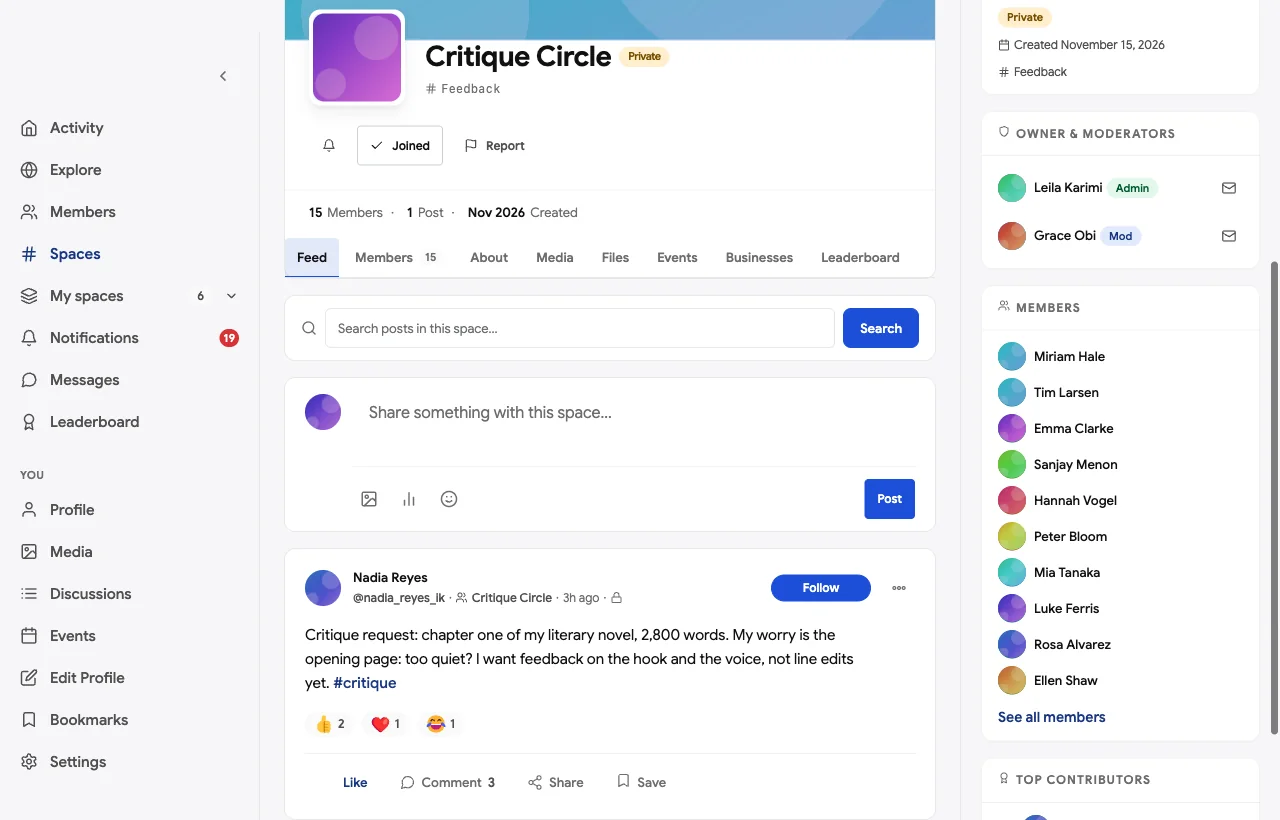
A debut novelist worries that her opening page is too quiet and asks for feedback on the hook and voice, not line edits. The critique lead tells her the hook is there, just late: her best line is in paragraph four, so open on it. A poet agrees. The writer replies that she is moving it up. Specific, kind feedback on exactly what was asked is what makes writers come back to a circle.
The Beta Reader Exchange
A finished manuscript needs readers, not critique. The Beta Reader Exchange is a private space for swapping whole drafts: a writer posts the genre, length and deadline, and the questions they want answered, and members offer a swap.

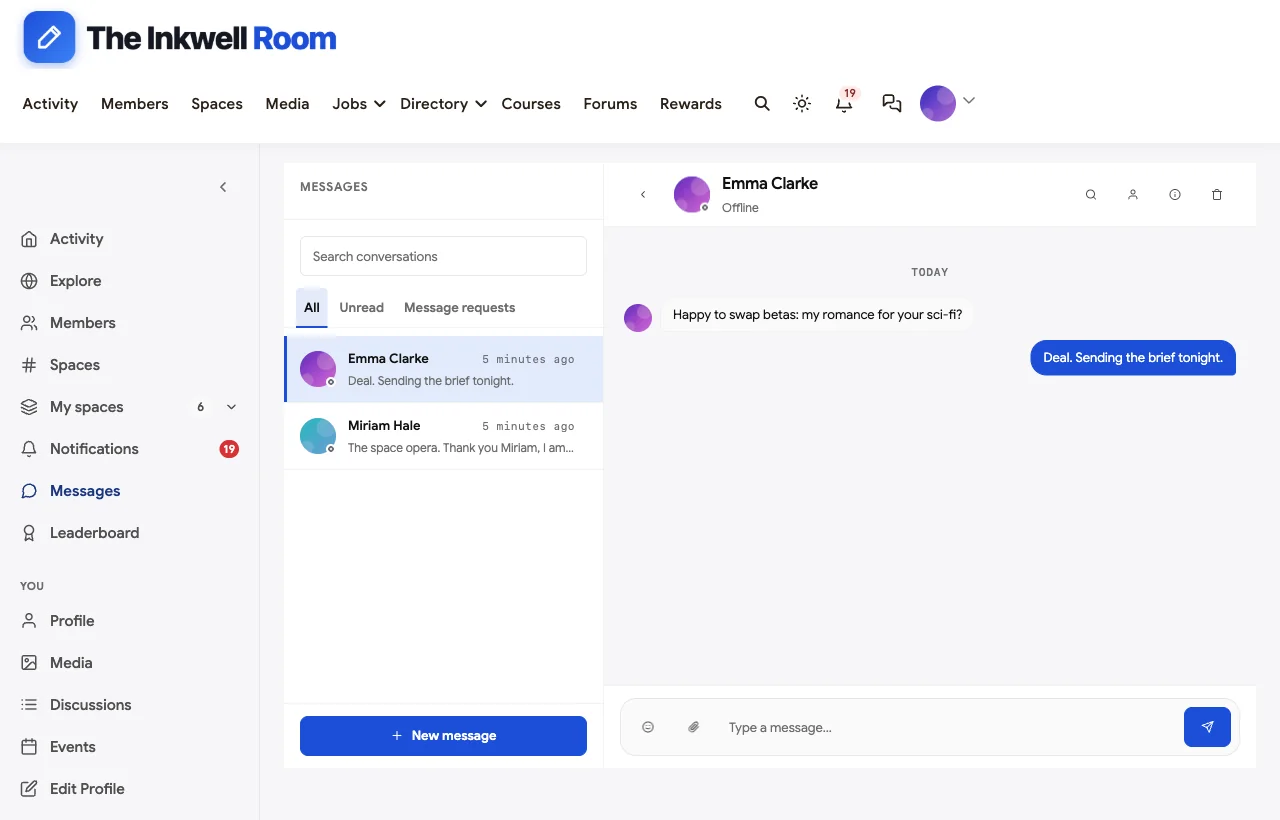
The details move to direct messages, where two members agree to swap a romance for a sci-fi draft and exchange their briefs.
Query Lab
Query letters, synopses and nonfiction proposals are high stakes and short, which makes them perfect for focused review. Query Lab is a private space run by a member who works as an agent’s assistant.
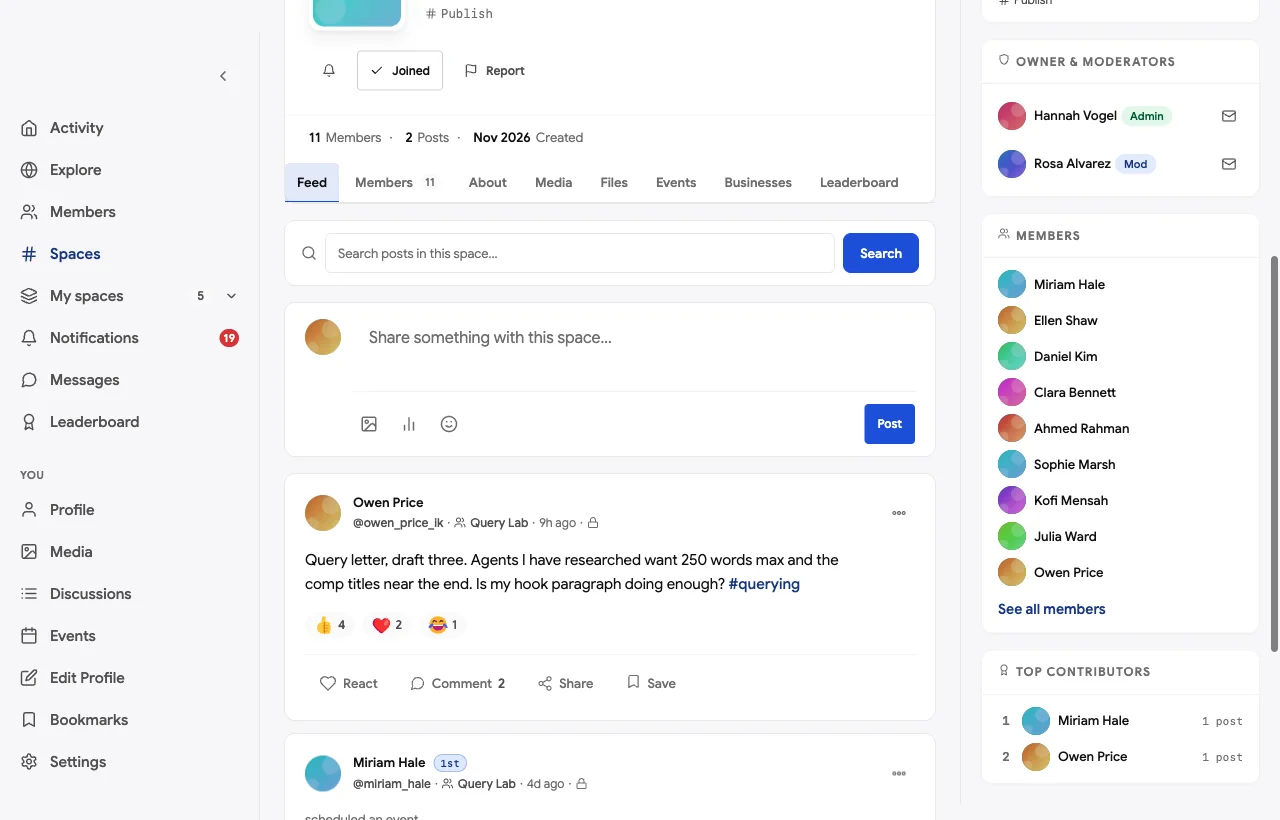
A crime writer posts the third draft of a query. The reviewer tells him to cut the first two sentences and start with the discovery of the body, because the stakes are buried in sentence three. A live Query Lab session reviews three letters each month.
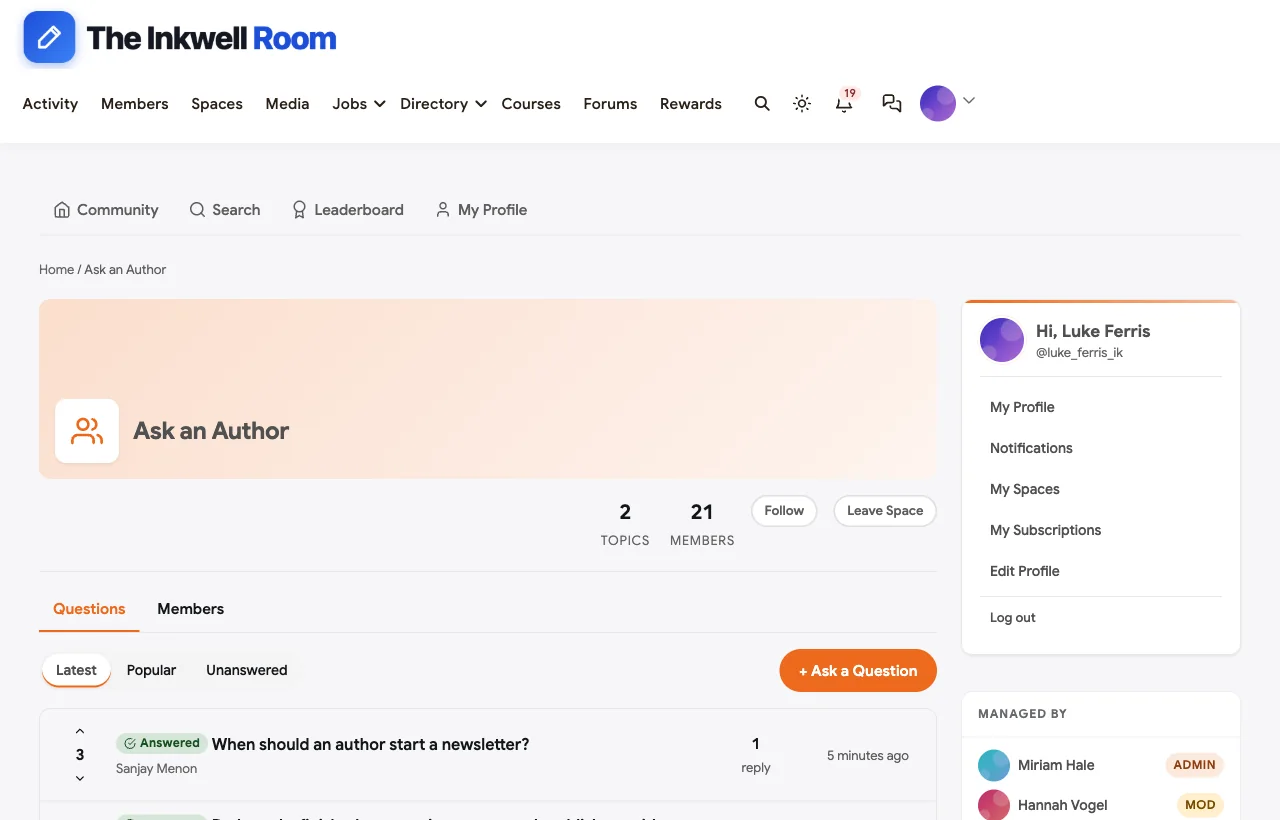
Ask an Author
Publishing questions are where writers most need someone who has been through it. Ask an Author is a Q&A forum where published authors, the agent’s assistant and the marketing coach answer, and the best answer is marked accepted.
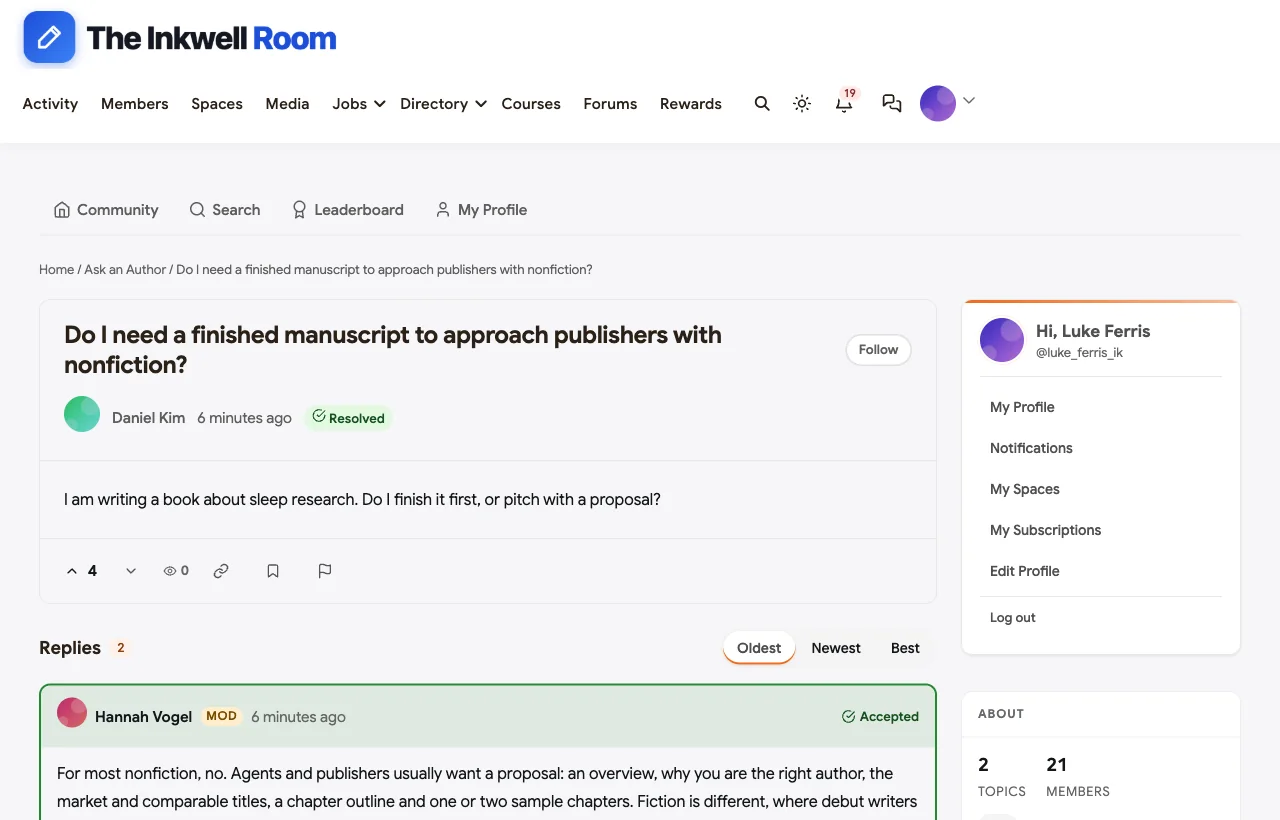

A nonfiction writer learns that most nonfiction is sold on a proposal, not a finished manuscript, with a clear list of what a proposal contains. A short story writer a year from publication learns to start a newsletter now, because the list is the one marketing channel an author fully owns.
Workshops and reading nights
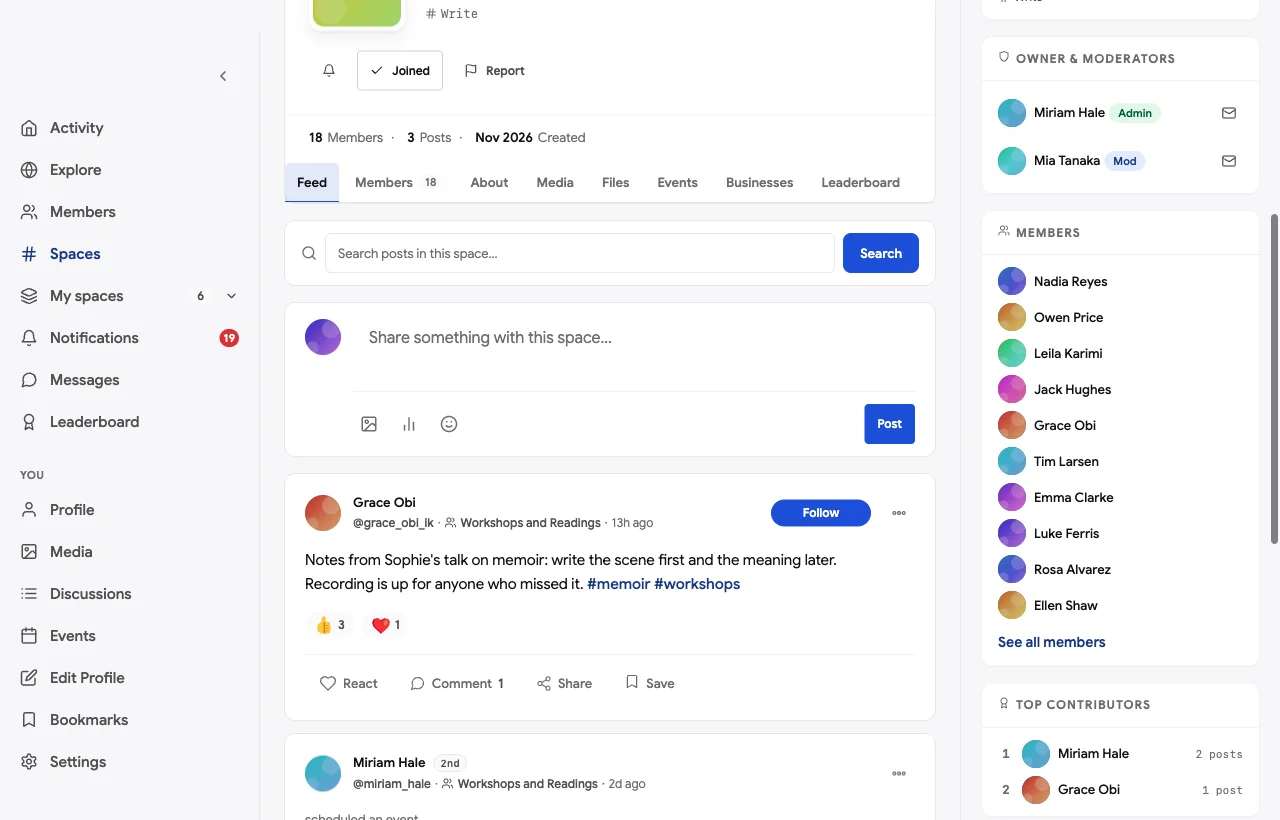
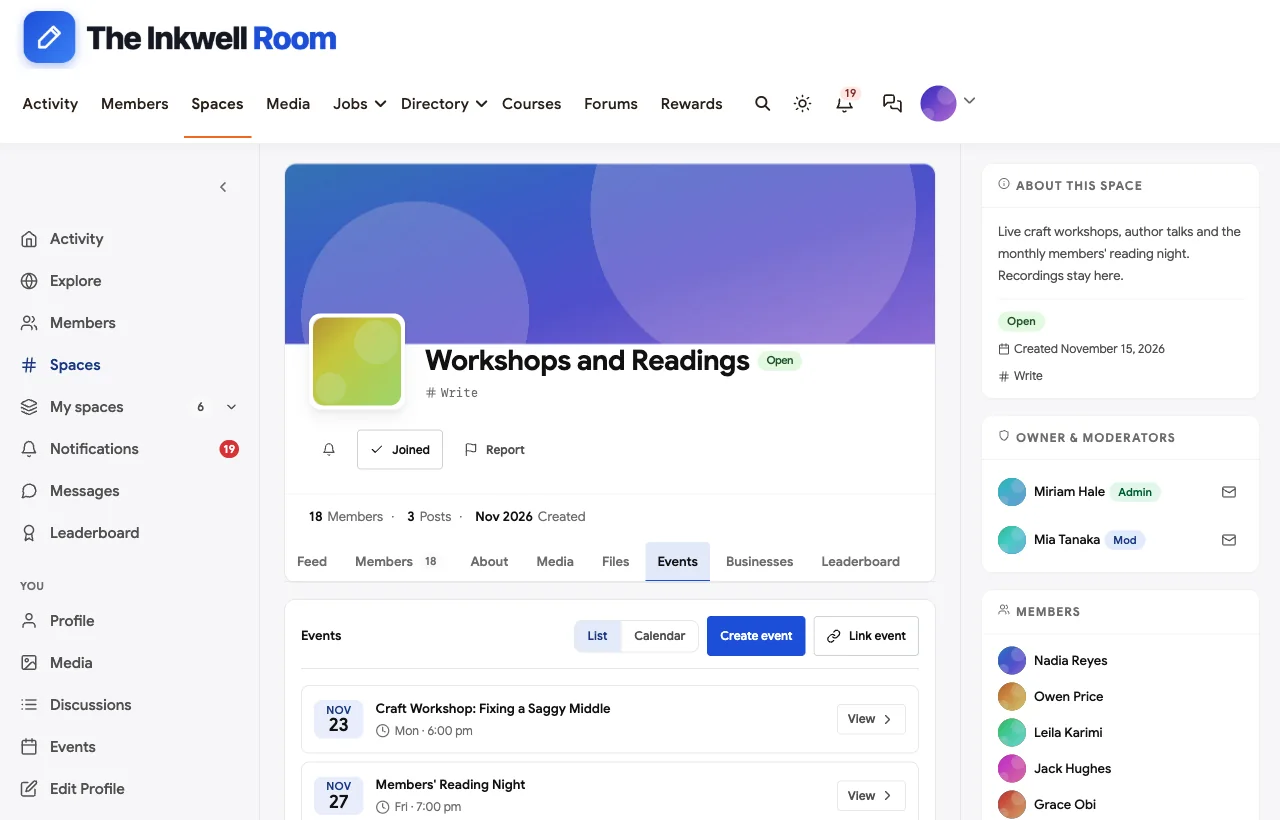
Craft workshops, author talks and the monthly members’ reading night are events attached to the Workshops and Readings space, with recordings kept in the space afterwards.
The course
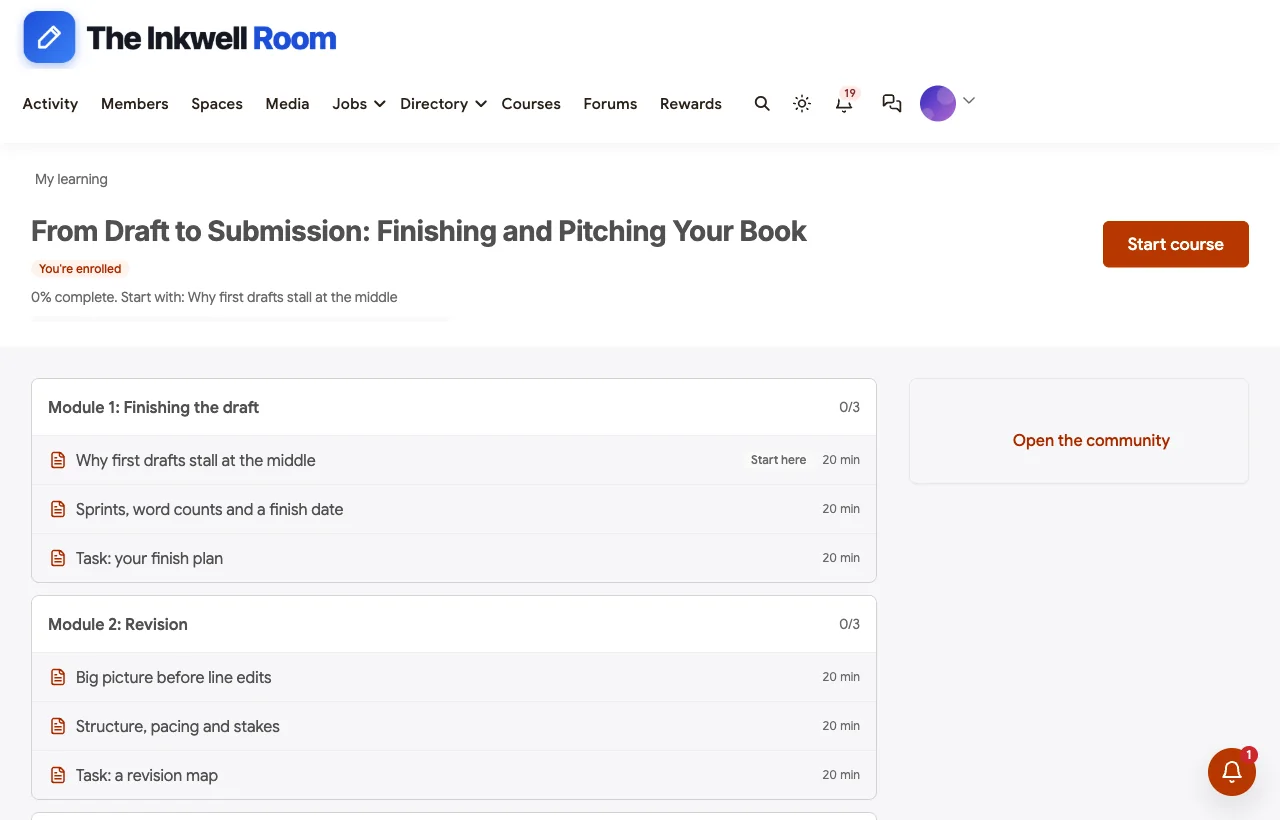
From Draft to Submission is a six-module course: finishing the draft, revision, critique and beta readers, the submission package, publishing paths, and the author platform. Each module ends with a task shared in a critique circle or the beta reader exchange, so the course feeds the community rather than sitting beside it.
Workshop requests and the roadmap
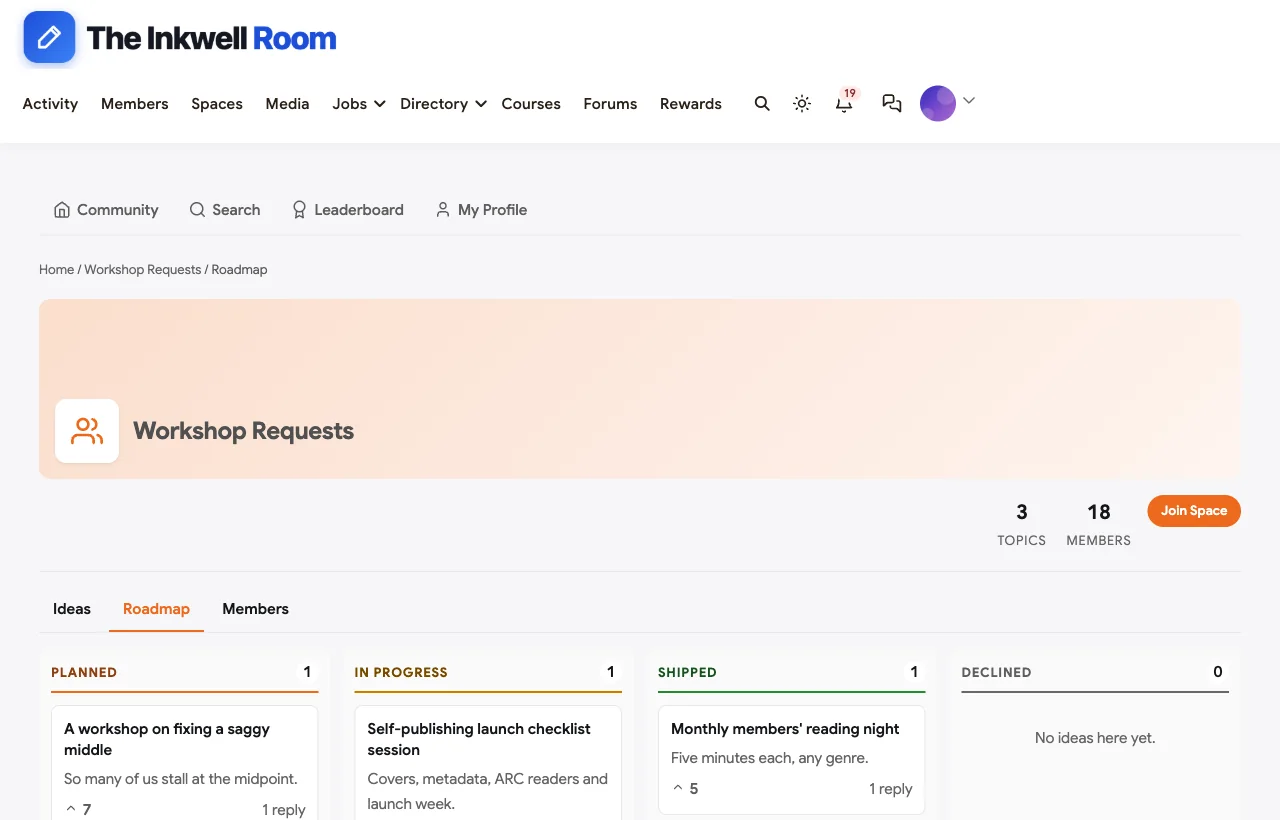
Members suggest workshops and vote. The host marks each idea as planned, in progress or shipped.
Opportunities, members and recognition
Most writers earn from writing in more than one way. The job board carries freelance work from partners: a feature writer, a brand copywriter and a ghostwriter for a business memoir.

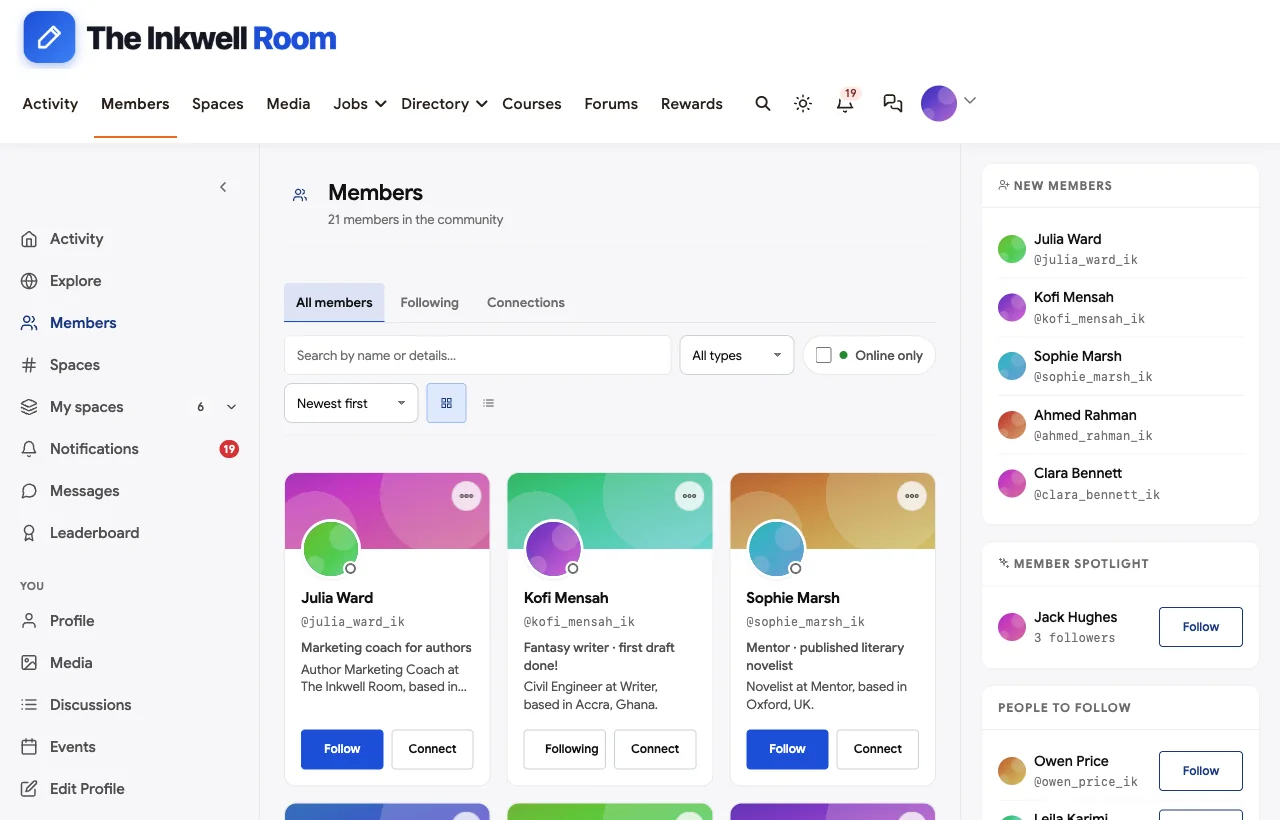
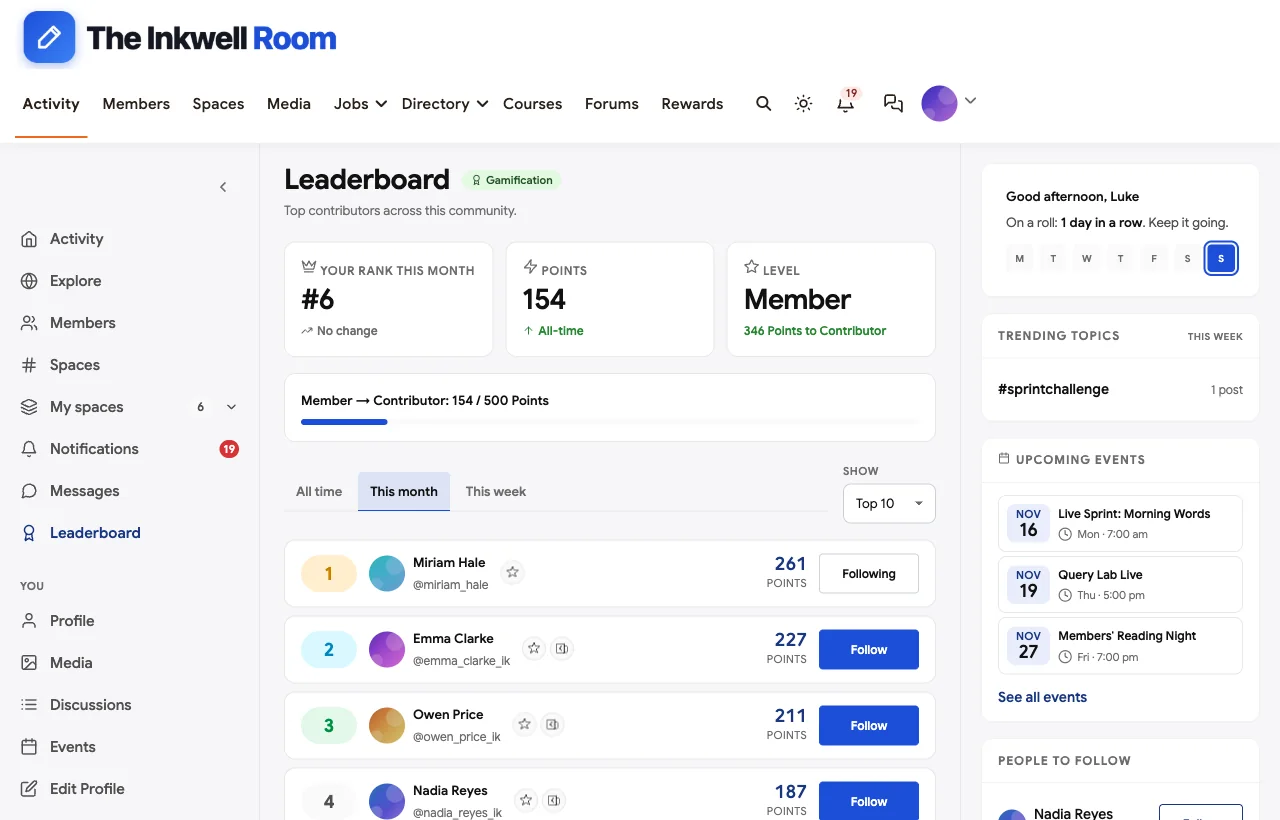
Points reward giving critique and answering questions, which keeps the give-and-take of a writing community healthy.
Keeping unpublished work private
Writers share unfinished work only when they trust where it goes. In the demo, critique, beta reading and query review happen in private spaces. Their posts are visible only to members of that space, and are not shown to logged-out visitors, so search engines cannot see them. Each post can also be set to public, members only, followers, connections, one space or private, and writers can edit or delete their own posts at any time.

Some magazines, contests and publishers treat work posted publicly online as already published, so check their guidelines. Keeping drafts in private spaces avoids that question.
On a phone
Writers sprint wherever they are. The whole membership works in the mobile browser without an app download.
Also built in. Polls for workshop topics, hashtags, a member directory, notifications, moderation and reporting, points and badges, and paid memberships with trials and coupons.
Not built for: publishing stories to a public readership, sending newsletters or hiring editors and designers through a marketplace. Keep Wattpad, Substack or Reedsy for those. Long manuscripts are better swapped as documents than pasted into posts. It is self-hosted, so you run WordPress or use a managed host.
What’s included, and how it is delivered
BuddyNext is one platform made of a core and add-on platform modules. Everything shown in the demo above runs on the BuddyNext platform. This table shows which parts come with the core, which are platform modules you install and activate alongside it, and which need a third-party plugin, another system or custom work.
| Capability | How it is delivered |
|---|---|
| Open, private and secret spaces for sprints, critique, beta reading and query review | Core platform |
| Per-post privacy and author edit and delete | Core platform |
| Activity feed, pinned announcements, polls and hashtags | Core platform |
| Member profiles and directory | Core platform |
| Reporting and moderation queue | Core platform |
| Direct messages | Platform module, installed alongside |
| Live sprints, workshops and reading nights as events | Platform module, installed alongside |
| Ask an Author Q&A with accepted answers and a workshop roadmap | Platform module, installed alongside |
| Book-finishing course with certificates | Platform module, installed alongside |
| Opportunities board for freelance work | Platform module, installed alongside |
| Points, streaks, badges and leaderboards | Platform module, installed alongside |
| Paid memberships with trials and coupons | Platform module, installed alongside |
| Email newsletter to readers | Another system (newsletter service) |
| Live video for sprints and workshops | Third-party video tool (Zoom, Google Meet) |
Want to click around yourself? The Inkwell Room in this guide was built on a private test site, so it is not public. The BuddyNext live demo is a general community you can open in your browser and explore without installing anything.
2. Scribophile: best established critique community
Scribophile invites writers to “Become a better writer and meet beta readers in our online writing group” (Scribophile). It runs a “points-based peer critique system” where you “Earn karma points by critiquing writing” and “post your own writing for critique,” plus “writing forums,” “writing contests” and an “extensive Writing Academy.”
Strengths: a mature critique economy that guarantees feedback in return for giving it.
Gaps: you join Scribophile’s community rather than running your own; no sprints, events or opportunities board found.
3. Critique Circle: best long-running critique exchange
Critique Circle describes “one of the largest and longest-running writing communities on the web” (Critique Circle). “It’s all about reciprocity”: you “Crit a couple of stories to gain enough credits,” then “Use your credits to submit your own story for review.” On privacy, it says “Stories submitted to CC are not considered ‘published online’ and cannot be found on search engines.”
Strengths: a clear credit system and strong protection for unpublished stories.
Gaps: no courses, sprints, events or opportunities board found; it is a shared community, not one you brand.
4. Wattpad: best for finding readers
Wattpad says “Millions of readers and writers come together on Wattpad to discover stories, champion new voices, and fuel fandoms,” and calls itself “The largest storytelling platform in the world” (Wattpad).
Strengths: a large audience for serialised fiction.
Gaps: built around public discovery, so it suits published chapters, not private critique; no structured critique, courses or events found on its company page.
5. Jericho Writers: best for writers aiming at traditional publishing
Jericho Writers sums up its offer as “Getting you published” (Jericho Writers). It offers “creative writing courses,” “editorial feedback,” “manuscript feedback,” a “supportive community,” “AgentMatch,” “live events” and the “Festival of Writing.”
Strengths: courses, manuscript feedback and agent research tools in one place.
Gaps: a membership you join, not one you run; no sprints, beta exchange or opportunities board found.
6. Reedsy: best for hiring editors and designers
Reedsy promises “Where beautiful books are made” and helps authors “Meet the editor, designer or marketer who can help bring your book to life” (Reedsy). It also offers “Writing courses, events and memberships,” “Writing prompts and contests” and “The writing app for authors.”
Strengths: the strongest marketplace here for professional editors, designers and marketers.
Gaps: no peer critique circles or sprints found; it complements a community rather than replacing one.
7. Writers.com: best for small online writing classes
Writers.com invites writers to “Follow the call to write” (Writers.com), with “Online Writing Classes,” “Live Workshops” and “One-to-One Editing and Coaching.” In its classes “a teacher offers insights on every project you submit,” with “written lectures, projects and assignments, and discussion forums,” and “Small groups keep our online classes lively and intimate.”
Strengths: teacher-led feedback in small classes.
Gaps: classes end; no ongoing membership features like sprints, beta reading or opportunities found.
8. Substack: best for building a paying readership
Substack’s pitch is “Make money doing the work you believe in,” and it says “You always own your intellectual property, mailing list, and subscriber payments” (Substack).
Strengths: newsletters and paid subscriptions with the author owning the list.
Gaps: built for writers and readers, not writers and writers: no critique, sprints, courses or beta reading found.
9. Patreon: best for supporting an author’s work
Patreon calls itself the place “Where Creator Communities Thrive,” with “Real-time group chats, comments, DMs” and the ability to “Share videos, podcasts, writing, art, music, recipes” (Patreon).
Strengths: a known membership model for authors with an existing audience.
Gaps: no writing-specific features such as critique, sprints or beta reading found.
10. Circle: best hosted community with courses and events
Circle helps you “Build a home for your community, events, and courses - all under your own brand” (Circle), with discussions, courses, events, a directory and automated moderation.
Strengths: a polished hosted community with courses and events.
Gaps: no writing-specific setup found: no critique exchange rules, beta reader exchange, Q&A with accepted answers or opportunities board.
Running a critique circle that people trust
A critique circle is the heart of a writing membership, and it fails in two ways: writers stop posting because feedback hurts, or the circle fills with requests nobody answers. A few rules prevent both:
- Give two, get one. Members give two critiques for every piece they post. It keeps the circle balanced without a credit system.
- State the feedback you want. “Hook and voice, not line edits” gets better critique than “thoughts?”.
- Cap the length. Around 3,000 words is enough to judge a chapter and short enough to critique well.
- Critique the page, not the person. Say what works, then the one or two changes that matter most.
- Keep it private. A private space gets honest drafts; a public one gets polished ones.
Sprints that finish drafts
Writing sprints work because they turn “I should write” into “I am writing for the next 25 minutes, with these people.” To keep them going:
- Fixed times. Two live sprints a day at the same times, so members can build a habit around them.
- Goal first, count after. Posting a goal before the sprint is what makes the count meaningful.
- Celebrate small numbers. 380 hard words count as much as 1,000 easy ones.
- A monthly challenge. A shared target gives the membership a story to tell together.
- Mark the finish. When a member finishes a draft, the whole community should hear about it.
Questions to ask before you choose
- Is this your community or someone else’s? Scribophile, Critique Circle, Wattpad and Jericho Writers are communities you join; BuddyNext and Circle are memberships you run.
- Where do drafts live? Look for private spaces that are hidden from logged-out visitors and search engines.
- Can writers write together? Sprints, a sprint space and a streak.
- Is there a path for finished drafts? Beta reading, query review and publishing Q&A.
- Can you teach? A course and recorded workshops.
- Can members earn? An opportunities board for freelance writing.
- Who owns the archive? On your own site, the critiques, answers and workshop recordings stay yours.
A 30-day launch plan
- Week one: foundations. Create Start Here, Writing Sprints, Critique Circle and Ask an Author, and post the privacy and critique rules.
- Week two: sprints. Start two live sprints a day and a monthly word count challenge.
- Week three: critique and craft. Open the circle with the give-two-get-one rule and run the first workshop.
- Week four: finishing. Open the Beta Reader Exchange and Query Lab, and announce the first reading night.
Which platform fits your writing community?
| If you… | Choose |
|---|---|
| Want sprints, critique, beta reading, query help and workshops in a membership you own | BuddyNext |
| Want to join an established critique exchange | Scribophile or Critique Circle |
| Want readers for serialised fiction | Wattpad |
| Want courses and manuscript feedback aimed at traditional publishing | Jericho Writers |
| Need to hire editors, designers or marketers | Reedsy |
| Want small teacher-led classes | Writers.com |
| Want to build a paying readership | Substack or Patreon |
| Want a general hosted community with courses | Circle |
More community platform comparisons
Running a different kind of creative or learning community? These guides use the same method: a working demo community and vendor claims checked at the source.
- Best platforms for a private book club community: next-book votes, chapter threads and hybrid meetings.
- Best platforms for a photography learning community: critique, weekly challenges and photo walks.
- Best platforms for a music teaching community: practice logs, feedback and recitals.
- Best platforms for a content creator community: creators, challenges and memberships.
- Best platforms for a paid coaching membership community: coach-led memberships with group calls.
- How to set up a community space on WordPress: the step-by-step setup guide behind every demo in this series.
How we built and checked this list
We built The Inkwell Room demo on a local WordPress site running BuddyNext, with fictional writers, editors, mentors, a course, sprints, workshops and freelance roles created for this guide. Every BuddyNext screenshot is from that demo. Competitor features were checked against each vendor’s own website in November 2026, and the employment figures come from O*NET OnLine and the US Bureau of Labor Statistics. We left out Self-Publishing School and Gotham Writers because their websites blocked our checks, and National Novel Writing Month because it closed in 2025. Where we could not confirm a feature on a vendor’s own pages, the scorecard says “Not found” or “Not confirmed”. We did not run a hands-on trial of every product, so features can change; confirm anything critical with the vendor. buddyxtheme.com is published by the team behind BuddyNext, which is why BuddyNext is listed first; we have tried to be fair about its gaps as well as its strengths.
Frequently asked questions
What is the best platform for a writers and authors membership?
BuddyNext is the best choice for a writers’ membership you own, with daily sprints, a private critique circle, a beta reader exchange, query review, Ask an Author, workshops, a course and an opportunities board. Scribophile and Critique Circle are the best established critique communities to join.
How do I keep members’ unpublished work private?
Run critique, beta reading and query review in private spaces, which are visible only to their members and hidden from logged-out visitors and search engines, and let writers edit or delete their own posts.
How do online writing sprints work?
Members meet at a set time, post a goal, write for 25 minutes, then post their word count. Two rounds with a short check-in between is a common format.
How do I run a fair critique circle?
Ask members to give two critiques for every piece they post, state the feedback they want, keep submissions to about 3,000 words and keep the circle private.
What can replace the November novel-writing challenge?
Any writing community can run its own monthly challenge: a daily word count goal, live sprints and a space to post counts and celebrate finished drafts.
Do I still need a newsletter tool?
If you are building a readership, yes. A membership serves writers working together; a newsletter tool such as Substack reaches readers.
Can members use the membership on their phones?
BuddyNext works in the mobile browser without an app download, so members can join a sprint from anywhere.
The bottom line
Books get finished when writers have company, feedback and a path to the end. If you want sprints, critique, beta reading, query help and workshops in a membership you own, BuddyNext is the strongest foundation, alongside a newsletter tool for readers. For an established critique exchange to join, Scribophile and Critique Circle lead.
And help your members finish the book.