
Ask any small-firm accountant where they learned the things that actually run their practice, and the answer is rarely a textbook. It is the partner who explained how to scope an engagement letter, the bookkeeper who shared a month-end checklist, the peer who answered a notice question at nine at night in the middle of busy season. Accounting is a profession where peer knowledge carries enormous weight, and most of it still travels through email chains, crowded social media groups and phone calls that nobody writes down.
This guide compares the software you can use to run a private community for accountants, bookkeepers and firm owners, whether you run a training company, a niche network or a coaching group for firm owners. It focuses on peer Q&A that stays searchable, firm owner groups, busy season support, courses and webinars, a firm directory for referrals, a job board and paid membership. We built a working accounting community for the first entry and checked every competitor claim on the vendor’s own pages in November 2026.
Quick answer
If you want a private accounting community you own, BuddyNext is the strongest choice: a Technical Desk where the best answer is marked accepted, a private firm owners group, a busy season space, courses with certificates, webinars, a firm directory for referrals, a job board and paid memberships on your own domain. Discourse and Higher Logic Vanilla are the strongest forum-first alternatives for searchable Q&A, Bettermode adds a knowledge base and job board, and Circle, Heartbeat and Kajabi suit communities built around courses and events.
In this guide
- What an accounting community needs
- The accounting community scorecard
- 1. BuddyNext: best for a private accounting community you own
- 2. Discourse: best for searchable technical Q&A
- 3. Higher Logic Vanilla: best for a support-style professional forum
- 4. Bettermode: best for a knowledge base plus a job board
- 5. Circle: best for a polished community with courses and events
- 6. Heartbeat: best for live webinars with replays
- 7. Kajabi: best for a training company selling courses first
- 8. Disciple: best for a branded app with groups and a directory
- 9. Mighty Networks: best for an app-first network with events
- 10. Skool: best for a simple paid group with courses
- Running a community through the accounting year
- From question to knowledge
- Running a busy season space that helps
- Confidentiality and professional standards
- Questions to ask before you choose
- A 60-day launch plan
- Which software fits your accounting community?
- More community platform comparisons
- How we built and checked this list
- Frequently asked questions
- The bottom line
What an accounting community needs
Accountants are not a general audience. Their community has to respect confidentiality, handle precise technical questions, and fit around a calendar with one very busy season.
| Need | Why it matters for accountants | What the platform needs |
|---|---|---|
| Technical Q&A | The same questions return every year | Answers marked accepted, full-text search |
| Confidentiality | Client details must never be shared | Private spaces, clear rules, moderation and reporting |
| Firm owner peer groups | Owners need a place to talk about staff, scope and growth | Private or secret groups with controlled membership |
| Busy season support | Quick help when time is shortest | A focused space, notifications that matter |
| Continuing learning | Members keep their skills and licences current | Courses, certificates and webinars with recordings |
| Referrals between firms | Firms refer work outside their niche | A searchable firm directory by specialty |
| Hiring | Firms constantly look for staff | A job board inside the community |
The long-term demand is steady. The U.S. Bureau of Labor Statistics projects that “employment of accountants and auditors is projected to grow 5 percent from 2025 to 2035, faster than the average for all occupations” (BLS). The same page notes that CPA candidates need “150 semester hours of college coursework to be licensed, which is 30 hours more than the usual 4-year bachelor’s degree.” Learning never really stops in this profession, and a community that supports it has a lasting reason to exist.
The accounting community scorecard
How each option handles what matters most. “Not found” means we could not confirm it on the vendor’s own pages, not that it is impossible.
| Platform | Q&A with accepted answers | Private groups | Courses with certificates | Events and webinars | Directory | Job board | Hosting |
|---|---|---|---|---|---|---|---|
| BuddyNext | Yes | Private and secret | Yes | Yes, with recordings | Members and firms | Yes | Self-hosted |
| Discourse | Yes | Groups and roles | Not found | Not found | Not found | Not found | Hosted or self-hosted |
| Higher Logic Vanilla | Q&A | Not found | Not found | Virtual events | Not found | Not found | Hosted |
| Bettermode | Not confirmed | Not confirmed | Academy, no certificates found | Events | Members | Job board | Hosted |
| Circle | Not found | Spaces | Courses, no certificates found | Live events | Directory | Not found | Hosted |
| Heartbeat | Not found | Channels | Courses, no certificates found | Live events with replays | Profiles | Not found | Hosted |
| Kajabi | Not found | Not found | Courses, no certificates found | Not confirmed | Not found | Not found | Hosted |
| Disciple | Not found | Groups | Not found | Events, livestreaming | Member directory | Not found | Hosted |
| Mighty Networks | Not found | Not confirmed | Not confirmed | Events | Not confirmed | Not found | Hosted |
| Skool | Not found | Not found | Courses | Events | Not found | Not found | Hosted |
1. BuddyNext: best for a private accounting community you own
BuddyNext is a complete community platform that runs on your own WordPress site. It brings together private and secret spaces, Q&A with accepted answers, courses with certificates, events, a business directory, a job board, member profiles, direct messages, polls and leaderboards. A training company or network can run its whole community under its own brand, with member data on its own server.
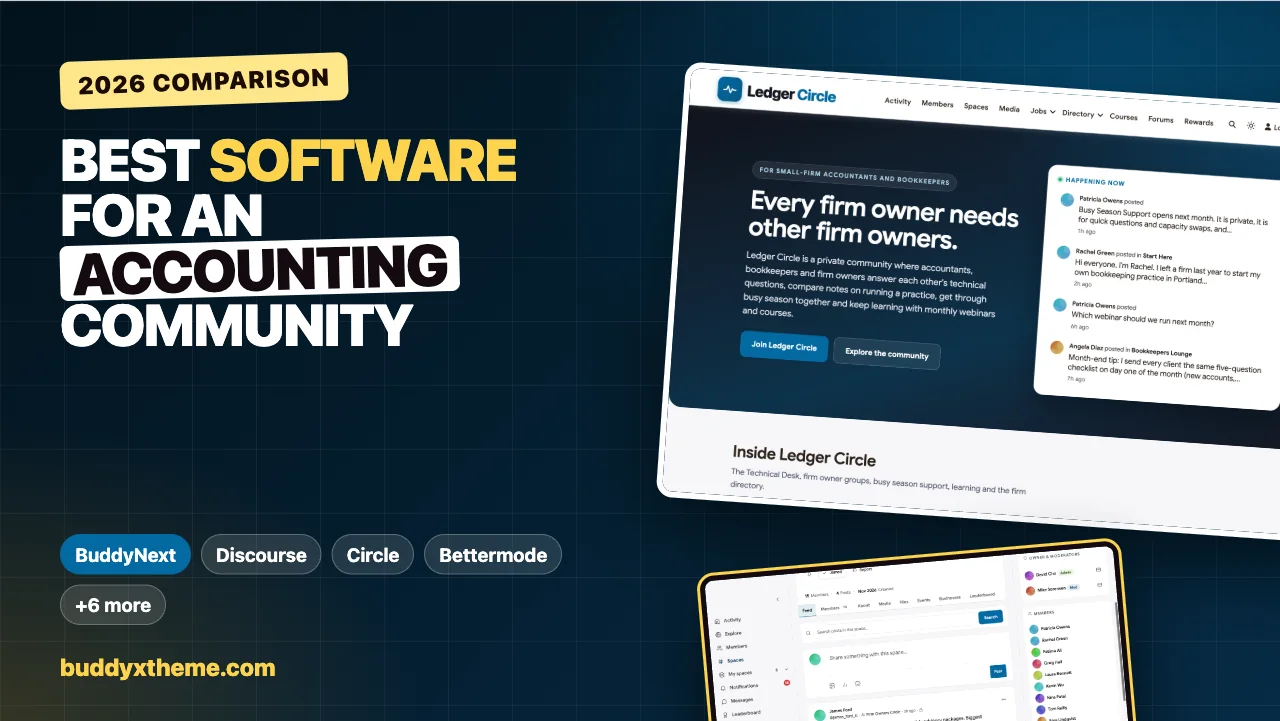
To show it in practice, we built Ledger Circle, a demo peer community for small-firm accountants and bookkeepers run by a former firm owner. It has 20 fictional members: CPAs, enrolled agents, bookkeepers, a payroll specialist, an audit partner, a UK chartered accountant with US clients, a staff accountant studying for the CPA exam, a recruiter, a practice tech consultant and a retired partner who mentors.
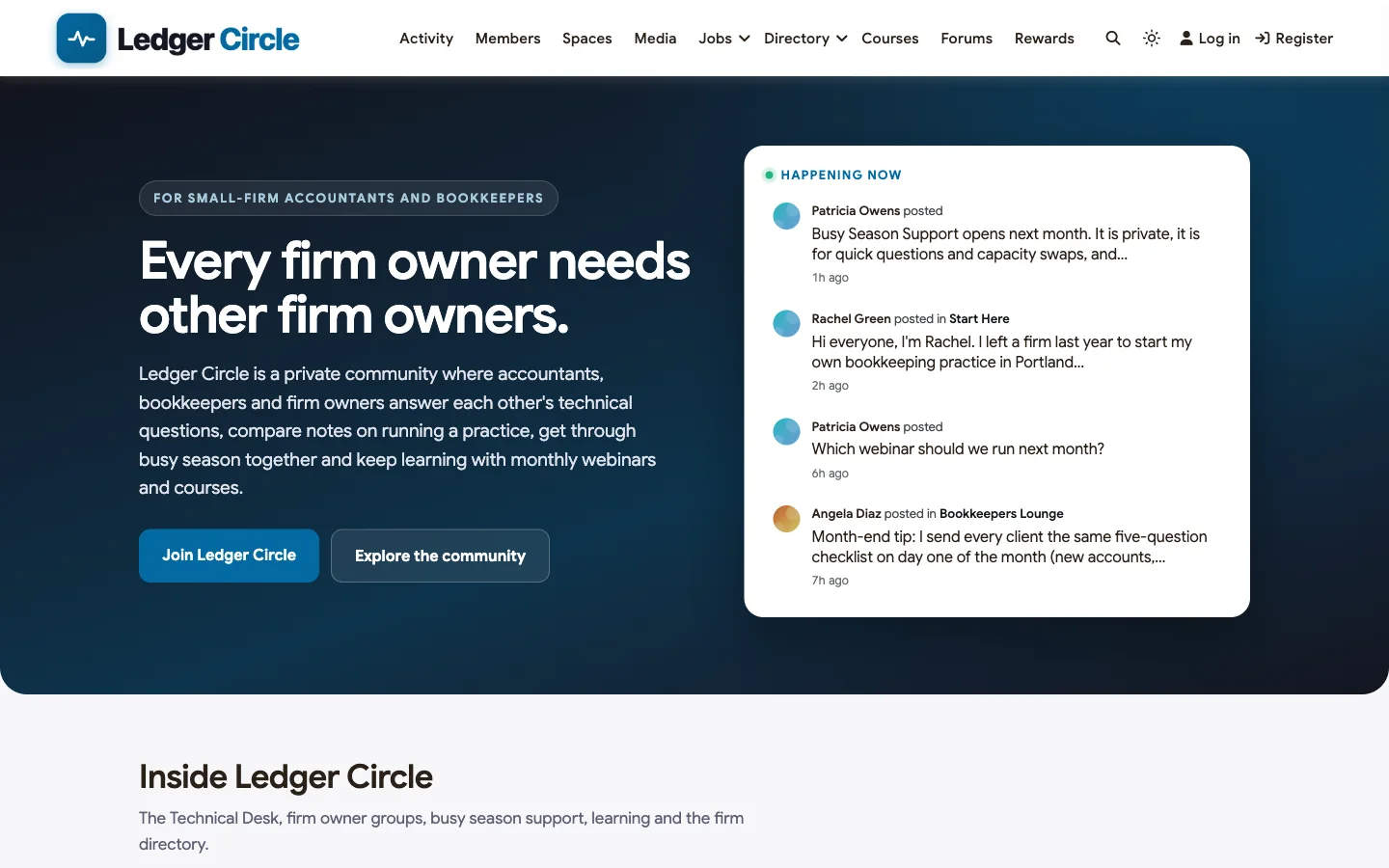
Good at: technical answers that stay findable, private groups for firm owners, seasonal support, learning and referrals in one place.
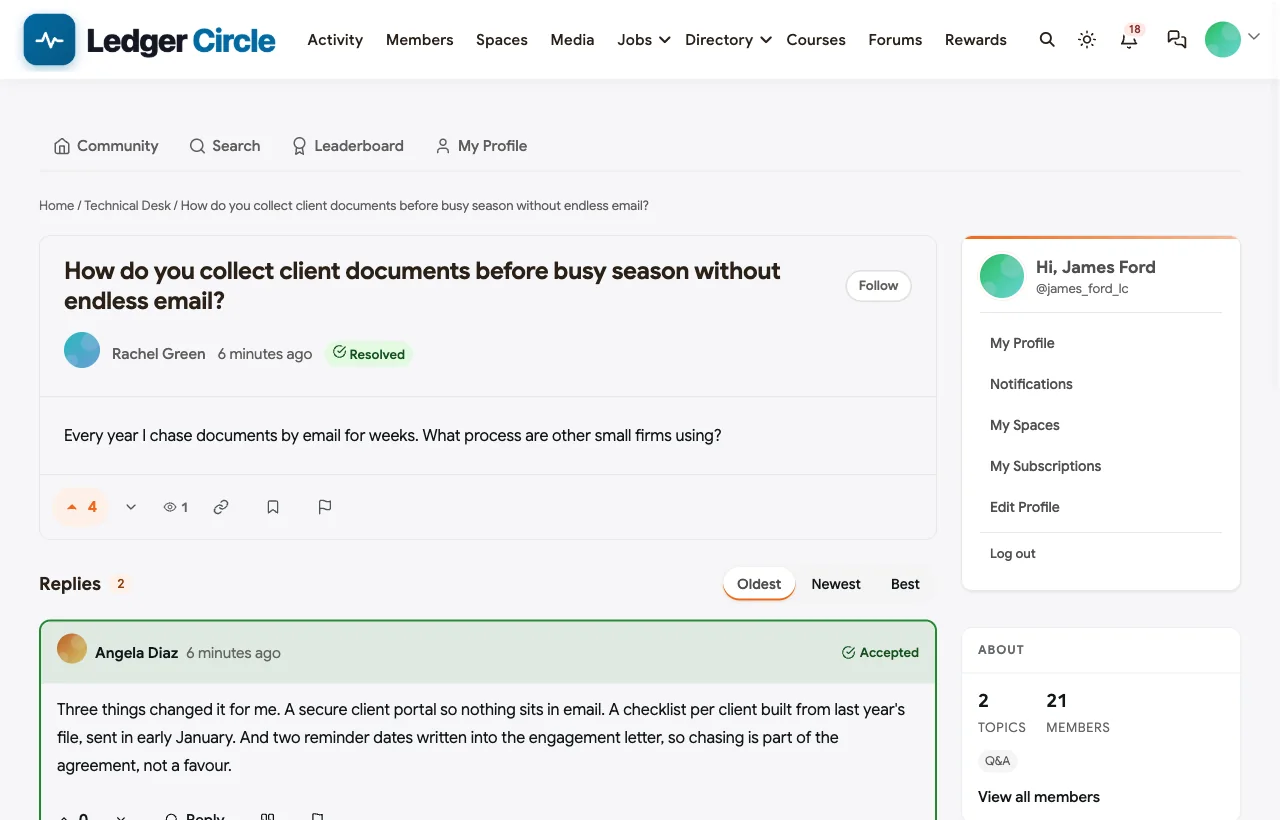
A Technical Desk with accepted answers. Members ask tax, accounting and payroll questions, peers who have handled them answer, and the answer that worked is marked accepted so the thread shows as resolved. In the demo, a new practice owner asks how to collect documents before busy season without endless email, and an experienced bookkeeper’s three-step process becomes the accepted answer:
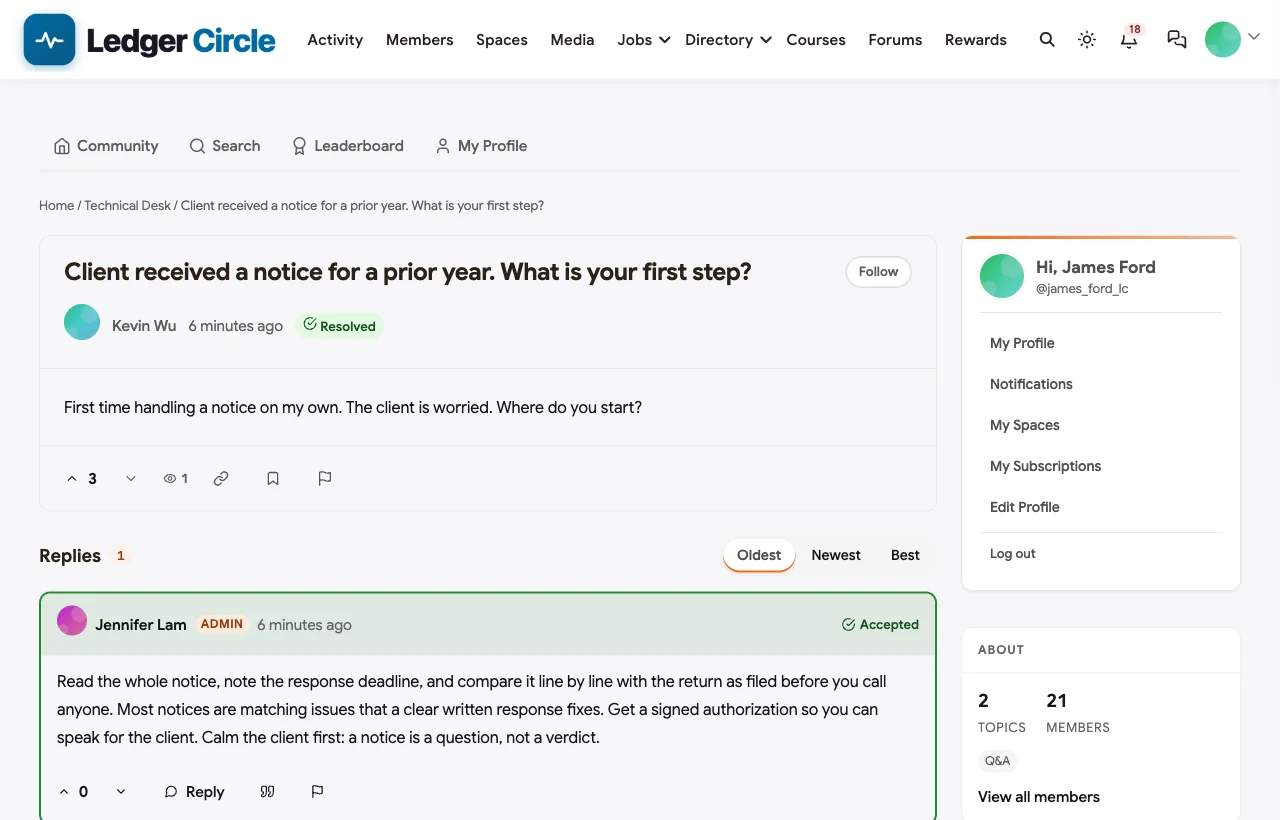
The space description makes the boundary clear: answers are peer experience, not formal advice, and members always check the source.
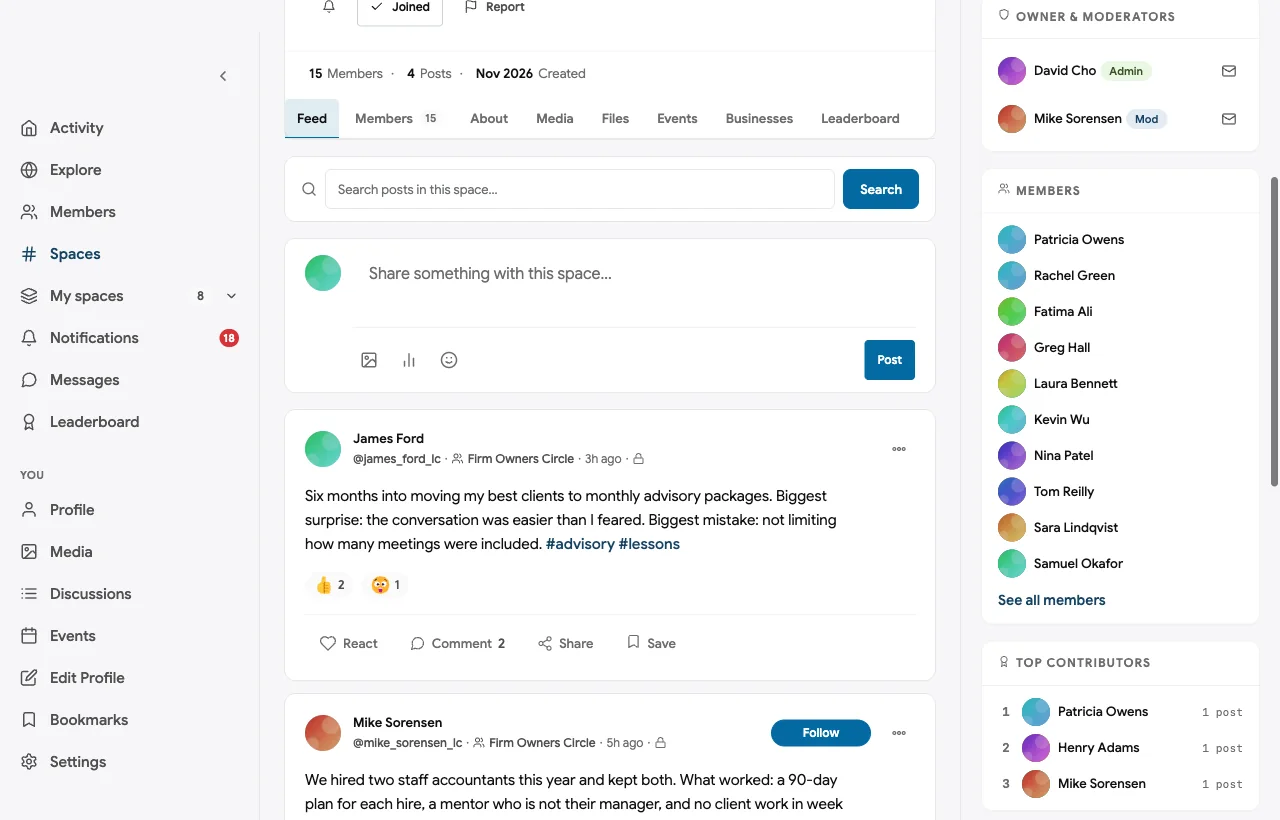
A private Firm Owners Circle. Owners and partners talk about scope, hiring, capacity, technology and succession in a private space. In the demo, an owner shares what six months of advisory packages taught him, and another explains how his firm kept two new hires:
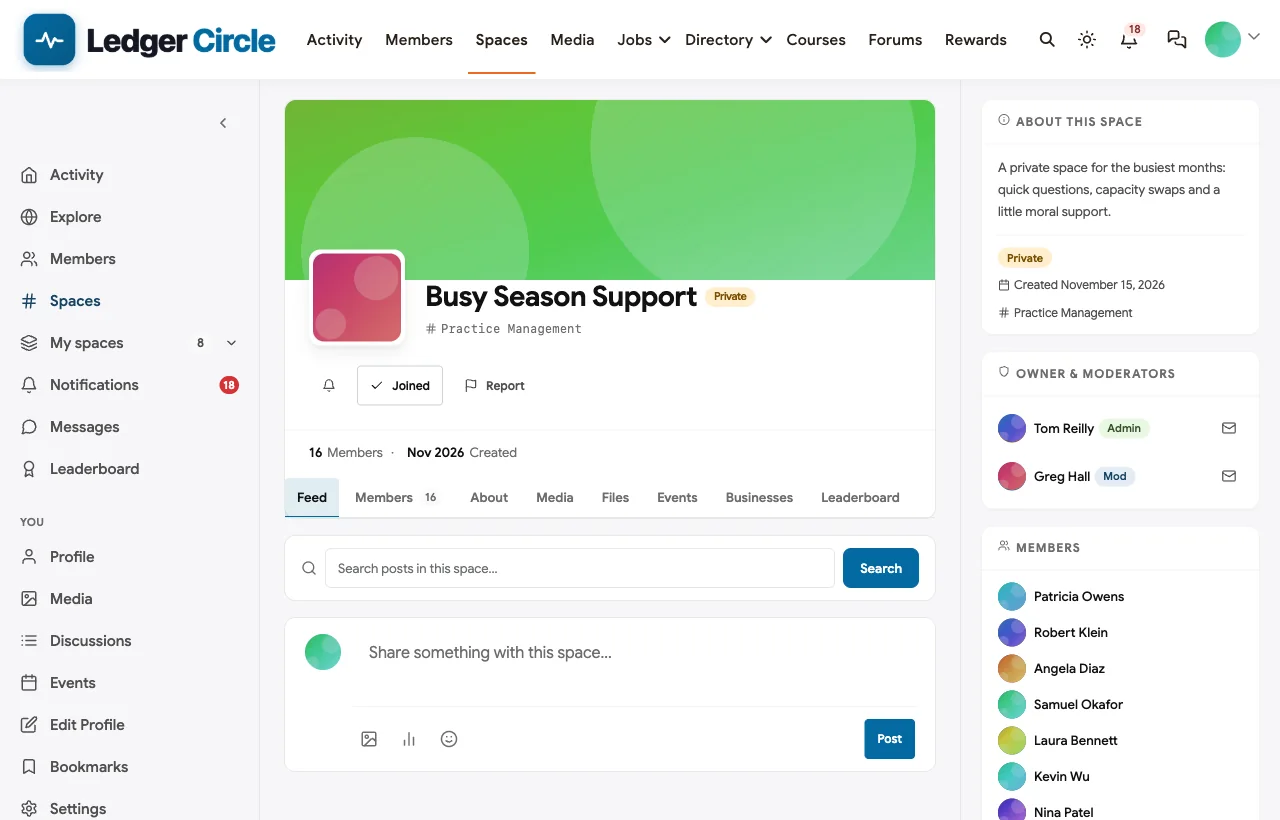
Busy season support. A private space opens for the busiest months, for quick questions, capacity swaps between firms and moral support, with one rule pinned at the top: no client names or identifying details:
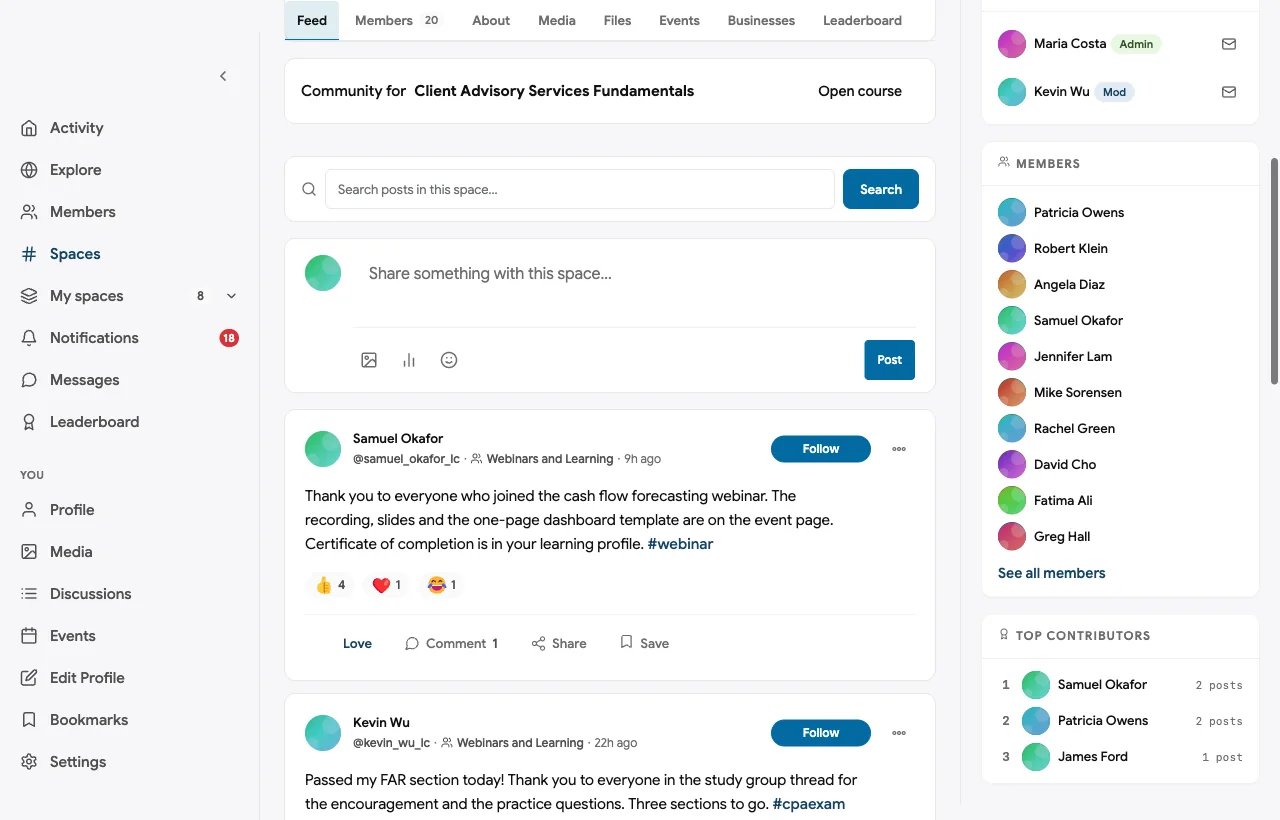
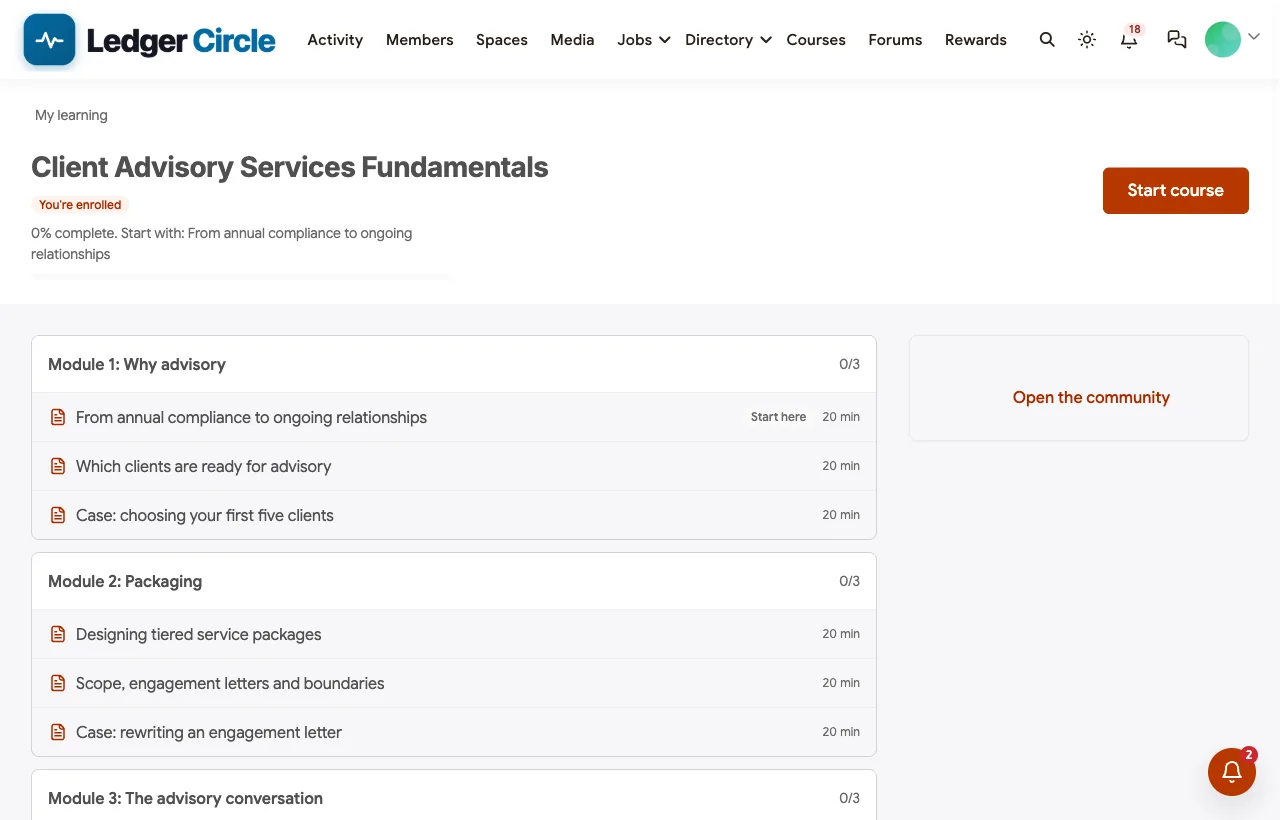
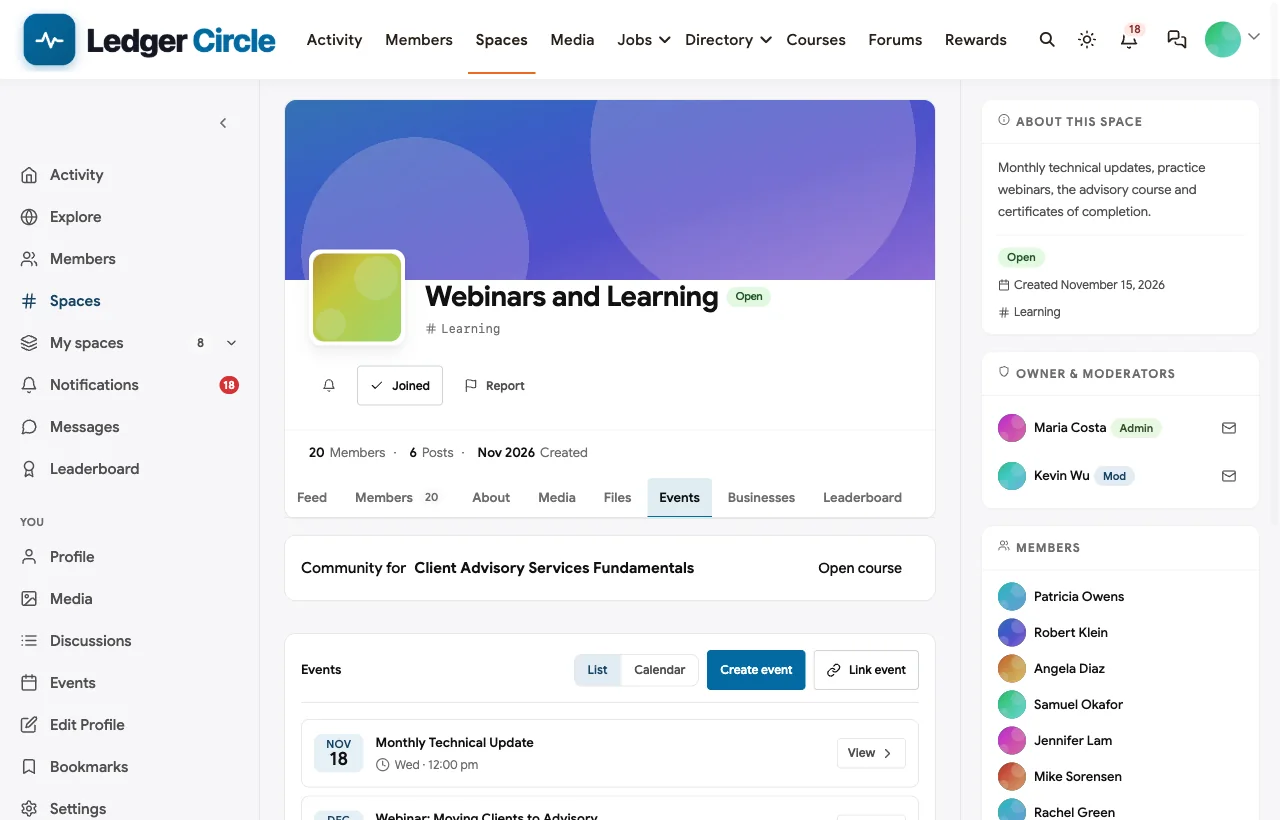
Courses, webinars and certificates. The community runs monthly technical updates and practice webinars as events with RSVPs, and posts recordings and templates afterwards. A course on client advisory services has six modules with case discussions and a certificate of completion:
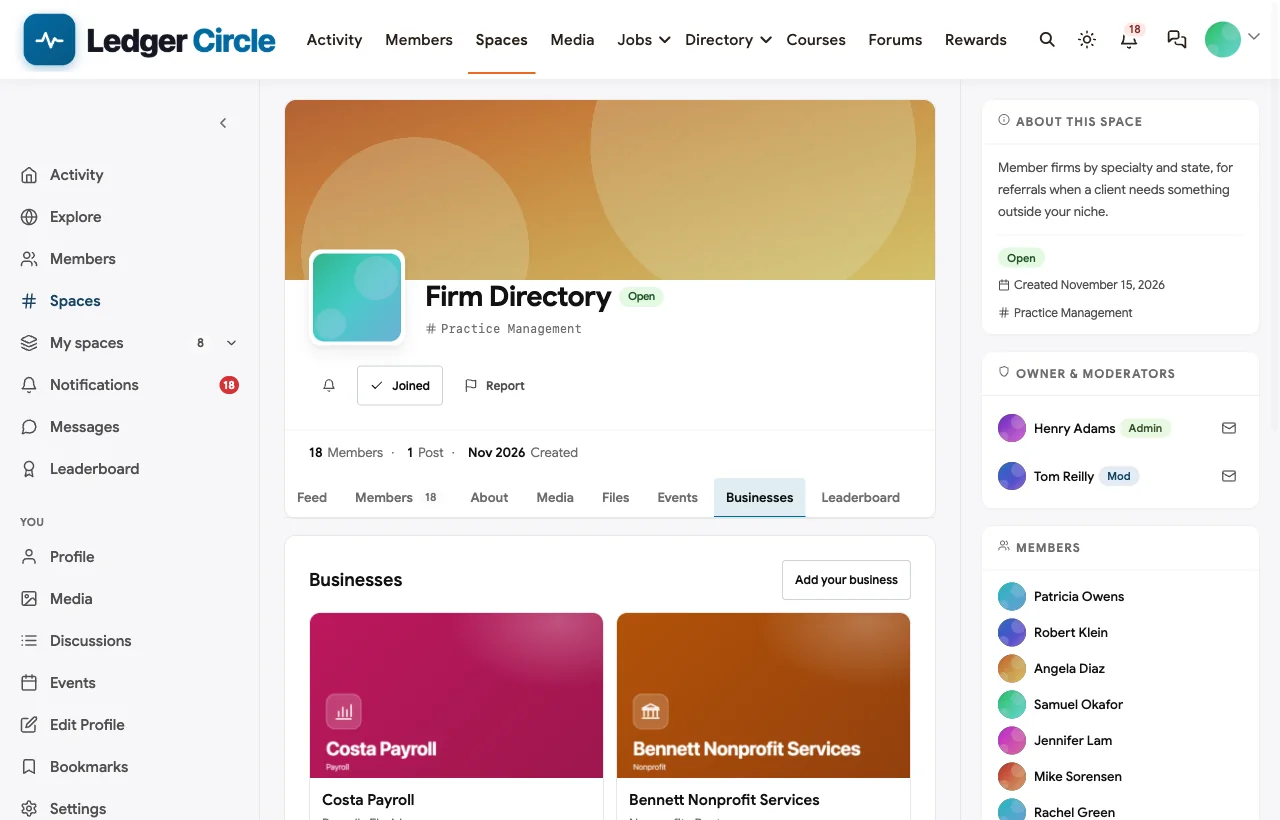
A firm directory for referrals. Member firms list their specialties and the states they serve, so a member can refer a client who needs audit, nonprofit, payroll or tax resolution work to a trusted peer:
A job board inside the community. Firms post roles where accountants already spend time, from staff accountant to remote senior tax roles and part-time bookkeeping:

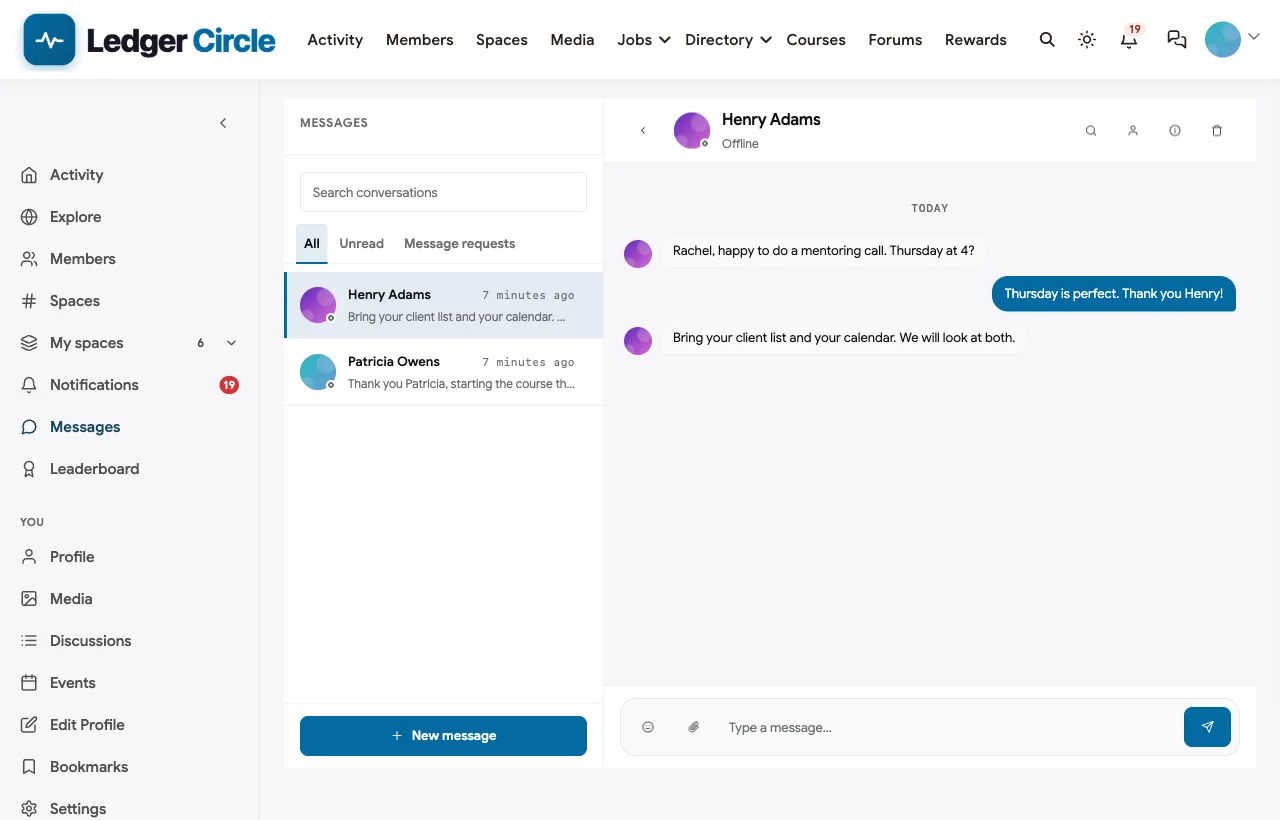
Mentoring and personal welcome. A retired partner offers mentoring calls to new practice owners through direct messages, and the founder welcomes every new member with a first step:
Also built in. A Bookkeepers Lounge, polls to choose webinar topics, a member directory, notifications, moderation and reporting, points and a leaderboard for helpful answers, a secret mentor room, paid memberships with trials and coupons, and a mobile layout that works without an app download.
Not built for: practice management, tax software or document portals. BuddyNext is the community, not the tool that runs client work, and it does not track continuing education hours against licensing rules. It is self-hosted, so you run WordPress or use a managed host.
What’s included, and how it is delivered
BuddyNext is one platform made of a core and add-on platform modules. Everything shown in the demo above runs on the BuddyNext platform. This table shows which parts come with the core, which are platform modules you install and activate alongside it, and which need a third-party plugin, another system or custom work.
| Capability | How it is delivered |
|---|---|
| Open, private and secret spaces | Core platform |
| Member profiles and searchable member directory | Core platform |
| Activity feed, pinned announcements and hashtags | Core platform |
| Polls | Core platform |
| Direct messages | Platform module, installed alongside |
| Moderation and reporting | Core platform |
| Q&A with accepted answers | Platform module, installed alongside |
| Courses with certificates | Platform module, installed alongside |
| Events and webinars with RSVPs | Platform module, installed alongside |
| Firm directory | Platform module, installed alongside |
| Job board | Platform module, installed alongside |
| Points, badges and leaderboards | Platform module, installed alongside |
| Paid plans with trials and coupons | Platform module, installed alongside |
| Live webinar video | Third-party video tool (Zoom, Google Meet) |
| Formal CPE credit tracking and reporting | Another system or custom work |
Want to click around yourself? The Ledger Circle community in this guide was built on a private test site, so it is not public. The BuddyNext live demo is a general community you can open in your browser and explore without installing anything.
2. Discourse: best for searchable technical Q&A
Discourse describes itself as a platform “powering more than 22,000 communities that create knowledge through conversation” (Discourse). It helps you “keep technical discussions organized with categories, tags, and accepted answers,” “create a searchable public knowledge base,” “organize members with groups and roles,” and offers “SSO and social logins,” with a mobile app.
Strengths: the strongest forum for long technical threads, accepted answers and search.
Gaps: no courses, certificates, webinars, member directory or job board found as native features.
3. Higher Logic Vanilla: best for a support-style professional forum
Vanilla Forums was “acquired by Higher Logic in 2021 and rebranded as Higher Logic Vanilla” (Higher Logic). It offers “Q&A and discussions” to “crowdsource support to get answers more quickly,” “federated search” to “pull content from external platforms and make it searchable in one place,” and “networking and virtual events.”
Strengths: Q&A, federated search and virtual events from an established community vendor.
Gaps: positioned as customer community software; no member directory, private groups, job board or courses found on the page we checked.
4. Bettermode: best for a knowledge base plus a job board
Bettermode, formerly Tribe, helps you “build a community your audience loves” (Bettermode). Its product areas include a knowledge base, an Academy for courses, events, member profiles and a job board, with a mobile app.
Strengths: knowledge base, courses, events and a job board under one product.
Gaps: accepted answers, certificates, paid membership and SSO were not confirmed on the pages we checked.
5. Circle: best for a polished community with courses and events
Circle helps you build a home for your community, events and courses under your own brand (Circle). It lets you “build, sell, and scale your online course alongside a thriving community” (Circle courses), host live events, use a member directory, sell one-time purchases, memberships or subscriptions, and send “email broadcasts” and marketing automations, with a branded app.
Strengths: a polished member experience with courses, events, paid memberships and email.
Gaps: no Q&A with accepted answers, course certificates or job board found.
6. Heartbeat: best for live webinars with replays
Heartbeat invites you to “build a community people will pay for” (Heartbeat). It offers “lessons, modules, and progress tracking” that are “cohort-based or self-paced,” “live video events and workshops” with “automatic recordings and replays,” channels and threaded discussions, member profiles and roles, and tiered pricing with built-in checkout.
Strengths: live webinars with automatic replays and courses in one place.
Gaps: no accepted answers, certificates or job board found.
7. Kajabi: best for a training company selling courses first
Kajabi is “the operating system for human expertise” (Kajabi). It turns knowledge into courses, offers structured coaching programs, a community where “connection drives retention,” and memberships for “ongoing access to content, connection, or support,” on web, iOS and Android.
Strengths: strong course selling, coaching and marketing for a training business.
Gaps: the community is secondary; no accepted answers, certificates, directory or job board found.
8. Disciple: best for a branded app with groups and a directory
Disciple promises “your community. Your brand. Your own app.” (Disciple). It lets you “create a white-labelled app on iOS, Android and Web,” with groups, a member directory, events, livestreaming and “Single Sign On (SSO) support.”
Strengths: a branded app, member directory, groups and SSO.
Gaps: no Q&A with accepted answers, courses with certificates or job board found.
9. Mighty Networks: best for an app-first network with events
Mighty Networks is “the community platform that delivers” and says “84% of activity on Mighty is created by members with other members” (Mighty Networks). It offers native iOS and Android apps, events and tiered memberships.
Strengths: member-led activity and native apps.
Gaps: no accepted answers, directory or job board confirmed.
10. Skool: best for a simple paid group with courses
Skool lets you “build your own community, courses, and events” and “charge subscription memberships or 1-time course purchases” (Skool).
Strengths: fast setup and simple paid access.
Gaps: one flat group with no private spaces, accepted answers, directory, certificates or job board found, which limits it for firm owner groups and confidential discussions.
Running a community through the accounting year
Accounting work comes in seasons, and the most successful professional communities change what they offer as the year turns instead of running the same programme every month.
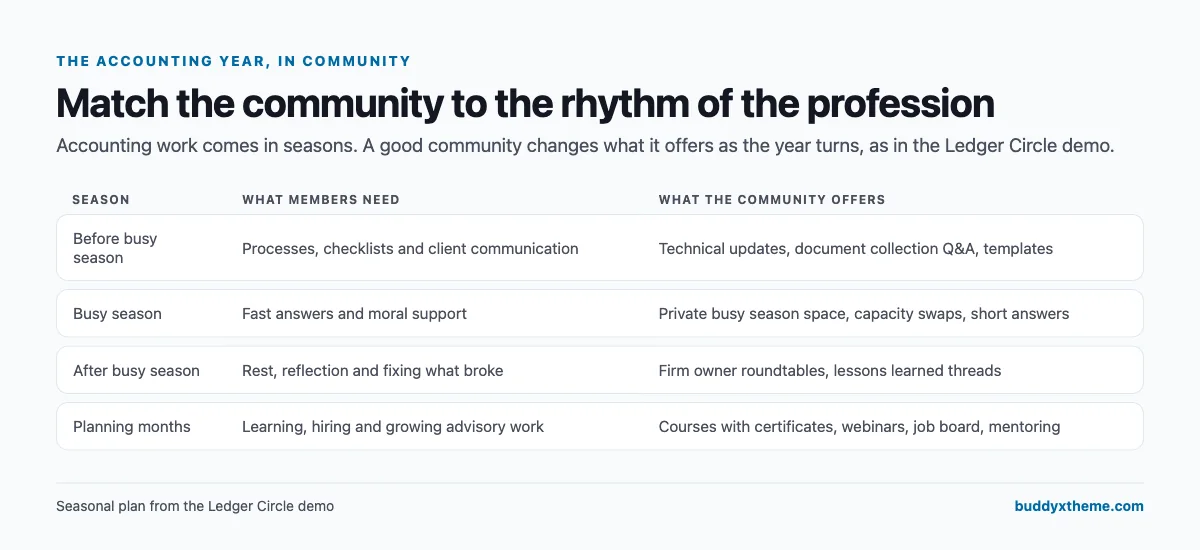
Before busy season, members want processes and templates. During it, they want fast answers and somewhere to vent. Afterwards, they want to reflect and fix what broke. In the planning months, they finally have time to learn, hire and grow their advisory work. Plan your events, courses and spaces around that rhythm.
From question to knowledge
Accounting communities answer the same questions year after year: document collection, notices, entity choices, payroll changes, engagement letters. A community that captures the answers once saves every future member time.
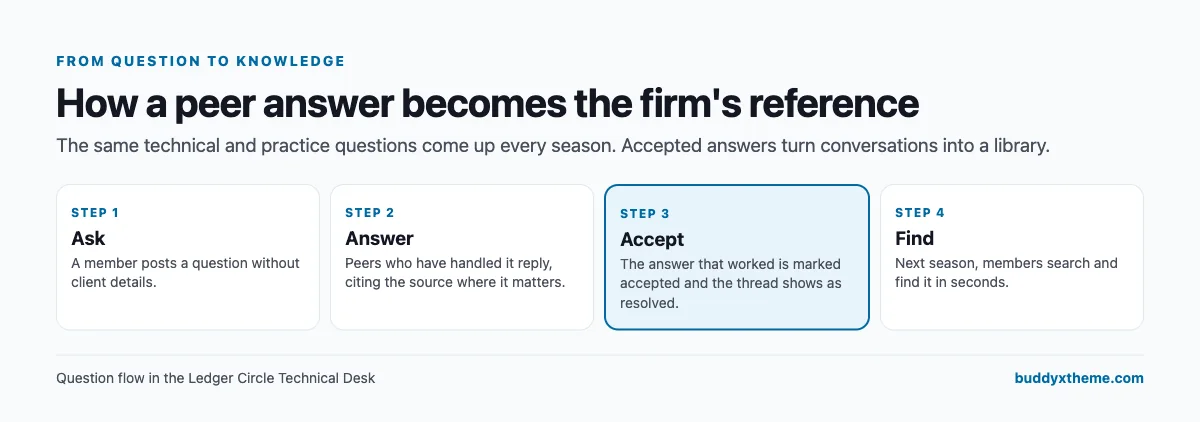
Encourage members to mark the answer that worked, to cite the source when a technical rule matters, and to search before asking. Over a few seasons, the Technical Desk becomes the first place members look.
Running a busy season space that helps
Busy season is when a community proves its worth or goes quiet. A few habits keep the space useful when members have the least time:
- Open it a few weeks early. Members join and set notifications before the rush, not during it.
- Keep posts short. One question, one screenshot with client details removed, one answer. Long debates move to the Technical Desk.
- Run a capacity thread. Firms with spare capacity add themselves; firms that are overloaded ask. Referrals happen between members, on their own terms.
- Pin a short list of trusted references. Members look up the source themselves; the community points them to it.
- Check in on people, not just work. A weekly “how are you holding up” post gets more replies than any webinar invitation in March.
- Close it with a lessons thread. When the season ends, ask what broke and what worked. Those answers become next year’s webinar topics.
Confidentiality and professional standards
| Practice | Why it matters |
|---|---|
| No client names or identifying details | Protects clients and members’ professional obligations |
| Peer experience, not formal advice | Members check the authoritative source before acting |
| Private groups for sensitive topics | Firm owners can discuss staff and scope candidly |
| Moderators who know the field | Questionable answers get corrected quickly |
| Clear rules for vendors and recruiters | Promotion stays in the directory and job board |
Questions to ask before you choose
- Will answers still be findable next year? Look for accepted answers and search, not just a feed.
- Can firm owners talk privately? Private or secret groups matter for honest conversations about staff and pricing approach.
- Does learning live in the same place as discussion? Courses, certificates and webinar recordings next to the Q&A keep members coming back.
- Can members refer work and find staff? A firm directory and job board make the community useful every week, not only during busy season.
- Who owns the member data? Training companies often depend on their member list; decide whether it lives on your domain or a hosted platform.
A 60-day launch plan
- Weeks one and two: structure. Create the Technical Desk, a Bookkeepers Lounge, a private Firm Owners Circle, Webinars and Learning, a Firm Directory and Start Here with the confidentiality rule.
- Weeks three and four: seed answers. Ask ten founding members to post and answer the questions they get most often, and mark accepted answers so the Technical Desk is useful on day one.
- Weeks five and six: first webinar. Run a technical update, post the recording and slides, and open the first course.
- Weeks seven and eight: referrals and jobs. Invite member firms to list their specialties, and open the job board to member firms.
Which software fits your accounting community?
| If you… | Choose |
|---|---|
| Want Q&A, firm owner groups, courses, a firm directory and jobs on your own domain | BuddyNext |
| Mostly need a searchable technical forum | Discourse |
| Want a support-style forum from an established vendor | Higher Logic Vanilla |
| Want a knowledge base and job board in a hosted product | Bettermode |
| Want a polished hosted community with courses and email | Circle |
| Run live webinars with replays | Heartbeat |
| Are a training company selling courses first | Kajabi |
| Want a branded app with groups and SSO | Disciple |
| Want an app-first network | Mighty Networks |
| Want the simplest paid group | Skool |
More community platform comparisons
Running a different kind of professional community? These guides use the same method: a working demo community and vendor claims checked at the source.
- Best platforms for a professional association community: chapters, committees, member directories and events.
- Best software for professional certification training: courses, exams and verifiable certificates.
- How to start a private professional association community: the step-by-step setup guide.
- Best software for a private business networking community: chapters, referrals and a member business directory.
- How to set up a community space on WordPress: the step-by-step setup guide behind every demo in this series.
How we built and checked this list
We built the Ledger Circle demo on a local WordPress site running BuddyNext, with fictional members, firms, questions, webinars, a course and jobs created for this guide. Every BuddyNext screenshot is from that demo. Competitor features were checked against each vendor’s own website in November 2026, and the employment and licensing figures come from the U.S. Bureau of Labor Statistics. We left out Hivebrite because its website could not be reached at the time of writing. Where we could not confirm a feature on a vendor’s own pages, the scorecard says “Not found” or “Not confirmed”. We did not run a hands-on trial of every product, so features can change; confirm anything critical with the vendor. buddyxtheme.com is published by the team behind BuddyNext, which is why BuddyNext is listed first; we have tried to be fair about its gaps as well as its strengths. Nothing in this guide is tax or accounting advice.
Frequently asked questions
What is the best software for an accounting professionals community?
BuddyNext is the best choice for a private accounting community you own, with a Technical Desk that marks accepted answers, private firm owner groups, busy season support, courses with certificates, webinars, a firm directory and a job board. Discourse is the strongest alternative if you mainly need a searchable technical forum.
How do I keep client information out of an accounting community?
Make confidentiality the first rule in Start Here, repeat it in sensitive spaces, use moderation and reporting, and train moderators to remove identifying details quickly.
Can an accounting community offer continuing education?
Yes. BuddyNext, Circle, Heartbeat, Kajabi, Bettermode and Skool support courses, and BuddyNext issues certificates of completion. Formal CPE credit tracking depends on your sponsor arrangements and usually needs a dedicated system.
Should firm owners have a separate space?
Yes. Firm owners discuss staff, scope and growth candidly only in a private group with controlled membership.
How do I make technical answers easy to find?
Use Q&A where the answer that worked is marked accepted, encourage members to search first, and link repeat questions to the accepted answer.
Can accounting firms post jobs in the community?
In BuddyNext, yes: member firms post roles on the built-in job board. Bettermode also lists a job board; most other platforms need a separate tool.
Is Discourse or BuddyNext better for accountants?
Discourse is excellent for technical forums. BuddyNext adds private firm owner groups, courses with certificates, events, a firm directory and a job board in the same community.
The bottom line
An accounting community earns its place when the answer to this year’s question is still there next year, when firm owners can speak freely, and when learning, referrals and hiring happen alongside the conversation. If you want all of that on your own domain, BuddyNext is the strongest foundation. If you mainly need a searchable forum, Discourse leads, with Higher Logic Vanilla and Bettermode as hosted alternatives.
And give accountants a place to answer each other.