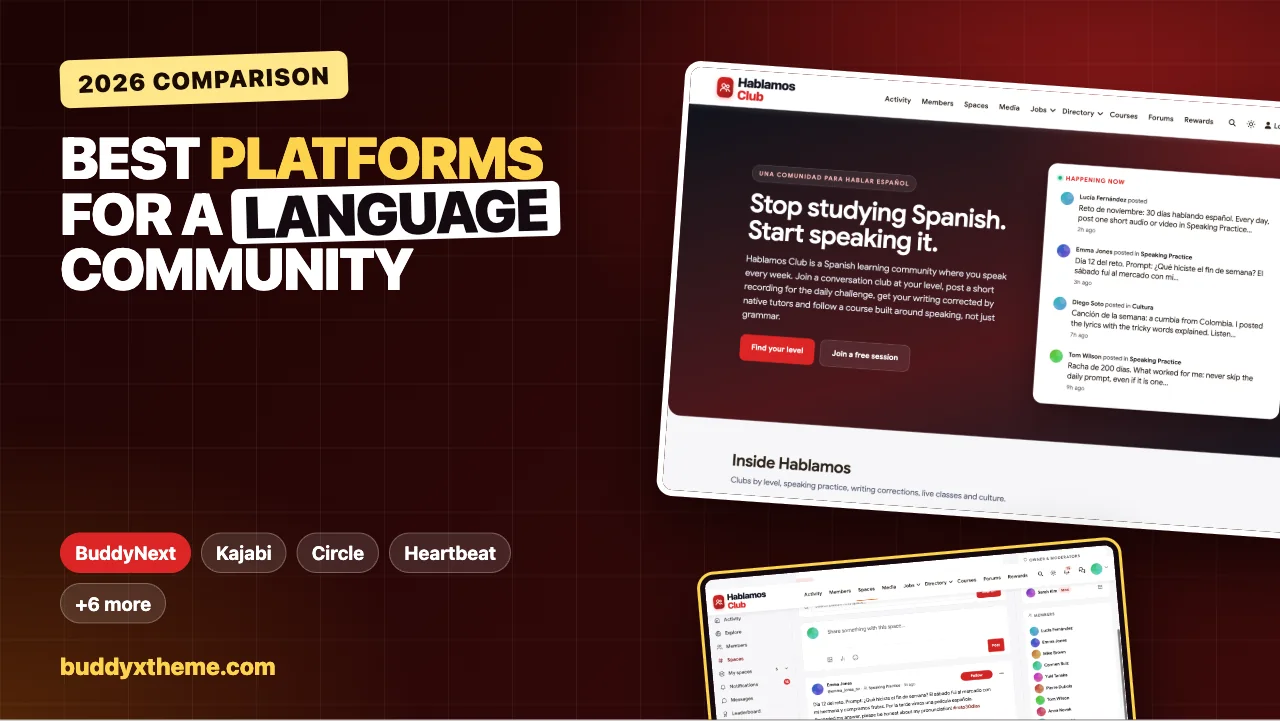
Most language learners do not quit because grammar is hard. They quit because they never speak. Apps teach vocabulary, courses explain the past tense, but the moment that changes everything is the first time a learner says five imperfect sentences out loud to a real person and gets a kind, useful correction. A paid language learning community exists to make that moment happen every day.
This guide compares the platforms you can use to run a paid language community as an independent teacher or small school: clubs by level, live conversation sessions across time zones, speaking practice with recordings, writing corrections, daily streaks and challenges, native tutors and a course to anchor it all. We built a working Spanish learning community for the first entry, checked every competitor claim against the vendor’s own pages in November 2026, and say plainly where each falls short for language teaching specifically.
Quick answer
If you want a paid language community you own and control, BuddyNext is the strongest choice: a private club for each level, a speaking practice space where learners post audio and video, writing corrections with accepted answers, live conversation sessions in several time zones, daily challenges, streaks and leaderboards, level courses with drip release, and paid memberships, all on your own WordPress site. Kajabi and Circle are the most complete hosted platforms, Heartbeat suits live-first clubs, LearnWorlds is strongest for structured level courses, and Discord works for live voice practice but not as a business.
In this guide
- What a language community needs that other communities do not
- Your own community or a tutor marketplace?
- The language community scorecard
- 1. BuddyNext: best for a paid language community you own
- 2. Kajabi: best hosted all-in-one for language courses and coaching
- 3. Circle: best for a polished community with live rooms and gamification
- 4. Heartbeat: best for live-first conversation clubs
- 5. LearnWorlds: best for structured level courses
- 6. Skool: best for a simple single-level club with strong gamification
- 7. Thinkific: best for selling language courses with a community add-on
- 8. Podia: best for a teacher selling a few courses with a simple community
- 9. Mighty Networks: best for an app-first community with courses
- 10. Discord: best for live voice practice
- A week of practice that keeps learners speaking
- Placing new learners at the right level
- Running conversation clubs
- Which platform fits your language community?
- More community platform comparisons
- How we built and checked this list
- Frequently asked questions
- The bottom line
What a language community needs that other communities do not
Language learning has a few needs most community platforms were not designed for:
| Need | Why it matters for languages | What the platform needs |
|---|---|---|
| Levels | An A2 learner and a B2 learner need different conversations | A private group per level, courses by level |
| Speaking practice | Speaking is the skill learners avoid and need most | Audio and video posts, voice messages |
| Corrections | Learners want to know exactly what to fix | Threads where tutors correct and the best correction is marked |
| Live conversation | Real-time speaking builds confidence | Live sessions in small groups, recordings |
| Time zones | Learners are spread across the world | Sessions at several times, events in each learner’s time |
| Daily habit | Little and often beats long and rare | Daily prompts, streaks, challenges |
| Native tutors | Learners want natural language and culture | Roles for tutors, tutor visibility |
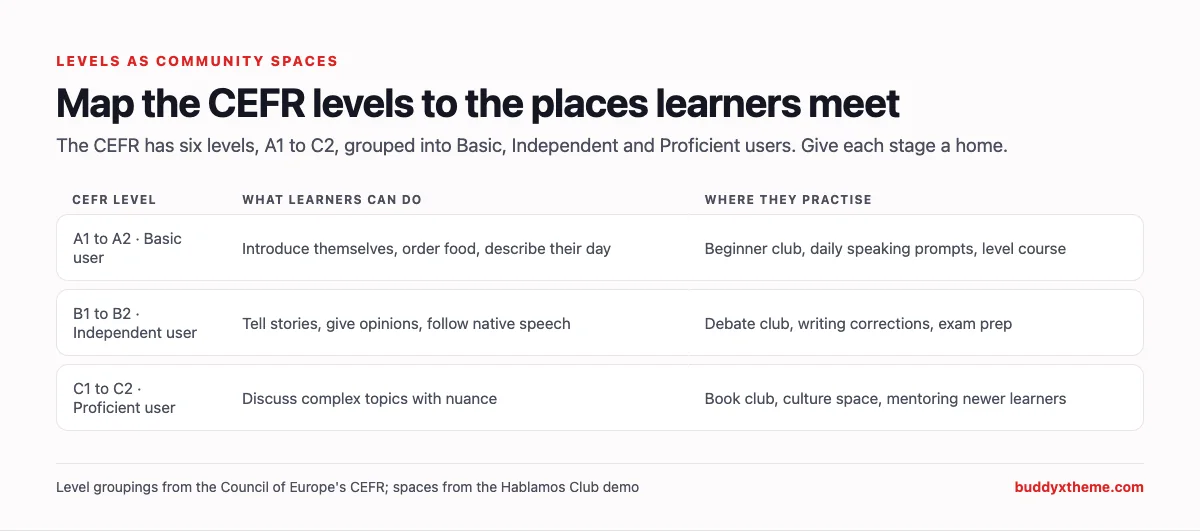
The levels themselves have a shared standard. The Council of Europe’s Common European Framework of Reference for Languages (CEFR) “organises language proficiency in six levels, A1 to C2, which can be regrouped into three broad levels: Basic User, Independent User and Proficient User,” and “the levels are defined through ‘can-do’ descriptors” (Council of Europe). Organising your community around those levels makes it easy for learners to find their place.
Your own community or a tutor marketplace?
Many teachers start on tutor marketplaces such as Preply, which invites teachers to “make a living by teaching the largest community of learners worldwide” and states, “we only charge a commission for the lessons that you have taught” (Preply). Marketplaces bring students quickly, but the platform owns the relationship and takes a share of every lesson.
A paid community is the opposite trade-off: you bring the learners, and in return you own the relationship, set your own membership and can serve many learners at once through clubs, challenges and courses instead of one lesson at a time. Many teachers use both: one-to-one lessons on a marketplace, and a paid community for group practice that keeps learners speaking between lessons.
The language community scorecard
How each platform handles what matters most. “Not found” means we could not confirm it on the vendor’s own pages, not that it is impossible.
| Platform | Groups by level | Speaking practice | Live sessions | Accountability | Level courses | Hosting |
|---|---|---|---|---|---|---|
| BuddyNext | Private spaces | Audio and video posts, voice messages | Events in several time zones, recordings | Challenges, streaks, leaderboards | Drip, quizzes, certificates | Self-hosted |
| Kajabi | Private channels, tiers | Rich media posts | Built-in live room | Leaderboard, challenges | Drip, quizzes, cohorts | Hosted |
| Circle | Spaces, access groups | Rich media posts | Live rooms and streams, replays | Points, badges, levels | AI-assisted courses | Hosted |
| Heartbeat | Channels, tiers | Live voice and video rooms | Live events, recordings | Not found | Drip, cohort, quizzes | Hosted |
| LearnWorlds | Not confirmed | Not found | Zoom, Webex, Teams | Not confirmed | Prerequisites, drip | Hosted |
| Skool | One group per community | Not found | Live calls | Points, levels, leaderboards | Unlock rules | Hosted |
| Thinkific | Private spaces | Video posts in app | Zoom | Not found | Quizzes, certificates | Hosted |
| Podia | Spaces by tier | Not found | Not confirmed | Not found | Drip, quizzes | Hosted |
| Mighty Networks | Spaces | Not confirmed | Not confirmed | Not confirmed | Courses | Hosted |
| Discord | Channels | Live voice | Live voice and video | Not found | None | Hosted |
1. BuddyNext: best for a paid language community you own
BuddyNext is a complete community platform that runs on your own WordPress site. Private and secret spaces, Q&A with accepted answers, audio and video uploads, direct messages including voice messages, events with RSVPs, courses with drip release and certificates, polls, points, challenges and streaks all work together, so clubs, practice, corrections and courses live in one place.
To show it in context, we built Hablamos Club, a demo Spanish learning community run by a teacher in Valencia, with 20 fictional members: learners from A1 to B2 in more than a dozen countries, three native tutors from Spain and Colombia, and a community manager.
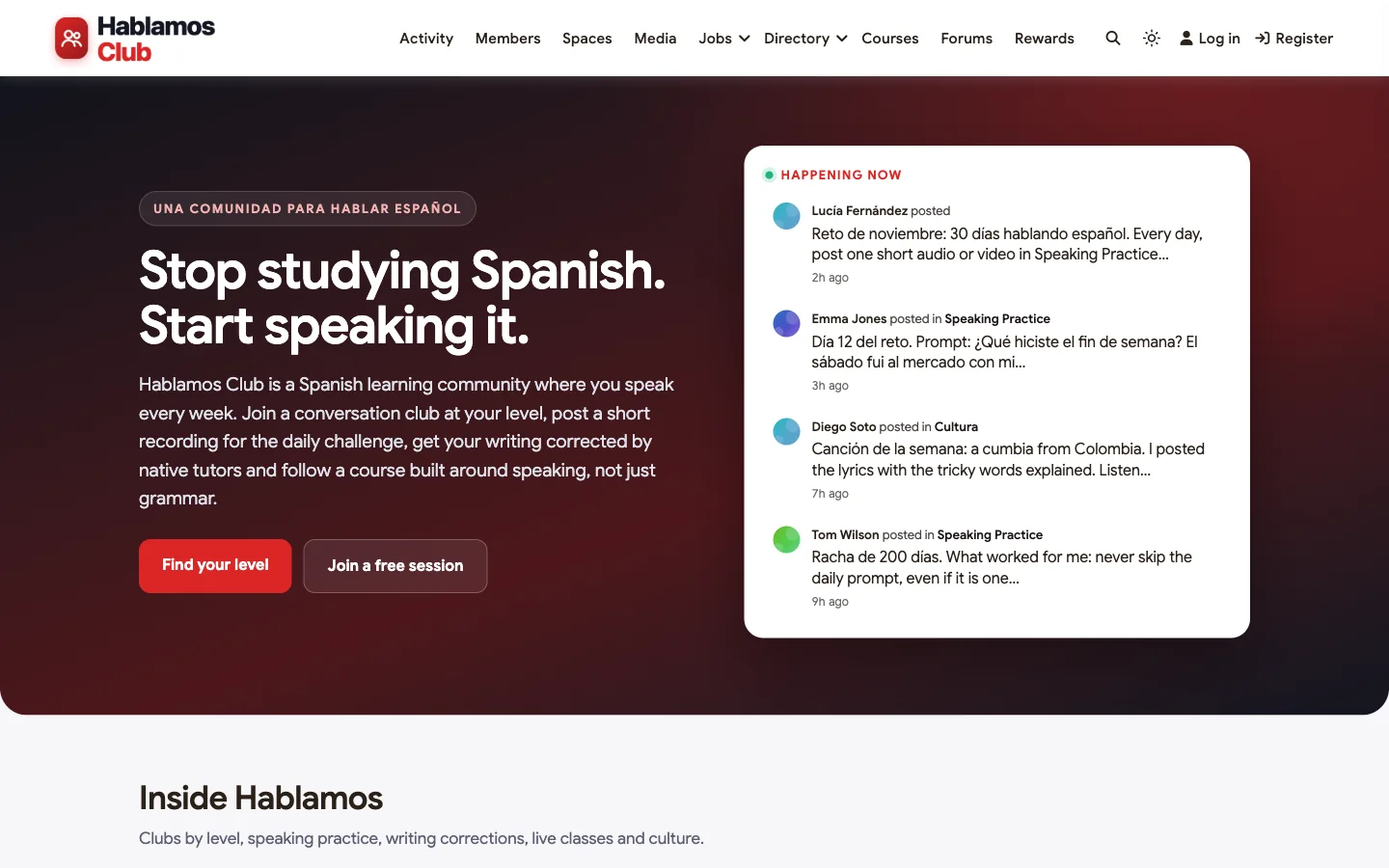
Good at: getting learners speaking every day, level-based clubs, corrections that stay findable, and owning the learner relationship.
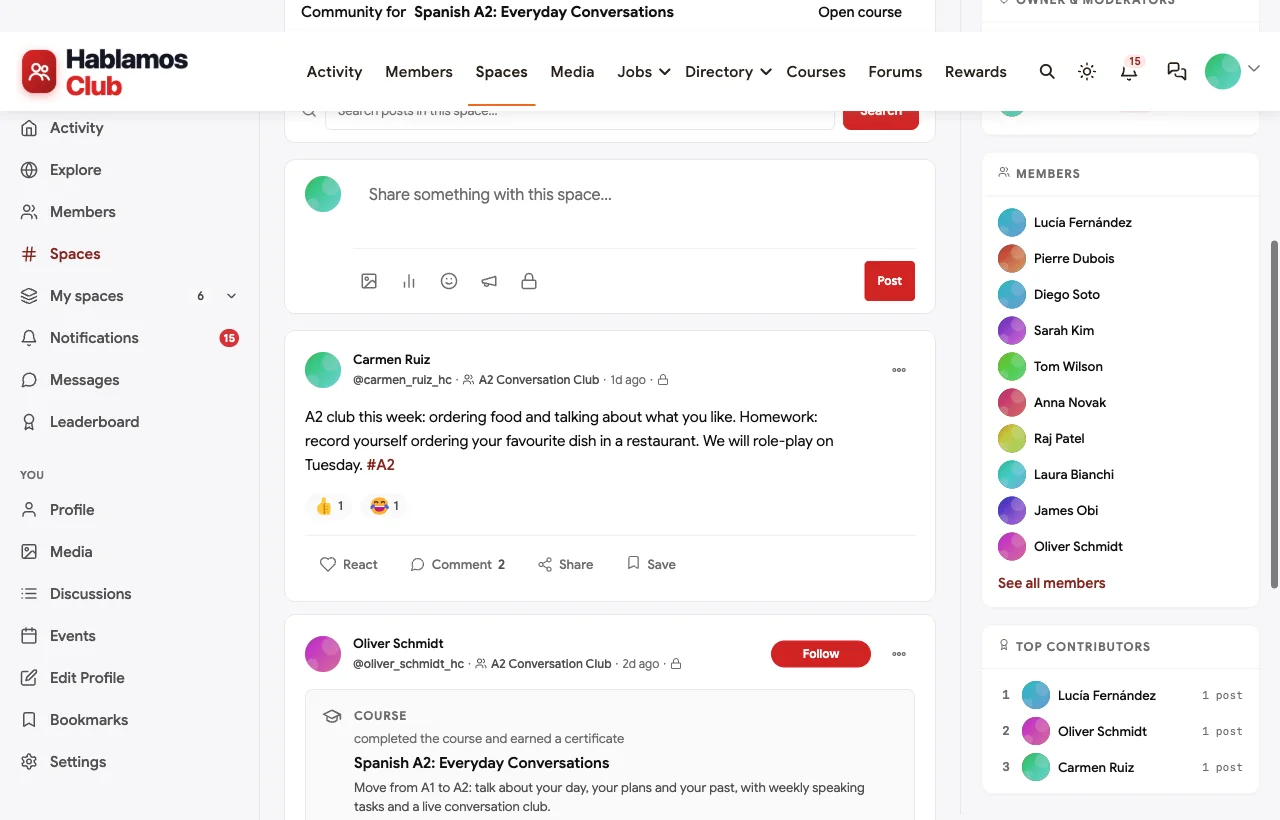
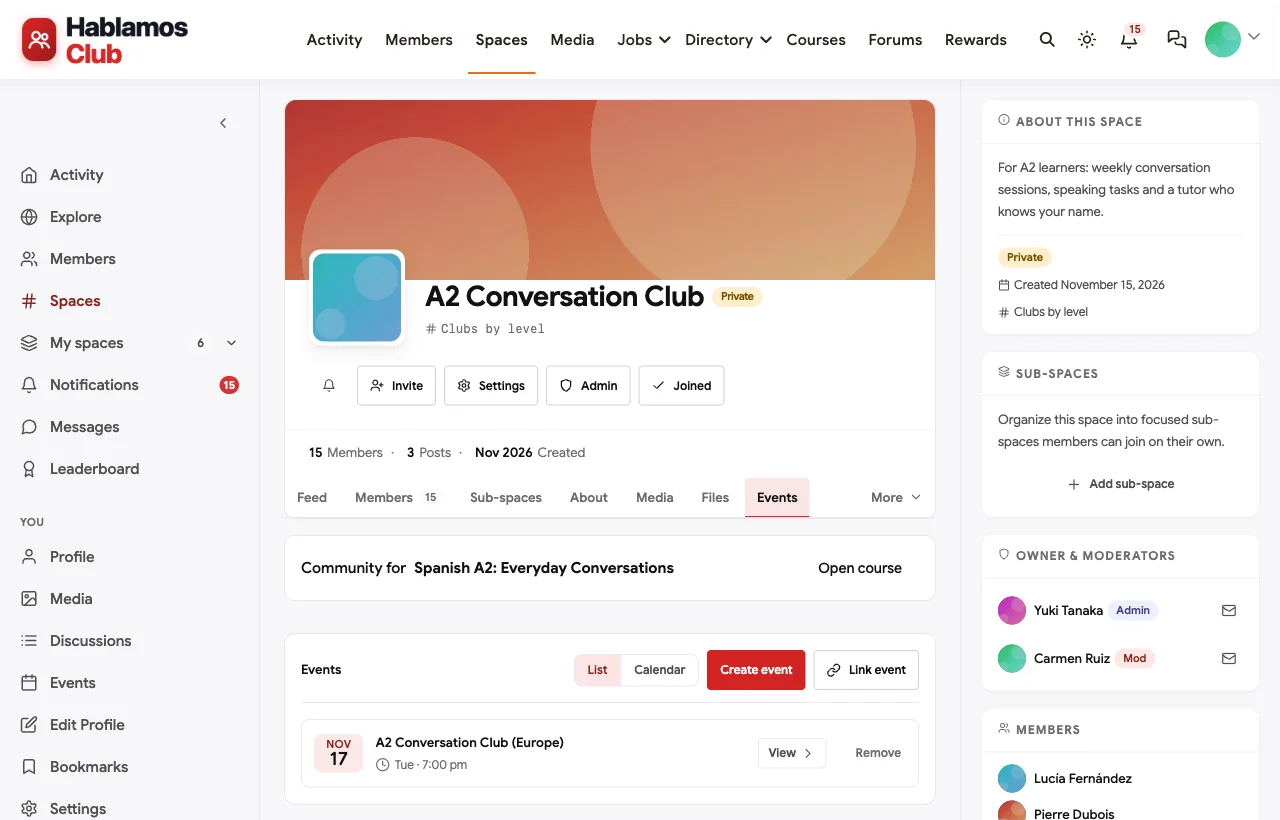
A private club for each level. Learners join the conversation club for their level, where tutors post the week’s topic and homework. In the demo, the A2 club practises ordering food, with a recording as homework and a role-play in Tuesday’s session:
Speaking practice. A daily prompt in the Speaking Practice space asks a simple question. Learners answer with a short audio or video recording, and tutors reply with one correction and one compliment. In the demo, a learner on day twelve of the monthly challenge gets a stress correction on “película” and praise for her past tense:

Audio and video uploads come from the platform’s media module, which also supports voice messages in direct messages, so a tutor can send a quick pronunciation note privately.
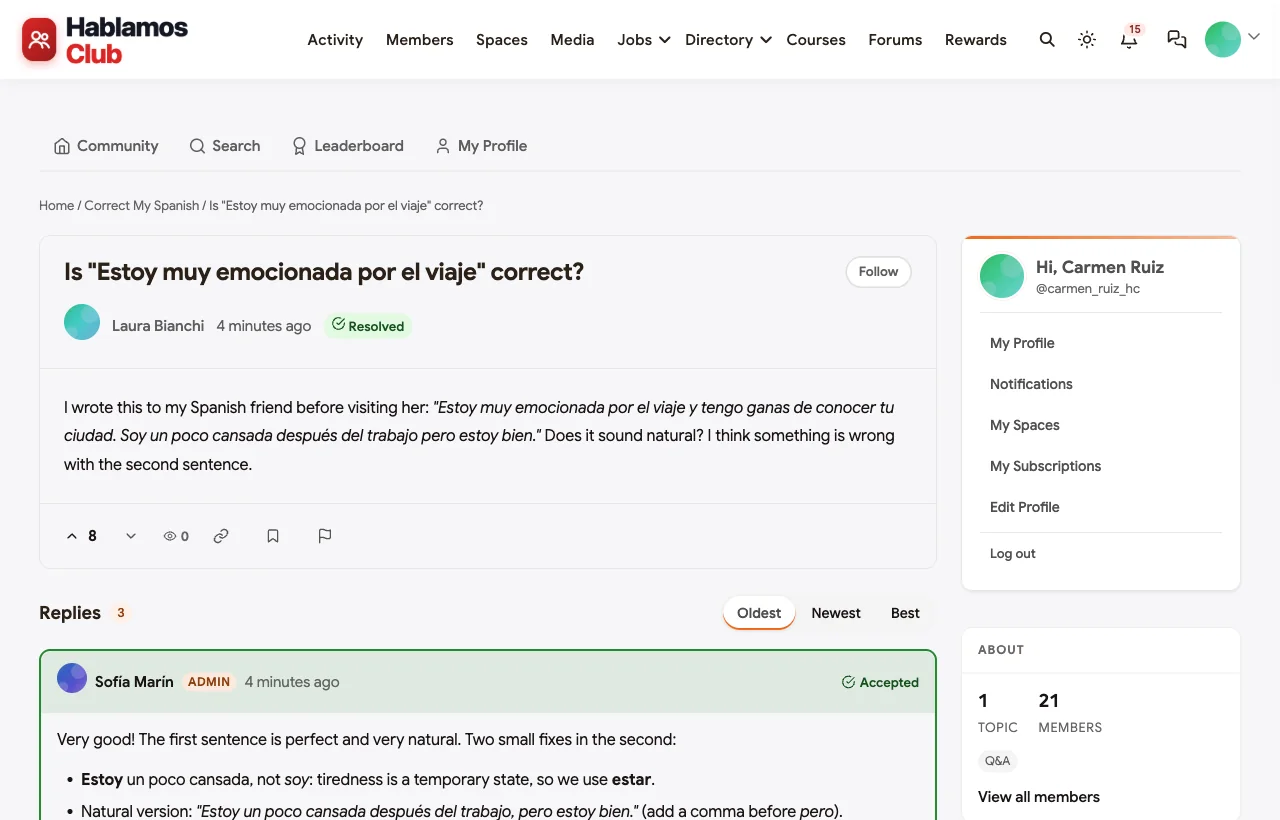
Writing corrections with accepted answers. Learners post sentences they wrote in Correct My Spanish, and tutors explain what to fix. The most helpful correction is marked accepted, so the next learner with the same mistake finds it. In the demo, an Italian speaker learns why it is “estoy cansada,” not “soy cansada”:
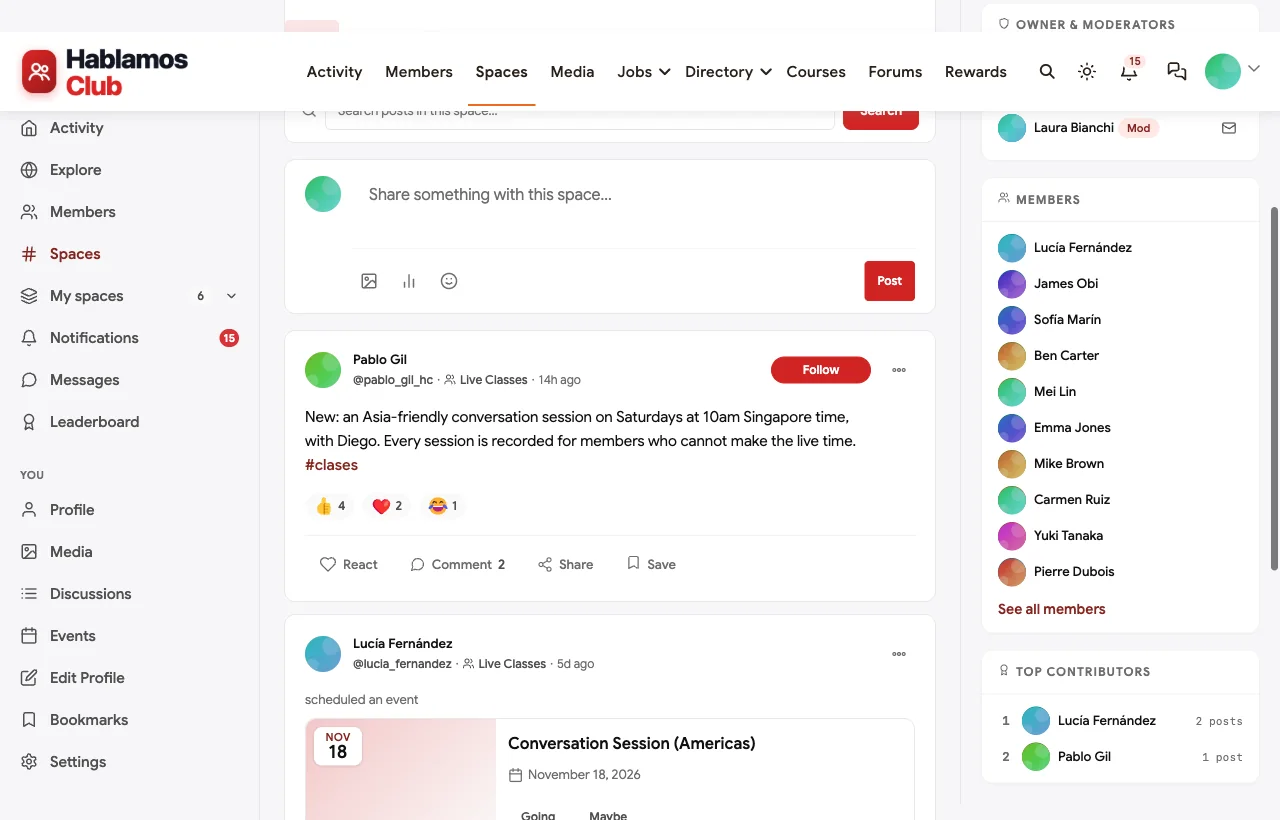
Live sessions in several time zones. Conversation sessions are events with RSVPs and reminders, scheduled for Europe, the Americas and Asia, with recordings posted for members who cannot make the live time:

Daily habits: challenges, streaks and leaderboards. A monthly challenge (“30 days speaking Spanish”) gives everyone a finish line, streaks reward showing up every day, and the leaderboard celebrates the most active learners, not the most advanced:

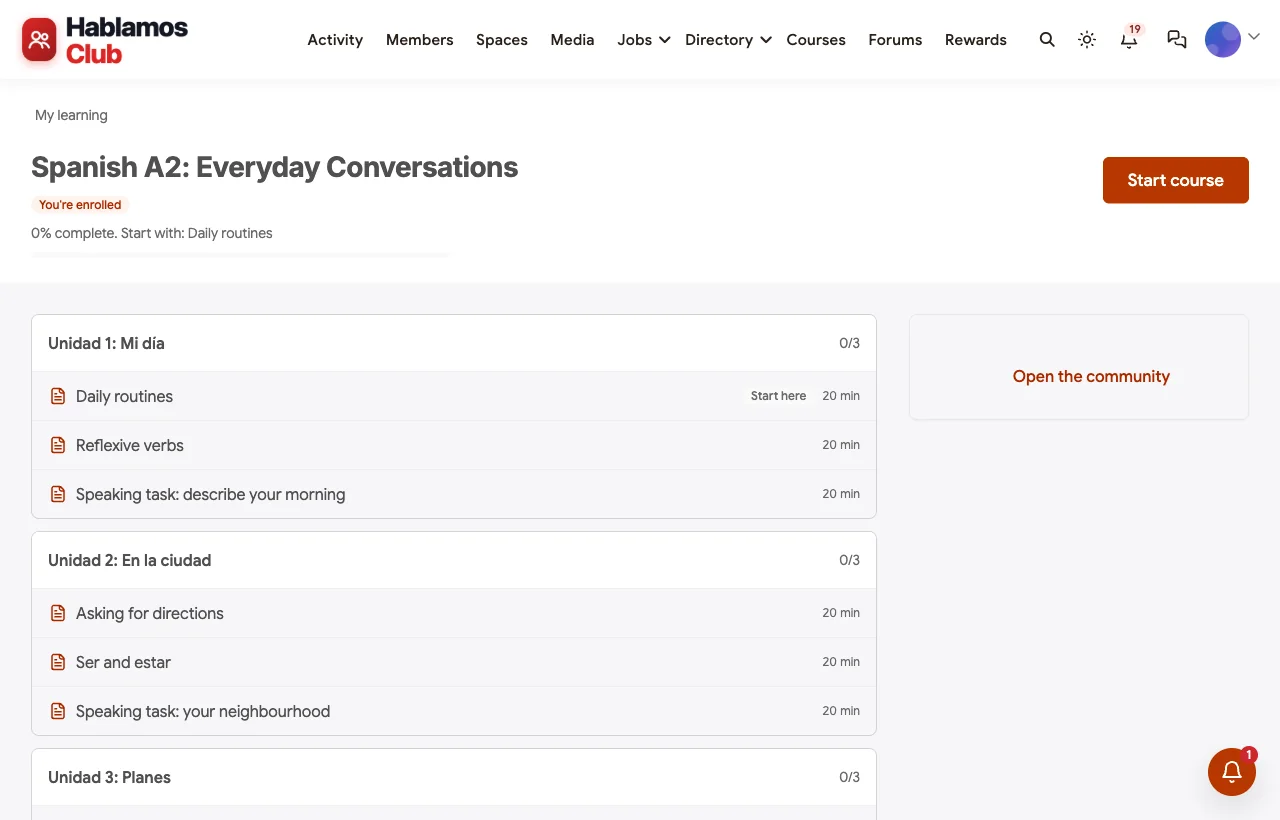
A course to anchor each level. The Spanish A2 course has six units, each ending with a speaking task the learner records and shares with their club. Lessons can be released week by week, with quizzes and a certificate on completion:
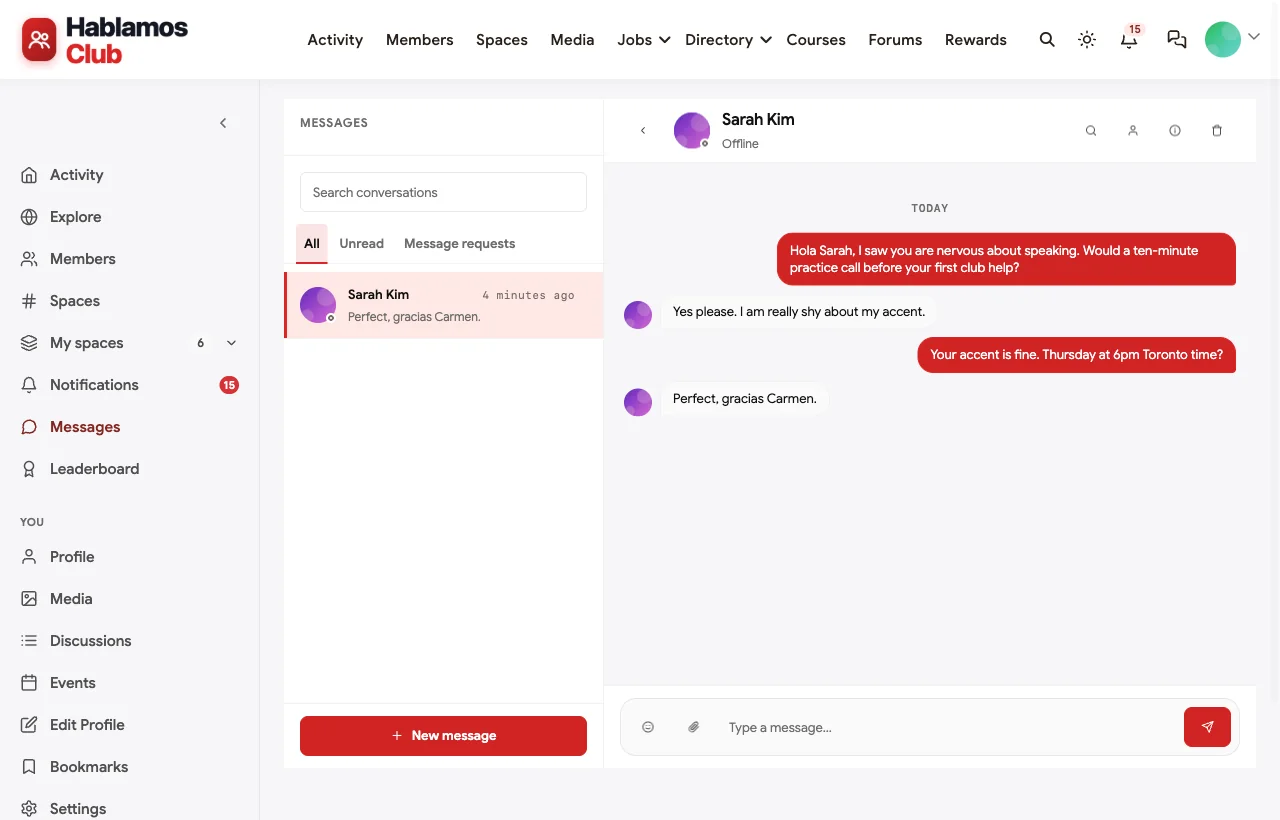
Culture and belonging. A Cultura space for music, films and recipes, an introductions space where learners post in Spanish at any level, and tutors who message nervous beginners before their first session:
Also built in. Polls in the target language (the demo asks which skill is hardest), member profiles, a searchable directory, notifications, paid memberships with trials, and a mobile layout that works without an app download.
Not built for: booking and paying for individual one-to-one lessons with tutors, or automated pronunciation scoring; use a booking tool or marketplace for private lessons and the community for everything around them. It is self-hosted, so you run WordPress or use a managed host.
What’s included, and how it is delivered
BuddyNext is one platform made of a core and add-on platform modules. Everything shown in the demo above runs on the BuddyNext platform. This table shows which parts come with the core, which are platform modules you install and activate alongside it, and which need a third-party plugin, another system or custom work.
| Capability | How it is delivered |
|---|---|
| Open, private and secret spaces | Core platform |
| Member profiles and searchable member directory | Core platform |
| Direct messages | Platform module, installed alongside |
| Activity feed, pinned announcements and hashtags | Core platform |
| Polls | Core platform |
| Audio and video uploads, voice messages | Platform module, installed alongside |
| Q&A with accepted answers | Platform module, installed alongside |
| Courses with drip release, quizzes and certificates | Platform module, installed alongside |
| Events with RSVPs, online or in person | Platform module, installed alongside |
| Challenges, streaks, points and leaderboards | Platform module, installed alongside |
| Paid plans with trials and coupons | Platform module, installed alongside |
| One-to-one lesson booking | Third-party booking tool |
| Live video classes | Third-party video tool (Zoom, Google Meet) |
Want to click around yourself? The Hablamos Club community in this guide was built on a private test site, so it is not public. The BuddyNext live demo is a general community you can open in your browser and explore without installing anything.
2. Kajabi: best hosted all-in-one for language courses and coaching
Kajabi is “the operating system for human expertise” (Kajabi). For language teachers it offers drip scheduling “on a specific date or a set number of days after purchase,” quizzes anywhere in a course, automatic certificates, and “Cohort Courses (scheduled groups that progress through material together, with live video sessions)” (Kajabi). Its communities include “a leaderboard and gamification settings that reward members for participation,” “challenges to drive participation,” private or tiered spaces, and meetups, which it describes as “scheduled virtual events with a built-in live room” (Kajabi).
Strengths for languages: courses, cohorts, live rooms, challenges and a leaderboard in one hosted product, with a branded app option.
Gaps: we found no audio posts or voice messages for speaking practice, no streaks and no correction workflow.
3. Circle: best for a polished community with live rooms and gamification
Circle helps you “build a home for your community, events, and courses, all under your own brand” (Circle). Its live rooms host “smaller, more interactive discussions” with camera and microphone, ideal for conversation groups, and replays come with “searchable transcripts and automated summaries” (Circle events). Gamification with points, badges, leaderboards and levels is available “on all plans” (Circle), and paid memberships use access groups for tiers.
Strengths for languages: native live rooms for small conversation groups, replays, and gamification on every plan.
Gaps: speaking practice is limited to rich media posts, with no confirmed voice messages; a branded app is reserved for the top tier.
4. Heartbeat: best for live-first conversation clubs
Heartbeat brings “memberships, courses, events, and payments” together (Heartbeat). It offers live video events with “automatic recordings and replays,” “recurring series and office hours,” native voice and video rooms, evergreen, drip and cohort-based courses with quizzes, tier-based access to “different events, courses, discussions,” a branded web and mobile app, and community data export on all plans (Heartbeat pricing).
Strengths for languages: recurring live sessions with recordings, voice rooms for conversation, courses and data export.
Gaps: no streaks, points or challenges found, and no asynchronous audio posts for daily practice.
5. LearnWorlds: best for structured level courses
LearnWorlds is “the #1 AI-powered LMS built for learning businesses” (LearnWorlds). It offers “sequential navigation, navigation with prerequisites, completion rules and drip feed to control lesson access and pacing,” which suits gating learners from one level to the next (LearnWorlds). Live sessions run through “Zoom, Webex, Microsoft Teams, and Calendly,” with recordings turned into course activities (LearnWorlds), and a built-in community includes discussion forums and peer feedback.
Strengths for languages: the strongest level progression and prerequisites, assessments and certificates.
Gaps: the community is forum-first, with no confirmed audio posts; live classes depend on an outside video tool.
6. Skool: best for a simple single-level club with strong gamification
Skool lets you “build your own community, courses, and events” with “unlimited live calls,” and its gamification includes points, levels and leaderboards (Skool). Courses support unlock rules.
Strengths for languages: simple setup and gamification that motivates daily participation.
Gaps: one flat community per group, so separate clubs by level are hard; no confirmed audio posts.
7. Thinkific: best for selling language courses with a community add-on
Thinkific offers quizzes, assignments and certificates, course content including audio, live lessons with Zoom on every plan, and community spaces “open to all members or kept private for select groups” (Thinkific). Its branded mobile app lets learners “post with videos or multiple files” in community spaces (Thinkific).
Strengths for languages: strong course selling, private spaces per level and video posts from the app.
Gaps: its learning communities page has no points, badges, streaks or leaderboards, which matters for daily habits; live classes depend on Zoom.
8. Podia: best for a teacher selling a few courses with a simple community
Podia brings “your courses, community, coaching, and email” together (Podia). Courses can “drip lessons out over time, add quizzes and downloads,” and the community supports paid memberships, spaces “by topic, tier, or however you’d like,” group chats and direct messages (Podia community).
Strengths for languages: simple courses with drip and quizzes, spaces by level, and built-in email.
Gaps: no gamification or audio posts found, and live sessions were not confirmed on the pages we checked.
9. Mighty Networks: best for an app-first community with courses
Mighty Networks promises “Community. Courses. Events.” where members “meet each other, build relationships, and return every week” (Mighty Networks), with unlimited spaces on iOS, Android and web.
Strengths for languages: an app-first experience and unlimited spaces for levels.
Gaps: we could not confirm live session, speaking practice or accountability features on the pages we could access; a fully branded app is reserved for Mighty Pro.
10. Discord: best for live voice practice
Discord lets members “text, call, video chat, and play games, all in one group chat” (Discord). Live voice channels are a natural fit for drop-in conversation practice.
Strengths for languages: excellent live voice for real-time conversation.
Gaps: positioned around gaming; no courses, levels, gamified practice or custom domain, and we could not confirm its paid server subscription terms on its own pages.
A week of practice that keeps learners speaking
Whatever platform you choose, a simple rhythm turns a membership into a habit:
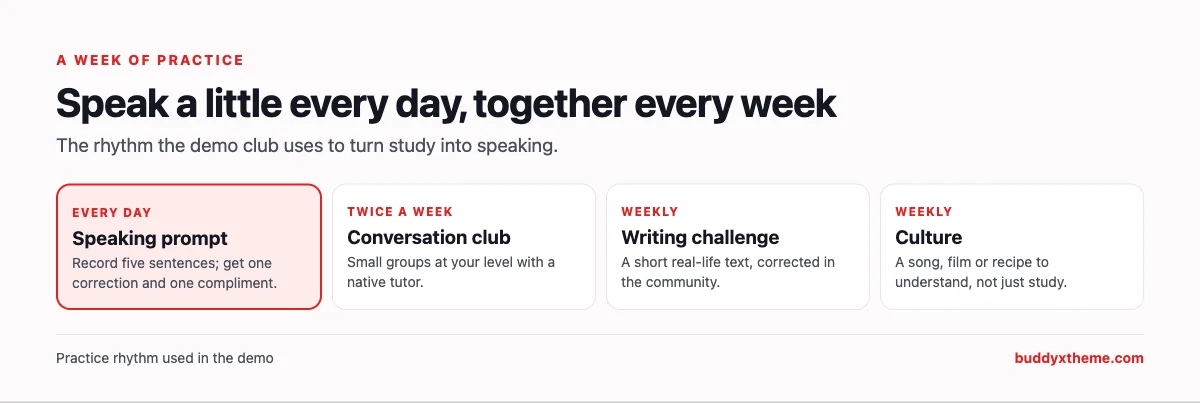
Habits that work in a language community:
- One prompt a day, five sentences. Small enough for a beginner, useful enough for an advanced learner.
- One correction and one compliment. Learners keep posting when feedback is specific and kind.
- Sessions in more than one time zone. In the demo, an Asia-friendly Saturday session brought in learners who had only watched recordings.
- Mark the correction that helped. The same mistakes come up every month; accepted corrections become a searchable library.
- Celebrate consistency, not level. A 200-day streak deserves more applause than a perfect test score.
- Make culture part of it. A song of the week or a recipe gives learners a reason to use the language outside the club.
Placing new learners at the right level
The first week decides whether a new member stays. A learner placed too high goes quiet; one placed too low gets bored. A simple placement flow works on any platform:
- Ask three can-do questions at sign-up. “Can you introduce yourself and your family?”, “Can you describe what you did last weekend?”, “Can you give your opinion on a news story?” Each maps roughly to A2, B1 and B2.
- Ask for a 60-second voice recording. A tutor listens and confirms the level within a day.
- Invite them to one club, not all of them. Fewer choices make the first post easier.
- Check in after two weeks. Move learners up or down a club without making it feel like a test.
In the demo, the Start Here space holds the placement prompt, and tutors reply with a welcome and a club recommendation.
Running conversation clubs
| Practice | Why |
|---|---|
| Groups of four to six per tutor | Everyone speaks several times in a session |
| A topic and a task posted beforehand | Nervous learners can prepare a few sentences |
| Separate clubs by level | Beginners need patience; advanced learners need challenge |
| A recording for every session | Learners in other time zones still benefit |
| A shy learner’s first session, prepared | A short private call before the first club keeps beginners from quitting |
Which platform fits your language community?
| If you… | Choose |
|---|---|
| Want clubs by level, speaking practice, corrections and courses in one place you own | BuddyNext |
| Want a hosted all-in-one with courses, live rooms and challenges | Kajabi |
| Want polished live rooms and gamification on every plan | Circle |
| Run live-first conversation clubs with recordings | Heartbeat |
| Need strict level progression with prerequisites | LearnWorlds |
| Run a single club and want simple gamification | Skool |
| Sell language courses with a community on the side | Thinkific or Podia |
| Want an app-first community | Mighty Networks |
| Only need live voice practice | Discord |
More community platform comparisons
Running a different kind of learning community? These guides use the same method: a working demo community and vendor claims checked at the source.
- Best platforms for a private book club community: next-book votes, chapter threads and hybrid meetings.
- Best platforms for an online tutoring community: study groups, homework help, parent updates and group sessions.
- Best platforms for cohort-based learning: live, dated courses with peer pods and feedback.
- Best software for an online course community: course creators who want learners to finish.
- Best platforms for a paid coaching membership community: coach-led memberships with group calls.
- How to create a paid fitness community with groups and challenges: daily challenges, streaks and leaderboards step by step.
- How to set up a community space on WordPress: the step-by-step setup guide behind every demo in this series.
How we built and checked this list
We built the Hablamos Club demo on a local WordPress site running BuddyNext, with fictional learners, tutors, clubs, a course, corrections and events created for this guide. Every BuddyNext screenshot is from that demo. Competitor features were checked against each vendor’s own website, help center or pricing page in November 2026, and the CEFR description comes from the Council of Europe. Where we could not confirm a feature on a vendor’s own pages, the scorecard says “Not found” or “Not confirmed”; several vendors’ feature and help pages could not be reached at the time of writing. We did not run a hands-on trial of every competitor, so features can change; confirm anything critical with the vendor. buddyxtheme.com is published by the team behind BuddyNext, which is why BuddyNext is listed first; we have tried to be fair about its gaps as well as its strengths.
Frequently asked questions
What is the best platform for a paid language learning community?
BuddyNext is the best choice for a language community you own, with private clubs by level, speaking practice with audio and video, writing corrections with accepted answers, live sessions in several time zones, challenges and streaks, and level courses on your own WordPress site. Kajabi and Circle are the strongest hosted alternatives.
How do I organise a language community by level?
Use the CEFR levels, A1 to C2, as your structure: a private club for each level or pair of levels, a placement check when learners join, and a course for each level. Learners move to the next club when they complete the level.
How can learners practise speaking in a community?
Post a daily prompt and ask learners to answer with a short audio or video recording. Tutors reply with one correction and one compliment. Add live conversation sessions in small groups for real-time practice.
Should I use a tutor marketplace or my own community?
Marketplaces bring students quickly but take a commission and own the relationship. Your own community lets you serve many learners at once and keep the relationship. Many teachers use both.
How do I handle learners in different time zones?
Run live sessions at two or three times, for example Europe, the Americas and Asia, and post every recording for members who cannot attend live.
How do I keep learners practising every day?
Use a daily prompt, a monthly challenge with a clear finish line, streaks and a leaderboard that rewards activity rather than level. Recognise consistency publicly.
Can I sell language courses and a membership together?
Yes. BuddyNext, Kajabi, Thinkific, Heartbeat and Podia support courses and paid memberships. Many teachers include the level course in the membership and sell one-to-one lessons separately.
Do I need a mobile app?
Learners practise on their phones, so the community must work well on mobile. BuddyNext works in the mobile browser without an app download; Kajabi, Circle, Heartbeat and Thinkific offer branded apps, often on higher plans.
The bottom line
A paid language community works when learners speak a little every day and together every week, at their level, with tutors who correct kindly and specifically. If you want clubs by level, speaking practice, corrections, live sessions and courses on your own domain, with your own learner relationships, BuddyNext is the strongest foundation. If you prefer a hosted platform, Kajabi and Circle lead, with Heartbeat for live-first clubs and LearnWorlds for structured level courses.
And give your learners a place to speak, not just study.