Most universities already have an alumni network on paper: a database of graduates, a magazine, a giving page and a LinkedIn group that someone set up years ago. What most do not have is a place where graduates actually talk to each other, find mentors, hear about jobs and show up for homecoming because a classmate asked them to. That gap is what alumni network software is meant to close.
This guide compares the software you can use to build that place, from dedicated advancement suites to general community platforms and the free social groups many alumni offices start with. We built a working alumni network for the first entry so you can see what it looks like with real spaces, chapters, jobs and events, checked every competitor claim against the vendor’s own pages in November 2026, and say plainly where each option falls short.
Quick answer
If you want a university alumni network you own and control, BuddyNext is the strongest choice: private class-year spaces, city chapters, a mentoring circle, an alumni jobs board, homecoming and chapter events, direct messages and a searchable member directory all run on your own WordPress site. Graduway (Gravyty), Hivebrite and PeopleGrove are the leading hosted alumni suites, Almabase suits advancement teams focused on giving and events, and LinkedIn or Facebook groups are free but give you no data and no control.
In this guide
- What an alumni network actually has to do
- What the research says about alumni engagement
- Advancement suite, community platform or social group?
- The alumni software scorecard
- 1. BuddyNext: best for an alumni network you own
- 2. Graduway (Gravyty): best for structured mentoring at large institutions
- 3. Hivebrite: best for very large networks with many clubs and chapters
- 4. PeopleGrove: best for career services and student-to-alumni mentoring
- 5. Almabase: best for advancement teams focused on events and giving
- 6. Glue Up: best for alumni associations run as dues-paying chapters
- 7. Circle: best for a modern, general-purpose community
- 8. Mighty Networks: best for a branded app with structured engagement
- 9. LinkedIn Groups: best as a free, low-effort starting point
- 10. Facebook Groups: best for informal class-year chatter
- Alumni network software compared
- Structuring the network: the spaces most alumni communities need
- The first 90 days: launching an alumni network that does not go quiet
- Data, privacy and ownership: questions to ask before you sign
- Which software fits your alumni network?
- More community platform comparisons
- How we built and checked this list
- Frequently asked questions
- The bottom line
What an alumni network actually has to do
An alumni network is not one feature. It is a set of jobs that the alumni office, career services and the advancement team all care about for different reasons. Before comparing software, it helps to name those jobs:
- Help graduates find each other. A directory people can search by class year, city, industry or employer, with profiles alumni keep up to date themselves.
- Give every cohort and chapter a home. Class-year spaces for reunions, city chapters for local meetups, affinity groups for shared interests, and a private space for volunteers and the alumni board.
- Connect students with alumni. Mentoring, informational interviews and career advice, which is usually the feature students and recent graduates value most.
- Share opportunities. Jobs and internships posted by alumni who are hiring, with alerts so people actually see them.
- Bring people back. Homecoming, reunions, chapter drinks, online career panels and lectures.
- Keep the institution in the loop. Updated contact details, engagement data and, eventually, support for fundraising.
Different software is built around different jobs on that list. Advancement suites start from job 6 and work outwards. Community platforms start from jobs 1 to 5. Free social groups do a little of job 2 and nothing else. Most of the disagreement about “the best alumni platform” comes from people valuing different jobs.
What the research says about alumni engagement
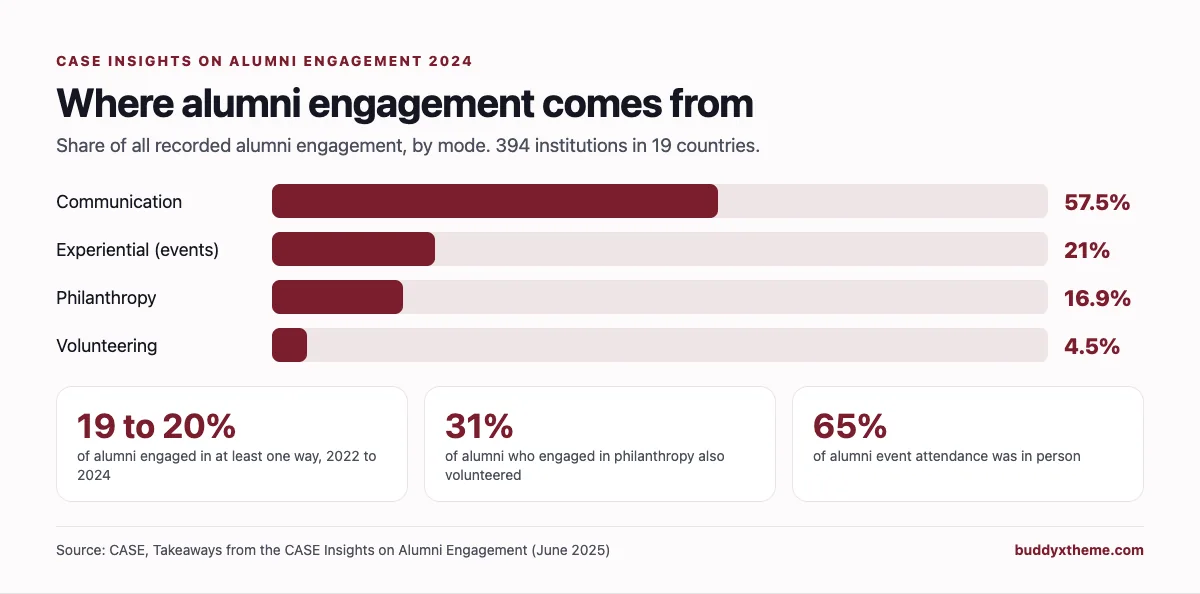
The Council for Advancement and Support of Education (CASE) runs the largest benchmark of alumni engagement. Its 2024 survey covered 394 institutions in 19 countries, and found that the share of alumni engaged in at least one way has held steady at 19 to 20% from 2022 to 2024 (CASE). Four in five graduates, in other words, do not engage with their institution at all in a given year.
The same CASE findings explain why a community matters:
- Communication dominates. Of all recorded engagement, 57.5% was communication, 21% experiential (events and programs), 16.9% philanthropy and only 4.5% volunteering. Reading an email counts, but it is the shallowest kind of engagement.
- Giving and volunteering go together. Of alumni who engaged in philanthropy, 31% also volunteered, a bigger overlap than with events (25.5%) or communication (14.7%). Programs that give alumni a role, such as mentoring, hosting a chapter event or speaking on a panel, reach the same people who support the institution.
- Events are still in person. Of alumni who attended events, 65% did so in person, 30% virtually and 5% both. Chapters and homecoming matter more than webinars.
- Engagement changes with age. Philanthropic engagement rises each decade after graduation, while communication is highest among recent graduates.
CASE’s 2025 survey grew to 398 institutions in 18 countries, reporting on more than 11.8 million alumni (CASE Insights on Alumni Engagement 2025). The pattern for anyone choosing software is clear: the platform that turns readers into participants, through mentoring, chapters and events, is the one that moves the numbers.
Advancement suite, community platform or social group?
Every option in this guide falls into one of three categories. Knowing which one you are looking at tells you most of what it will and will not do.
| Category | Built around | Strengths | Gaps | Examples |
|---|---|---|---|---|
| Advancement suite | The institution’s CRM and fundraising goals | CRM sync, giving tools, structured mentoring, vendor-run onboarding | Hosted only, data stays on the vendor’s platform, community features can feel like a portal | Graduway (Gravyty), Hivebrite, PeopleGrove, Almabase |
| Community platform | Members talking to each other every day | Feeds, spaces, messaging, events, mobile-friendly, cheap to start | Little or no advancement CRM integration out of the box | BuddyNext, Circle, Mighty Networks, Glue Up |
| Social group | An existing social network | Free, alumni already have accounts | No directory, no data export, no control over who sees what | LinkedIn Groups, Facebook Groups |
Large universities with a central advancement office, a Raiser’s Edge or Salesforce database and a fundraising campaign often buy an advancement suite. Alumni associations, smaller colleges, schools, departments, business schools and independent alumni groups more often want a community they can run themselves. Many institutions end up with both: a CRM of record for the advancement team and a community where alumni spend their time.
The alumni software scorecard
Use this scorecard to compare any platform, including ones not on this list. Each row is a question to put to a vendor or test in a free trial.
| Requirement | Why it matters | What good looks like |
|---|---|---|
| Searchable directory | Alumni join to find people | Search by name, class year, city and employer, with member-maintained profiles |
| Class and chapter spaces | Reunions and local meetups need their own home | Private spaces per class year and city, with chapter leaders as moderators |
| Mentoring | The most valued feature for students and recent grads | A private mentoring space, direct messages, and ideally structured matching |
| Jobs | Alumni hiring alumni is a core benefit | Alumni can post roles, members can filter and set job alerts |
| Events | 65% of event attendance is in person | Homecoming, chapter events and online panels with RSVPs and venues |
| Privacy controls | Some spaces must stay invisible | Open, private (request to join) and secret spaces |
| Single sign-on | Graduates should not need another password | Sign in with the university account or a social login |
| Data ownership | The alumni record is an institutional asset | Full export or direct database access, no lock-in |
| CRM connection | Advancement teams need engagement data | Native sync or an API to push updates to the CRM |
| Cost to scale | Alumni numbers only go up | Pricing that does not punish you for inviting every graduate |
1. BuddyNext: best for an alumni network you own
BuddyNext is a complete community platform that runs on your own WordPress site. It brings spaces, a member directory, profiles, messaging, events, jobs, discussions, courses and gamification together in one product, so an alumni office, alumni association or department can run the whole network from one place without stitching tools together.
To show what that looks like, we built a demo network for a fictional university, the Halden Alumni Network, with 20 members, class-year spaces, two city chapters, a career network, a private mentoring circle and a secret alumni board space.

Who picks it. Alumni associations, colleges, schools, business schools, departments and independent alumni groups that want a branded network on their own domain, with no per-member limits and full control of the data.
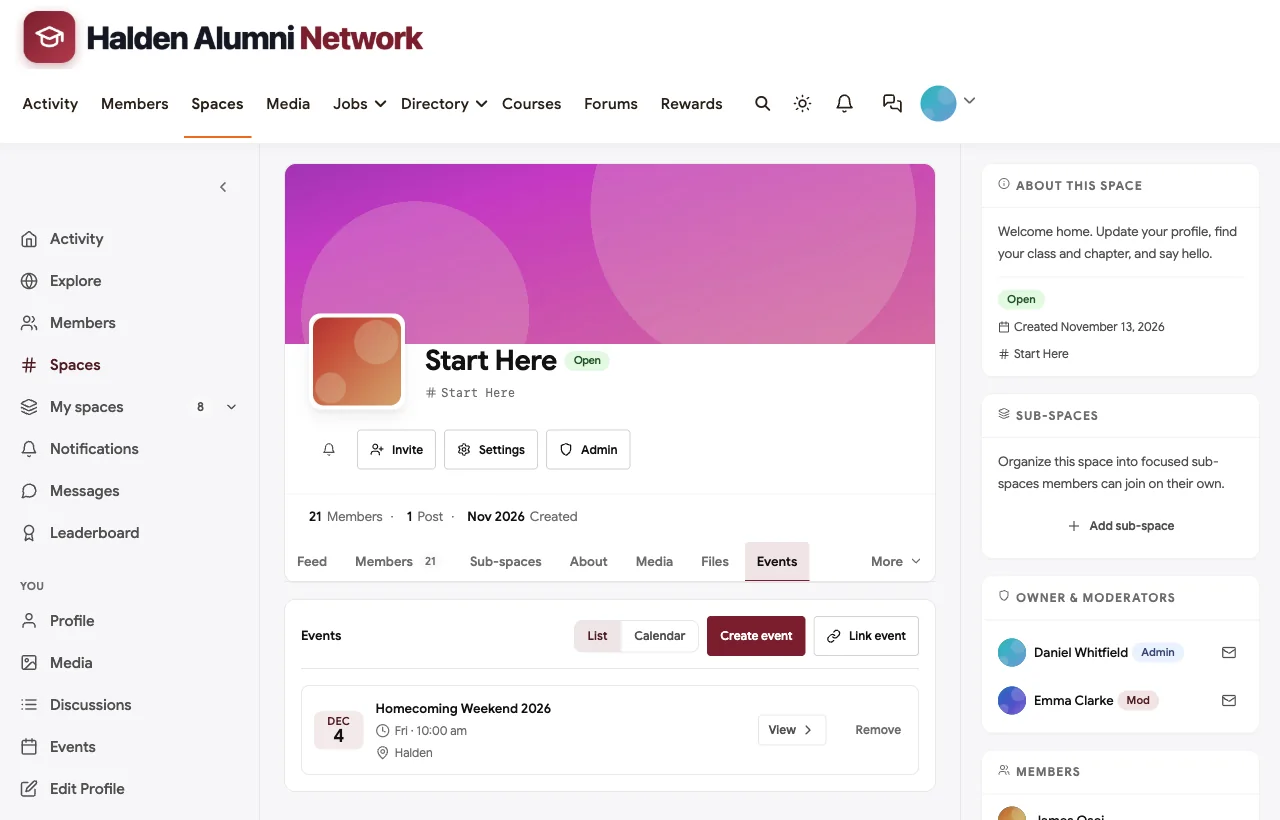
Class-year and chapter spaces. Each graduating class can have its own space. In the demo, the Class of 2015 space is private: classmates request to join and a class volunteer approves them, so reunion planning, old photos and catch-ups stay among classmates. City chapters such as London and New York are open spaces where local alumni plan drinks and breakfasts.
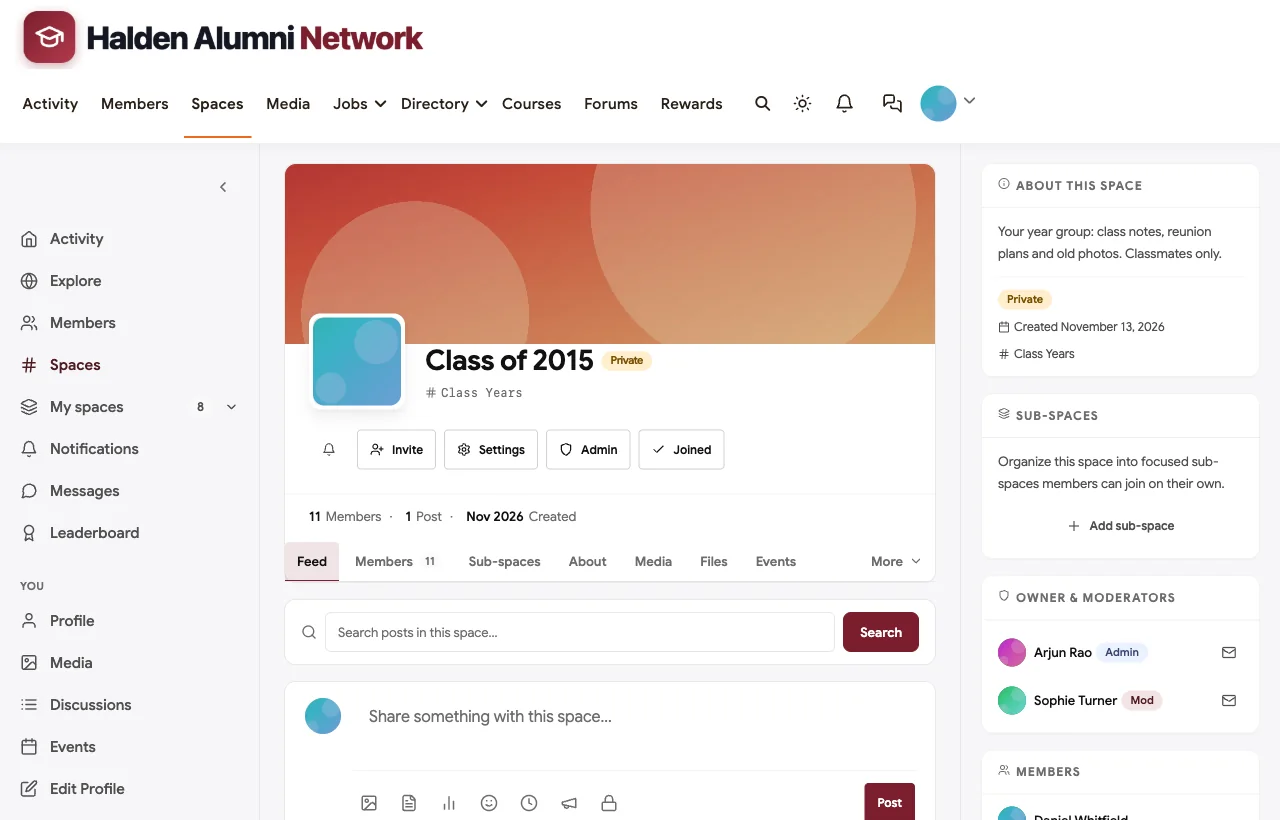

Spaces can be open, private or secret. The demo’s alumni board space is secret, so it does not appear in the spaces list for anyone who is not a member. That is exactly what an alumni board, a reunion committee or a volunteer council needs.
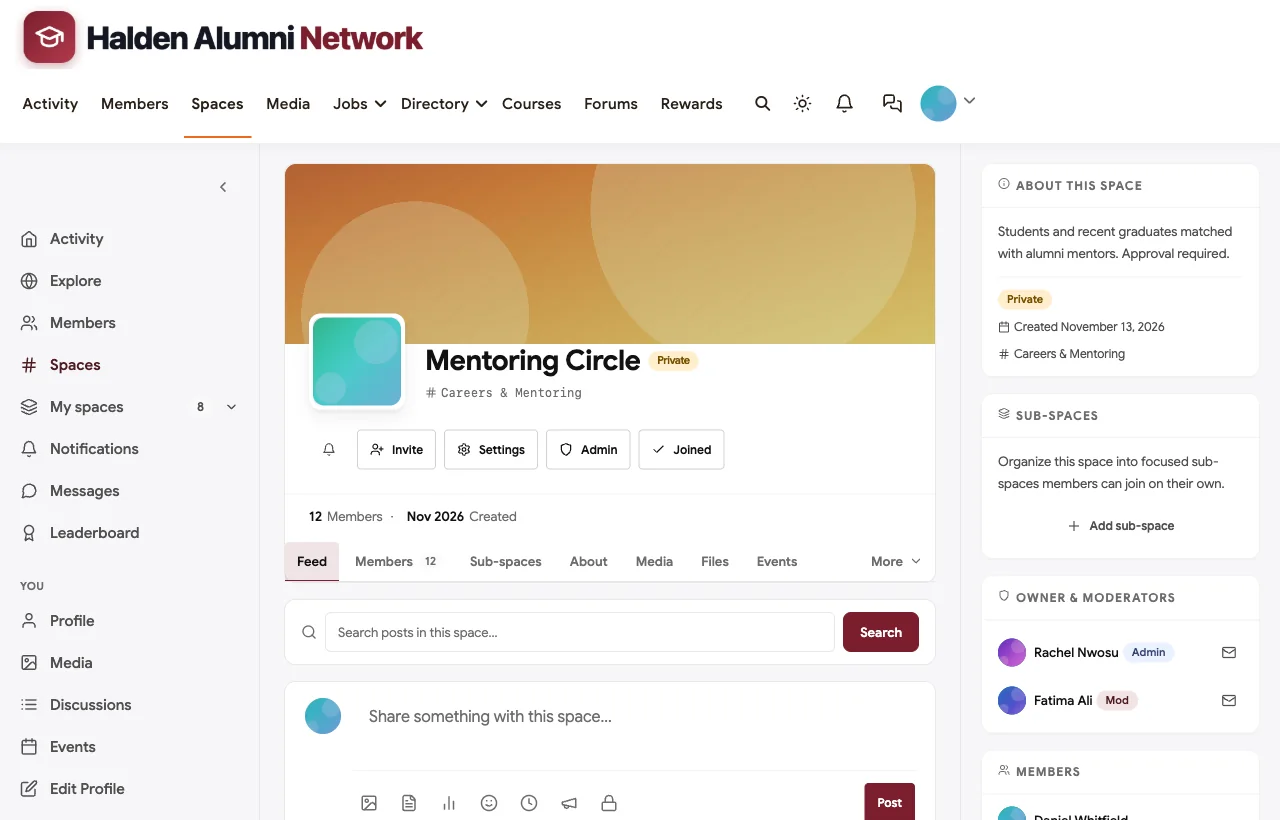
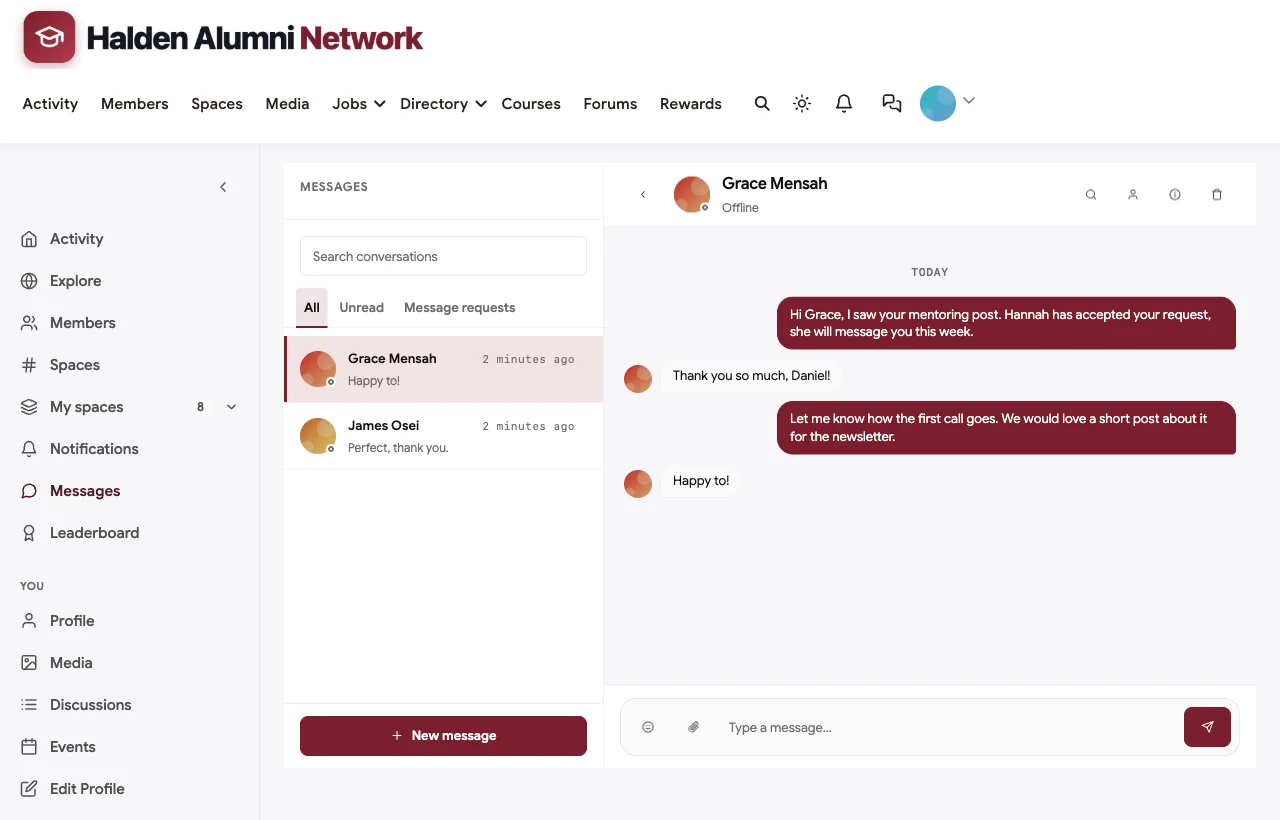
A mentoring circle. The mentoring circle is a private space that students and recent graduates request to join. Alumni mentors post office hours and advice, mentees ask questions, and conversations move into direct messages when they get personal.
For a deeper look at running mentoring programs, see how to build a mentorship community on WordPress.
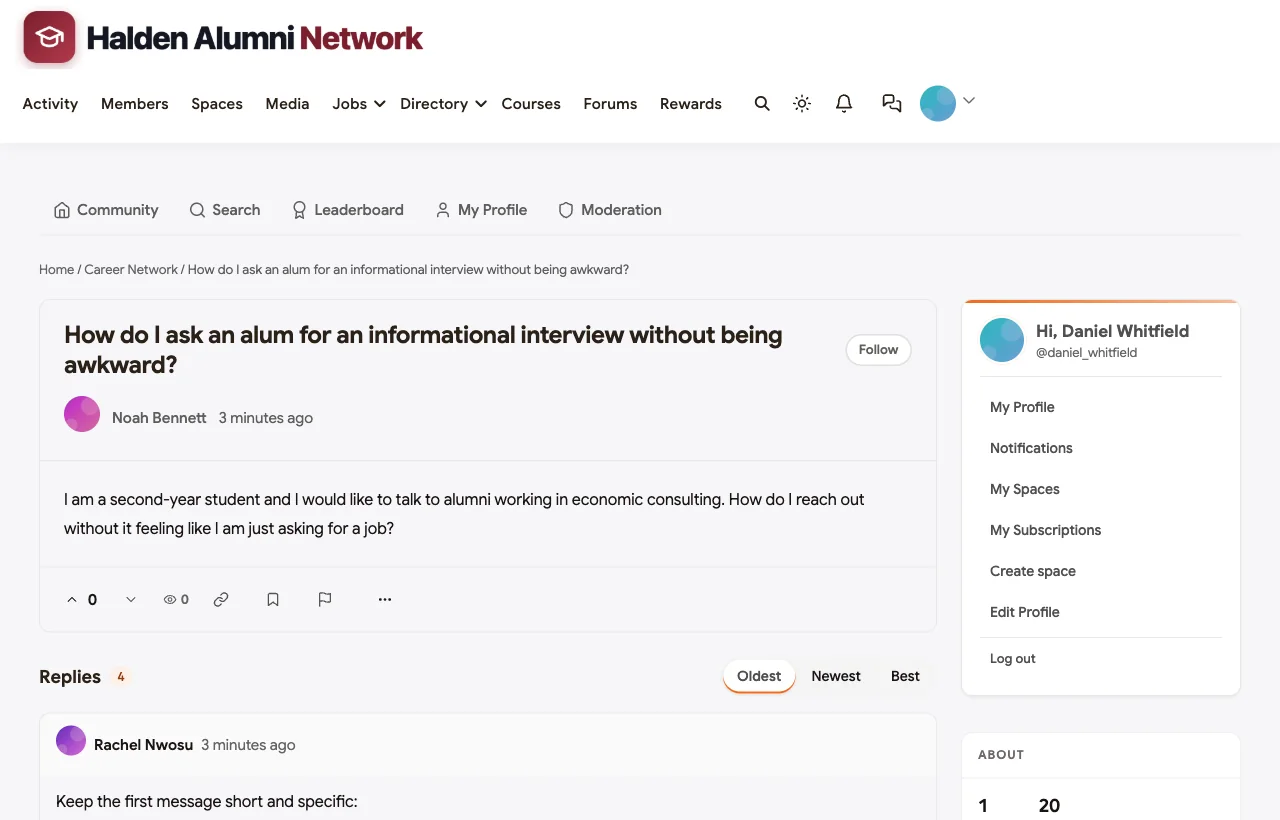
A Q&A that keeps good advice. Questions like “How do I ask an alum for an informational interview without being awkward?” get answered once and stay searchable, so next year’s students find the answer without asking again. The discussion area supports threaded replies, sorting by best answer and follow notifications.
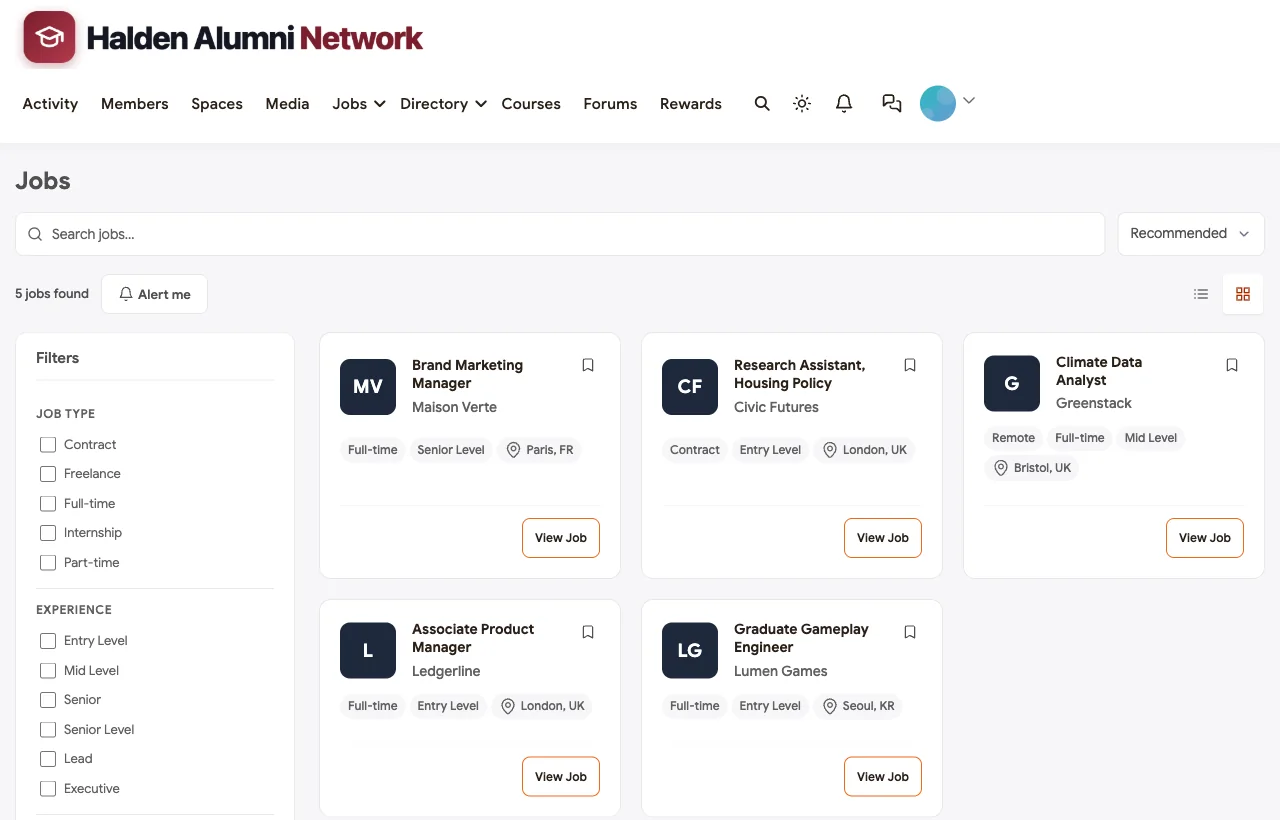
An alumni jobs board. Alumni who are hiring post roles directly. Members can search, filter by job type and experience level, save jobs and set an alert for new postings. When a new job is posted, it also appears in the community feed, so people who never visit the jobs page still see it. Our guide to building an alumni career board on WordPress walks through the setup.
Homecoming and chapter events. Events can be in person, with a venue and city, or online. The demo has an in-person homecoming weekend, London chapter drinks, an online career panel and a New York alumni breakfast. Events show up on the homepage, in the relevant space and in members’ feeds.
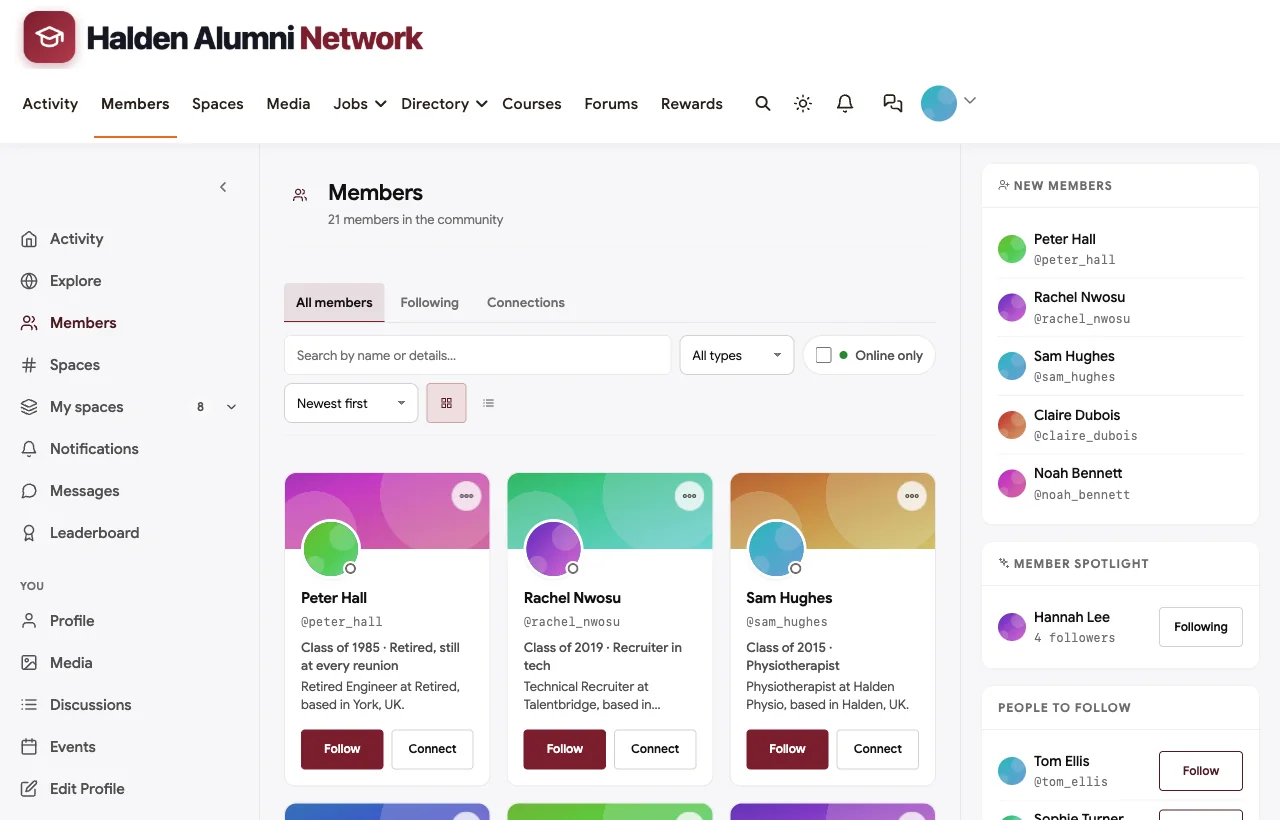
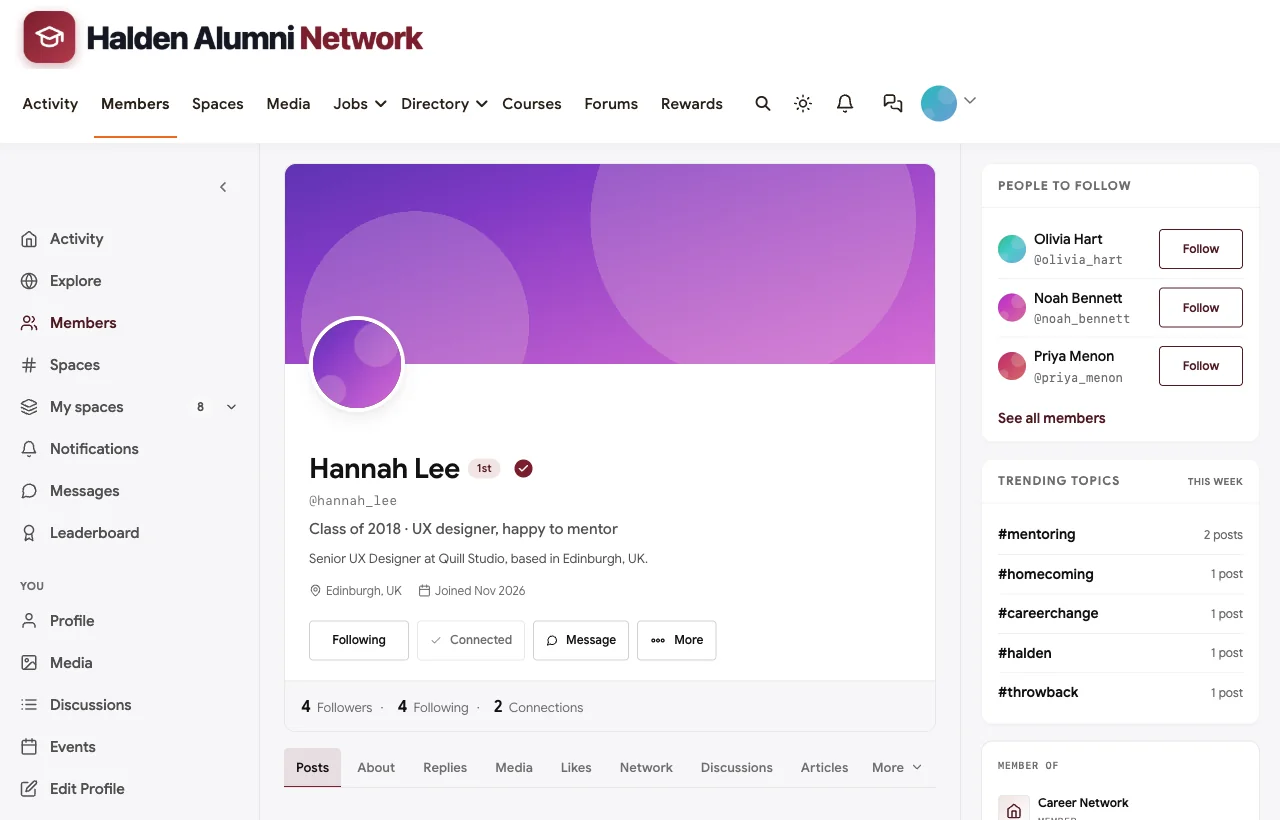
A directory people actually use. The member directory shows each graduate’s headline, class and location. Members can search, follow and connect, and the profile shows posts, connections, spaces and activity. Because graduates keep their own profiles up to date, the directory stays more current than a spreadsheet the alumni office updates once a year.
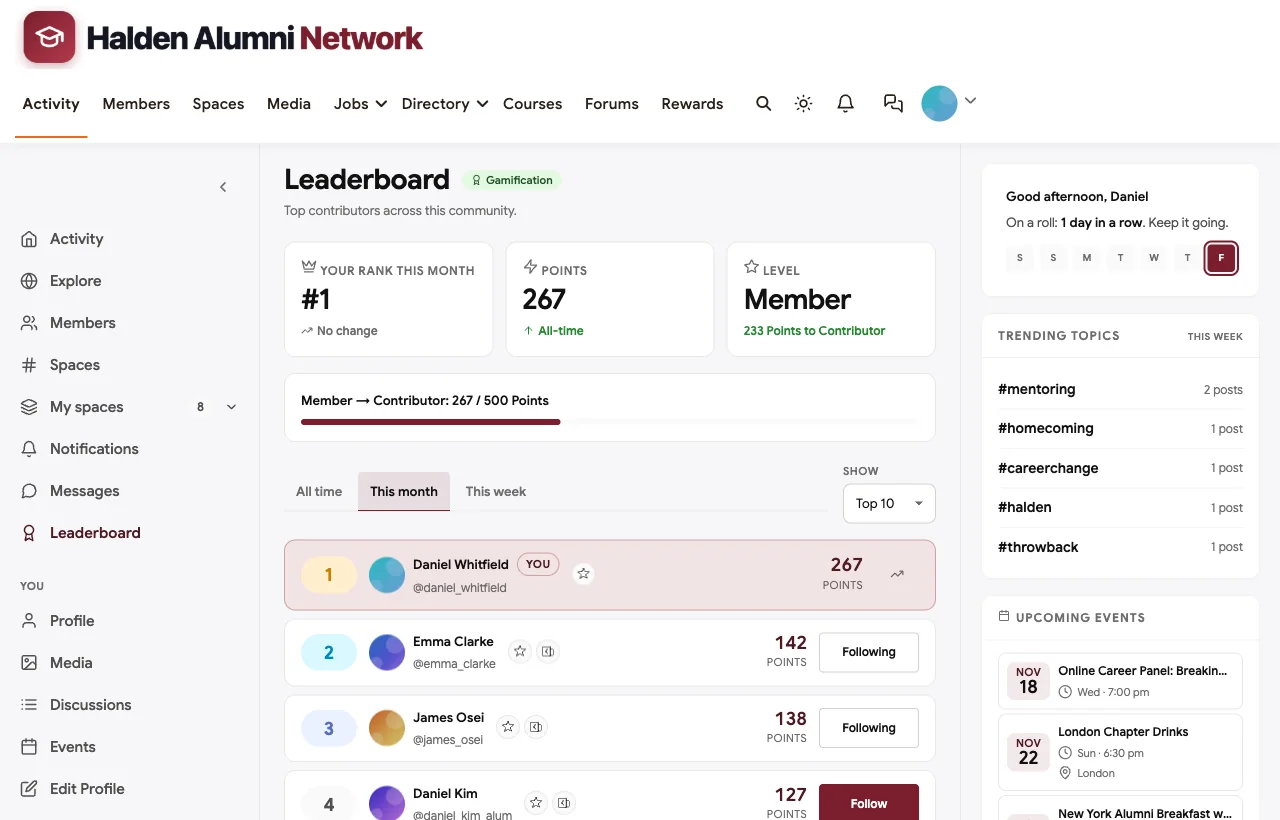
Recognition for volunteers. CASE’s data links volunteering closely with giving, so volunteers are worth celebrating. BuddyNext’s points, badges and leaderboard make volunteering visible: members earn points for posting, answering questions, hosting events and helping others, and the leaderboard shows who is making the network work.
Also built in. A business directory where alumni can list their companies, courses for career workshops or continuing education, polls for reunion planning, hashtags such as #homecoming and #mentoring, notifications, and a mobile-friendly layout that works on phones without a separate app download.
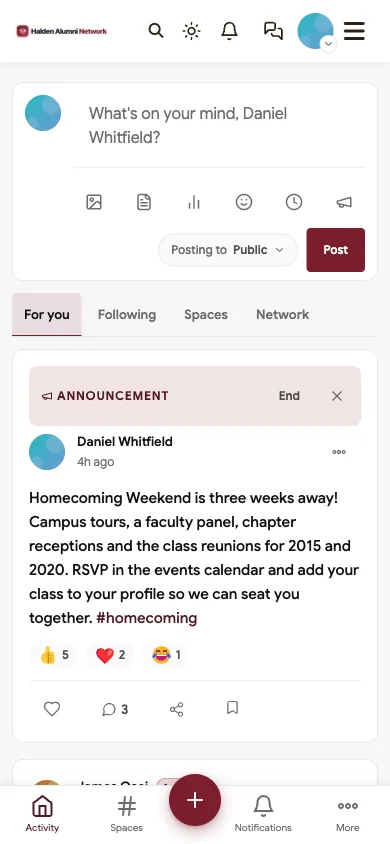
Where it falls short. BuddyNext does not include a native connector for advancement CRMs such as Raiser’s Edge NXT, and it has no built-in donation forms; most institutions link to their existing giving page or add a WordPress donation plugin. Mentor matching is done by people, not an algorithm. And because it is self-hosted, someone needs to look after the WordPress site, or you need a host that does.
Integration notes. WordPress supports single sign-on through widely used SAML and OpenID Connect plugins, so alumni can sign in with a university account. BuddyNext’s REST API lets a developer push engagement data to a CRM. And because the data sits in your own database, you can export all of it whenever you need to.

What’s included, and how it is delivered
BuddyNext is one platform made of a core and add-on platform modules. Everything shown in the demo above runs on the BuddyNext platform. This table shows which parts come with the core, which are platform modules you install and activate alongside it, and which need a third-party plugin, another system or custom work.
| Capability | How it is delivered |
|---|---|
| Open, private and secret spaces | Core platform |
| Activity feed, pinned announcements and hashtags | Core platform |
| Member profiles and searchable member directory | Core platform |
| Direct messages | Platform module, installed alongside |
| Polls | Core platform |
| Members-only mode, admin approval, invites and email verification | Core platform |
| Q&A with accepted answers and code highlighting | Platform module, installed alongside |
| Jobs board with filters and alerts | Platform module, installed alongside |
| Events with RSVPs, online or in person | Platform module, installed alongside |
| Business and partner directory listings | Platform module, installed alongside |
| Courses and certificates | Platform module, installed alongside |
| Points, badges, streaks and leaderboards | Platform module, installed alongside |
| Single sign-on (SAML or OpenID Connect) | Third-party WordPress plugin |
| CRM or helpdesk sync | Third-party plugin or custom development (REST API) |
| Donation forms | Third-party WordPress plugin |
Want to click around yourself? The Halden Alumni Network community in this guide was built on a private test site, so it is not public. The BuddyNext live demo is a general community you can open in your browser and explore without installing anything.
2. Graduway (Gravyty): best for structured mentoring at large institutions
Graduway is an alumni engagement and mentoring platform that now operates under Gravyty; its product pages live on gravyty.com. Gravyty describes it as a “fully branded, secure virtual hub” for alumni to connect, access career resources, mentor, attend events and give (Gravyty).
Who picks it. Universities that want a hosted alumni portal with formal mentoring programs and a vendor to run setup.
Where it shines. Mentoring is the standout: structured programs with milestones, quick “flash mentoring” for one-off career advice, automated mentor matching and built-in video chat. Affinity groups, a job board, a business directory, custom email digests and embedded giving forms round out the platform. Gravyty says it is “trusted by 2,750+ institutions” and integrates with Blackbaud Raiser’s Edge NXT and Salesforce.
Where it falls short. It is hosted only. Independent RFP comparison sites report that member data exports are requested through support rather than downloaded self-serve; we could not confirm this from Gravyty’s own documentation, so ask during evaluation. Day-to-day community discussion is less central than mentoring and careers.
Proof point. Gravyty’s own case studies name Ohio University’s “Bobcat Network” and Wesleyan University among its customers. These are vendor-reported results.
3. Hivebrite: best for very large networks with many clubs and chapters
Hivebrite is a community engagement platform widely used by universities and alumni associations. It covers an alumni directory, groups and sub-communities, events with ticketing, mentoring, donations, email campaigns, a mobile app and single sign-on.
Who picks it. Large institutions with hundreds of clubs, classes and chapters that need one hosted platform to hold them all.
Where it shines. Breadth and scale. Hivebrite’s directory can be searched by graduation year, degree, industry, job title and location, with a map view. Event management handles everything from chapter meetups to multi-day conferences with ticketing. Its mentoring module includes AI-assisted matching. Hivebrite also lists integrations with Raiser’s Edge NXT, Salesforce and Ellucian.
Where it falls short. Hosted only, so your alumni data lives on Hivebrite’s platform. It is a big platform, and smaller alumni groups may find it more than they need.
Proof point. Lesley University’s own support site describes the “Lesley Alumni Network Powered by Hivebrite” and confirms it uses the university’s Microsoft single sign-on (Lesley University). The West Point Association of Graduates runs its Sallyport community on Hivebrite, and MIT’s alumni association uses a Hivebrite-hosted community for its volunteer-led clubs, classes and groups.
4. PeopleGrove: best for career services and student-to-alumni mentoring
PeopleGrove positions itself as an alumni management platform that covers mentorship, alumni networking and lifelong engagement across the full student-to-alumni journey (PeopleGrove).
Who picks it. Universities where career services leads the alumni network, and where connecting current students with alumni is the main goal.
Where it shines. AI-assisted connections match students and alumni by interests, goals and career path. Mentoring comes in three forms: informal flash conversations, structured career or peer mentoring, and fully managed programs run by PeopleGrove staff. It also includes an alumni directory with business listings, event and campaign management, and integrations with Slate, Salesforce and GiveCampus.
Where it falls short. It is career-led rather than community-led, so everyday conversation among alumni is not its focus. Chapter features, single sign-on and data export were not documented on the pages we reviewed. Hosted only.
Proof point. PeopleGrove’s University of Kansas case study describes scaling career services to the university’s 375,000 alumni, with nearly 3,000 alumni joining in the first quarter after launch (PeopleGrove). Those are vendor-published figures.
5. Almabase: best for advancement teams focused on events and giving
Almabase describes itself as “a comprehensive donor engagement tool for modern advancement teams”, built to work on top of an institution’s existing CRM rather than replace it (Almabase).
Who picks it. Advancement and alumni relations teams that run a lot of events and giving days and want them tied to the CRM.
Where it shines. Events are a real strength: branded registration pages, CRM-segmented invitations, multi-day and sub-events, tiered tickets, on-site check-in and attendance synced back to constituent records. It also offers an alumni directory, mentorship, a job board, affinity groups, online giving, peer-to-peer fundraising and personalised email updates. Raiser’s Edge NXT sync is a headline feature.
Where it falls short. Almabase is an advancement tool first. Members talk to the institution more than to each other, and the community side is lighter than on a community platform. Single sign-on and a branded mobile app were not confirmed on the pages we checked. Hosted only.
6. Glue Up: best for alumni associations run as dues-paying chapters
Glue Up is association management software for associations, chambers of commerce and professional communities. It is not alumni-specific, but alumni associations that run like membership organisations, with dues and regional chapters, sometimes choose it (Glue Up).
Who picks it. Alumni associations that charge membership dues and manage many local chapters.
Where it shines. Chapter management is the strongest of any platform we reviewed: a unified dashboard, consolidated membership data, granular permissions and a shared event calendar. Membership renewals, reminders, event ticketing, email campaigns and a branded mobile app are all included.
Where it falls short. No mentoring, jobs or fundraising modules out of the box, and the directory is a general participant directory without alumni fields such as class year. A poor fit for a university’s central advancement office.
7. Circle: best for a modern, general-purpose community
Circle is “the complete community platform” for building a community, events and courses under your own brand (Circle). It is aimed at creators and businesses generally, not alumni offices.
Who picks it. Smaller alumni groups, bootcamp or program alumni, and business school cohorts that want a polished community and do not need advancement features.
Where it shines. A clean, modern member experience with spaces, live events and streams, courses, an email hub with segmentation, an API and fully branded mobile apps.
Where it falls short. No alumni-specific features: no class-year directory filters, no mentoring matching, no jobs board and no advancement CRM integration. Hosted only.
8. Mighty Networks: best for a branded app with structured engagement
Mighty Networks combines community, courses and events, built around its “Community Design” approach of regular themes, events and prompts (Mighty Networks).
Who picks it. Alumni groups that want members on a phone app and like the idea of a structured engagement rhythm.
Where it shines. Native mobile apps are a headline feature, with fully branded apps on its top tier. Courses and events are core parts of the product.
Where it falls short. Like Circle, it is built for creator communities, so there is no alumni directory, mentoring matching, jobs board or CRM integration documented. Hosted only.
9. LinkedIn Groups: best as a free, low-effort starting point
Many alumni offices already run a LinkedIn group because graduates already have LinkedIn profiles. It costs nothing and takes minutes to set up.
Who picks it. Offices that want a light professional presence before investing in a real platform.
Where it shines. Alumni are already on LinkedIn, their profiles are already current, and a single group can hold up to 3 million members (LinkedIn Help).
Where it falls short. No alumni directory scoped to the group, no mentoring tools, no events or chapters beyond creating more groups, no giving tools and no member data export. You do not own the list, and LinkedIn’s feed decides who sees each post.
10. Facebook Groups: best for informal class-year chatter
Facebook groups are where many classes already talk, especially around reunions.
Who picks it. Individual classes and chapters that want something quick and familiar.
Where it shines. Free, familiar, with posts, photos, polls, events and file sharing.
Where it falls short. No directory, mentoring, jobs or giving tools, no export of members, and no control over the platform’s feed, advertising or policies. Many younger graduates no longer use Facebook regularly.
What about Fishbowl? Some career-services offices point students to Fishbowl, an app for anonymous professional discussion. It can be useful for candid career questions, but it is not alumni network software: the institution has no directory, no data and no control, and anonymity is the opposite of a named mentoring program.
Alumni network software compared
| Software | Type | Directory | Class and chapter spaces | Mentoring | Jobs | Events | Hosting and data |
|---|---|---|---|---|---|---|---|
| BuddyNext | Community platform | Yes, member-maintained | Open, private and secret spaces | Private mentoring spaces and messages | Jobs board with alerts | Yes, in person and online | Self-hosted, you own the data |
| Graduway (Gravyty) | Advancement suite | Yes | Affinity groups | Structured, matching, video | Job board | Yes | Hosted |
| Hivebrite | Advancement suite | Yes, with map | Groups and sub-communities | Module with AI matching | Not confirmed | Yes, with ticketing | Hosted |
| PeopleGrove | Advancement suite | Yes, with business listings | Not documented | AI-assisted, three program types | Career tools | Yes | Hosted |
| Almabase | Advancement suite | Yes | Affinity groups | Yes | Job board | Strong, CRM-synced | Hosted |
| Glue Up | Association software | General directory | Strong chapter management | No | No | Yes, ticketed | Hosted |
| Circle | Community platform | General directory | Spaces | No | No | Yes | Hosted |
| Mighty Networks | Community platform | Not alumni-specific | Groups | No | No | Yes | Hosted |
| LinkedIn Groups | Social group | No | Sub-groups only | No | No | No | LinkedIn’s platform |
| Facebook Groups | Social group | No | Separate groups | No | No | Basic | Facebook’s platform |

Structuring the network: the spaces most alumni communities need
Whichever software you choose, the structure of spaces decides whether people find their way. This is the structure we used in the demo, and it works for most universities and colleges:
| Space | Visibility | Purpose | Who moderates |
|---|---|---|---|
| Start Here | Open | Welcome, profile reminders, how the network works | Alumni office |
| University News | Open | Announcements, campus news, calls for volunteers | Alumni office |
| Class of [year] | Private | Reunions, photos, class notes | Class volunteers |
| [City] Chapter | Open | Local meetups, chapter events | Chapter leaders |
| Career Network | Open | Jobs, career questions, informational interviews | Career services and alumni volunteers |
| Mentoring Circle | Private | Mentor office hours, advice, matching | Mentoring coordinator |
| Alumni Board | Secret | Board and committee work | Board chair |
Start with fewer spaces than you think you need. A new class space with three members feels empty; a lively Start Here space with three hundred does not. Create class and chapter spaces when a volunteer asks to lead one.
The first 90 days: launching an alumni network that does not go quiet
For the full setup, screen by screen, see our step-by-step guide to building a university alumni network on WordPress.
If you are starting from scratch on WordPress, our step-by-step guide to setting up a community space covers installation, spaces, messages and moderation.
The software is the easy part. Most alumni networks fail in the first three months because nobody posts. This plan is built around what the CASE data says actually works: participation, volunteering and in-person events.
Days 1 to 30: build with volunteers, not for them
- Recruit 10 to 20 founding volunteers: class agents, chapter leaders, a few well-connected alumni and two or three recent graduates.
- Invite them before anyone else. Ask each one to complete their profile, post an introduction and answer one question.
- Seed the Career Network with three or four real questions from current students, and ask volunteers to answer them.
- Post the next homecoming or reunion as an event so there is a reason to come back.
Days 31 to 60: open the doors in waves
- Invite the most recent graduating classes first. They are the most active communicators, according to CASE, and still remember campus.
- Then invite chapter cities one at a time, each with a chapter event already on the calendar.
- Ask hiring alumni to post one role each. A jobs board with real roles is the strongest reason for recent graduates to join.
- Run one online career panel and post the recording and follow-up questions in the community.
Days 61 to 90: make volunteering visible
- Launch the mentoring circle with a small first round of mentors and mentees, and share a short story from a successful match.
- Thank volunteers publicly. Use points, badges or a leaderboard so mentors and chapter hosts get recognised.
- Send a monthly digest that highlights member posts, not just news from the institution.
- Review what worked: which spaces are busy, which are quiet, and which volunteers need help.
Data, privacy and ownership: questions to ask before you sign
Alumni data is personal data, and in many countries it is covered by laws such as GDPR. Before choosing any platform, get clear answers to these questions:
- Where is the data stored, and who can access it? With a hosted suite, the vendor’s infrastructure and staff are part of the answer. With a self-hosted platform, it is your server and your team.
- Can we export everything, at any time, without asking? Members, profiles, posts, messages and event history. If export requires a support ticket, plan for that.
- What happens if we leave? Find out the format of the export and whether the vendor deletes the data afterwards.
- Can members control what others see? Alumni should be able to hide contact details, choose who can message them and leave spaces.
- How do private and secret spaces work? Test that a non-member really cannot see the alumni board space.
- How does sign-in work? Single sign-on with a university account reduces password resets, but alumni who no longer have a university account still need a way in.
Which software fits your alumni network?
- You want your own branded network with no per-member limits and full control of the data: BuddyNext.
- You are a large university that wants structured mentoring and a vendor to run setup: Graduway (Gravyty).
- You have hundreds of clubs, classes and chapters and need one hosted home for all of them: Hivebrite.
- Career services leads, and student-to-alumni mentoring is the goal: PeopleGrove.
- The advancement team leads, and events and giving days come first: Almabase.
- Your alumni association runs on dues and regional chapters: Glue Up. (Our guide to professional association community platforms covers dues-based bodies in more depth.)
- You run a small program or cohort alumni group and want a polished general community: Circle or Mighty Networks.
- You just need somewhere free to start: a LinkedIn or Facebook group, with a plan to move.
More community platform comparisons
Building a different kind of community, or one that overlaps with this one? These guides use the same method: a working demo community and vendor claims checked at the source.
- Best platforms for a diaspora and expat networking community: city chapters, newcomer Q&A, mentoring and a members’ business directory.
- Best platforms for a career coaching membership community: group coaching, teardowns, interview practice, pods and a job board.
- How to build a university alumni network on WordPress: the step-by-step build behind this demo, from alumni profile fields to mentoring and invitations.
- Best software for a professional association community: chapters, committees, CPD and member directories.
- Best software for a startup founder community: confidential pods, intros and fundraising rooms.
- Best software for an online course community: course creators who want learners to finish.
- Best software for a freelancer networking community: referrals, jobs and member directories.
- How to set up a community space on WordPress: the step-by-step setup guide behind every demo in this series.
How we built and checked this list
We built the Halden Alumni Network demo on a local WordPress site running BuddyNext, with fictional members, class spaces, chapters, jobs and events created for this guide. Every BuddyNext screenshot is from that demo. Competitor features were checked against each vendor’s own website in November 2026, and named customer examples come from the institution’s own site or the vendor’s published case studies, as noted in each section. Engagement statistics come from CASE’s published findings. We did not run a hands-on trial of every competitor, so features can change; confirm anything critical with the vendor. buddyxtheme.com is published by the team behind BuddyNext, which is why BuddyNext is listed first; we have tried to be fair about its gaps as well as its strengths.
Frequently asked questions
What is the best software to build a university alumni network?
BuddyNext is the best choice for an alumni network you own, with class spaces, chapters, mentoring, jobs, events and a member directory on your own WordPress site. Graduway (Gravyty), Hivebrite and PeopleGrove are the leading hosted alumni suites for large universities that want vendor-run setup and CRM integration.
What features should alumni network software have?
At minimum: a searchable member directory, private class-year and chapter spaces, mentoring, an alumni jobs board, events for homecoming and chapters, direct messages, privacy controls, single sign-on and full data export. Advancement teams will also want a way to send engagement data to their CRM.
How do I get alumni to actually use the network?
Launch with volunteers before opening to everyone, invite recent graduates first, put real events and real jobs on the platform from day one, and recognise mentors and chapter hosts publicly. CASE’s research shows giving overlaps more with volunteering than with any other kind of engagement.
Is a LinkedIn group enough for an alumni network?
It is a reasonable free starting point, but not a network you control. LinkedIn groups have no alumni directory, no mentoring or jobs tools, no class or chapter structure and no member export, and LinkedIn’s feed decides who sees each post.
Can a small college or alumni association afford alumni software?
Yes. Self-hosted community software such as BuddyNext runs on ordinary WordPress hosting with no per-member limits, so the network can grow with every graduating class. LinkedIn and Facebook groups cost nothing but give you no control.
How should we organise spaces for classes and chapters?
Give each graduating class a private space run by class volunteers, each city chapter an open space run by chapter leaders, and add a career network, a private mentoring circle and a secret space for the alumni board. Create class and chapter spaces when a volunteer asks to lead one, not all at once.
Can alumni sign in with their university account?
On most platforms, yes. Hivebrite publicly supports single sign-on, and Lesley University uses its Microsoft sign-in for its Hivebrite network. On WordPress, BuddyNext works with established SAML and OpenID Connect plugins. Keep a regular sign-in option for alumni whose university accounts have expired.
Does alumni network software help with fundraising?
Indirectly, and that is the important part. CASE found that of alumni who engaged in philanthropy, 31% also volunteered, a bigger overlap than with any other engagement mode. Advancement suites such as Almabase and Graduway also include giving tools. BuddyNext does not include donation forms; most institutions link to their existing giving page.
Who owns the alumni data on a hosted platform?
Contracts usually say the institution owns its data, but on a hosted platform the data lives on the vendor’s infrastructure and export works the way the vendor designed it. Ask how exports work before you sign. On a self-hosted platform, the data sits in your own database.
Should students join the alumni network before they graduate?
Yes, for mentoring and careers. Inviting final-year students into the career network and mentoring circle means they arrive at graduation already connected, which is when communication engagement is highest.
The bottom line
The best alumni network software is the one your graduates actually use: where they find classmates, get advice from alumni a few years ahead of them, hear about jobs and come back for homecoming because someone they know asked. If you want that network on your own domain, with your own data and no per-member limits, BuddyNext is the strongest foundation. If you are a large university that wants a hosted suite with vendor-run mentoring and CRM integration, Graduway, Hivebrite and PeopleGrove each lead in their own area.
And build an alumni network your graduates keep coming back to.