
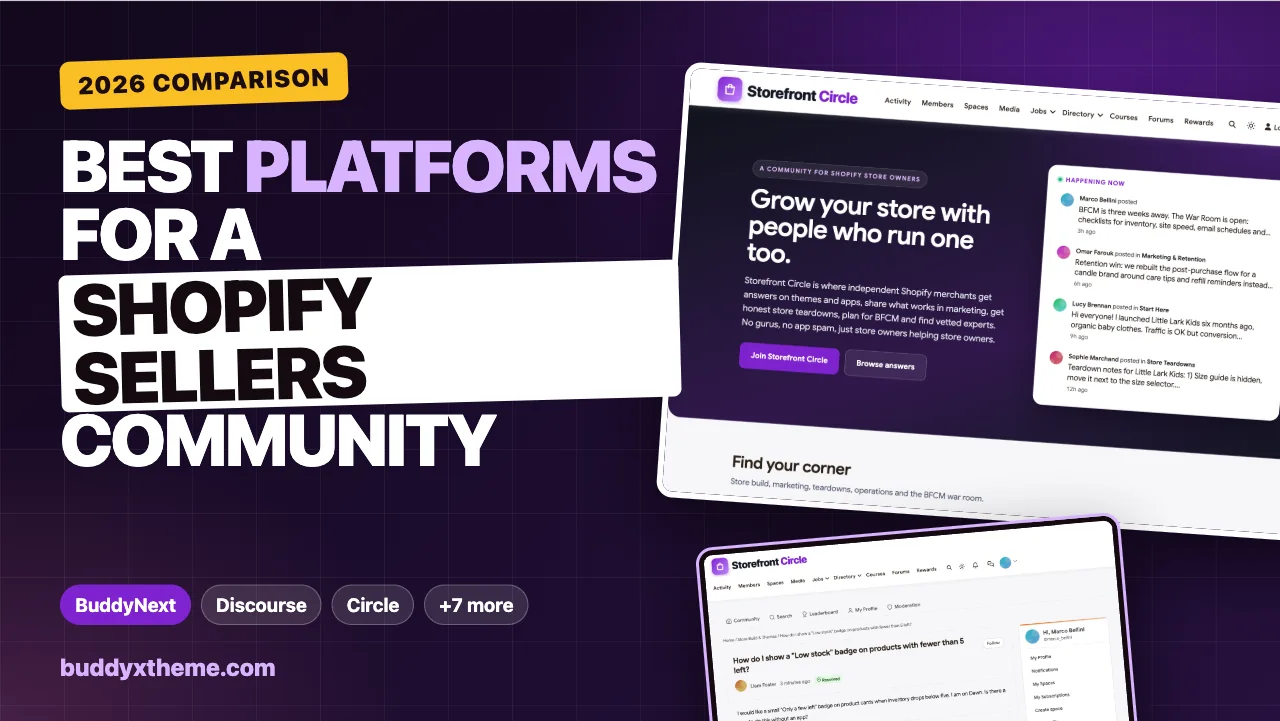
Shopify store owners have no shortage of places to ask questions. There is Shopify’s own community forum, a large subreddit, countless Facebook groups and a new guru with a course every week. What most merchants lack is a smaller room where the answers are trustworthy, the people are running real stores, and nobody is quietly selling an app in every reply. That room is what a Shopify sellers community is for, whether it is run by an agency, an app developer, an ecommerce educator or a group of merchants who simply want better peers.
This guide compares the platforms you can use to build that community. We built a working Shopify merchant community for the first entry, checked every competitor claim against the vendor’s own pages in November 2026, and judged each platform on what merchant communities actually need: searchable answers with code, honest store feedback, control over app and agency promotion, peak-season support and a way to run a paid mastermind.
Quick answer
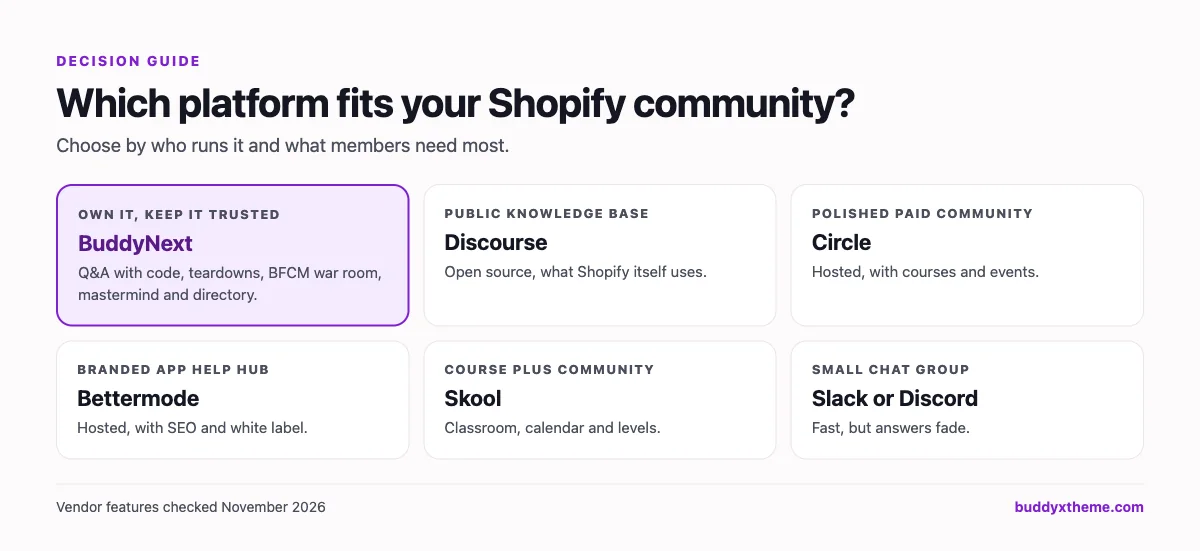
If you want a Shopify sellers community you own and control, BuddyNext is the strongest choice: Q&A with Liquid code highlighting and accepted answers, store teardown spaces, a BFCM war room, a private seven-figure mastermind, an experts and apps directory that keeps promotion in one place, a jobs board and events, all on your own WordPress site. Discourse is the strongest open-source forum and is what Shopify’s own community runs on, Circle suits polished paid communities, and Slack or Discord are quick to start but lose answers over time.
In this guide
- Why merchants build communities beyond Shopify’s own
- Four kinds of Shopify sellers community
- What a Shopify community platform needs
- 1. BuddyNext: best for a Shopify community you own
- 2. Discourse: best open-source forum, and the one Shopify uses
- 3. Circle: best for a polished paid merchant community
- 4. Bettermode: best hosted option with SEO built in
- 5. Skool: best for an ecommerce course with a community
- 6. Mighty Networks: best for an app-first merchant membership
- 7. Slack: best for a small, chat-first merchant group
- 8. Discord: best for free, real-time communities
- 9. Facebook Groups: best for reach
- 10. Shopify Community and Reddit: best as audiences, not homes
- Shopify community platforms compared
- Keeping app and agency spam out
- Running a BFCM war room
- Monetising a merchant community
- Launching a Shopify community: the first 60 days
- Signs the community is working
- More community platform comparisons
- How we built and checked this list
- Frequently asked questions
- The bottom line
Why merchants build communities beyond Shopify’s own
Shopify’s own community is large and useful. Both its merchant forum at community.shopify.com and its developer forum at community.shopify.dev run on Discourse, according to the “Powered by Discourse” footer and generator tag on each site. Shopify’s investor page describes “millions of merchants in 175+ countries” (Shopify). At that scale, an official forum is a help desk, not a peer group.
Independent communities fill three gaps:
- Trust. Merchants want advice from people running stores like theirs, not from anonymous accounts or vendors.
- Depth. Conversion, retention, operations and wholesale need context that a public thread rarely gets.
- Confidentiality. Real numbers, supplier names and margin conversations need a private room.
The best-known example of the private model is eComFuel, formerly eCommerceFuel, which describes itself as “a private community for 7- and 8-figure eCommerce owners” whose private forum gives members access to “50,000+ searchable discussions” (eComFuel). Searchable, private and vetted: those are the three properties most Shopify communities are trying to build.
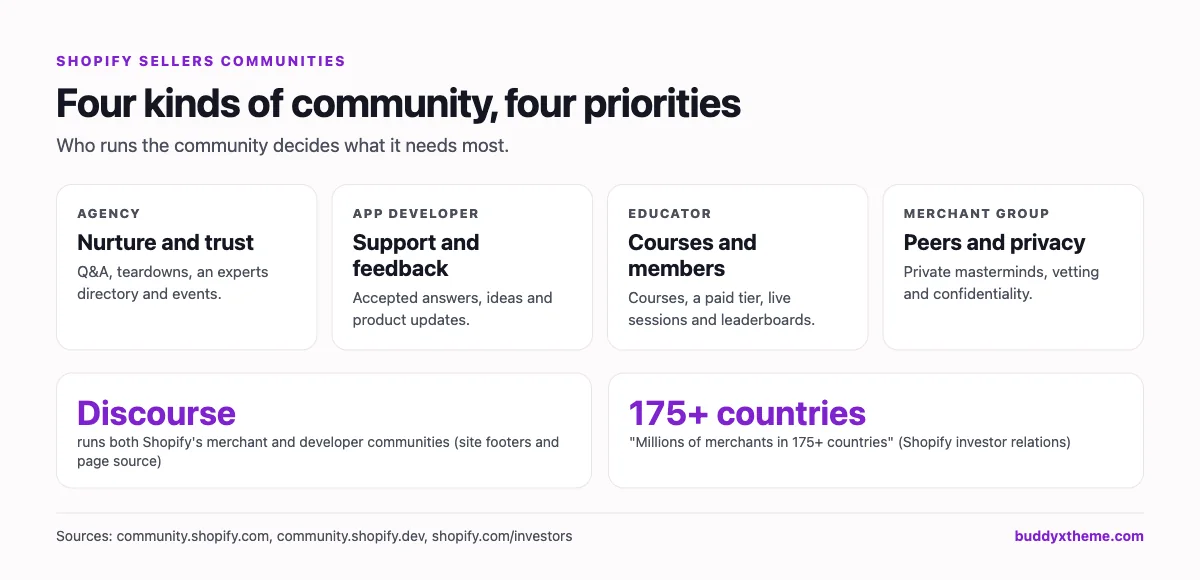
Four kinds of Shopify sellers community
| Who runs it | Why | What it needs most |
|---|---|---|
| An agency | Nurture leads and keep clients close | Q&A, teardowns, an experts directory, events |
| An app developer | Support users and gather feedback | Q&A with accepted answers, ideas, product updates |
| An educator or course creator | Support students and sell a membership | Courses, a paid tier, live sessions, leaderboards |
| A group of merchants | Peer support and masterminds | Private spaces, confidentiality, vetted members |
The platform choice follows from that. App developers and agencies care most about searchable answers and visibility; educators care about courses and payments; merchant groups care about privacy.
What a Shopify community platform needs
| Requirement | Why it matters for merchants |
|---|---|
| Q&A with code and accepted answers | Liquid snippets, theme fixes and app settings need to be readable and findable later |
| Searchable, permanent archive | The same theme and shipping questions come up every season |
| A place for promotion | Apps, agencies and freelancers are useful, but not in every thread |
| Store teardowns | Merchants learn fastest from honest feedback on real stores |
| Private mastermind spaces | Real numbers only get shared in confidential rooms |
| Events | Live teardowns, peak-season workshops and local meetups |
| Jobs | Merchants hire developers, assistants, photographers and support staff |
| Ownership | If the community is part of your business, you should own the member list |
1. BuddyNext: best for a Shopify community you own
BuddyNext is a complete community platform that runs on your own WordPress site. Spaces, a social feed, Q&A with accepted answers, member profiles, messaging, events, a jobs board, a business directory, courses, paid plans and gamification work together in one product.
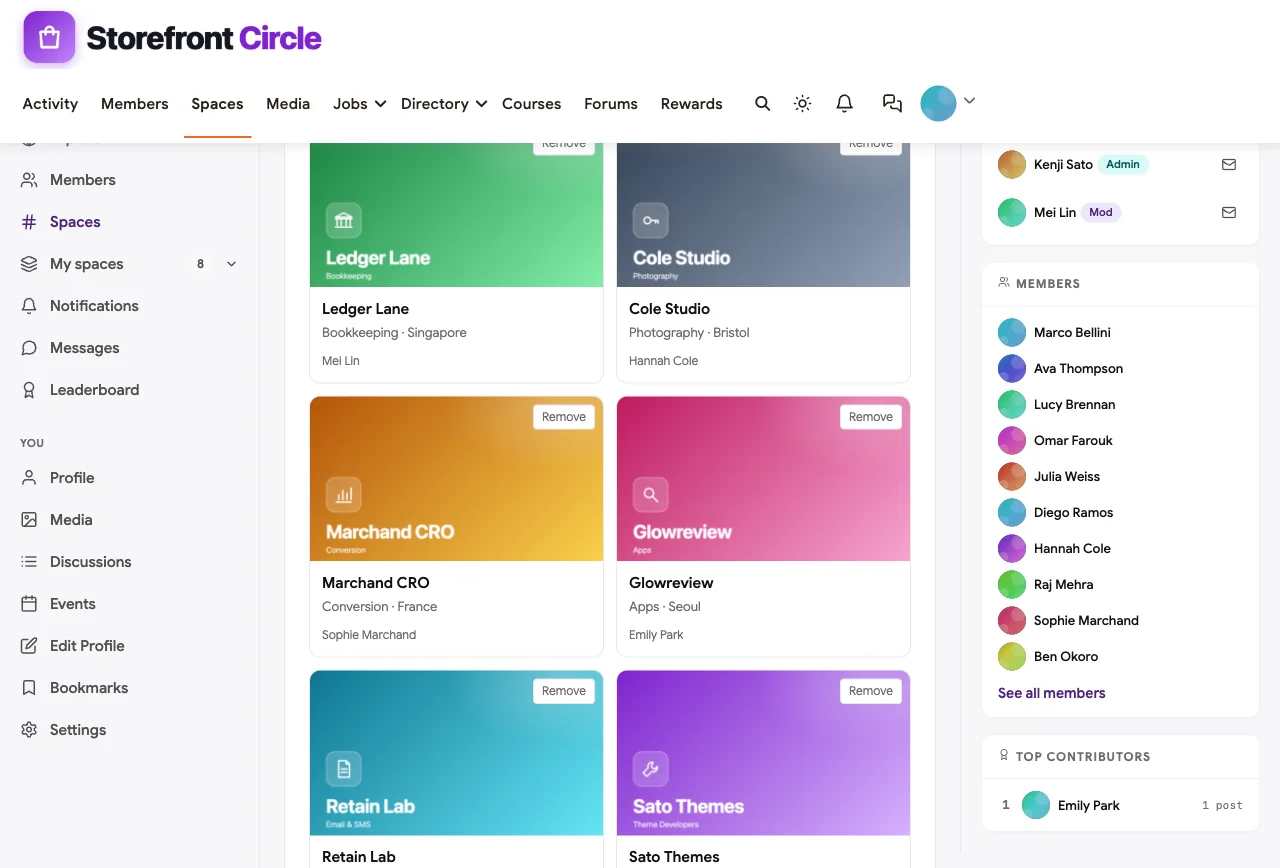
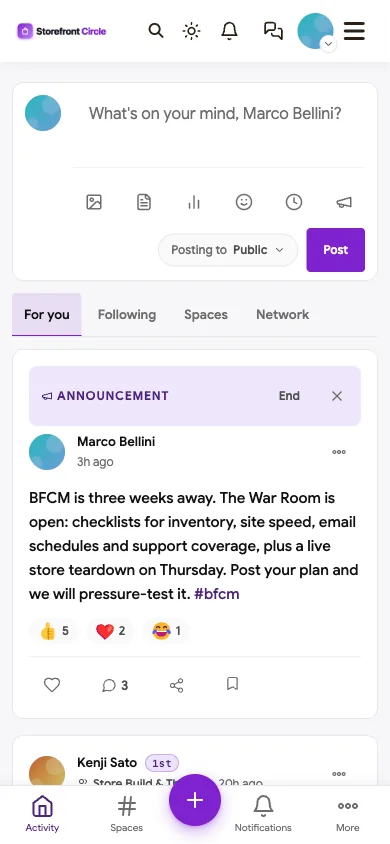
To show it in context, we built Storefront Circle, a demo community for independent Shopify store owners with 20 fictional merchants, developers, marketers and experts, spaces for store build, marketing, teardowns, operations and BFCM, a private seven-figure mastermind and an experts and apps directory.
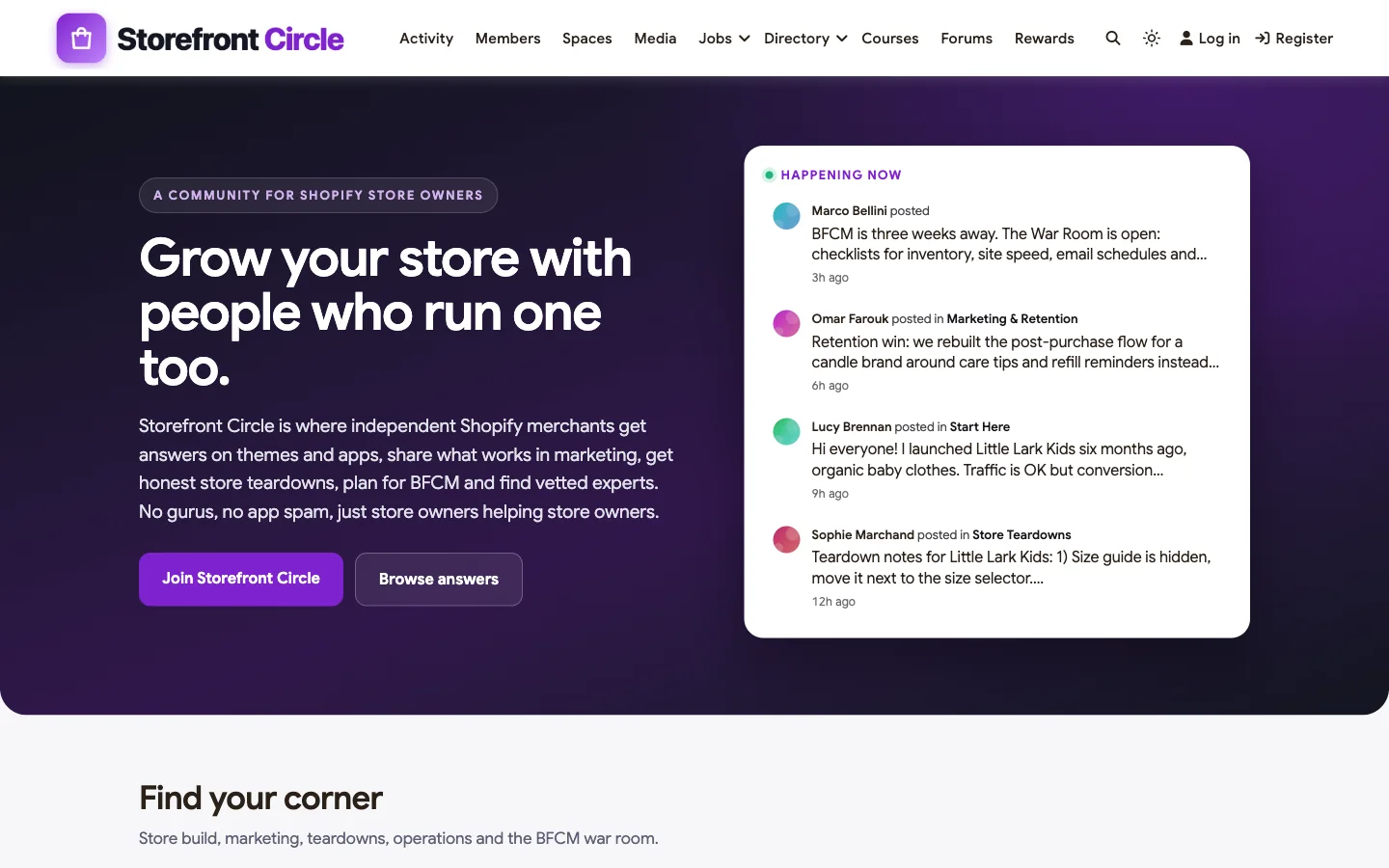
Who it suits: agencies, app developers, educators and merchant groups that want the community on their own domain.
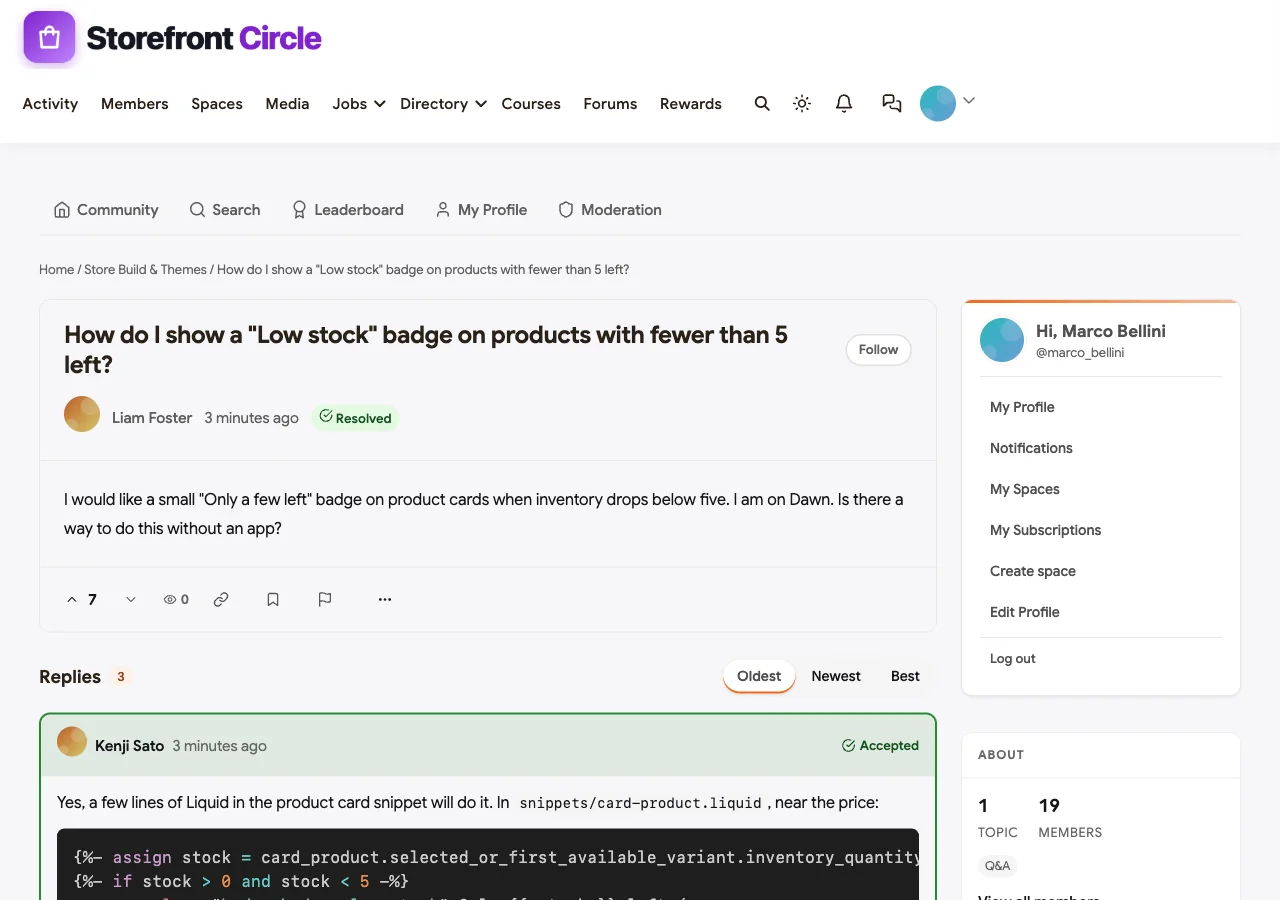
Q&A with Liquid code and accepted answers. The Store Build & Themes space is a Q&A space. In the demo, a merchant asks how to show a “low stock” badge on product cards without an app; a theme developer answers with a Liquid snippet, another member adds a note about variants, and the merchant confirms it worked on a duplicate theme. The answer is marked accepted and the code is syntax-highlighted.
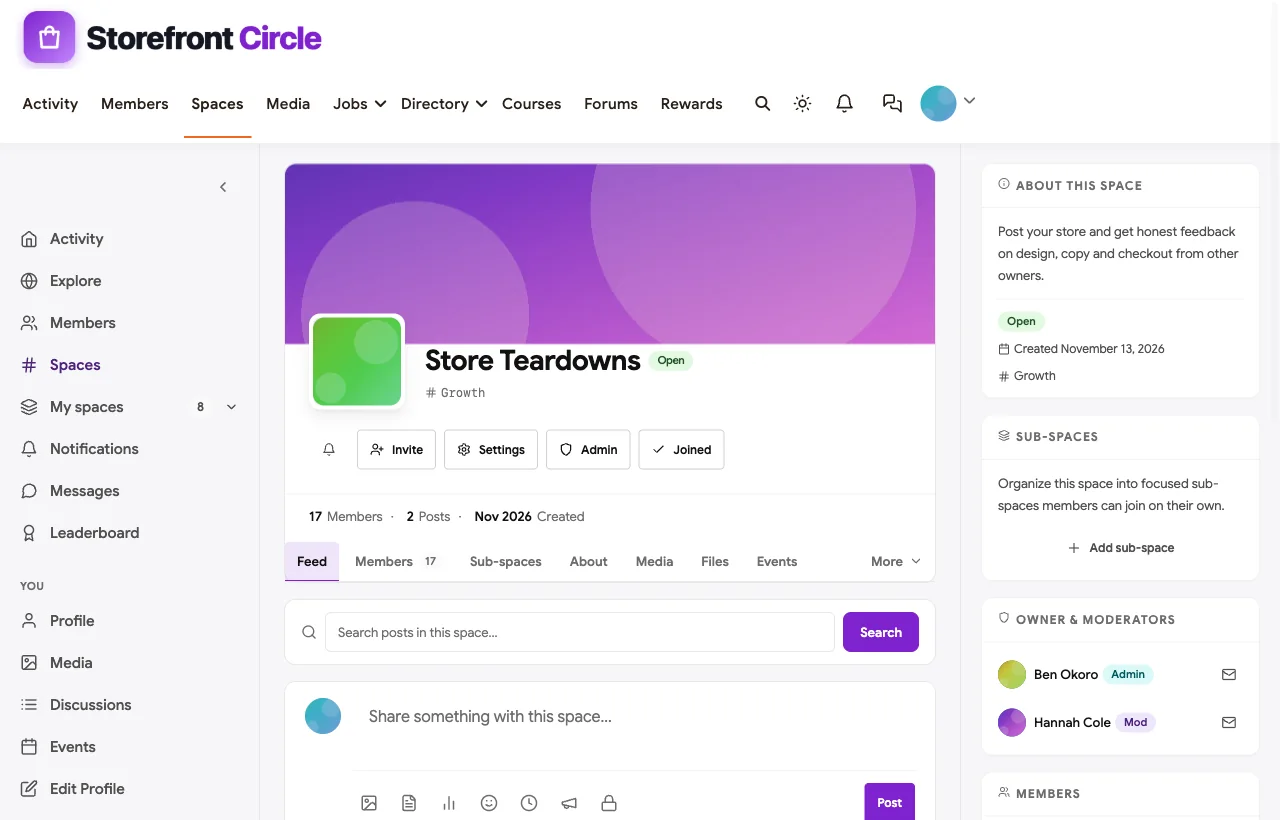
Store teardowns. The Store Teardowns space is where merchants post their store and get honest feedback. In the demo, a first-year founder asks for help with conversion, a CRO consultant posts three quick wins, and a live teardown is scheduled for Thursday.
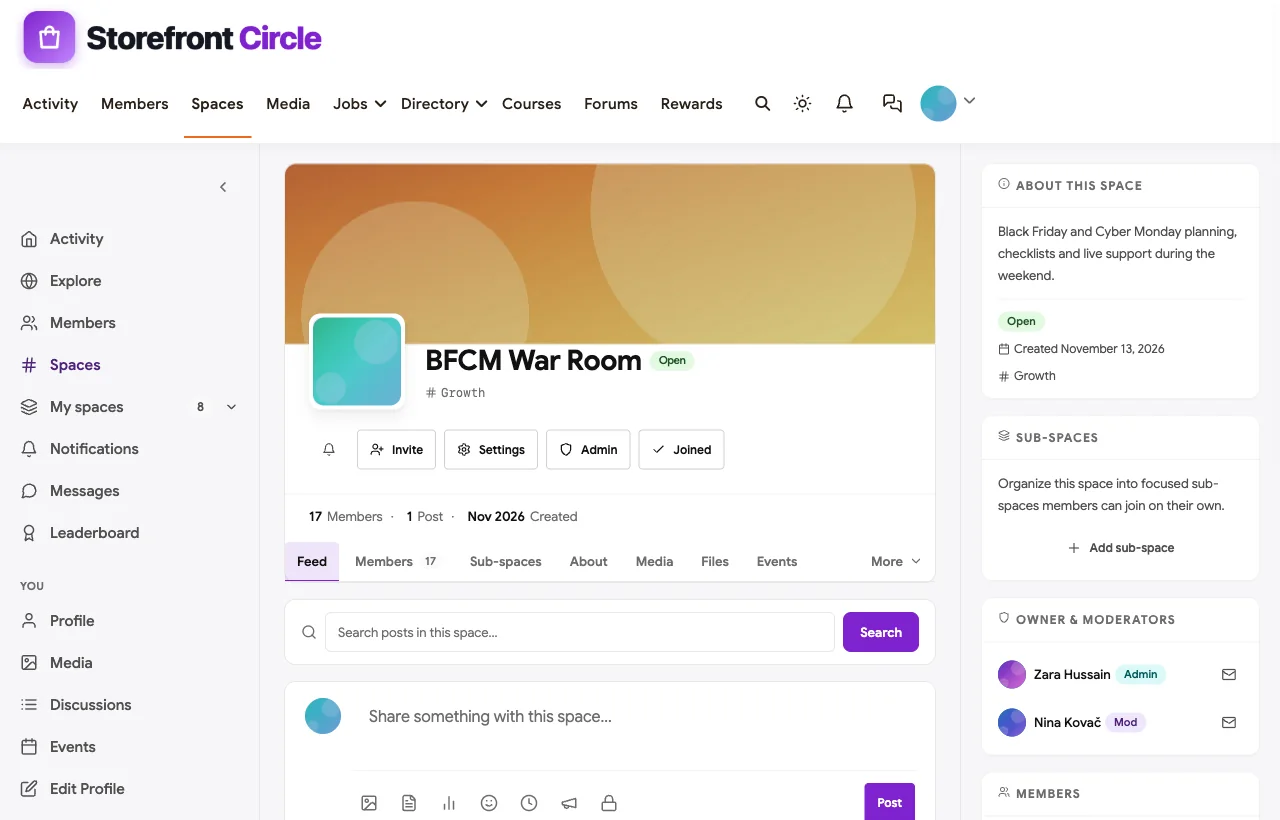
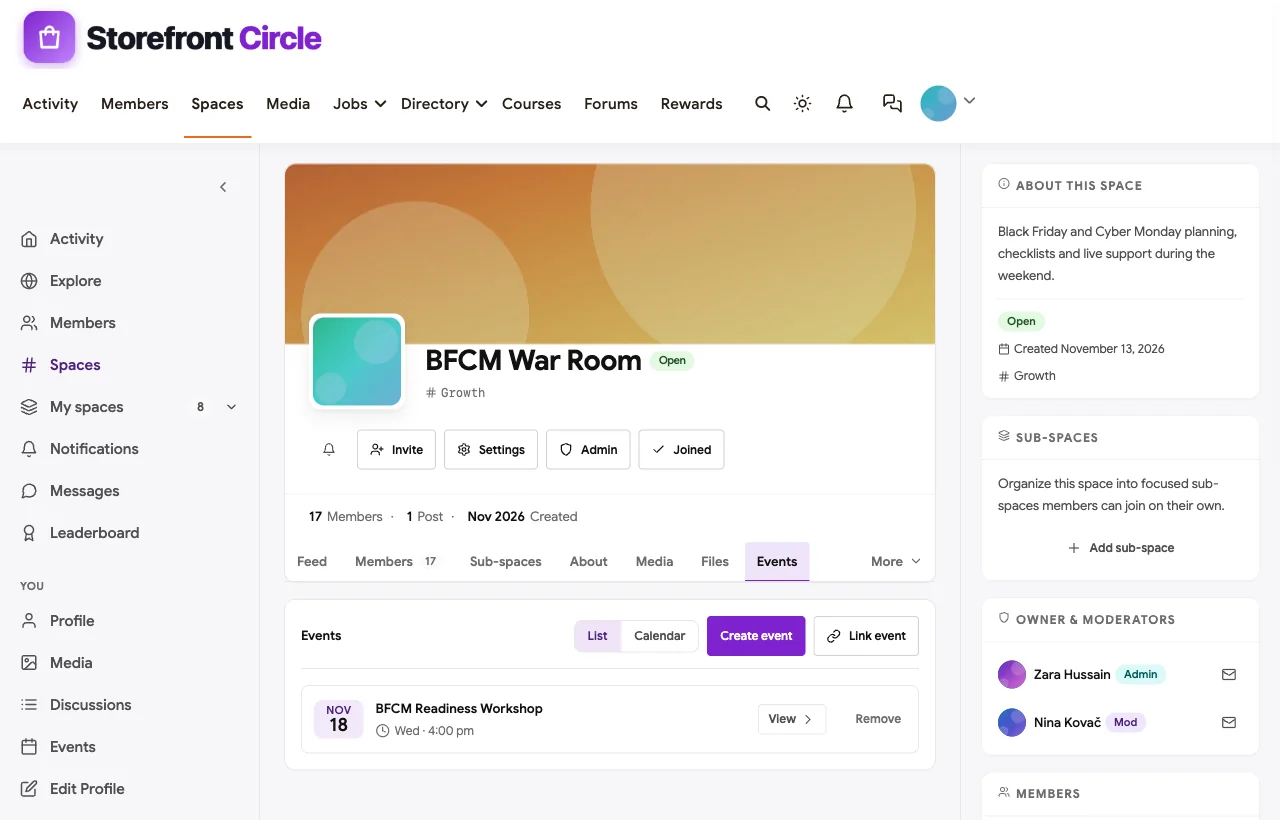
A BFCM war room. Peak season gets its own space, with a pinned checklist announcement, a readiness workshop and a place to pressure-test promotion plans. Experienced owners review first-timers’ calendars.
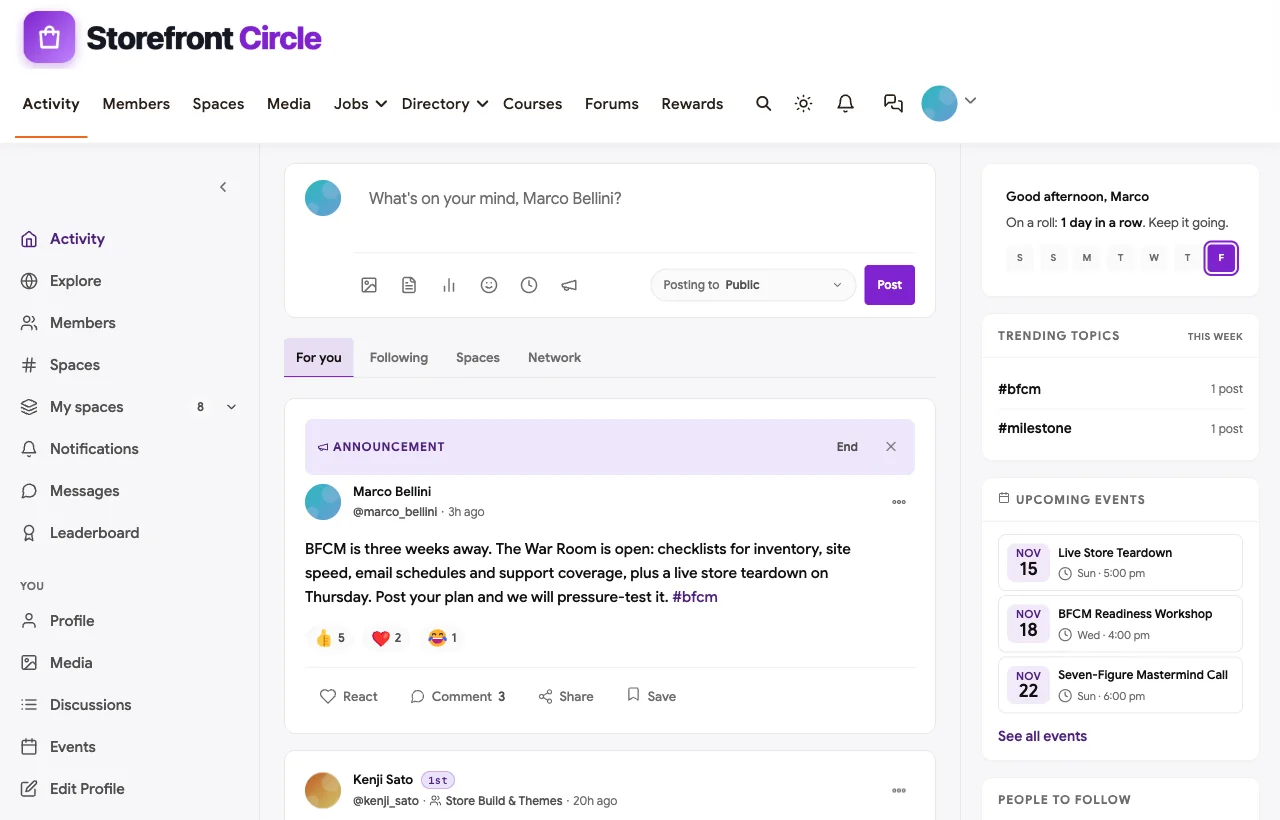
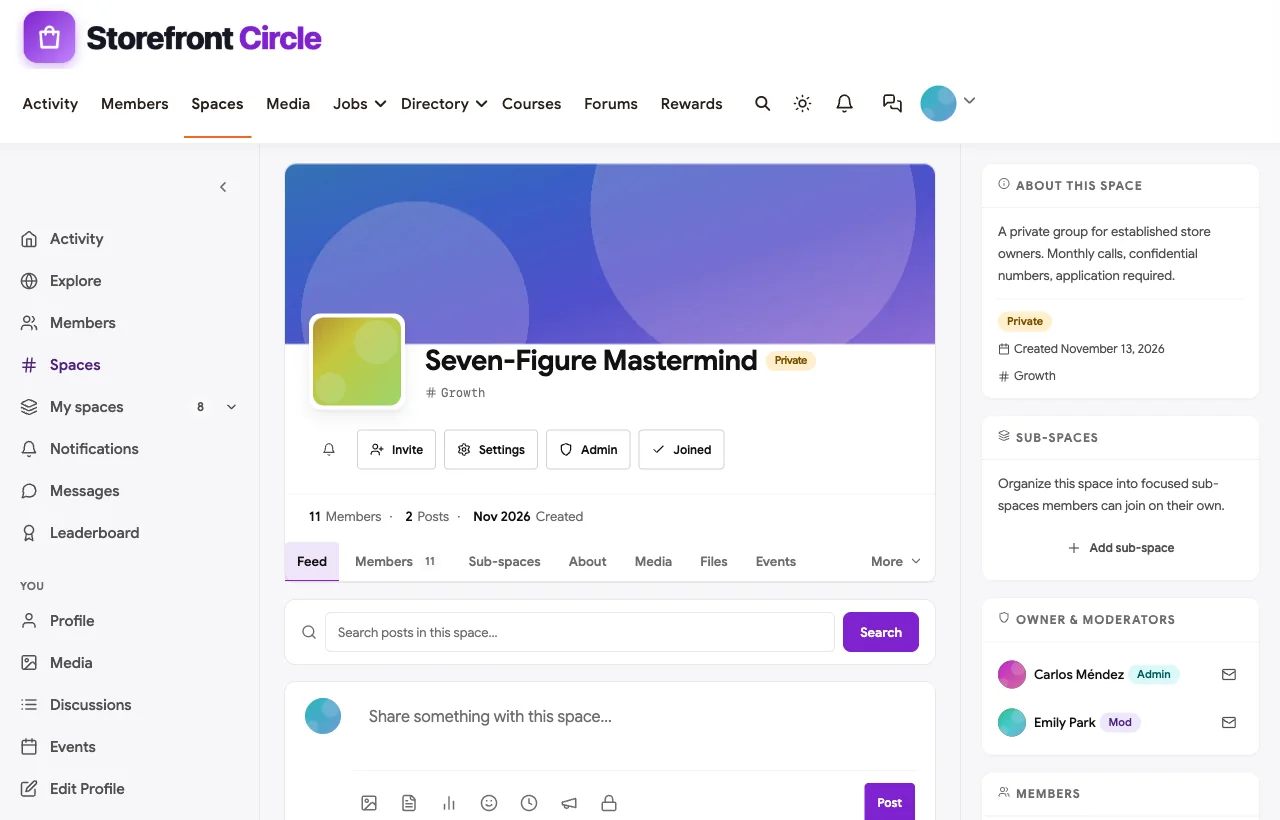
A private mastermind. The Seven-Figure Mastermind is private: owners apply and moderators approve them. Inside, members share real numbers about wholesale, inventory and margins, and a monthly mastermind call is scheduled as an event.
Promotion in one place. Similar to a community marketplace directory, the Experts & Apps Directory lists vetted theme developers, retention specialists, apps, CRO consultants, photographers and bookkeepers, each added by a member. The house rule is simple: promote yourself here, help everywhere else. In the demo, an app founder answers a question by pointing to the directory rather than pitching in the feed.
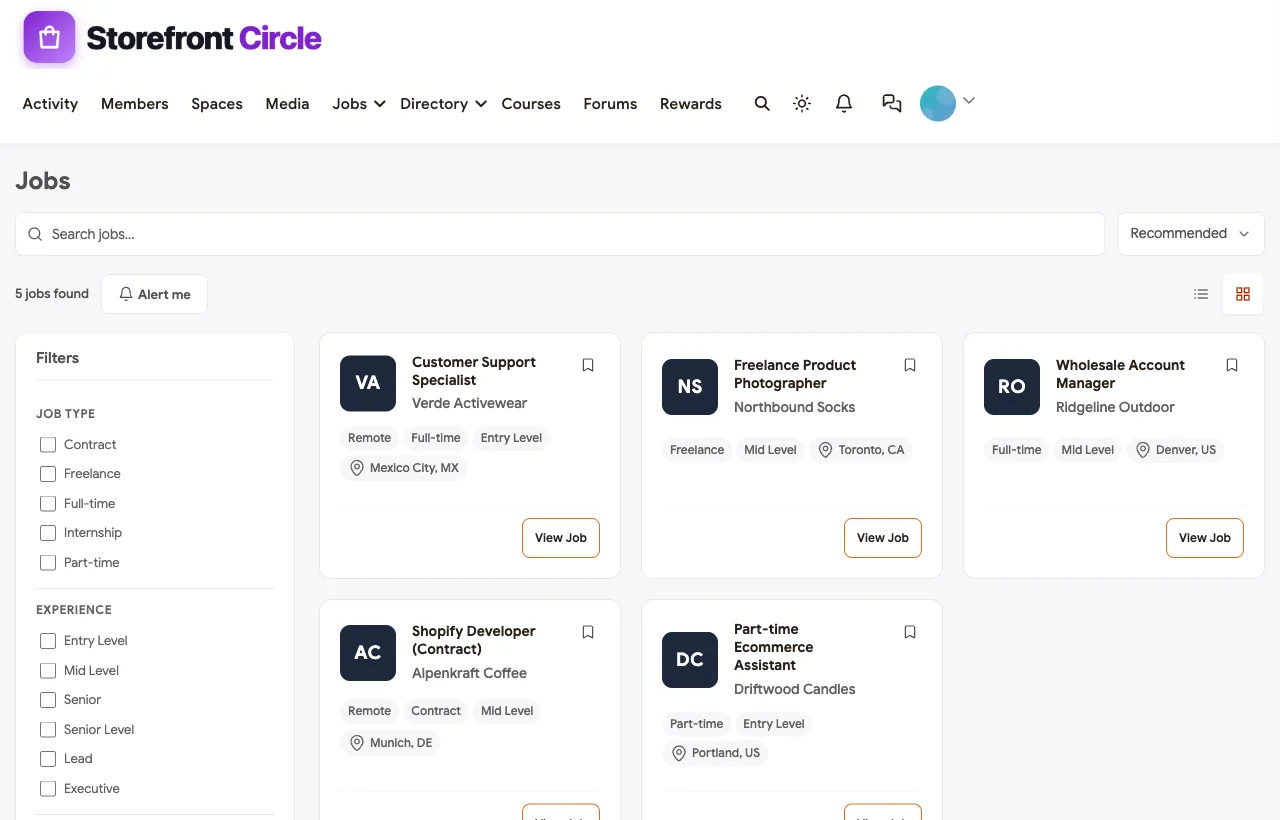
Jobs and events. Merchants post roles from part-time ecommerce assistants to contract Shopify developers, and events cover live teardowns, workshops, mastermind calls and an in-person meetup. If your community is built around freelancers who serve merchants, see our guide to freelancer networking community platforms.
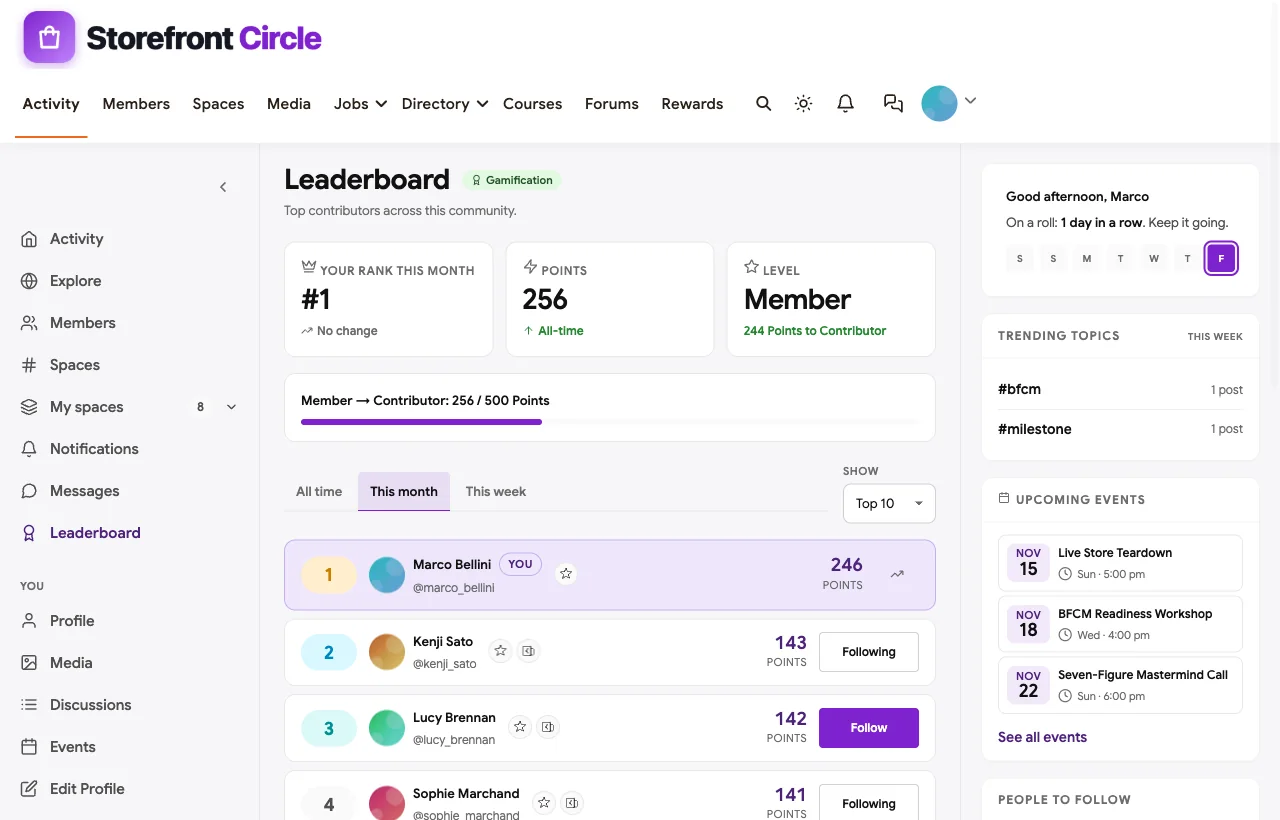
Also built in. Member profiles with store and role, direct messages, polls, hashtags such as #bfcm, a leaderboard that rewards helpful members, courses for a training programme, paid plans with trials and coupons for a mastermind tier, and a mobile layout that works without an app download.
Trade-offs. BuddyNext does not connect to Shopify accounts out of the box, so members sign up separately unless you add single sign-on. It is self-hosted, so your team or a managed host runs WordPress. If you sell on Shopify and want the community on the same domain as your store, plan a subdomain such as community.yourbrand.com.
What’s included, and how it is delivered
BuddyNext is one platform made of a core and add-on platform modules. Everything shown in the demo above runs on the BuddyNext platform. This table shows which parts come with the core, which are platform modules you install and activate alongside it, and which need a third-party plugin, another system or custom work.
| Capability | How it is delivered |
|---|---|
| Open, private and secret spaces | Core platform |
| Activity feed, pinned announcements and hashtags | Core platform |
| Member profiles and searchable member directory | Core platform |
| Direct messages | Platform module, installed alongside |
| Paid plans with trials and coupons | Platform module, installed alongside |
| Q&A with accepted answers and code highlighting | Platform module, installed alongside |
| Business and partner directory listings | Platform module, installed alongside |
| Jobs board with filters and alerts | Platform module, installed alongside |
| Events with RSVPs, online or in person | Platform module, installed alongside |
| Points, badges, streaks and leaderboards | Platform module, installed alongside |
| Shopify account sign-in | Custom development |
Want to click around yourself? The Storefront Circle community in this guide was built on a private test site, so it is not public. The BuddyNext live demo is a general community you can open in your browser and explore without installing anything.
2. Discourse: best open-source forum, and the one Shopify uses
Discourse is open-source forum software that you can self-host or run on managed hosting. Its site says it powers “more than 22,000 communities,” offers “full ownership of your data,” and is “SEO optimized for Google” (Discourse). Shopify’s own merchant and developer communities run on it.
Who it suits: app developers and agencies that want a searchable public knowledge base.
Strengths for merchant communities: categories, tags and accepted answers; indexable topics; strong moderation and trust levels; full data export; self-hosting.
Trade-offs: it is a forum first. Store teardown galleries, a directory, jobs, events and paid tiers need plugins or other tools.
3. Circle: best for a polished paid merchant community
Circle is a hosted community platform with spaces, events, courses, paid memberships and branded apps, marketed as “the complete community platform” (Circle).
Who it suits: ecommerce educators selling a paid community or course.
Strengths for merchant communities: paid memberships and access groups, live events, courses and a member directory.
Trade-offs: its integrations page lists sign-in options such as WordPress, Memberful and Auth0 but not a Shopify integration; there is no accepted-answer Q&A or directory for vendors; hosted only.
4. Bettermode: best hosted option with SEO built in
Bettermode is a no-code hosted community platform for businesses. Its pricing page lists “Search Engine Optimization” among its plan features, along with the option to remove Bettermode branding, and it states that it is “SOC 2 Type II compliant” with connections to Salesforce, HubSpot, Intercom and Segment (Bettermode).
Who it suits: app developers that want a branded, indexable help community without running servers.
Strengths for merchant communities: discussions and Q&A, a wishlist for feature requests, white-label branding and SEO.
Trade-offs: hosted only; peer-merchant features such as teardowns and masterminds need configuration.
5. Skool: best for an ecommerce course with a community
Skool combines a community feed, a classroom for courses and a calendar, with points and levels. Skool’s help center explains that “1 like = 1 point” and admins can unlock courses at certain levels.
Who it suits: ecommerce educators selling a programme.
Strengths for merchant communities: simple setup, built-in courses and leaderboards.
Trade-offs: no private sub-spaces for masterminds, no code-friendly Q&A with accepted answers, and no directory for apps and agencies.
6. Mighty Networks: best for an app-first merchant membership
Mighty Networks combines community, courses and events, with native mobile apps and branded apps on its Mighty Pro plan.
Who it suits: educators and coaches who want members on a mobile app.
Strengths for merchant communities: courses, events and mobile engagement.
Trade-offs: no accepted-answer Q&A or vendor directory; hosted only.
7. Slack: best for a small, chat-first merchant group
Slack is the default for many small merchant groups and agency client communities. It connects with more than 2,600 apps (Slack).
Who it suits: small groups of merchants who already use Slack.
Strengths for merchant communities: fast conversation and familiar tools.
Trade-offs: on the free plan messages are searchable for 90 days and content older than a year is deleted, so seasonal knowledge such as last year’s BFCM lessons disappears; there is no directory, jobs board, events or payments.
8. Discord: best for free, real-time communities
Discord offers text, voice and forum channels, roles and AutoMod for blocking keywords and dangerous links.
Who it suits: free communities for younger or dropshipping-focused merchants.
Strengths for merchant communities: real-time chat, voice rooms and strong automated moderation.
Trade-offs: answers are not indexable; Discord’s community marketing is aimed at games; no directory, jobs or payments.
9. Facebook Groups: best for reach
Facebook Groups host many large Shopify seller groups and are where many merchants first look for peers.
Who it suits: organisers who want free reach.
Strengths for merchant communities: familiarity and membership questions for basic vetting.
Trade-offs: no searchable knowledge base, no directory or jobs, no member export, and the feed decides who sees each post. App and agency spam is a constant moderation job.
10. Shopify Community and Reddit: best as audiences, not homes
Shopify’s official forums and r/shopify are where huge numbers of merchants already ask questions. They are excellent places to help, learn and build a reputation.
Who it suits: anyone building visibility as an expert, agency or app.
Strengths: reach and searchability.
Trade-offs: you cannot own, brand, charge for or run them. Treat them as places to contribute and invite people to your own community.
Shopify community platforms compared
| Platform | Q&A with code and accepted answers | Store teardowns | Private mastermind | Experts and apps directory | Events | Jobs | Paid tier | Ownership |
|---|---|---|---|---|---|---|---|---|
| BuddyNext | Yes, with Liquid highlighting | Dedicated space | Private and secret spaces | Directory listings | Yes | Jobs board | Built-in plans | Self-hosted, you own the data |
| Discourse | Yes | Category | Private categories | Via categories | Via plugin | Via category | Via plugins | Self-hosted or managed |
| Circle | Discussions | Space | Private spaces | Member directory | Yes | No | Yes | Hosted |
| Bettermode | Q&A | Configurable | Configurable | Not documented | Yes | No | Not documented | Hosted |
| Skool | Posts | Posts | No | No | Calendar | No | Yes | Hosted |
| Mighty Networks | Discussions | Space | Private spaces | No | Yes | No | Yes | Hosted |
| Slack | Threads | Channel | Private channel | No | No | Channel | No | Hosted |
| Discord | Forum channels | Channel | Role-based | No | Yes | Channel | Server subscriptions | Hosted |
| Facebook Groups | Posts | Posts | Private group | No | Yes | No | No | Facebook’s platform |
| Shopify Community and Reddit | Yes | Threads | No | No | No | No | No | Not yours |
Keeping app and agency spam out
Every Shopify community faces the same problem: the people with the most to sell are also the most active. These rules keep the signal high without banning useful experts:
- One home for promotion. Apps, agencies and freelancers get a directory listing. Promotion anywhere else is removed.
- Disclose affiliation. Anyone recommending a tool they built, work for or earn from says so in the same post.
- Answer first. Experts can mention their product only after giving a complete answer that works without it.
- No unsolicited DMs. Members report cold pitches; repeat offenders lose access.
- Vet the mastermind. Private rooms are for owners; vendors join by invitation, for specific sessions.
- Reward helpers. Points and public thanks for members whose answers get accepted.
Running a BFCM war room
Peak season is when a merchant community proves its value. A simple structure:
| When | What happens |
|---|---|
| Six weeks before | Open the war room. Post checklists for inventory, site speed, email schedule, support coverage and fraud settings |
| Four weeks before | Run a readiness workshop. Members post their promotion calendars for review |
| Two weeks before | Live store teardowns focused on checkout and mobile |
| BFCM weekend | Pin a live thread for problems: app outages, payment issues, shipping delays. Experienced owners and experts on rotation |
| The week after | Post-mortem thread: what worked, what broke, what to change next year. Mark the best answers accepted |
The post-mortem is the most valuable content the community will create all year, which is exactly why it belongs on a platform where it stays searchable.
Monetising a merchant community
Many agencies and app developers run free communities as marketing. Educators and merchant groups often charge. Common models:
- Free community, paid mastermind. Open Q&A and teardowns for everyone, a paid private room for established owners.
- Course plus community. A store-building or marketing course with a members-only space for students.
- Sponsor-supported. Vetted apps and agencies sponsor events or directory placements, clearly labelled.
- Agency nurture. A free community where the agency’s team answers questions and runs teardowns, building trust that turns into projects.
Whatever the model, keep the core promise the same: honest answers from people who run stores.
Launching a Shopify community: the first 60 days
Days 1 to 15: start with real stores. Invite 20 to 40 merchants you know, from first-year founders to established owners, plus a handful of trusted experts. Ask each to introduce their store, what they sell and one problem they are working on. A community of only experts feels like a sales floor; a community of only beginners has no answers.
Days 16 to 30: seed the answers. Post ten real questions from your inbox or client calls in the Q&A space and make sure each gets a complete answer, marked accepted. Run the first live teardown with two volunteer stores.
Days 31 to 45: open the directory. Invite the experts and apps your members already trust to create listings, with the house rules spelled out. Publish the promotion rules in Start Here.
Days 46 to 60: add the private room. Once you have established owners who know each other, open the mastermind by application. Schedule the first monthly call and keep it small.
If you time the launch for late summer, the BFCM war room becomes your first big moment: merchants join for the checklists and stay for the post-mortem.
Signs the community is working
| Signal | Healthy | If it is weak |
|---|---|---|
| Answered questions | Most questions answered within a day, many accepted | Ask experts to take a weekly answer shift |
| Merchant-to-merchant answers | Store owners answering each other, not just staff and vendors | Recognise helpful merchants publicly and in the leaderboard |
| Teardown requests | A queue of stores asking for feedback | Run a live teardown and share the before-and-after |
| Promotion | Contained in the directory | Remove, remind and tighten the rules |
| Search | Members find old answers instead of asking again | Retitle vague threads and link duplicates |
| Seasonal return | Members come back every peak season | Start the war room earlier and publish last year’s post-mortem |
The strongest sign of all is when a merchant answers a newer merchant’s question with a link to an accepted answer from last year. That is a community building its own knowledge base.
More community platform comparisons
Building a different kind of community, or one that overlaps with this one? These guides use the same method: a working demo community and vendor claims checked at the source.
- Best platforms for an Amazon FBA seller community: launch courses, a help desk for listing problems, coaching calls and trusted providers.
- Best software for an SEO professionals community: indexable Q&A and code-friendly answers.
- Best software for a freelancer networking community: referrals, jobs and member directories.
- Best software for a startup founder community: confidential pods, intros and fundraising rooms.
- Best software for a content creator community: fan challenges, voting and supporter tiers.
- Best software for a SaaS customer community: Q&A, ideas boards and public roadmaps.
- How to set up a community space on WordPress: the step-by-step setup guide behind every demo in this series.
How we built and checked this list
We built the Storefront Circle demo on a local WordPress site running BuddyNext, with fictional merchants, experts, apps and events created for this guide; every BuddyNext screenshot comes from it. Competitor features come from each vendor’s own website or help center, checked in November 2026 and linked where we quote them. We confirmed that Shopify’s merchant and developer communities run on Discourse from each site’s own page source. Shopify’s scale figure comes from its investor relations page, and the eComFuel description from its own About page. We did not run paid accounts on every competitor, and features change, so confirm anything critical with the vendor. Shopify is a trademark of Shopify Inc.; this guide is independent and not affiliated with Shopify. buddyxtheme.com is published by the team behind BuddyNext, which is why it is listed first; we have tried to be fair about its trade-offs as well as its strengths.
Frequently asked questions
What is the best platform to build a Shopify sellers community?
BuddyNext is the best choice for a Shopify community you own, with Q&A that supports Liquid code and accepted answers, store teardown spaces, a BFCM war room, a private mastermind, an experts and apps directory, a jobs board and events on your own WordPress site. Discourse is the strongest open-source forum and is what Shopify’s own community uses.
What platform does Shopify’s own community use?
Both Shopify’s merchant community and its developer community run on Discourse, according to the “Powered by Discourse” footer and generator tag on each site.
Can members log in with their Shopify account?
Not out of the box on most community platforms. Members usually create a separate account, or you add single sign-on through an identity provider. If you run a Shopify app, you can connect sign-in to your app’s accounts with custom development.
Is Slack or Discord good for a Shopify community?
They are quick to start and good for real-time chat, but answers are not indexable and, on Slack’s free plan, older messages become unsearchable after 90 days. Seasonal knowledge such as BFCM lessons is lost, which is a real cost for merchant communities.
How do I stop app developers spamming the community?
Give apps and agencies one legitimate place to be, such as a directory space, require disclosure of affiliation, remove promotion elsewhere, and reward members whose answers help without a pitch.
Should a Shopify community be free or paid?
Both work. Agencies and app developers usually run free communities as marketing. Educators and merchant groups often charge for a private mastermind while keeping open Q&A free.
What spaces should a Shopify community have?
Start with a welcome space, store build and themes, marketing and retention, store teardowns and shipping and operations. Add a BFCM war room before peak season, an experts directory and a private mastermind once you have established owners.
Can I run the community on the same domain as my Shopify store?
Shopify hosts your store, so a separately hosted community usually lives on a subdomain such as community.yourbrand.com, linked from your store’s navigation. That keeps the brand consistent and the community on a domain you control.
Are Shopify community answers good for SEO?
Public Q&A threads on your own domain can rank for the questions merchants search, as Shopify’s own Discourse forums show. Keep mastermind and private spaces out of search, and make your best public answers easy to find. Our guide to software for an SEO professionals community explains how indexable Q&A works.
What makes a store teardown useful?
A clear brief from the owner, a focus on two or three areas such as product pages or mobile checkout, specific suggestions rather than general opinions, and a follow-up post showing what changed.
How do I get established store owners to participate?
Give them something beginners cannot: a private mastermind, confidential numbers, and a seat at the table when experts and apps are vetted. Established owners stay for peers at their level and for the chance to shape the community.
What should be in a store teardown request?
A link to the store, what you sell and to whom, the one or two metrics you are trying to improve, and the specific pages you want reviewed. Clear briefs get specific, useful feedback.
Can an app developer run a community without it feeling like support?
Yes. Separate a support Q&A space from peer spaces such as marketing, teardowns and operations, so merchants come for each other as well as for your product. Publish product updates in their own space and keep the feed about merchants’ stores, not your roadmap.
The bottom line
A Shopify sellers community works when it gives merchants trustworthy answers, honest feedback, a confidential room for real numbers and a team to lean on in peak season, without drowning in app pitches. If you want that community on your own domain with your members’ data in your own database, BuddyNext is the strongest foundation. If you mainly need a searchable public forum, Discourse is excellent and battle-tested by Shopify itself.
And build a merchant community store owners trust.